— A Joint Consideration in two movie reviews.
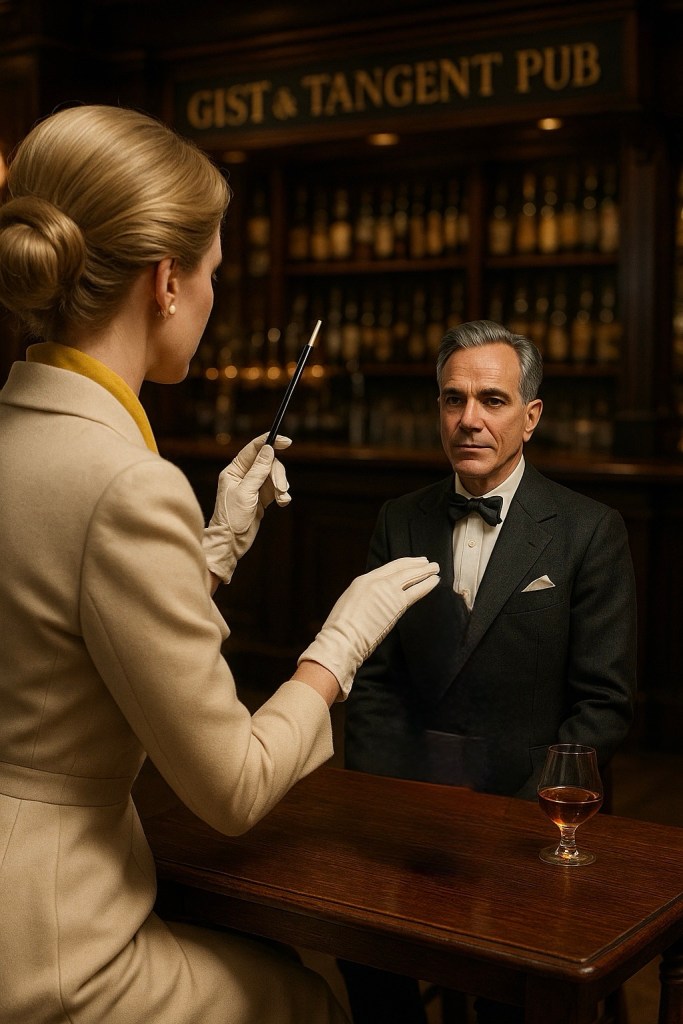
I. Cliff Languor and Arturo Haus.
(The Council’s resident partners writing on art, movies, TV, and Other Cultural Matters)
This is, as always, a review of movie reviews, undertaken so that our readership might enjoy the comforts of secondhand certainty without the inconvenience of actually watching the film.
Phantom Thread is a movie straight outta the Restoration Bureau—an agency which, if it does not yet exist, should be chartered to issue citations for aesthetic dereliction—in its precise detailing and its depiction of a not unfamiliar mid-century modern gothic effect. If one grew up in New York City, even in the outer boroughs, surrounded by somber brownstone architecture and the mini medieval cathedrals that were the Catholic churches of the time, one could feel at home—uneasy, frightened, and alone—but oddly familiar and comforted (as much as could be found).
Phantom Thread is the story of a self-driven man striving for perfection in his art of dress design, who finds some relief for his intensity in an encounter with toxic femininity—and he likes it![1]
The film was slow-moving, with many pauses allowing facial expression to do the communication. Add a vaguely 1950s Britain to the mix and an aristocracy still functioning on some level, at least in taste, and you have a movie of viewing pleasure right up the alley of the people who read these reviews.
Since this column is a review of movie reviews, to qualify we will just say that the few we read afterwards to help explain it were all positive. At the time of writing, we can’t recall if our take is from the reviews or from our own thoughts. We did get excited by the driving scene and the stop at the Esso station with a spired building in the background, and the appearance of the main character giving off a modern gothic vibe.
What may have gone over our heads was the fact that the female lead added a bit of poisonous mushroom to just slow the guy down. We assumed, as the story played out, she was trying to kill him. The other reviewers informed us that it was a non-lethal dose, though they admitted to watching multiple times before realizing this.
We will put Phantom Thread on the back burner for another viewing sometime in the future. Much was left unsaid in this film, making it one to enjoy and return to.
We just realized that Daniel Day-Lewis would be the perfect actor to portray Nathaniel Hawthorne or Ferdinand Céline. He’s a dead ringer for both.
FOOTNOTE:
[1]Toxic femininity here is understood as the discreet art of strategic mushroom deployment, a practice not endorsed by the Council except under strictly controlled laboratory conditions.
(European Correspondent, Nouvelle Vague Zwischenschaft NVZ)
Unlike my esteemed colleagues, who prefer the delicate pastime of reviewing reviews—a practice I have always regarded as rather like kissing through a lace veil—I have actually watched Phantom Thread firsthand, and more than once. I understand, of course, that some souls require the interpretive scaffolding of professional critics to feel certain a film has properly impressed itself upon them. It is an endearing trait of our Council: this collective faith in secondhand certainties.
Personally, I prefer to let the images and silences do their work upon me directly, like a draught of strong liqueur taken neat.
I have always believed that beautiful things are rarely innocent. Phantom Thread is the sort of film that affirms this principle so elegantly you nearly forget it is also a cautionary tale about love, appetite, and the microdoses of poison that make both bearable.
From the first velveteen hush of the soundtrack to the last gaze between Daniel Day-Lewis and Vicky Krieps, the film glides with a severity that only the British can convincingly deliver—though I assure you certain Viennese tailors were no less unmerciful. If you have ever been fitted for a garment that cost as much as a small car, you will recognize the quiet terror of being assessed for worthiness before a single measurement is taken.
The Restoration Bureau aesthetic—Cliff called it that, and I shall borrow the phrase—spills over everything: lace pinned with ecclesiastical solemnity, pastries that seem designed less for nourishment than for metaphysical punishment, a general air of fastidious cruelty. I admired it without reservation.
Some reviewers insisted it is a love story. Perhaps. To me it felt closer to an exorcism. And while everyone was at pains to speak of its psychological complexity, I could not help noticing that the title sounds suspiciously like one of those modern superhero franchises—Phantom Thread alongside Iron Man and Doctor Strange. Only here, our masked avenger is a dressmaker whose superpowers are the strategic application of guilt, the occasional poisonous mushroom, and a lapel so perfect it could bring a duke to his knees. I have found no evidence the filmmakers intended the title as a wry pastiche of superhero culture, though it amuses me to imagine such a thing. Perhaps it is simply coincidence—but then again, all modern titles must now contend with the semiotics of caped crusaders. And really, if there is any “phantom thread” binding this story, it may be that thin, invisible filament of toxins Alma uses to stitch her lover to her, one careful dose at a time.
I did laugh when the Esso station appeared, a reminder that even amid all this gothic perfection, one still needs petrol. Nothing is ever purely aesthetic; the vulgar world persists.
And since we are confessing: I once prepared a certain ragù for our Council photographer, Mr. Sfocato, seasoned with a proprietary blend of Calabrian peppers and something he swears made him see the Madonna in the ceiling plaster. He recovered—eventually—and claimed to feel more devoted to me than ever. One must test these things carefully, and always with affection.
In truth, he later admitted he suspected the sauce contained a nonlethal soporific. I neither confirmed nor denied this. I merely smiled and asked whether he preferred the dreams it produced to waking life. He said he could not decide—and that he would require further doses to be sure.
When I mentioned this to Lee just yesterday, he sent a note in his spectacularly inconsistent English:
“Mia cara, the sauce… it was more strong than the wine and the love together. I see the Madonna, and also maybe your face in the light. Next time, per favore, you give me only half the portion—or none, if you wish I stay awake to kiss you.”
For all its quiet perversity, Phantom Thread struck me as oddly hopeful. Imagine finding someone who not only tolerates your neuroses but insists on polishing them to a higher sheen. If that isn’t love—or at least a tolerable simulacrum—I don’t know what is.
I commend this film to anyone who prefers their romances to unfold with the slow inevitability of an embroidered funeral pall.
Editor’s Final Addendum
Mrs. Begonia assures us she has never administered truly poisonous mushrooms to Mr. Sfocato or any other gentleman caller. The Council disclaims responsibility for any recipes that induce visions, revelations, or sudden matrimonial inclinations. As for Daniel Day-Lewis, consensus holds that he would also make an impeccable Don Juan in a future adaptation—though preferably one who survives the final act.
—John St. Evola
 COUNCIL-OF CONCERNED-CONSERVATIONISTS…..Between Jest And Earnest…..
Leave a comment