Staten Island’s Surprising Literary History.
Filed by: The Rootless Metropolitan, who didn’t mean to stay so long either.
“The great ones pass through quietly, like wind over marshgrass—leaving behind a stirred silence and maybe, if you’re lucky, a manuscript draft.”
— from the marginalia of the Accidental Initiate, while waiting for the ferry
I. A Quiet Island, Loud with Echoes
It doesn’t boast a Walden Pond. It lacks a Concord or a Bloomsbury. But if you listen closely in the salt air and ferry fog, you’ll hear it: Staten Island, the overlooked borough, has harbored more than its share of literary minds—sometimes unwillingly, often temporarily, and always ironically.
Consider this rogue’s gallery of reluctant residents:
II. Herman Melville – The Whale in Clifton
In 1847, freshly married and seeking quiet for his next book, Herman Melville rented a house in Clifton, Staten Island. He was not yet the prophet of Moby-Dick, but rather the still-celebrated adventurer-author of Typee.
There, overlooking the Narrows, he wrote parts of Mardi—a dense, dreamlike allegory that confused readers and publishers alike. Staten Island was, perhaps, a tuning fork for Melville’s drift into metaphysical waters. It was the beginning of his descent into greatness—into the kind of obscurity only true visionaries earn in their lifetime.
We imagine him squinting at the waves, muttering something about the “inscrutable tides of the soul,” while ferry horns bellow like unseen whales.
III. Henry David Thoreau – The Walden Ferry Missed a Stop
Yes, Thoreau was here too. In 1843, he worked briefly as a tutor for William Emerson’s children—William being Ralph Waldo’s brother. The tutoring gig was in Staten Island, not Concord, and while Thoreau longed for home, he kept a sharp eye on Manhattan from across the harbor, a mix of scorn and curiosity simmering in his journal entries.
He walked, as always, observed the flora, and called city life “a labyrinth without a Minotaur,” which may or may not have been a compliment. His stay was short—just a few months—but his botanical observations from Staten Island were later cited in his naturalist writings.
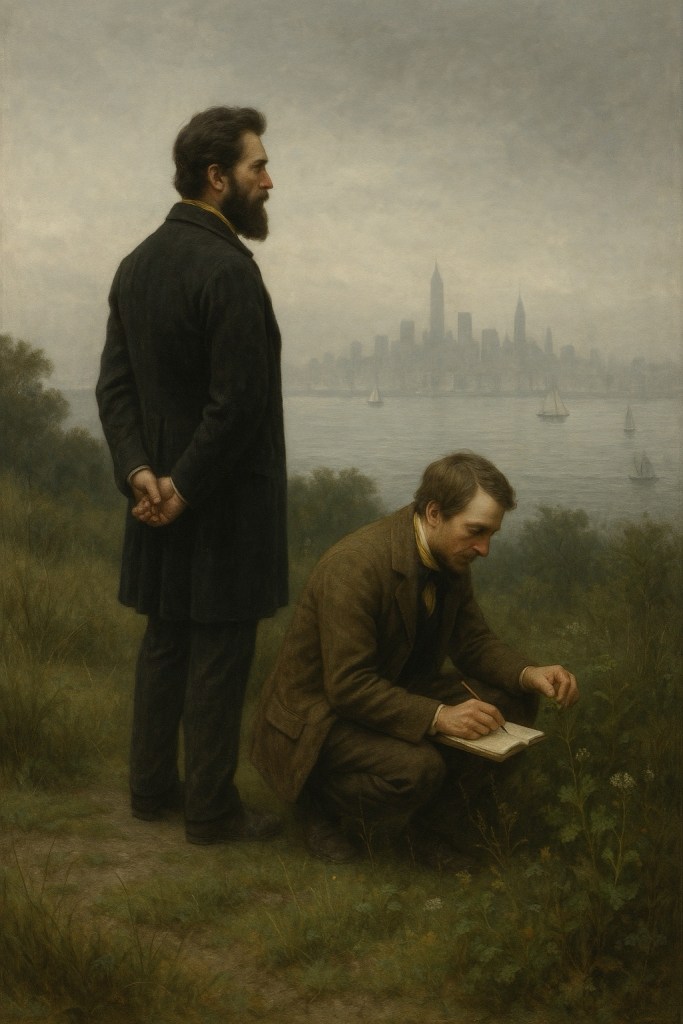
The lesson? Even Thoreau had to take the ferry to pay the bills.
IV. George R. R. Martin – Winter Began on the South Shore
Before Westeros, there was Bayonne and then Staten Island.
George R.R. Martin, the eventual chronicler of dragons and dynastic doom, lived for years in Staten Island during his youth. Raised just across the Kill Van Kull in New Jersey, he later taught journalism at Clarke College, and lived in an apartment in the borough during the 1970s.
This was before fame, before HBO, before the Iron Throne. But perhaps the layered borough politics, the ferry delays, and the endless snowplow dramas informed the intricate sadism of King’s Landing. (There are whispers that Westeros was first drawn on the back of a Staten Island Mall napkin.)
V. H.P. Lovecraft – The Horror Commuter
While Lovecraft never lived permanently on Staten Island, he visited multiple times in the 1920s during his moody Brooklyn exile.[1] He toured what he called the “neglected capes and catacombs” of New York’s lesser boroughs, roamed its graveyards, and stared into the harbor fog with what one letter called “a grim admiration.”[2]
“The borough seems exiled from time itself,” he wrote.[3]
On one trip, he visited the Conference House in Tottenville, calling it “a relic of colonial striving… solemn and sullen… its walls thick with mute reproach.”[4] Standing at the southernmost point of New York State, he described the surrounding waters as “pre-human in their dullness,” refusing to reflect even moonlight. It may be America’s first recorded instance of marine gothic sarcasm.[5]
It’s not hard to picture him on the ferry, gripping the railing with pale fingers, thinking the sea might speak if he just leaned in.
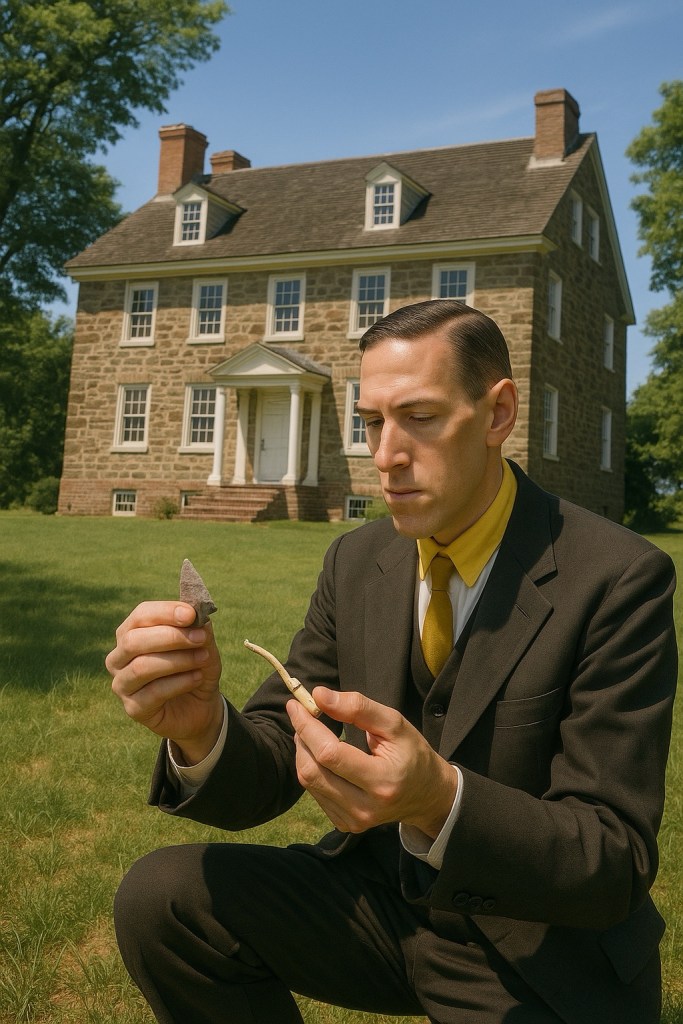
In Tottenville, he found what he always sought: evidence that the past was not quite finished, just resting underfoot.
VI. Harold Ross – Invisible with a Pencil
The famously irritable founder of The New Yorker, Harold Ross, also spent a brief period living on Staten Island in the early 20th century. While his magazine gave its heart to Manhattan, Ross gave his edits to the Staten Island Ferry.
According to New Yorker lore, Ross used the crossing to edit proofs and clear his mind. He referred to Staten Island as “a good place to be invisible with a pencil.” [6] Which, by Council standards, qualifies as high praise.
VII. Conclusion: The Literary Ley Line No One Mapped
If one were to overlay a psycho-geographic map of American letters, Staten Island might form a strange ley line—a metaphysical transit lounge where great writers briefly hid, healed, or hesitated.
The Council has taken note. We now designate Staten Island a Zone of Accidental Inspiration, complete with its own unofficial literary landmark system (details to follow once the signs arrive from the Bureau of Sublimated Plaques).
Until then, look closer the next time you step off the ferry. The borough may not claim the writers, but the land remembers.
Field Note:
“A man must travel far to find his own country—sometimes across the harbor.”
—John St. Evola, quoting himself again while checking property values in Tottenville
FOOTNOTES
[1] Selected Letters of H.P. Lovecraft, Volume II (1925–1929), Arkham House, 1968.
[2] Letter to Frank Belknap Long, July 2, 1925. Lovecraft remarks on Staten Island’s solemnity and rural quality.
[3] Ibid. “The borough seems exiled from time itself.”
[4] Letter to Lillian D. Clark, 1925. Scholars identify the unnamed colonial relic as the Billopp House, now known as the Conference House.
[5] Letter to Belknap Long, September 1925: “There is something pre-human in their dullness… refusing even to reflect moonlight.”
[6] Source: Oral history from The New Yorker editorial staff archives. Ross often edited on the ferry and praised Staten Island’s anonymity as conducive to focus.


Leave a Reply