Filed under: Commercial Rituals and the Great Unsubscribe
“It began, as these things often do, with books.”
— From the Marginalia of the Marginalized
It started innocently enough—an envelope, a catalog, a little card to mail back (or not). The Book-of-the-Month Club, founded in 1926, seemed like a civilizing force: curated culture delivered by post. For a time, it even was. A well-meaning attempt to democratize taste. The occasional Harold Bell Wright novel was a small price to pay for introducing middle America to Sinclair Lewis or Willa Cather.
But as with so many things in the American experiment, what began as taste became automation, and what was once a club for readers has metastasized into an economic ecosystem of psychological blackmail.
We are now trapped in the ultimate morality play of subscription capitalism—a Kafkaesque revolving door of “convenience,” in which everything from razors to romance, toilet paper to therapeutic mantras, cheese boxes to cloud storage arrives unbidden each month like some cursed inheritance from a techno-bureaucratic uncle.
You no longer own your music.
You no longer own your software.
You no longer own your films, your maps, your operating system, your Adobe tools, your gym access, your car’s features, your own brainspace.
You rent them, monthly—forever.
This is not commerce. It is controlled codependency.
When the Church Invented the Subscription Model
Let us not be naïve. Subscriptions are not new.
In the Middle Ages, monastic orders ran on recurring donations—a form of spiritual subscription. Wealthy patrons pledged tithes—regular gifts of land, grain, silver, or wool—in exchange for ongoing prayers, rituals, and favorable heavenly bookkeeping. Some even subscribed to chantry chapels, paying for masses said long after death—spiritual auto-renewal, set and forget.
It wasn’t called “content,” but it functioned the same.
One paid, and the monks delivered—liturgically.
So no, subscription culture is not inherently evil. It once sustained cloisters, not cloud platforms.
But the modern version has no grace. No monks. No margin for the soul.
Software Updates You Can Never Decline
In ancient days, you bought a tool once and kept it until it broke.
Now? You must subscribe to a hammer.
(Coming soon: **Hammer+™ — $2.99/month for firmware updates, and exclusive ergonomic advice from AI carpenter “Chip.”)
Even language has been infected.
We now subscribe to beliefs.
We subscribe to identities.
We subscribe to movements, ideologies, people.
Cultural loyalty is managed through push notifications.
You are always behind.
There is always a new season, a new drop, a new tier, a new upgrade you didn’t ask for that breaks everything you were already using.
This isn’t progress—it’s induced ephemerality, disguised as convenience.
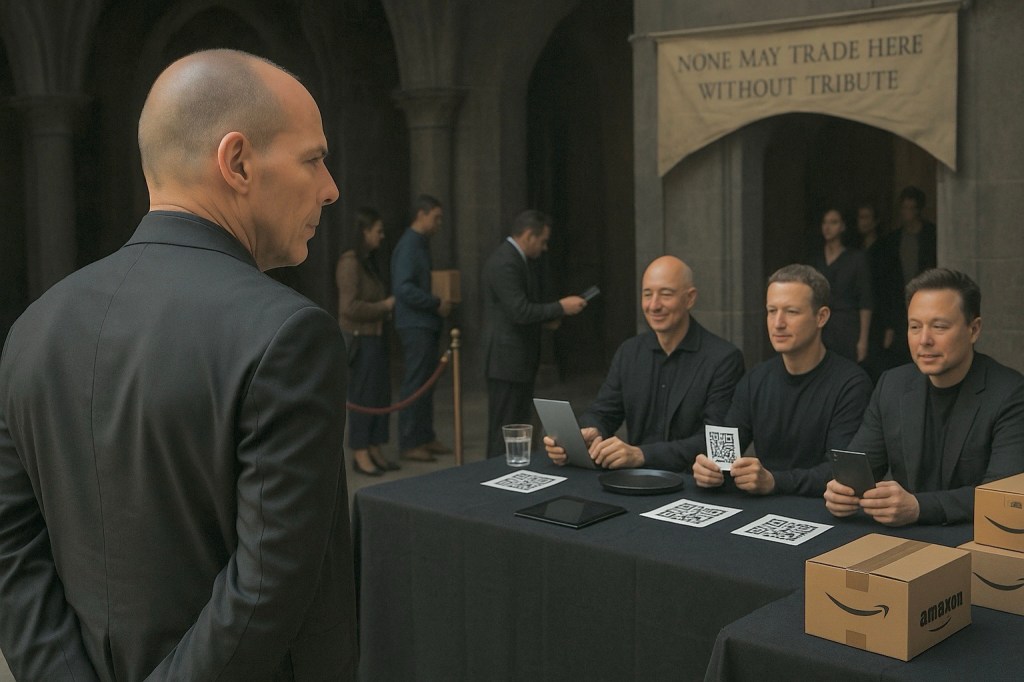
“You traditionalists always said you wanted to return to the Middle Ages. Well—congratulations. You’ve got your fiefdoms back. Only now, the castles are corporate, the vassals pay monthly, and the lords feast on data. As The Leopard warned: everything must change… so that everything may stay the same.” —Yanis Varoufakis,[reputed] on the arrival of techno-feudalism with free two-day shipping
Tithing to the Lords of Silicon Valley
Let us call it what it is: Techno-Feudalism.
In the medieval world, serfs didn’t own the land they worked. They labored under oaths of loyalty, paid in crops and obedience, and lived under the gaze of a local lord. In return, they received “protection”—a mix of security and surveillance familiar to anyone living under Terms & Conditions.
Today, you don’t own your domain either.
Your apps, your content, your tools, your smart refrigerator—all reside on platforms you do not control. You are granted conditional access, in exchange for monthly tithes, behavioral data, and the quiet surrender of autonomy.
Where serfs once owed a tenth of their produce, we now offer a tenth of our income—not for food or safety, but for continued access to ourselves.
To keep using the tools that mediate our work, our friendships, even our memories.
And what do we receive in return?
Endless updates. Uptime promises. Locked features behind new paywalls. And the creeping suspicion that none of this is really ours.
This is not progress.
It is rebranding.
We have not transcended the feudal age.
We have merely upgraded the interface.
When Libraries Were Enough
The Sub-Sub Librarian cannot help but weep. Not for the books, but for the dispossession of sovereignty. In the Library, one returns what one borrows. There is rhythm. There is memory. In the Subscription Model, there is only accumulated latency—digital debt piled like unopened mail, unlistened playlists, unread book boxes, and forgotten charges for services you never used but were too tired to cancel.
And when you do cancel? The interface becomes unfriendly.
Your cloud evaporates.
Your music stops mid-song.
Your AI assistant forgets who you are.
We have trained ourselves to pay not for goods, but for permission—and the price of that permission keeps rising.
A Final Note from the Council:
We at the Council-of-Concerned-Conservationists propose a radical solution:
Own things again.
Buy the book.
Download the album.
Use a hammer that works without updates.
Remember how to stop something.
There is no nobility in eternal trial periods.
To the Subscription Gods, we offer this humble prayer:
“Deliver us not from scarcity, but from dependency.
And if the box arrives again next month, we are not home.”
With unsubscribed affection,
—Paige Turner
Sub-Sub Librarian,
Council-of-Concerned-Conservationists
Postscript:
This dispatch was inspired in part by a chapter in Jason Voiovich’s Booze, Babe, and the Little Black Dress, which traces the origins of modern subscription culture to the rise of the Book-of-the-Month Club. It reminded us that what now arrives algorithmically once arrived by post—and before that, by monk.
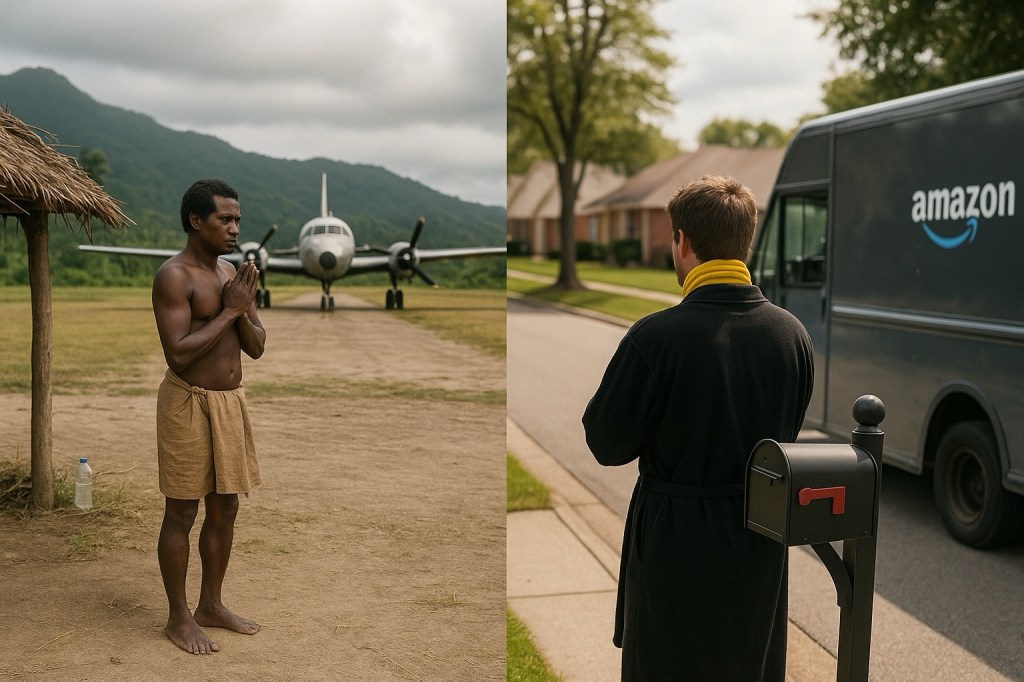
In a consumer culture, grace is defined by cargo: not by its meaning, but by its arrival. Whether it’s VHS tapes, book boxes, or cloud-based dopamine pellets, the ritual is the same: wait, receive, repeat. What once descended in mystery now arrives by courier.
We flatter ourselves with the word progress, but the rituals have simply changed their uniforms. The South Sea cargo cultists built bamboo towers, waved wooden flags, and cleared landing strips in hope that the gods of the sky would return bearing canned meat and radios. Today, we refresh our tracking numbers, chase the UPS truck down the block, and set notifications for the next drop. The cult is alive—it just ships Prime.
All this change, just to keep the altar intact. Somewhere, a Leopard nods.
***
Post-Postscript
Filed by John St. Evola, Editor
Let’s be honest.
This subscription model may be spiritually bankrupt, economically parasitic, and metaphysically humiliating—but it works. The cargo actually arrives. You can summon rare earth teas, obscure Japanese chisels, Slovakian mushroom tinctures, Portuguese hymnals, and ethically harvested beeswax candles to your door in under 72 hours. And people still complain. They sigh as they click. They curse the monthly fee.
Our ancestors fasted and invoked the gods.
We grumble and cancel AutoPay.
Yes—it hooks you. But it delivers.
And if you can’t recognize grace even when it comes with a tracking number, maybe the problem isn’t the system. Maybe it’s your appetite.
As Paige Turner wrote:
“What they longed for in myth, we now expect as routine. And still, it is never quite enough.”


Leave a Reply