—ON CERTAIN THINGS THAT KEEP THE WORLD TURNING
Before proceeding with the sermon, I recommend spending a few minutes with Alison Krauss & Union Station’s “The Captain’s Daughter.” It is adapted from a poem by Johnny Cash of all people.
Captain’s Daughter
I’m a poor boy as you know. But I love the Captain’s daughter so. If I begged her would she go? Or would she tell me no, no. . . no no no?
Daddy is a sailor man. You’re fresh from the farm land. He said when you ask my hand, For me to tell you no, no. . . no no no.
Your daddy’s gone away to sea. You’re as lovely as can be. Come and go away with me. Oh, don’t you tell me No, no. . . no no no.
My daddy owns a clipper ship. He brings me pearls on every trip. Pink champagne for me to sip. And you’re the poorest boy I know, know. . . know know know.
I’ve got no pearls to give you. I’ve got two arms and heart that’s true. We could start with a dream or two. Oh, won’t you say you’ll go, go. . .?
The poor boy came from the farm land. She was the daughter of a sailor man. The Captain says, “When he begs your hand. You better tell him no, no. . . no no no.”
(Lyrics by Johnny Cash. Melody by Robert Lee Castleman.)
Most people assume this is a song about whether the poor boy gets the girl. It ain’t. The song ends before we ever find out. What the song is really about is desire.
The boy desires the captain’s daughter. The daughter desires the pearls and champagne her father brings home from distant ports. The captain desires his daughter’s happiness and believes a farmer’s life may not provide the sort of future she wants. Nobody in this song is wrong. Everybody is hungry.
Now before anyone gets high-minded about the daughter’s attraction to pearls and champagne, let us remember that for most of human history such things were not merely decorations. They were evidence. Evidence that somebody knew how to navigate the world, acquire resources, survive uncertainty, and bring something home besides excuses. At some deep level, the attraction is not necessarily to the pearls themselves. It is to what they signify :
competence, abundance, and the prospect of security for a future family.
The daughter may be admiring not the gift, but the qualities behind the gift.
The captain understands this, which is why he worries. He does not appear to hate the boy. He simply suspects that his daughter, accustomed to dreams of a wider world, may someday find a farmer’s life too small. His desire is to see her flourish and have babies. The boy’s desire is different. He is not calculating futures, resources, or social position. He simply wants her and maybe “a dream or two” as he proposes.
That is why the poor boy carries the emotional weight of the song. Not because his desire is the only legitimate one, but because it is the most exposed. The captain can command. The daughter can choose. The poor boy can only ask. He places himself entirely at the mercy of forces beyond his control.
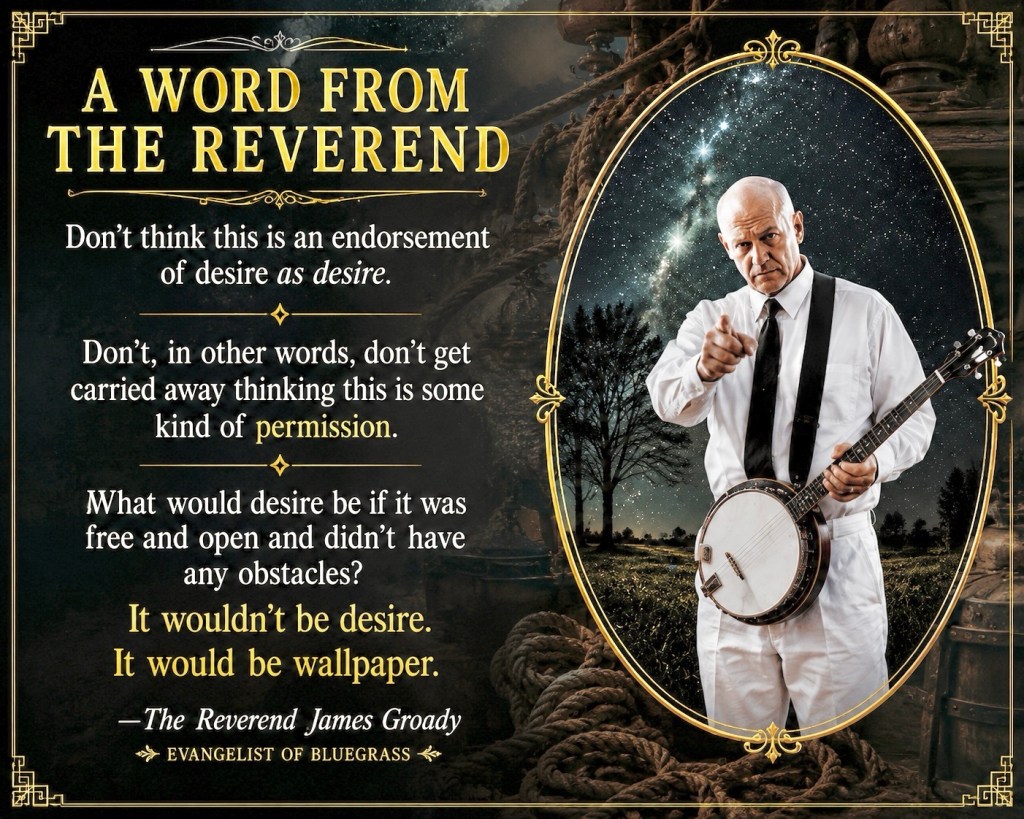
The desire is not a defect in the machinery. It is the machinery. The world runs on appetite.
Take away desire and the ships stop sailing, the farms stop growing, the fathers stop worrying, the daughters stop dreaming, and the boys stop singing.
Every character in this song is being pulled toward a different vision of the good life. The captain toward security. The daughter toward abundance. The boy toward beauty. The plot exists because those visions do not quite line up.
Some people imagine Heaven as a place where every appetite is finally satisfied. Maybe. But if satisfaction means the end of desire, it sounds less like Heaven and more like Thanksgiving afternoon. Everybody full. Everybody sleepy. Nobody writing ballads.
Which brings us to Black Friday. The nation spends Thursday proving that abundance exists and Friday proving that abundance does not cure longing. One appetite is satisfied and another immediately takes its place. The machinery starts right back up. The object changes, but the reaching remains.
The poor boy never wins the captain’s daughter. At least not in the song. Yet he possesses something the others do not. His desire becomes music. Long after the pearls have tarnished and the champagne has gone flat, we are still listening to the boy sing.
Amen.
One final observation before we all head home.
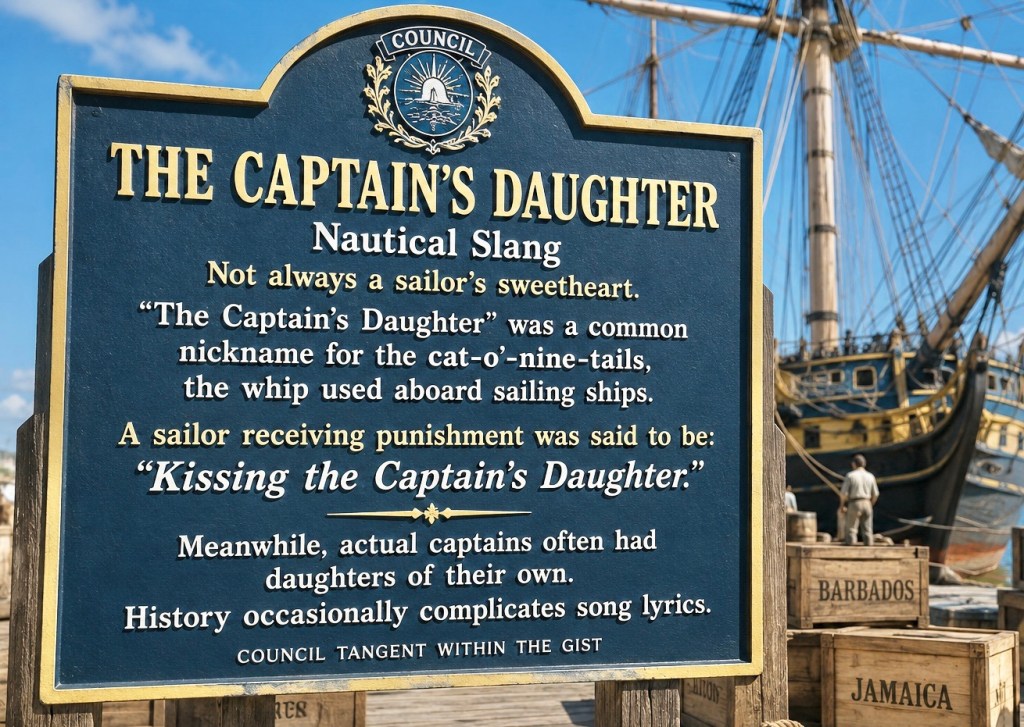
Old sailors sometimes used the phrase “the captain’s daughter” for the cat-o’-nine-tails.
A whip.
Which seems appropriate. Because some people imagine the solution to desire is to eliminate it altogether. But the denial of desire is not the end of suffering. It is a form of suffering.
The hunger for food hurts.
The hunger for love hurts.
The hunger for meaning hurts.
Yet the attempt to become a creature with no hunger at all brings its own lash.
The man who chases desire may suffer from longing as the man who spends his life trying to extinguish desire may suffer from emptiness.
Either way, the captain’s daughter leaves her mark.
Perhaps that is the final joke hidden in the title. The captain’s daughter is not merely the object of longing. She is also the reminder that longing costs something. But then so does its absence.
And if I had to choose between a world with longing, bluegrass, courtship, voyages, and broken hearts, and a world without desire at all, I believe I’d take the first one.
Even if it occasionally comes with a whipping.
Amen, again


Leave a Reply