—Spearcasting the Future: An Inquiry into Advanced Stick Technologies
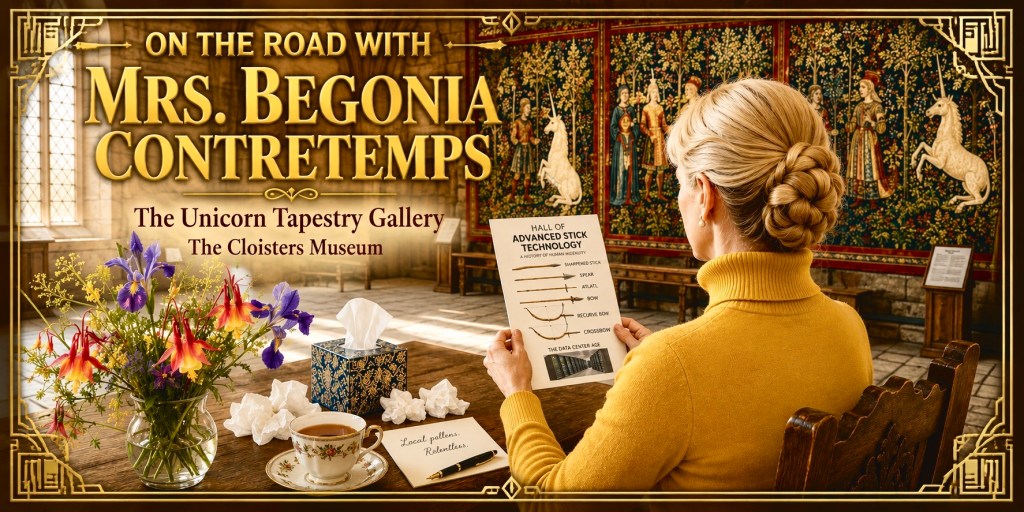
As part of her ongoing investigation into the meaning of America, Mrs. Begonia Contretemps had intended to visit the American Museum of Natural History. Unfortunately, the local pollens intervened. Confined to the Unicorn Tapestry Gallery at The Cloisters Museum, she delegated the assignment to Eugene Bodeswell and the Accidental Initiate, who returned with a postcard, a theory, and an alarming amount of information concerning advanced stick technology.
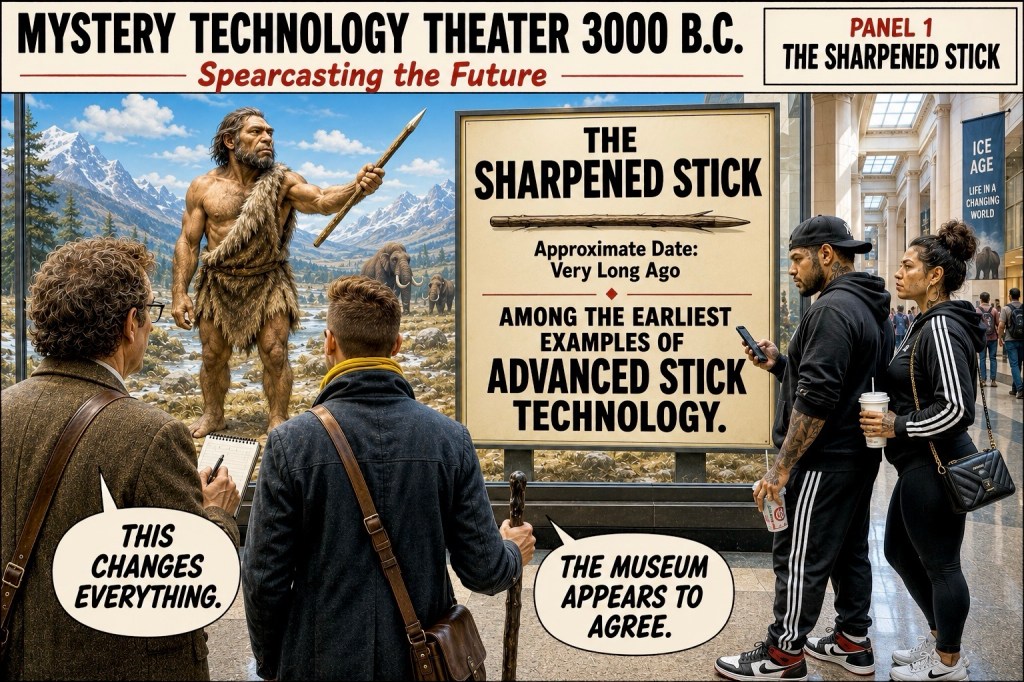
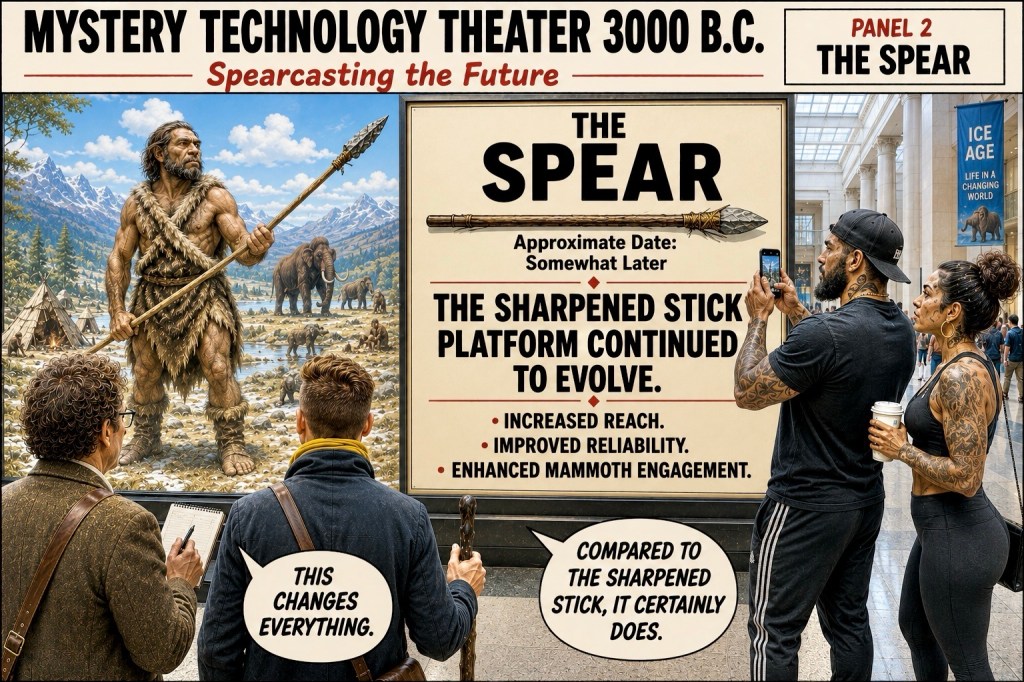
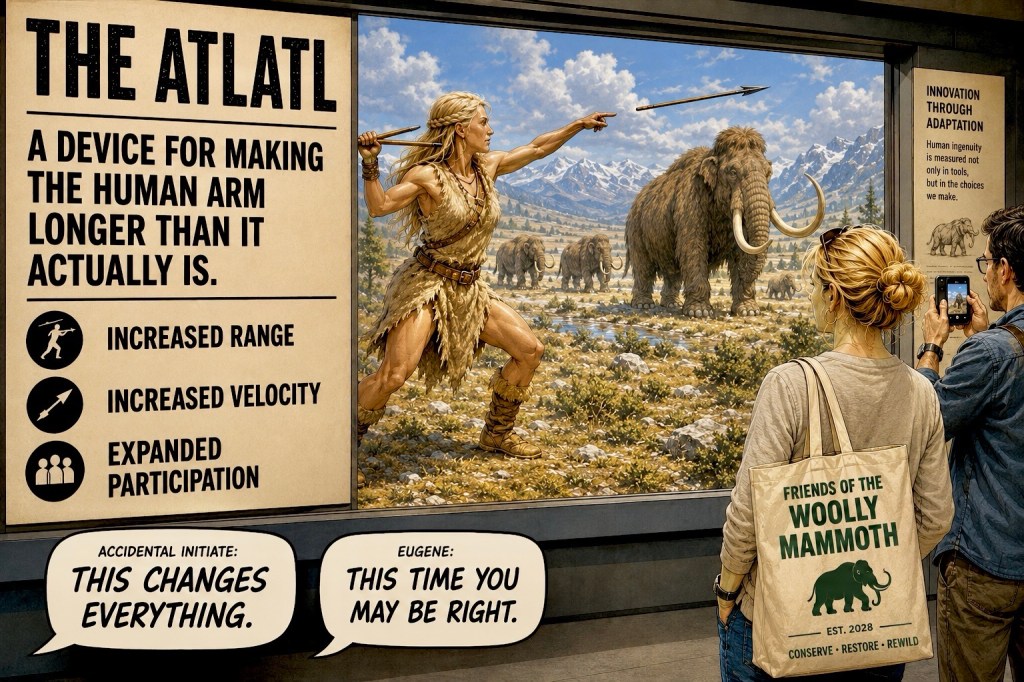
Having spent several exhibits making the stick larger, heavier, and more elaborate, our ancestors abruptly changed direction. The Council notes that this pattern would later reappear in transistors, microchips, and other devices whose size declined while their ambitions expanded.
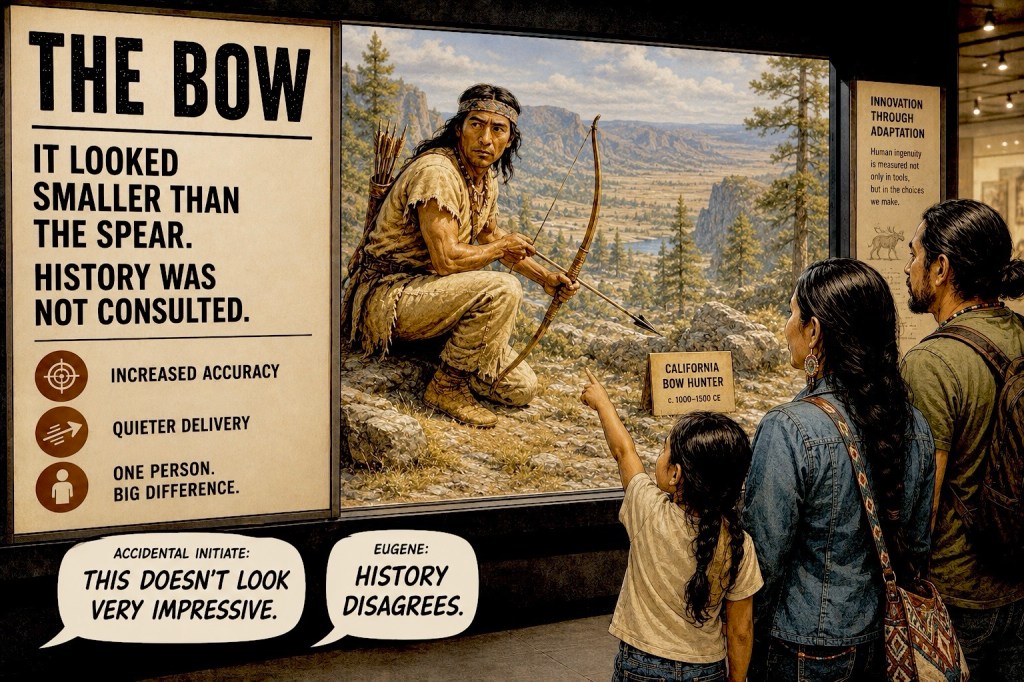
The figure is loosely inspired by Ishi, last of his tribe, who spent his final years working in a museum. Following his death, his brain was preserved for study. The autopsy was performed by Dr. Saxton Pope, a physician, hunting companion, and close friend whom Ishi had taught the arts of bowmaking and archery. One anthropologist connected with his story was Alfred Kroeber, whose daughter later became Ursula K. Le Guin.
The Council observes that the trail of one bow hunter eventually passed through anthropology, museums, modern bowhunting, and science fiction—a respectable journey for a man who began with a stick and a string.


Completing their investigation into advanced stick technology, Eugene Bodeswell and the Accidental Initiate communicated their findings to Mrs. Begonia Contretemps in the traditional scientific manner: by postcard.
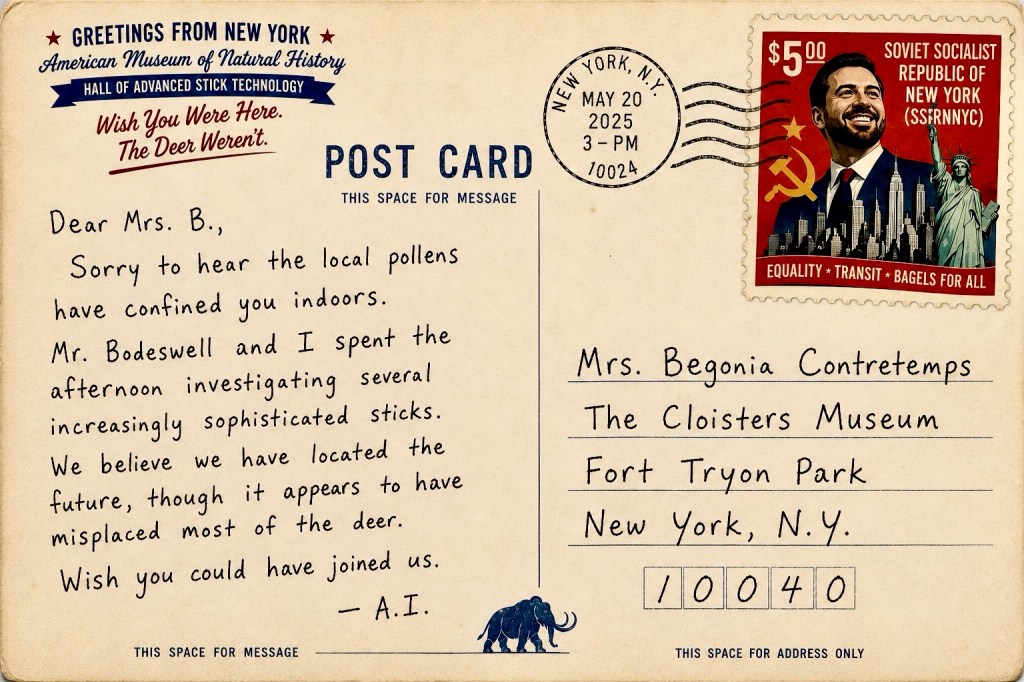
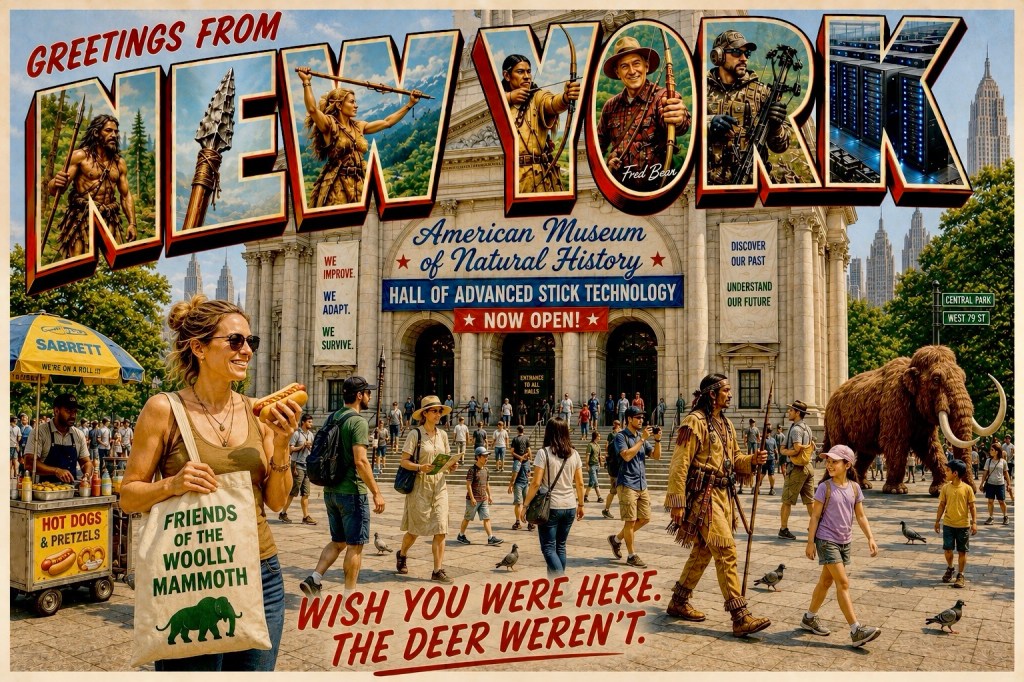
Upon receipt of the postcard, Mrs. Begonia Contretemps retired to a quiet corner of the Unicorn Tapestry Gallery, armed with tea, tissues, and a growing suspicion that Eugene Bodeswell and the Accidental Initiate had accidentally discovered something important.
The Unicorn Tapestry Gallery
The Cloisters Museum
Fort Tryon Park, New York
June MMXXVI
My Dear René,
As I write beneath a medieval tapestry depicting a hunt, I find myself reflecting on a rather different one.
While confined indoors by the local pollens—which appear to regard English visitors as an invasive species—I received a postcard from the Accidental Initiate concerning several increasingly sophisticated sticks. His repeated use of the word “pollens” strikes me as suspicious. Perhaps this is retaliation for “maths.” Perhaps not. Or perhaps for our habit of saying “maths” and attending “university” without first inserting the “the” or “a” Americans feel should be standing in front of it. One should be cautious when assigning motive. In any case, I appear to have lost the linguistic initiative
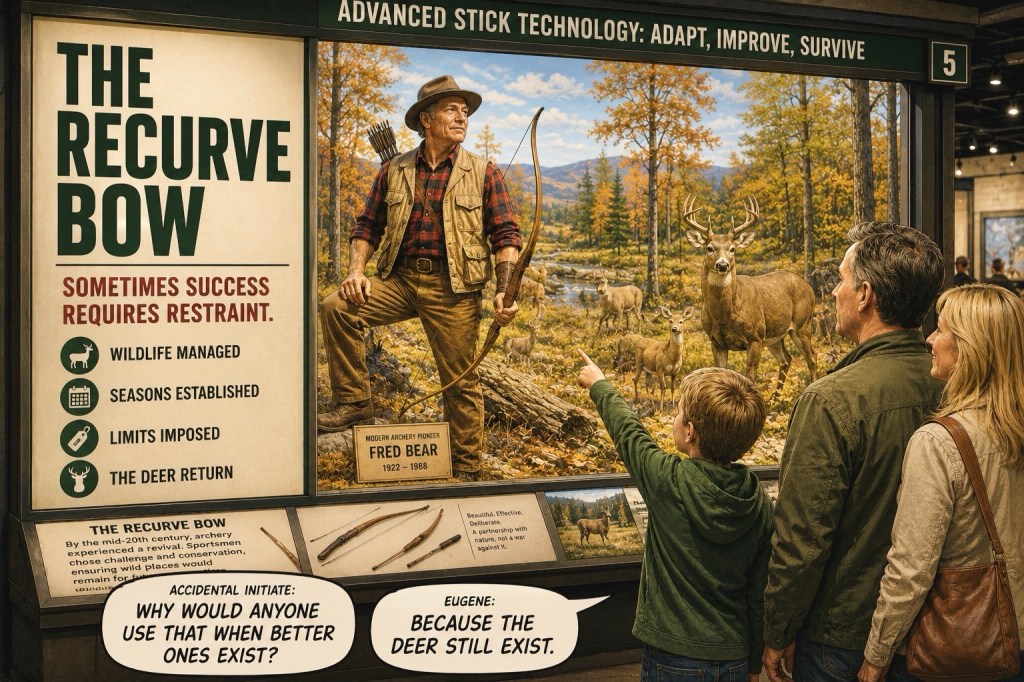
The museum’s lesson, whether intended or not, was surprisingly simple. The sharpened stick became a spear. The spear became an atlatl. The atlatl became a bow. The bow became a crossbow. Each solved the hunting problem more effectively than the last.
Eventually, however, the technology became so successful that attention shifted from improving the weapon to preserving the deer.
The Americans responded with seasons, limits, licenses, and wildlife management. In other words, they discovered that a successful hunt still requires something left to hunt.
This struck me as relevant to current discussions surrounding artificial intelligence. Much enthusiasm is presently devoted to improving the machine. Considerably less attention is devoted to preserving the human habitat upon which the machine ultimately depends.
One cannot help wondering whether the deer and the consumer occupy a similar position in their respective ecosystems.
The museum assured us that advanced stick technology had solved the targeting problem. It seemed rather less certain about the consequences.
Yours,
Mrs. Begonia Contretemps
More from the On The Road series: HERE


Leave a Reply