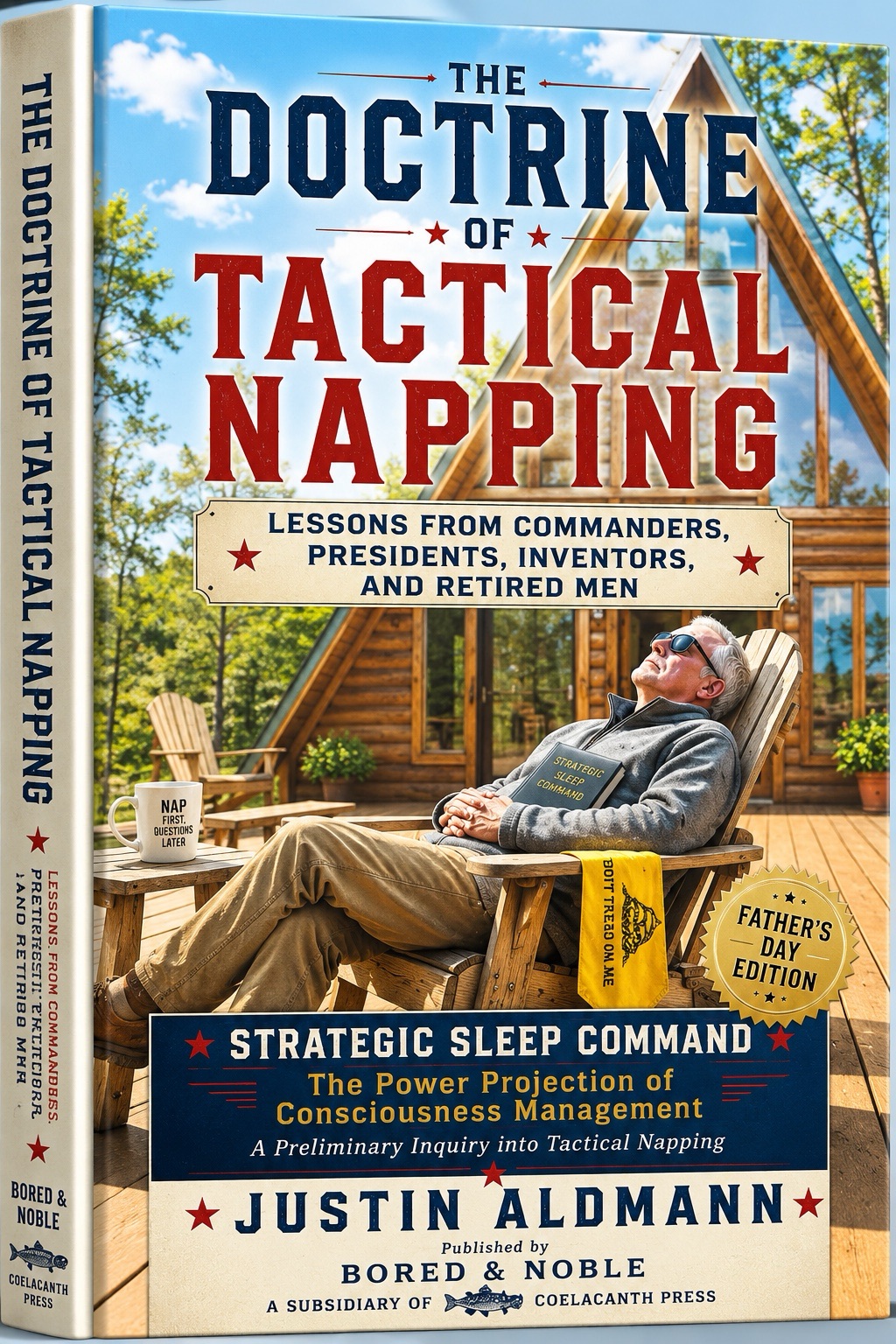
—The Power Projection of Consciousness Management
—Being a Preliminary Inquiry into Tactical Napping.
Historians have devoted considerable attention to logistics, morale, industrial capacity, terrain, doctrine, leadership, and technological innovation.
Far less attention has been paid to the possibility that a surprising number of the world’s most successful commanders occasionally found a comfortable chair and closed their eyes for twenty minutes.
The present study seeks to correct this omission.
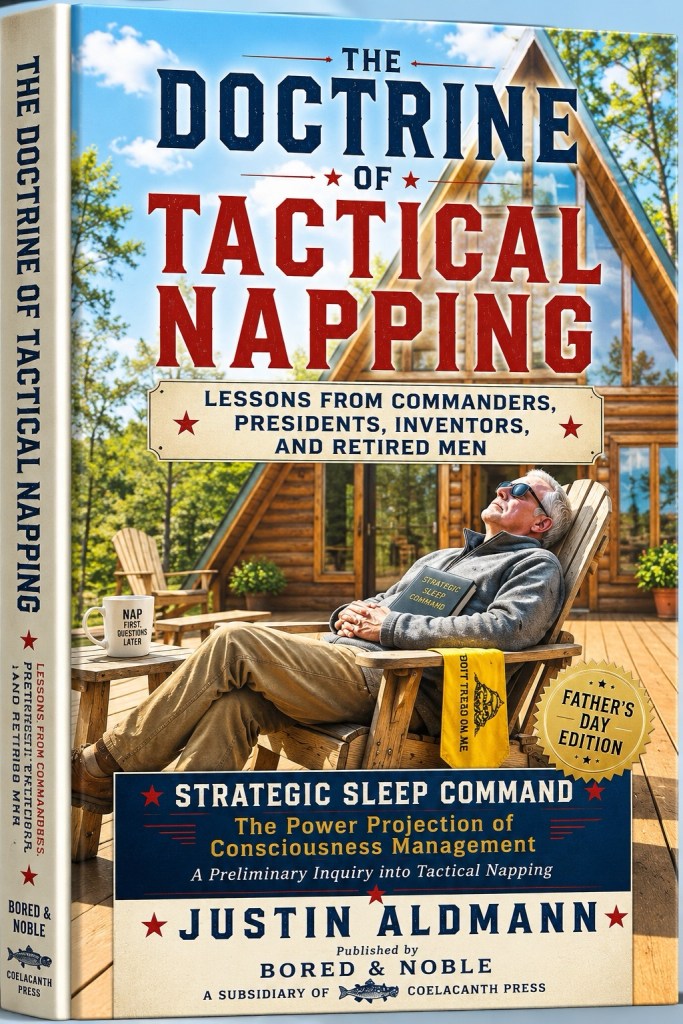
For many years the afternoon nap suffered from an unfortunate public-relations problem. It became associated with retirement communities, golf shirts, daytime television, and men who accidentally fell asleep while explaining thermostatic expansion valves.
Yet a review of military history reveals a startling fact:
Some of the most successful commanders—military, political, industrial, and domestic—in human civilization spent portions of their careers unconscious.
Napoleon napped.
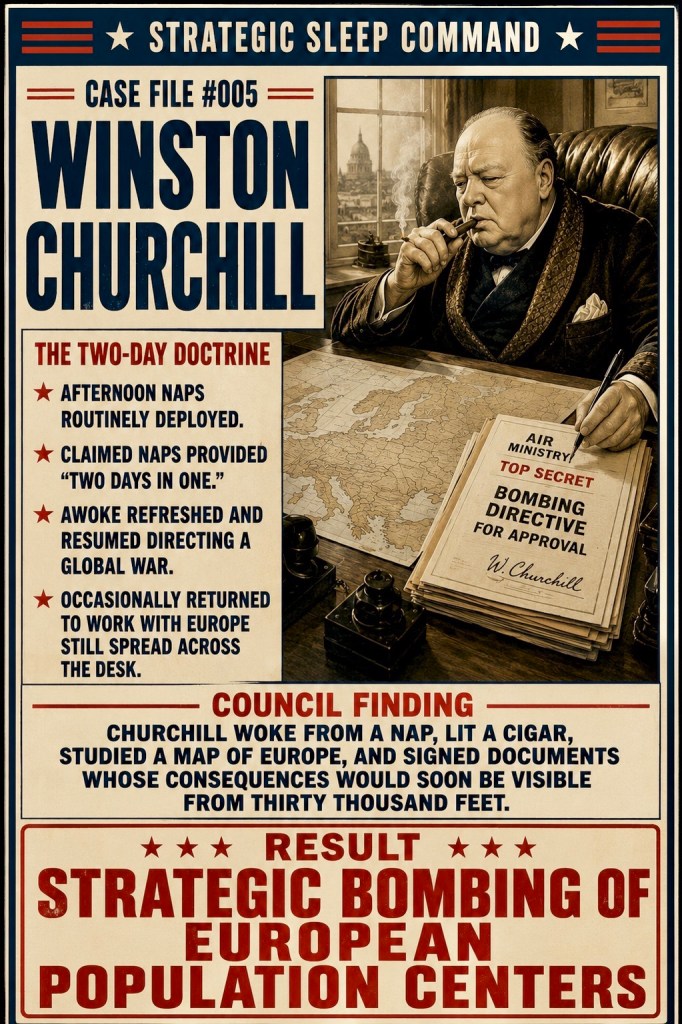
Churchill napped.
Edison napped.
Entire empires may have been administered by men who, at critical moments, simply announced that they would be unavailable for approximately twenty minutes and proceeded to ignore the world.
This brings us to what I shall call Strategic Sleep Command.
The modern world possesses Strategic Air Commands, Transportation Commands, and Cyber Commands. Yet nowhere in the bureaucratic architecture of the contemporary state do we find an agency dedicated to the projection, preservation, and tactical deployment of consciousness itself.
This seems an oversight.
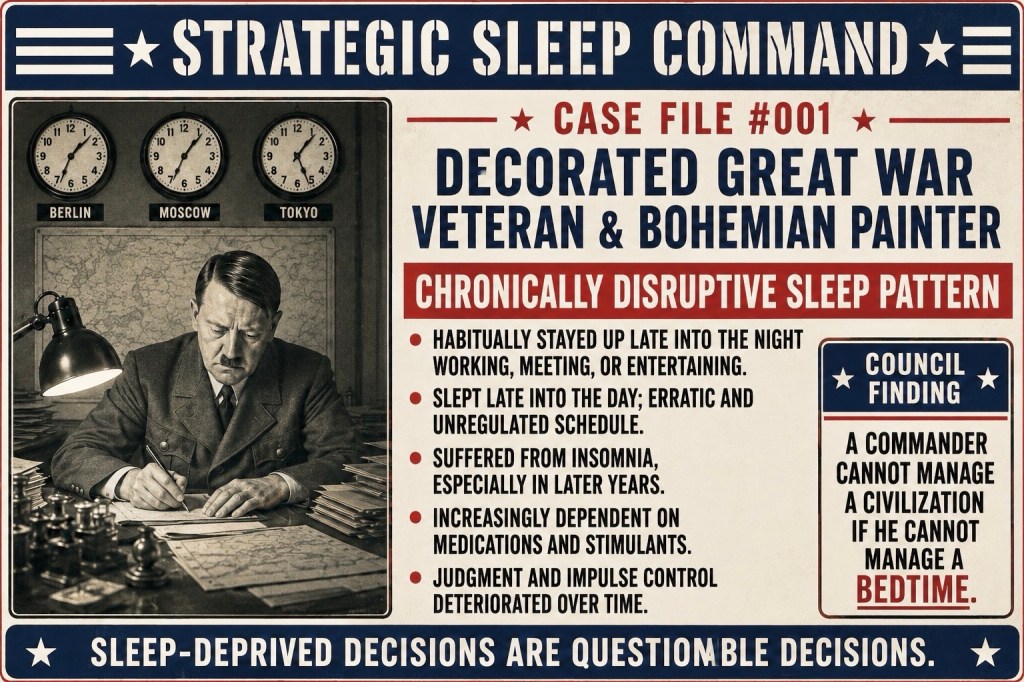
Napoleon Bonaparte reportedly possessed the remarkable ability to sleep whenever circumstances permitted. Campaigns, marches, headquarters, battlefields—it scarcely mattered. If an opportunity for strategic unconsciousness presented itself, he seized it.
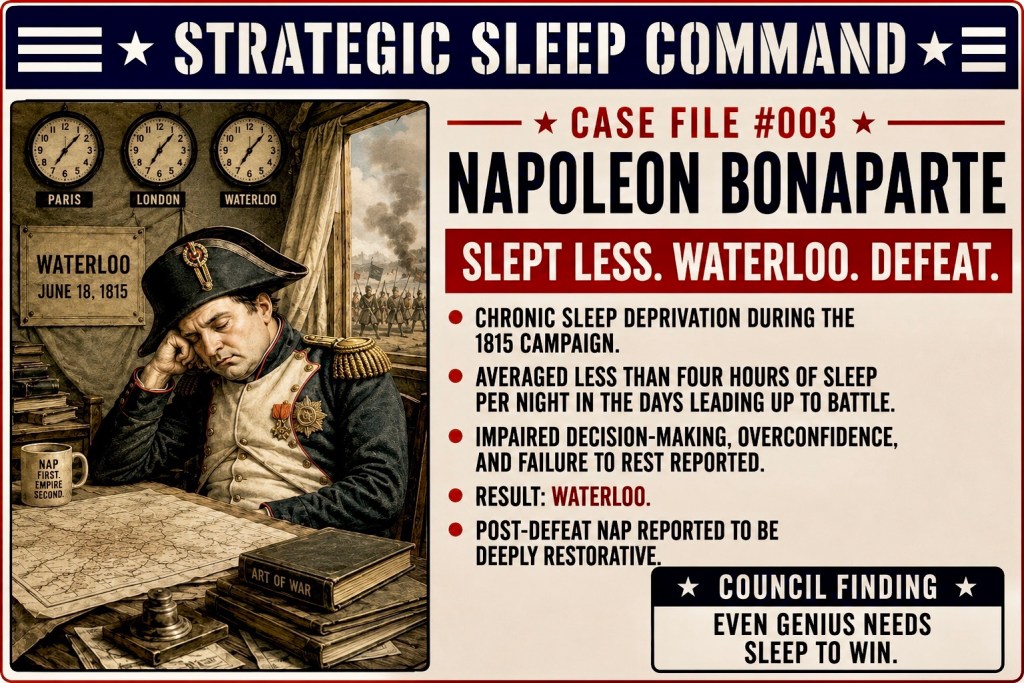
Winston Churchill conducted much of the Second World War under a similar doctrine. He routinely took afternoon naps and claimed they effectively gave him two working days in one.
To the casual observer this appears to be laziness.
Military history suggests otherwise.
A commander operating while exhausted is like an artillery battery firing with damp powder. The machinery remains intact. The results become less impressive.
The tactical nap therefore represents not a withdrawal from operations but a replenishment of command capacity.
This principle remains poorly understood among civilians.
To the untrained eye, the retired gentleman reclining in his chair after lunch appears inactive.
Military historians recognize the posture immediately.
He is conserving strength for operations later in the afternoon.
The television remains on. One hand rests upon the armrest. The eyes are closed. Yet beneath this tranquil exterior complex restorative procedures are underway.
Consciousness reserves are being replenished.
Decision-making systems are undergoing maintenance.
Command-and-control functions are being restored to operational readiness.
The grandchildren mistake this for sleeping.
The grandchildren are wrong.
This is Strategic Sleep Command.
Recent developments in artificial intelligence have only strengthened my conviction.
For decades consciousness received remarkably little attention from the average citizen. People simply woke up, remained conscious for a while, and then stopped being conscious at bedtime.
Suddenly consciousness has become fashionable.
Artificial intelligence researchers debate it. Philosophers analyze it. Technology executives warn about it. Podcasters discuss little else.
What is consciousness How does it emerge? Can it be measured? Can it be optimized?
At this point Grandpa clears his throat from the recliner.
“I’ve been managing consciousness for years,” he says.
“What do you mean?”
“I consciously turn it off for twenty minutes after lunch and it comes back better.”
The room falls silent.
The experts return to discussing neural architectures.
Grandpa returns to tactical operations.
One side possesses billions of dollars in research funding. The other possesses a plaid blanket and forty years of field experience.
Who among us is prepared to say with certainty which approach has generated superior results?
Perhaps the final lesson comes from Thomas Edison, who reportedly developed methods of deliberately drifting into brief periods of sleep to stimulate creativity. The inventor understood what modern civilization often forgets:
Consciousness is not merely expended. It is renewed.
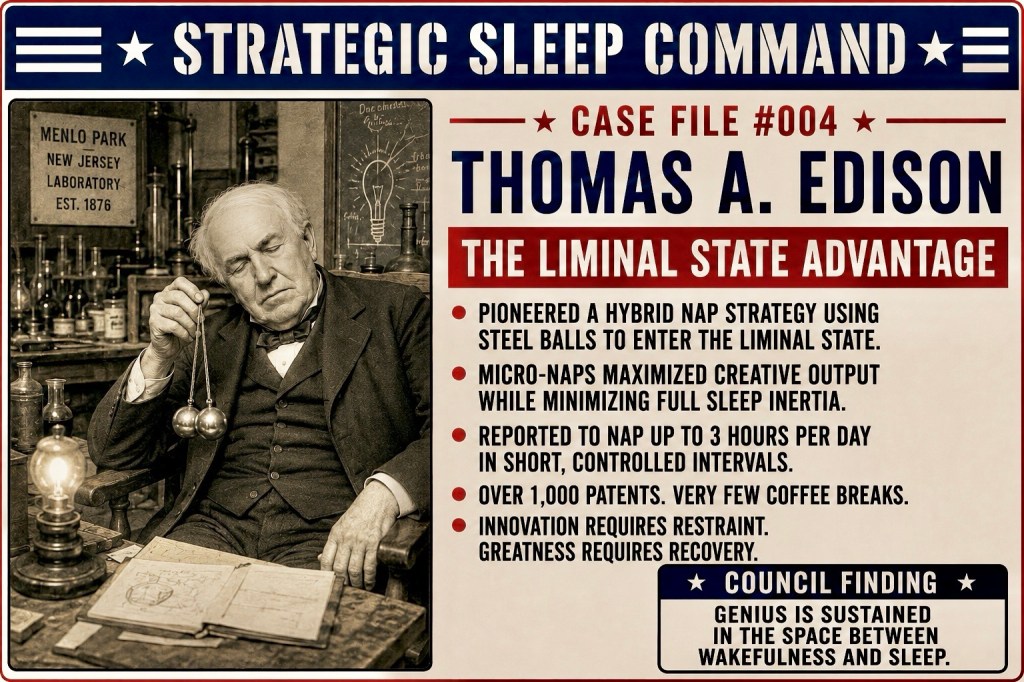
The Council classifies this as a Hybrid Nap Strategy.
The soldier cleans his rifle. The mechanic services his engine. The farmer sharpens his tools. The commander occasionally closes his eyes. Viewed in this light, the afternoon nap is not an indulgence.
It is logistics.
It is maintenance.
It is doctrine.
And until the Department of Defense formally establishes Strategic Sleep Command, responsibility for preserving this vital body of knowledge will remain with retired men in recliners, veterans on porches, grandfathers in lawn chairs, and certain highly experienced individuals who insist they were:
“just resting their eyes.”
History suggests we should take them seriously.
They may be the last practitioners of a forgotten strategic art.
—More from Justin Aldmann can be found: HERE


Leave a Reply