—Mrs. Begonia’s expedition from Indian Territory into America’s hidden civilization of the sharpened edge.—
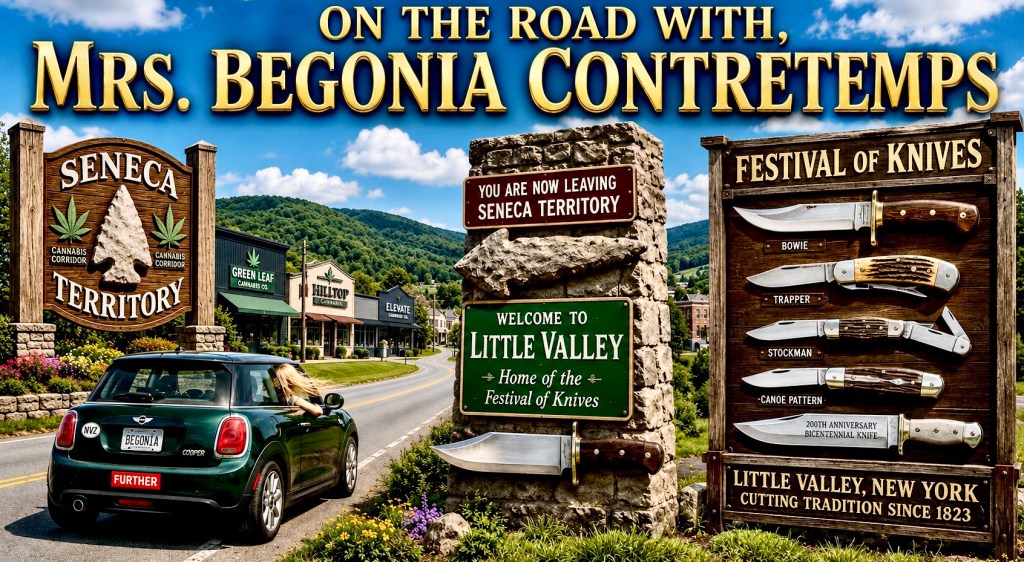
Mrs. Begonia Contretemps continues her American assignment on behalf of the NVZ, this time following John St. Evola’s curious instruction to investigate what he has dubbed the “Magic Dirt Theory.” Her destination is Little Valley, New York, home of the Festival of Knives and one of America’s forgotten industrial clusters. Along the way, a black bear quietly crosses the road from a magnificent stand of European larch. Only later does she wonder whether the encounter had been prophetic. Like the transplanted larches, she soon discovers that Little Valley’s greatest natural resource had also arrived from Europe—but it was carried not in the soil, but in the heads and hands of master craftsmen
From the Cannabis Corridor, Seneca Territory
—During the Moon of the Ripe Berries
Dear René,
John St. Evola has once again seen fit to dispatch me on what he insists is “field research.” I am increasingly persuaded that his actual occupation is devising improbable assignments for unsuspecting correspondents.
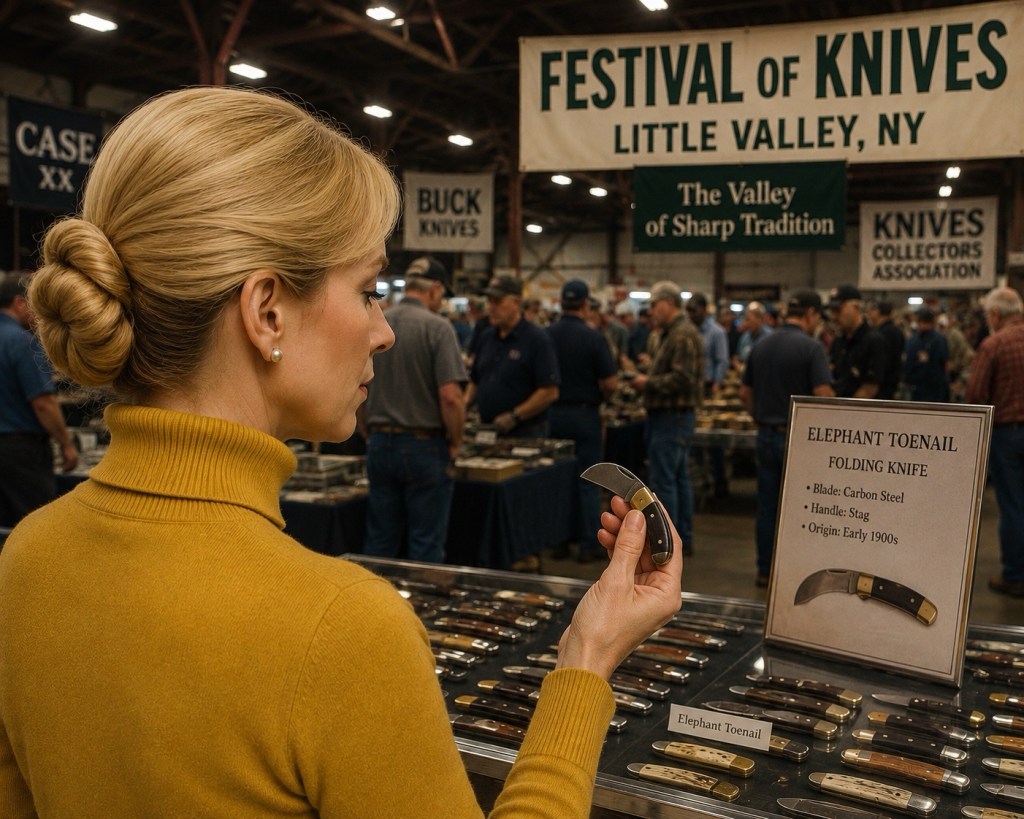
This latest expedition carried me to the Festival of Knives at the Cattaraugus County Fairgrounds in Little Valley, New York, where I was instructed to investigate what John has taken to calling The Magic Dirt Theory.
You will recall that I first encountered this peculiar line of inquiry about magic dirt while visiting Greenfield Village in Dearborn, Michigan. There, Henry Ford faithfully reconstructed Thomas Edison’s original Menlo Park laboratory and, not content with relocating the buildings alone,
even transported wagonloads of New Jersey earth beneath them!
It struck me at the time as an oddly American gesture—as though genius itself might refuse to travel unless accompanied by its native topsoil.
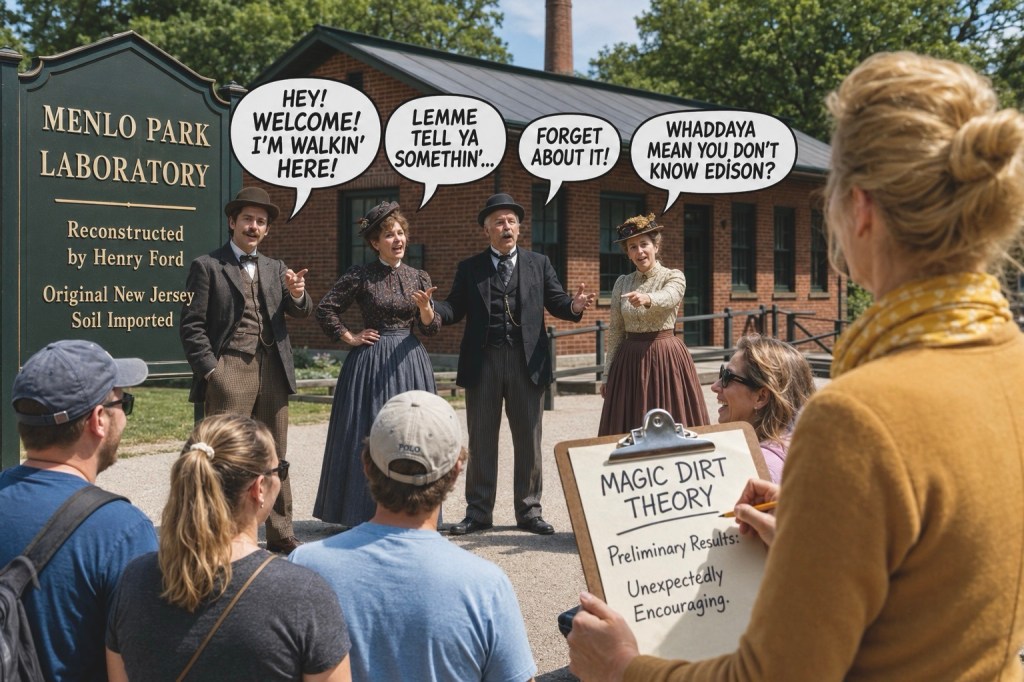
Even so, I cannot help observing that, after Mr. Ford imported the original Menlo Park buildings and New Jersey soil, the museum interpreters now seem to welcome visitors as though they were in New Jersey. An amusing coincidence, nothing more. Or maybe I imagined it.”
—Mrs. Begonia
John has since expanded his theory into a broader hypothesis. Americans, he claims, often speak as though the soil itself possesses transformative powers. Place someone upon it and—presto!—an American appears. Leave genius in one location long enough and perhaps the dirt itself acquires unusual properties. The theory, however, contains an obvious difficulty. One cannot simply lower any random human being onto a patch of celebrated American soil and expect the ground to manufacture an Edison, a master cutler, or an accomplished machinist. If the dirt truly possessed such powers, every visitor would depart transformed. Clearly, something else must be at work.
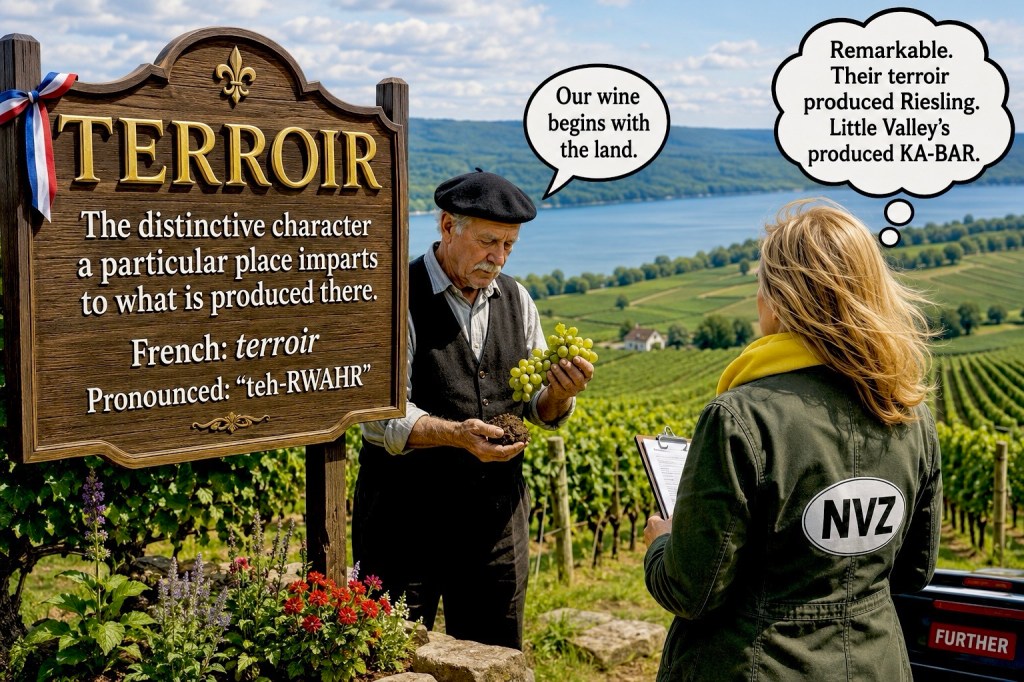
I decided to remain skeptical. Little Valley, however, had other plans.
I confess, René, that I had no notion what awaited me.
Imagine accidentally wandering into an entire universe devoted to sharpened edges.

Pocketknives.
Hunting knives.
Military knives.
Kitchen knives.
Bowie knives.
Antique knives.
Modern tactical knives
Even an Elephant toenail knife
Knives whose names I had never before encountered.
The atmosphere resembled a comic-book convention—except that every enthusiast could distinguish a Sheffield blade from a Solingen blade, identify a particular pattern at twenty paces, and discuss carbon content, heat treatment, and bolster shapes with the seriousness of medieval theologians debating the number of angels capable of balancing upon a pin.
Collectors bartered.
Craftsmen sharpened.
Historians reminisced.
Families proudly displayed heirlooms that had accompanied grandfathers through wars or generations of daily labor.
It soon became apparent that I had stumbled into an entire civilization hidden in plain sight.
Naturally, I assumed there must be rich deposits of iron ore nearby. There are not. This surprised me considerably.
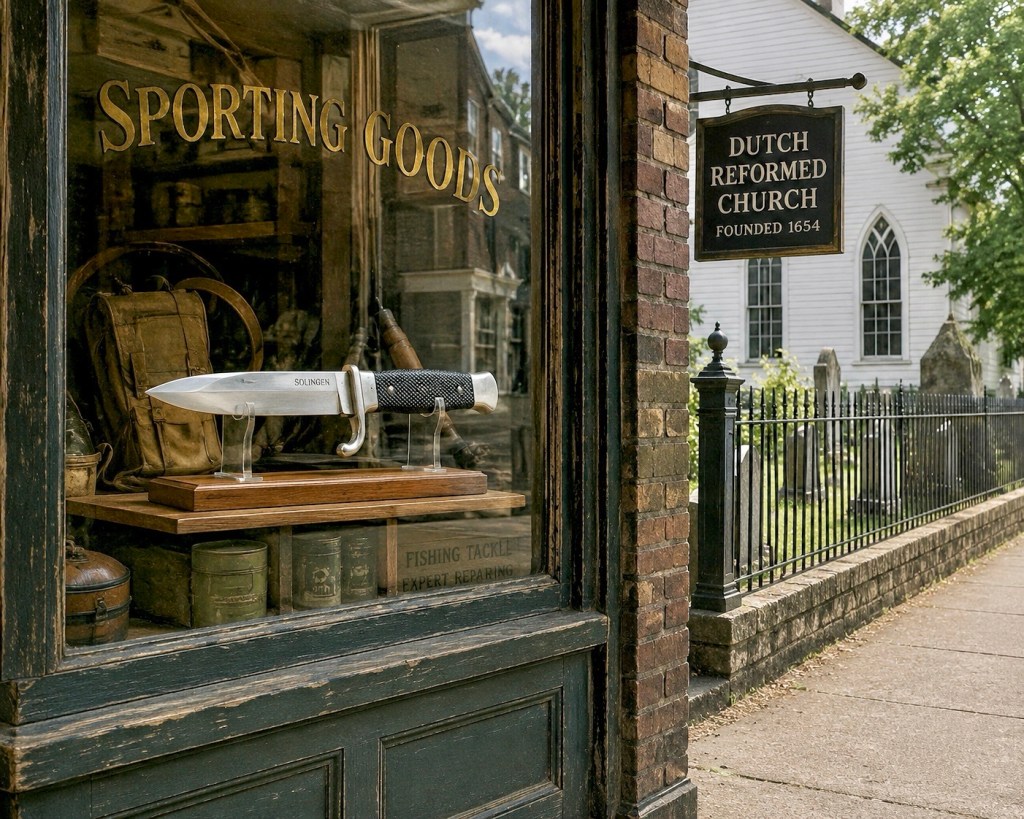
As a Brooklyn schoolboy, John St. Evola stared through a sporting-goods window at a German hunting knife stamped SOLINGEN. Having seen photographs of Hitler Youth daggers in his history books—and knowing many of them had also been made in Solingen—this postwar blade seemed to possess some of their borrowed aura despite the fact that it was the exact knife minus the lozenge. Years later, Little Valley would teach him that the real magic was never in the dirt, but in the craftsmen who carried Solingen’s centuries-old cutlery tradition.
If Little Valley had become one of America’s great centers of cutlery, surely the valley itself must possess some extraordinary geological advantage.
Instead, the history revealed something far more interesting. The steel came from elsewhere. The true natural resource arrived by ship.
Master cutlers emigrated from Sheffield in England, Solingen in Germany, and from older American cutlery centers. They brought neither magical ore nor enchanted soil.They brought memory.
Including:
Technique.
Apprenticeships.
Trade secrets.
Generations of accumulated metallurgical knowledge.
But the deeper I investigated, the stranger matters became.
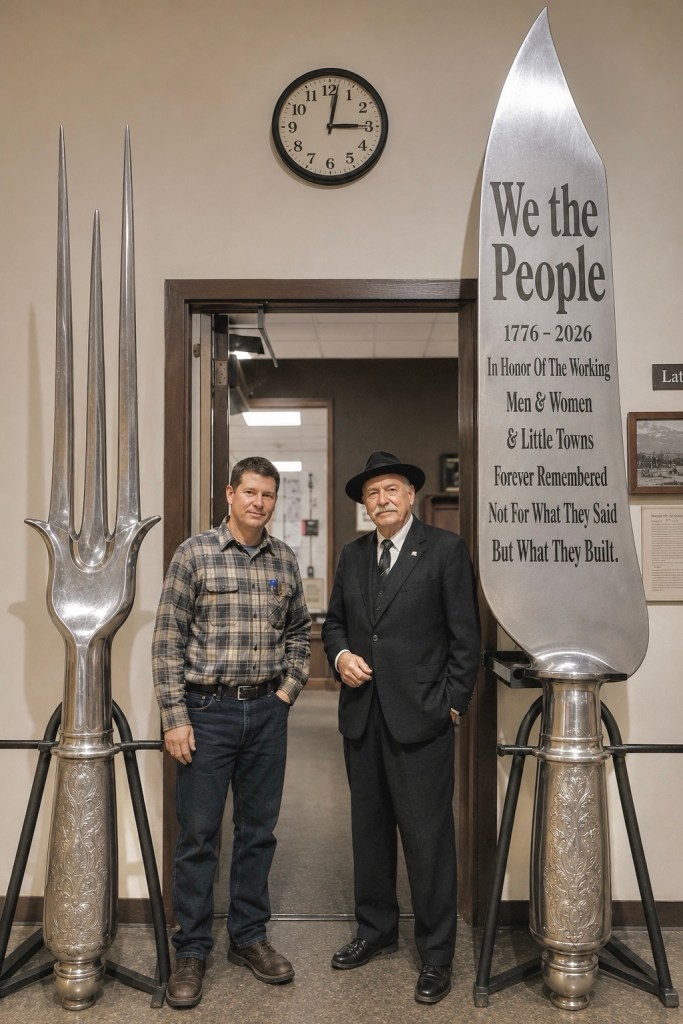
“René, Lest you suspect the Council of embellishment, I must assure you that these are actual, full-sized monuments standing in Little Valley, New York. They were fashioned for America’s 250th anniversary to replace earlier originals lost to history. By this point I had quite abandoned the Magic Dirt Theory and begun considering a more troubling possibility: that prolonged exposure to one of America’s great industrial clusters eventually compels a town to construct its specialty on a heroic scale.”
Little Valley had not merely produced a successful knife manufacturer.
It had become one of America’s great industrial clusters.
Like mushrooms appearing after rain, new firms continually seemed to emerge from the old.
Cattaraugus Cutlery was eventually joined by nearby makers including Case, Union Cutlery—later known as KA-BAR—Platts, Kinfolks, Standard Knife, and numerous smaller concerns whose craftsmen moved from one workshop to another carrying decades of accumulated experience with them.
It reminded me less of a collection of factories than of a family tree.
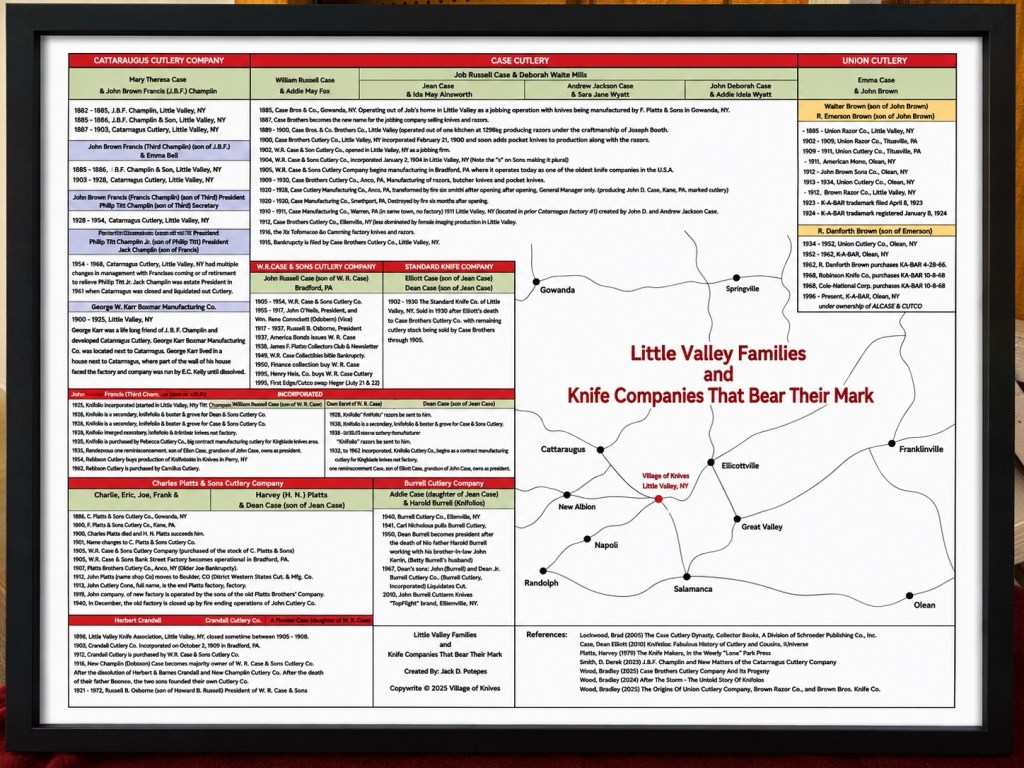
Apprentices became foremen. Foremen became partners. Partners established competitors. Cousins hired cousins.
Skilled workmen crossed the street carrying their greatest tools not in their pockets but in their heads.
The valley was not exporting iron. It was exporting and importing competence.
Earlier that morning I had stopped at a small historical display devoted to the region’s original inhabitants.
Little Valley lies immediately beside the Allegany Territory of the Seneca Nation. The history of the valley cannot be understood without acknowledging that it adjoins lands that have long been home to a tribe that was part of the Iroquois Confederation.
Within the exhibit rested beautifully crafted projectile points, scrapers, and stone knives fashioned from carefully worked stone.
They were elegant examples of genuine craftsmanship. Yet an inconvenient question presented itself.
If the valley itself possessed magical properties, why had it patiently produced chipped stone cutting tools for thousands of years before suddenly deciding to manufacture mirror-polished steel?
The answer, of course, is that it never had.
The hills, streams, and forests remained the same. Even the valley retained its Seneca name. What changed was not the landscape.
What changed was the arrival of a different technological tradition carried across the Atlantic by actual Europeans, reinforced by their relatives, apprentices, and descendants already at work in America.
The miracle had not occurred beneath the ground. It had occurred above it.
As though to discourage mystical interpretations altogether, I also discovered that the name Cattaraugus is generally understood to derive from a Seneca expression meaning something akin to
“bad-smelling banks” or “stinking shores,”
a reference to natural gas seeps once noticed along local waterways.
So much for “The Valley of Enchanted Steel.”
As I departed the fairgrounds, I quietly collected a small spoonful of Little Valley soil and sealed it inside one of John’s specimen envelopes.
The label now reads:
MAGIC DIRT — LITTLE VALLEY, NEW YORK.
It shall sit beside the sample we previously obtained from Edison’s Menlo Park. I suspect, René, that laboratory analysis will once again reveal nothing remarkable. Which is precisely the point. The real deposits were never hidden in the earth. They were carried inside the heads, hands, and habits of people who knew how to teach difficult things to the next generation.
Perhaps Henry Ford understood this all along. Perhaps the dirt beneath Edison’s laboratory was never what he truly wished to preserve.
Perhaps he merely needed something tangible to symbolize an invisible ecosystem of craftsmen, inventors, machinists, apprentices, and accumulated knowledge. If so, his wagonloads of New Jersey earth were not superstition.
They were poetry.
The magic was never in the dirt. It was in the people who stood upon it.
From Little Valley,
Where the Magic Dirt Theory has suffered a significant setback. I remain, as ever,
Your obligatory skeptical correspondent,
Mrs. Begonia Contretemps
Read the Further Writings of Mrs. Begonia Contretemps: HERE


Leave a Reply