—In Which Mrs. Begonia Contretemps Encounters a Convergence of Catastrophes in Cherbourg

John St. Evola, our editor, had assigned me another word for investigation.
UNIVERSALISM.
According to my dictionary, the word referred to the belief that certain principles or truths applied universally, to all people, everywhere.
Everyone? Everywhere?
I telephoned John.
“Does that include the French?”
“Especially the French,” he replied.
“Have they been consulted?”
“That’s what you’re supposed to find out.”
I had recently watched The Umbrellas of Cherbourg, Jacques Demy’s enchanting 1964 motion picture, in which Catherine Deneuve and practically everyone else sang their lines rather than spoke them.
The colours were extraordinary, the faces unmistakably French, and even the most mundane conversation was conducted to music. I was reminded of something John St. Evola had once written in a moment of literary exuberance:
“Oh, the colours! The colours! The magnificent brightness of it all! The noble ideals, the universal brotherhood, the voices raised in perfect harmony—and beneath it all, the unspeakable lightness of understanding nothing.”
He had attributed the passage to his own unpublished work, The Heart of Lightness. I had thought it rather excessive at the time. Now I wondered whether he had been to Cherbourg.
I had also been particularly charmed by the fact that the film made no apparent effort to be anything other than French. One could understand the characters’ sorrows without wishing them to become English, American, or anything else.
I proposed Cherbourg as the destination for my investigation.
John agreed, although he cautioned me that contemporary France might differ somewhat from the France of 1964.
I assured him that I was prepared for minor alterations.
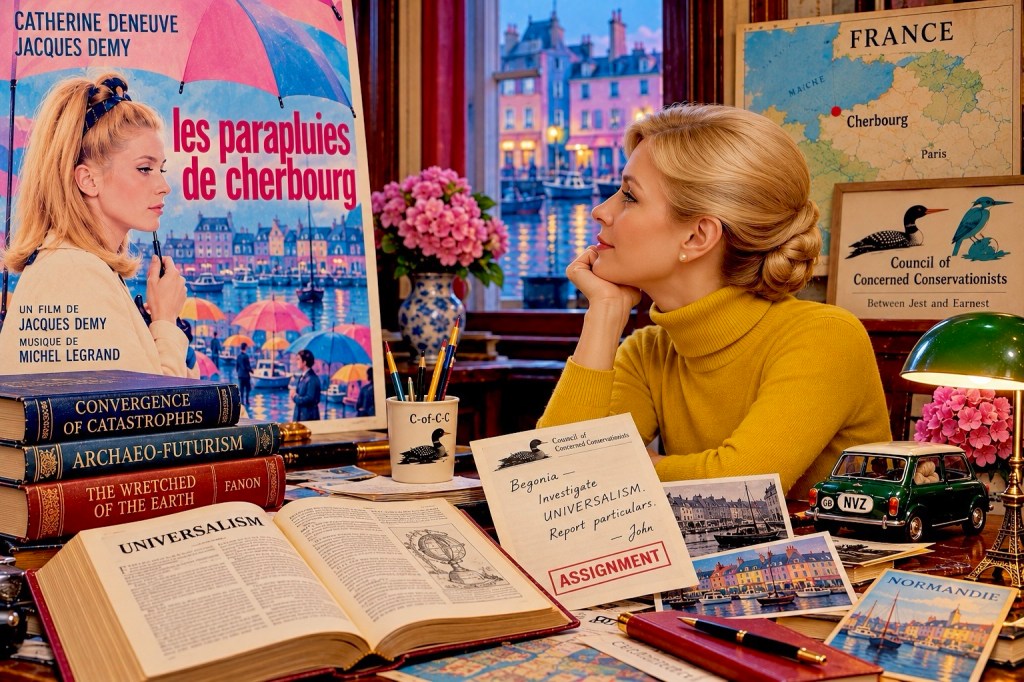
I. A French Overture
Cherbourg greeted me in Technicolor. At least that was how I perceived it. The buildings appeared painted in extraordinary combinations of coral, turquoise, butter yellow, and violet. Umbrellas blossomed along the pavements like exotic flowers. Even the rain seemed to have been selected by a competent art director.
I parked my green Mini near the town centre. A parking attendant approached.
“Madame, you cannot park here,” he sang.
I looked at him.
“Are you singing?”
“🎶Only the parking regulations, madame.”
He delivered the applicable ordinance in a pleasant tenor. I replied, somewhat experimentally, in recitative:
“🎶Then where, monsieur,
May I leave my little car?”
He pointed toward a nearby garage and completed his answer on a sustained note.
I was delighted. It appeared that Jacques Demy had not exaggerated French life after all.
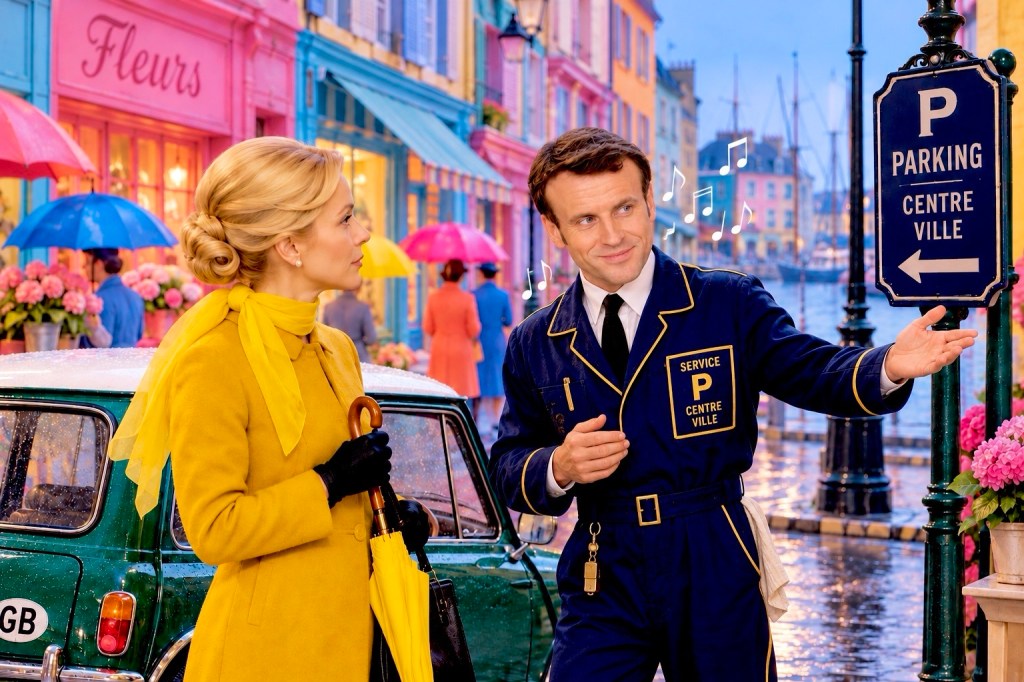
II. The Universal Umbrella
My first interview was with Monsieur Lucien Universel, a lecturer in civic philosophy and chairman of a local association devoted to universal values.
He had organized a public gathering beneath an enormous umbrella bearing the words:
LIBERTÉ — ÉGALITÉ — FRATERNITÉ — UNIVERSALITÉ
“Madame,” he sang, spreading his arms, “our principles are intended for everyone!”
“How generous,” I replied. “And who decided that?”
“Humanity!”
“All of it?”
“Enlightened humanity.”
“And by an extraordinary coincidence, monsieur, YOU happen to belong to it.”
He appeared pleased that I had understood him. He explained that humanity must eventually recognize its common values, overcome inherited divisions, and gather beneath the protective umbrella of universal principles.
I asked whether other civilizations had contributed to designing this umbrella.
“Naturally! We respect all cultures.”
“And if one of them declines your invitation?”
“Then we must explain the benefits more carefully.”
“And if they still decline?”
He looked genuinely puzzled.
“Why would they?”
It occurred to me that Monsieur Universel’s umbrella was not so much an invitation as an assumption.
He regarded cultural differences as charming variations upon a common theme, provided everyone eventually agreed upon the theme.
“But monsieur,” I asked, “isn’t your understanding of universalism itself a product of a particular civilization?”
“Certainly not! It is universal!”
“Yes, I gathered that from the name.”

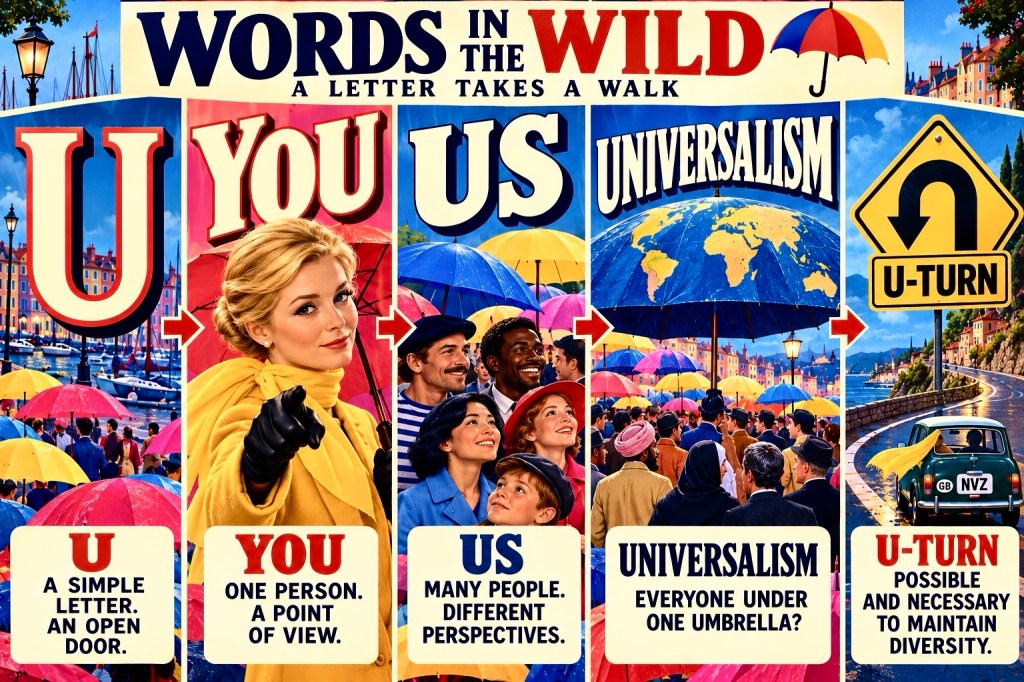
III. U, YOU, and US
I began to suspect that the letter U was causing much of the difficulty.
UNIVERSALISM began with U.
YOU contained U.
And US, although beginning with the same sound, was considerably less inclusive than its advocates seemed to suppose.
Who was this YOU who proposed to speak for US, and by what authority had US become EVERYONE?
I put the question to Monsieur Universel.
“Surely, madame, you believe that human beings have much in common?”
“Of course. We are all human beings. But I do not conclude from this that we must all become the same sort of human being.”
“Difference is welcome!”
“Provided everyone agrees about what differences are welcome?”
He began another song about brotherhood. I made a note that universalism appeared to possess a particularly effective method of answering objections: it simply sang over them.
IV. The Universal Chorus
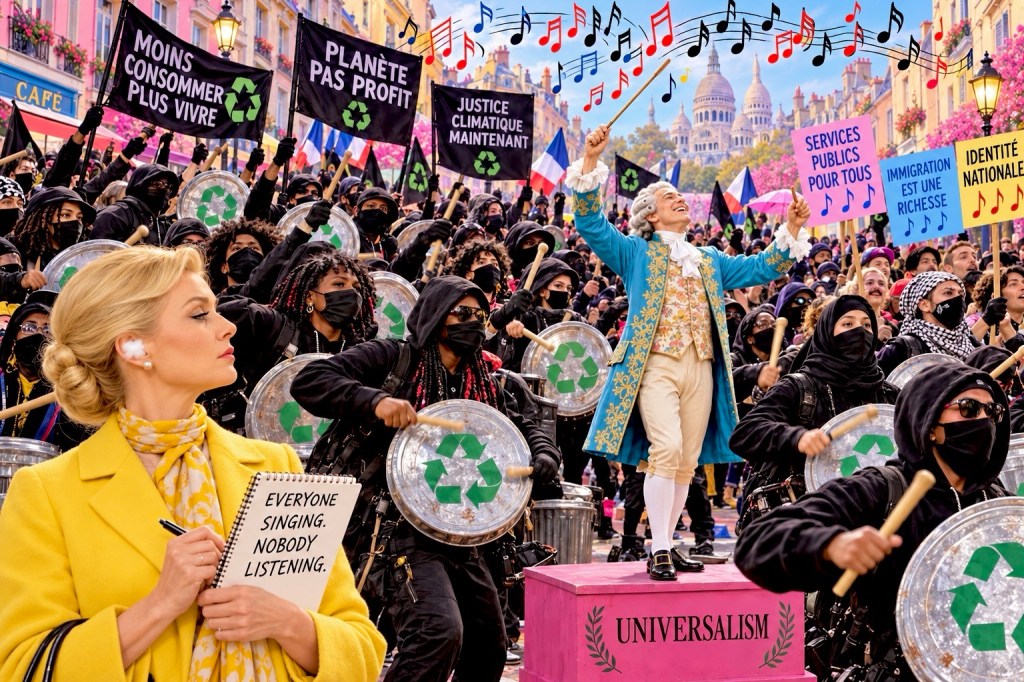
By afternoon, a demonstration had gathered in the town square.
Students, teachers, political activists, longtime residents, and other immigrants from the banlieue had assembled to protest a bewildering assortment of grievances. The French call it the banlieue, a perfectly elegant word for what my American readers might recognize as the hood or the ghetto. Rather a pity, I thought, that such a respectable French word should have come to look as though it had been written in graffiti.
Some among la foule wished to defend public services. Others demanded changes to immigration policy. Still others opposed those demands. A number seemed primarily interested in opposing one another. La foule, incidentally, is French for the crowd or the mob. Its resemblance to the English word fool is merely a happy coincidence, although I suspect the French have occasionally wished it were otherwise.
Monsieur Universel was delighted.
“Observe, madame! The magnificent diversity of humanity!”
The crowd began singing.
One group sang of liberty. Another sang of equality. A third sang of national identity. A fourth sang that national identity was an artificial construction. A fifth demanded that everyone stop singing the previous four songs.
The melodies were not compatible.
Indeed, the resulting noise suggested an orchestra whose members had each been issued a different score.
Monsieur Universel beamed.
“Listen, madame! They’re all singing!”
“Indeed,” I replied. “But have you noticed that none of them is listening?”
He shook his head.
“The important thing is that they are united in song.”
I considered this.
The universalist insisted that everyone was singing in harmony because everyone was singing.
It was an extraordinary proposition, and one that explained a good deal about my assignment.
V. Assimilation by Insurrection
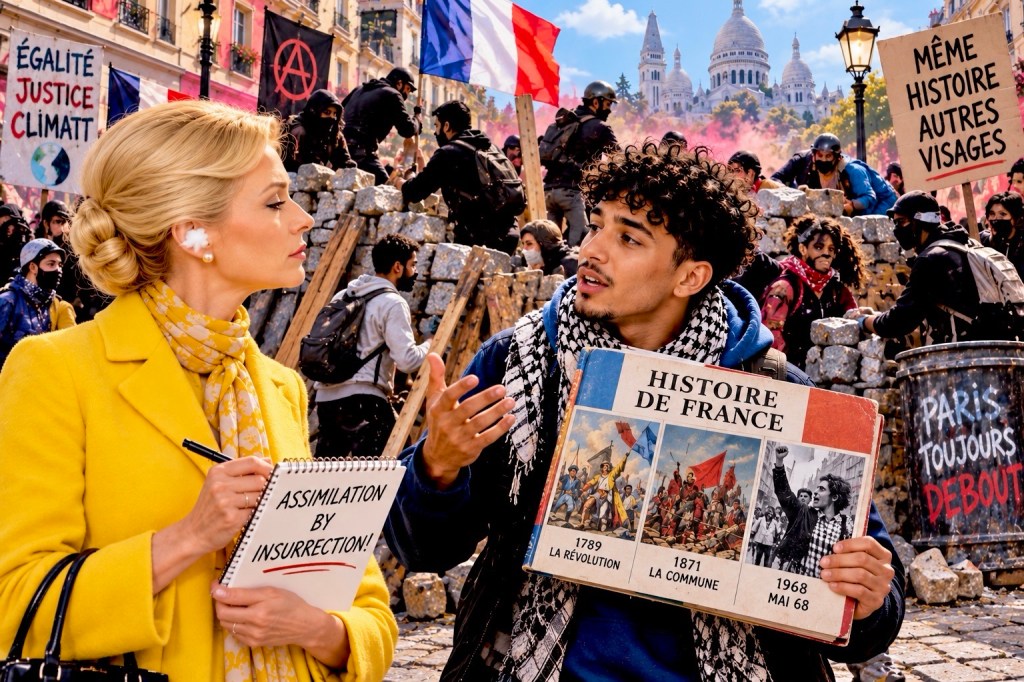
The demonstration became more animated. A barricade appeared across the street, constructed from overturned bins, abandoned bicycles, street furniture, and objects whose owners had apparently not been consulted.
I climbed onto a convenient stone planter to photograph it. A young demonstrator approached me.
“Madame, are you a journalist?”
“Indeed. Council of Concerned Conservationists Newsletter.”
“An international organization?”
“International in its concerns. Rather selective in its membership.”
He seemed impressed. I asked whether he considered himself thoroughly French.
“Naturally, madame! I have studied French history.”
“How commendable.”
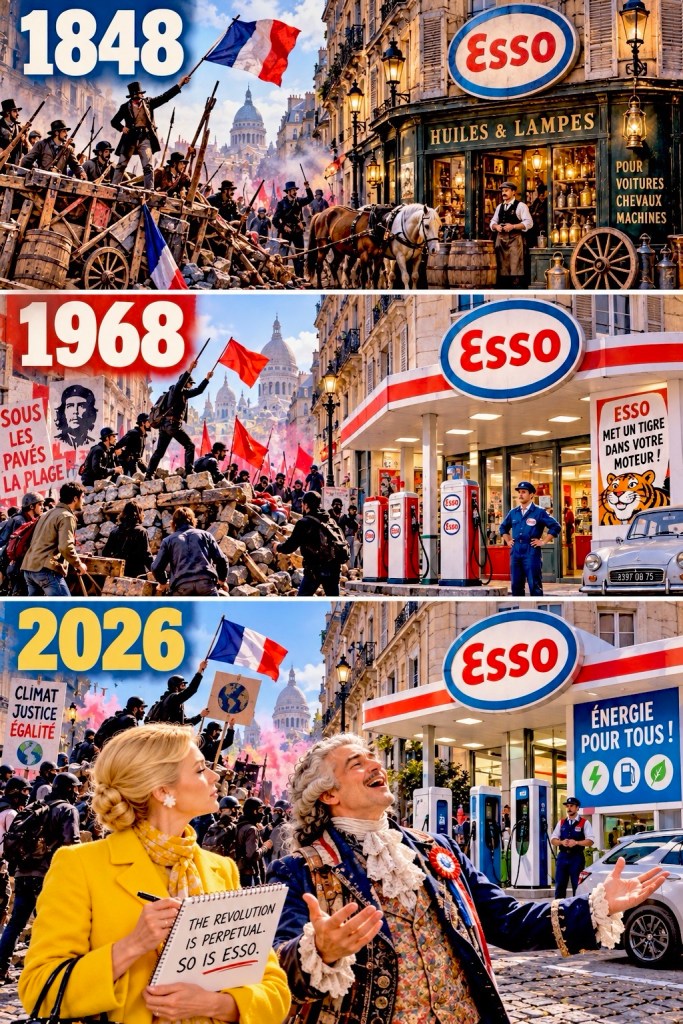
“The Revolution of 1789! The barricades of 1848! The Paris Commune! May 1968!”
He gestured proudly toward the barricade.
“We are continuing the tradition!”
I surveyed the wreckage.
“Your studies have been remarkably practical.”
“We wish to assimilate!”
“Have you considered beginning with the cuisine?”
He looked disappointed. I had to concede that he possessed a point. France had been overturning governments, erecting barricades, and occasionally setting fire to its own furniture for centuries. The newcomers accused of failing to assimilate had, in at least one respect, adopted a French tradition with astonishing enthusiasm.
Assimilation by insurrection!
I wondered whether the Ministry of Culture offered certificates.
VI. The People Beneath the Umbrella
I found Monsieur Universel standing with a group of French schoolteachers. They were distressed by the disorder.
“These young people,” one teacher lamented, “do not understand our republican traditions!”
I pointed toward the barricade.
“On the contrary, madame. Some of them appear to have studied them rather too diligently.”
“That is not what we meant!”
“Then perhaps you should specify which traditions are compulsory and which are merely decorative.”
Monsieur Universel intervened.
“France has always survived its revolutions.”
This was true enough. Kings had fallen. Republics had come and gone. Empires had risen and collapsed. Yet France had repeatedly recovered from its own extraordinary political convulsions.
But I wondered whether its capacity for recovery had depended upon something deeper than constitutions, ministries, or monuments.
Perhaps it depended upon the historical continuity of the French people themselves.
The French were not all alike, of course. Nor had they ever agreed about much of anything. Nevertheless, generations had inherited and transmitted a recognizable civilization, despite their considerable talent for disrupting its government.
I suspected that this continuity had helped France remain France.
The universalists seemed confident that the same result could be achieved regardless of how profoundly the composition and cultural understandings of the population changed.
I was less certain.
This was not something I could establish from an afternoon’s reporting in Cherbourg. But it struck me as a rather important question for a civilization conducting an experiment upon itself.
I also wondered whether people who had arrived from very different cultural backgrounds were being encouraged to adopt the least constructive lessons of modern French political thought! Forgive my outburst. I am usually rather more charitable toward the French, but they do make it difficult.
Monsieur Universel assured me that universal principles would supply the necessary cohesion.
“All people share the same fundamental aspirations,” he sang.
“Do they?”
“Certainly!”
“Then why are they arguing?”
“Because they have not yet understood that they agree.”
I admired his perseverance. I also admired that peculiarly Gallic capacity for producing irony without appearing to notice it.
VII. A Convergence of Catastrophes
By late afternoon, the situation had deteriorated. The demonstration had divided into several competing demonstrations. A transport stoppage had complicated movement through town. Rain began falling in earnest. Police attempted to separate groups whose members were no longer entirely certain whom they opposed.
Someone overturned a rubbish bin. Someone else overturned the bin that had been placed there to replace it. A shopkeeper began boarding his windows. The universalist chorus continued.
I recalled the expression convergence of catastrophes.
It seemed an excellent description of events, although I suspected the catastrophes had not coordinated their arrival.
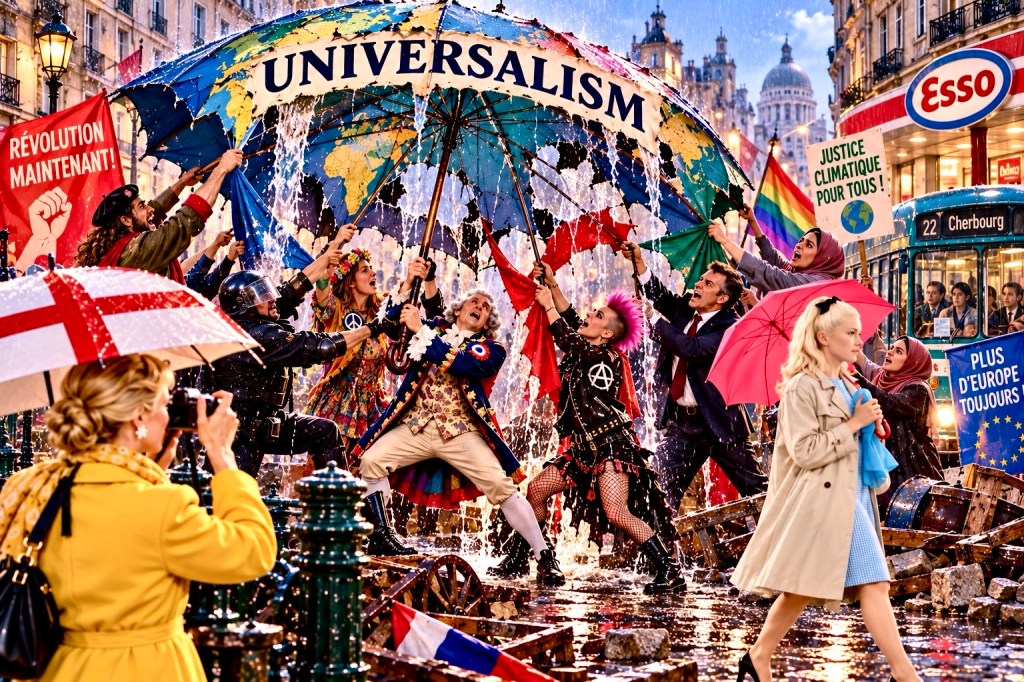
Monsieur Universel opened his enormous umbrella.
“Come, everyone! There is shelter for all!”
A crowd gathered beneath it. One man complained that the umbrella was too French. Another objected that it was insufficiently French. A third demanded equal access to the handle.A fourth insisted that the handle represented an oppressive hierarchy.
Monsieur Universel proposed forming a committee.
At this point someone attempted to seize the umbrella.
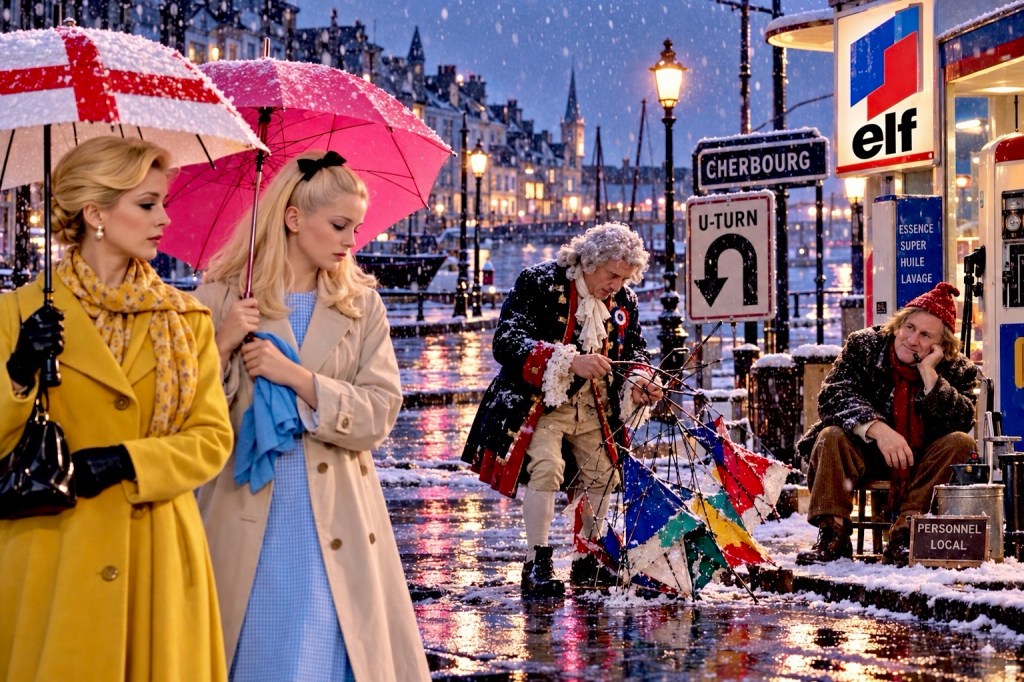
A struggle followed. The canopy turned inside out. The handle broke. Monsieur Universel stood in the rain holding a short length of wood. I photographed him.
He looked like a man who had just discovered that the universal brotherhood of humanity did not necessarily include universal agreement about umbrella ownership.
VIII. The U-Turn
The rain became heavier. The singing, remarkably, continued. I asked Monsieur Universel whether his experience had altered his opinion.
“Not at all, madame. Universalism remains the only possible future.”
“Even if some people reject it?”
“They must be persuaded.”
“And if they refuse?”
“Then society must insist upon its fundamental principles.”
“So universalism is compulsory?”
“Oui, YES! where necessary.”
I opened my notebook.
U-TURN.
There it was.
We had traveled from universal brotherhood to compulsory agreement in the space of a few musical phrases.
“Tell me, monsieur,” I asked, “if a people wishes to preserve its own distinct civilization, must it surrender that wish in the name of universalism?”
“Not at all! We cherish diversity!”
“Provided it leads to uniformity??”
“Madame, you are oversimplifying.”
“That is possible and often necessary. I am a journalist.”
He resumed singing.
I looked about me.
The French had given the world a remarkable civilization. Its language, literature, music, cuisine, architecture, and habits of thought were not interchangeable with those of any other people.
Nor, I reflected, was my own British inheritance interchangeable with theirs.
We were close neighbors, with centuries of shared European history, overlapping ancestry, and an impressive record of disagreeing about nearly everything. Our similarities had never prevented us from remaining distinct. Why, then, should the entire world be expected to fit beneath a single cultural umbrella?
I thought that preserving genuine diversity might require something rather different from persuading everyone to accept the same definition of it.
Monsieur Universel continued singing of universal harmony. Behind him, the barricade was being dismantled by people who disagreed about whether it ought to have been erected.
I decided that I had obtained sufficient material for my report.
IX. The Umbrellas of Cherbourg
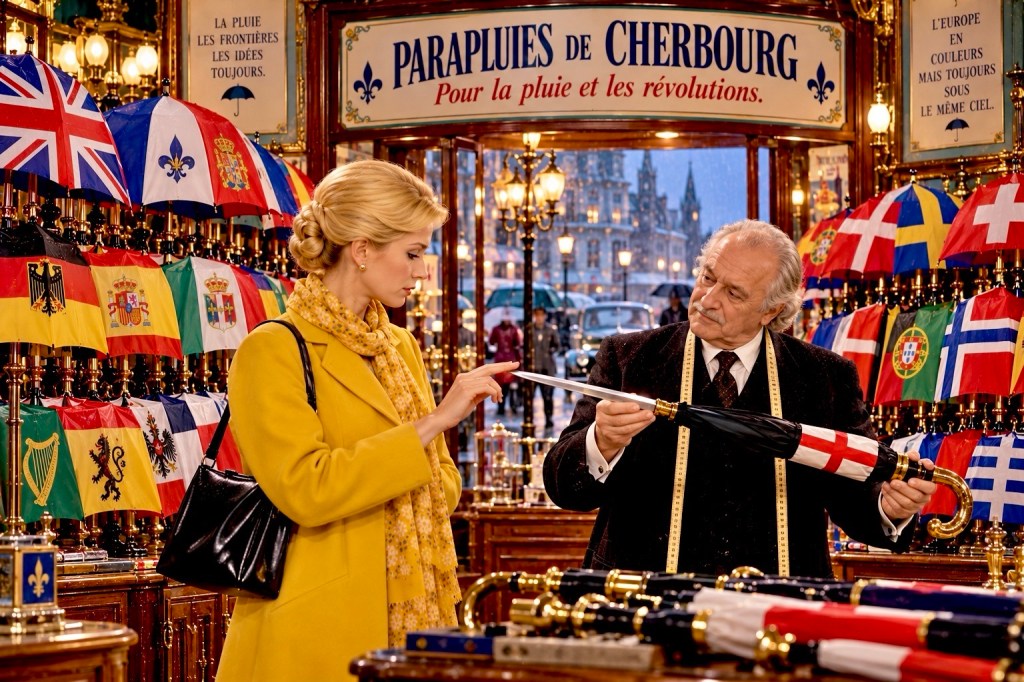
Before leaving town, I sought out an umbrella shop. It was a delightful establishment, filled with canopies of every imaginable color. The walls were decorated in extravagant floral patterns, the counters gleamed, and the proprietor wore a beautifully tailored suit.
For a moment, I was back in Jacques Demy’s France.
“🎶Bon soir, madame,” he sang.
I smiled.
At last, someone who understood the proper conduct of French commerce.
“🎶I require an umbrella,” I replied in recitative.
“🎶Naturally, madame. For the rain?”
“🎶Among other things.”
He displayed several elegant models. One was pale blue. Another was yellow. A third had a charming floral pattern.
“Very pretty,” I said. “But I have just attended a demonstration.”
“Ah.”
“And a barricade.”
“Ah!”
“And witnessed a convergence of catastrophes.”
The proprietor’s expression brightened.
“Then perhaps madame would prefer something from our traditional collection.”
He reached beneath the counter and produced an elegant umbrella with a polished handle. He pressed a concealed catch and carefully withdrew a slender sword from its shaft.
I regarded it with interest.
“An umbrella with a sword?”
“An old-fashioned curiosity, madame. For the rain and the revolutions.”
“Is it legal?”
“That, madame, is a question for the authorities—and how they choose to apply the law.”
The French, naturally, had a name for this: anarcho-tyrannie. Why? I thought it rather elegant. One never knew whether one was to be governed or abandoned until the authorities had decided which was more convenient.
I considered the object. It was beautifully made, thoroughly impractical for ordinary modern travel, and quite possibly the least universal umbrella in France.
“I shall take it,” I said, arranging for its lawful shipment and display rather than carrying it through the streets.
The proprietor wrapped it with exquisite care.
“🎶Would madame like it in another color?”
“No, monsieur. Red on white will do,” I replied, having abandoned the practice of singing my lines.
“And shall I include the guarantee?”
“Does it cover revolutions?”
“Only manufacturing defects, madame. Ideological failures are the responsibility of the purchaser.”
I paid him. For the first time all afternoon, I found myself singing without prompting, at least for a while.
Postscript — A Report to John
Back at my hotel, I filed my findings.
Universalism, I concluded, was an umbrella intended to shelter the entire world, provided the entire world agreed upon who should hold it.
The difficulty was not that human beings lacked things in common. It was that they possessed so many things that were not common, and some of those differences were worth preserving.
France, I thought, had produced enough revolutions to demonstrate that a civilization could survive a remarkable amount of disagreement.
Whether it could survive the disappearance of the historical continuities that had helped make it a civilization was another matter.
The universalists believed that everyone could be brought beneath the same umbrella.
I preferred a world in which different peoples might retain their own umbrellas, provided they refrained from beating one another with them.
I added that last qualification after examining my purchase.
John telephoned the following morning.
“Well, Begonia, did you discover what universalism means?”
“Indeed. It means everyone is expected to sing the same song.”
“Do they?”
“Not remotely.”
“Then what did you learn?”
“That the French are still very good at revolutions, John. The difficulty is deciding who gets to be French afterward.”
There was a pause.
“And the umbrella?”
“An excellent souvenir.”
“Anything else?”
“🎶Yes. I believe I shall watch the film again. Because, John, in The Umbrellas of Cherbourg, everyone sings.”
“And?”
“They occasionally listen.”
— Mrs. Begonia Contretemps
Foreign Correspondent, Council of Concerned Conservationists
Between Jest and Earnest
P.S. — To John St. Evola
On my way back to Azilum, Pennsylvania, where I am presently domiciled, I stopped in Frenchville, where families from eastern France settled in the early 1800s. Their isolation in the Pennsylvania woods had preserved a dialect of French that retained much of its original form from that period, surviving remarkably intact well into the late twentieth century. I found it rather touching that a language could survive so long without anyone organizing a demonstration on its behalf.
And then, of course, there is Azilum itself, established as a refuge for people fleeing the French Revolution, with the extraordinary expectation that Marie Antoinette might one day join them.
It occurred to me, John, that I had travelled all the way to Cherbourg in search of universalism, only to return home to two little fragments of France that had escaped it.
Neither, so far as I could determine, had required an enormous umbrella.
Mrs. Begonia Contretemps
More Examples of Words Found In The Wild Can Be Found: HERE
Mrs Begonia Contretemps Further Writings Are Currently Domiciled: HERE


Leave a comment