—A Beginner’s Guide to a Language You Already Recognize.

I blame the bumper music.
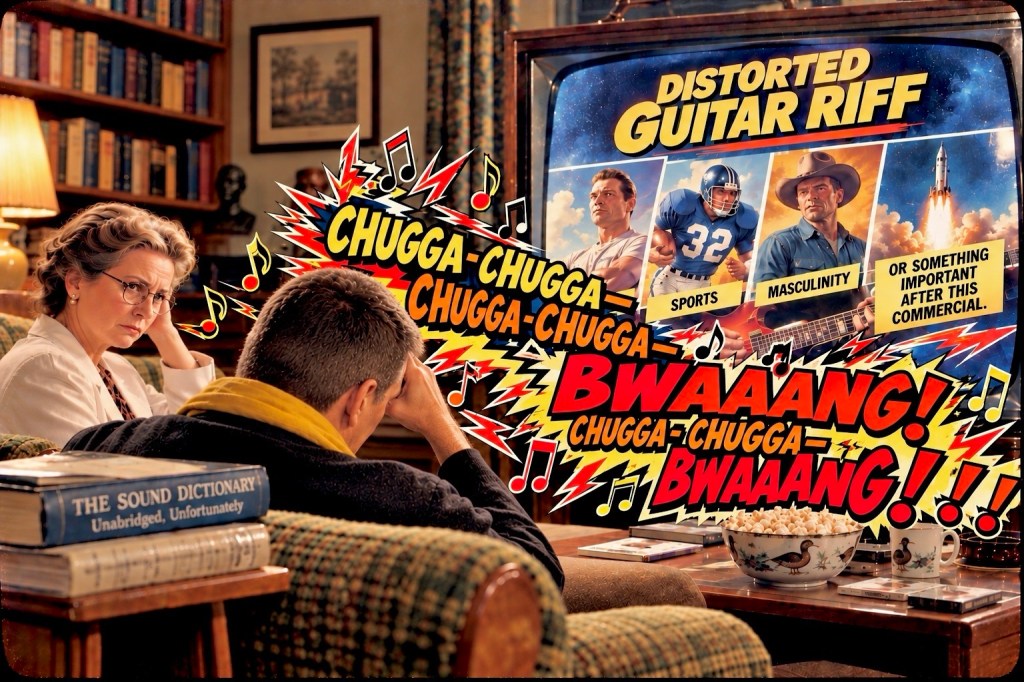
You know the sonic presentation. A television program goes to commercial, returns, and somebody hits you with five seconds of distorted electric guitar.
CHUGGA-CHUGGA—BWAAANG.
We are back.
Apparently it is no longer sufficient simply to return from a commercial. We must return with attitude.
Then there is the banjo.
I have nothing against the banjo. The banjo has done nothing to me. It has been improved and Americanized from its African origin. But somewhere along the way three seconds of banjo ceased to be music and became an announcement:
RURAL AMERICA.
And then there was the loon.

The loon was the breakthrough.
Put a cabin beside a lake. Add mist. Perhaps a canoe. Then, whether or not a loon has been consulted about the matter:
Ooooo-OOOO-oooo.
WILDERNESS.
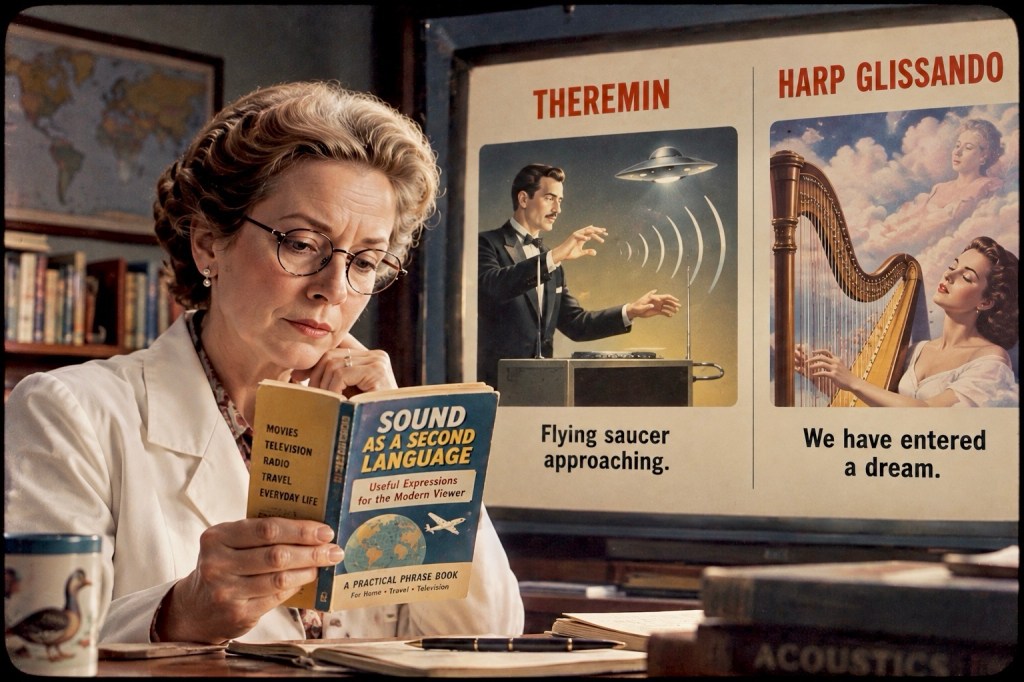
That was when I realized we have all been carrying around a dictionary nobody knew existed.
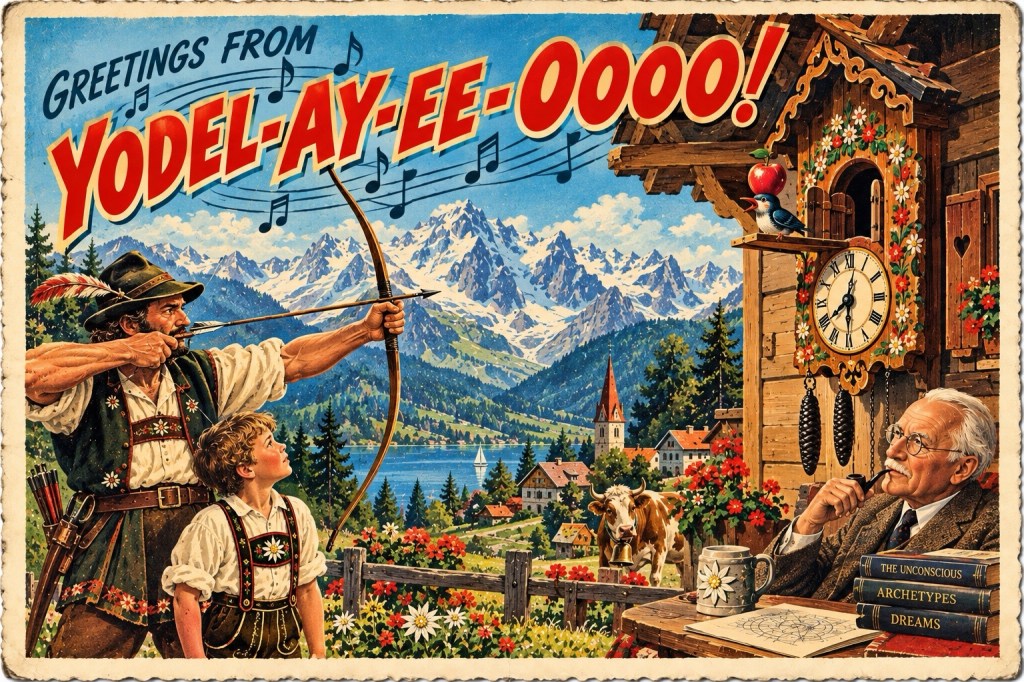
This dictionary has no pages. It has no editor. Nobody remembers buying a copy. There are no definitions printed anywhere. Nevertheless, practically everybody seems to know them. And this raises a question appropriate to WORDS IN THE WILD:
Must a word contain letters? Must it even be spoken?
After all, what is a spoken word but a sound to which people have agreed to attach a meaning?
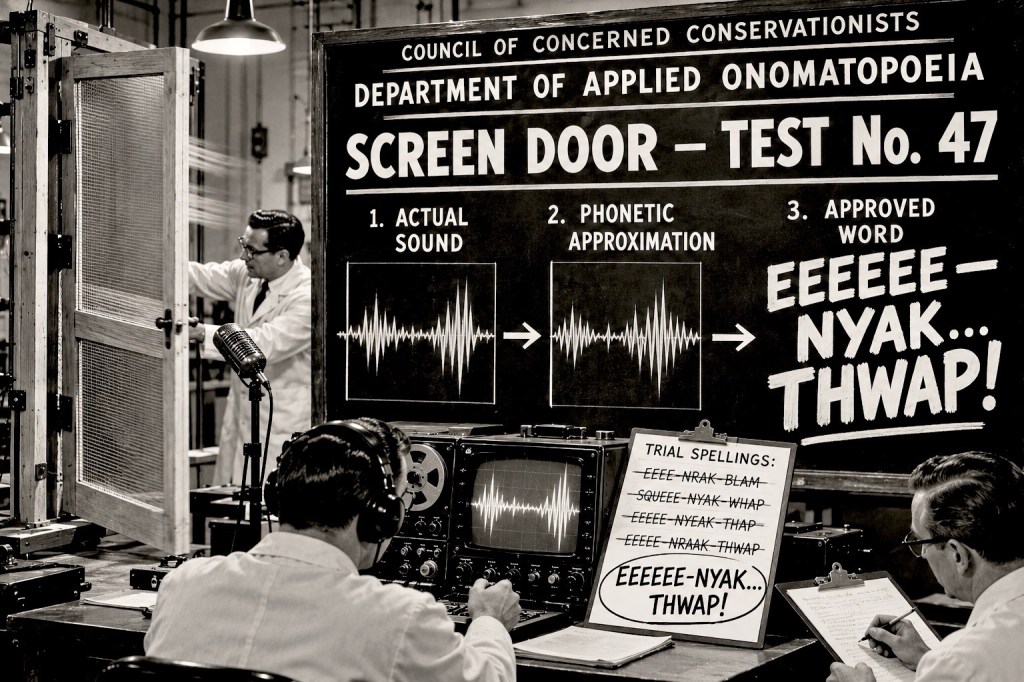
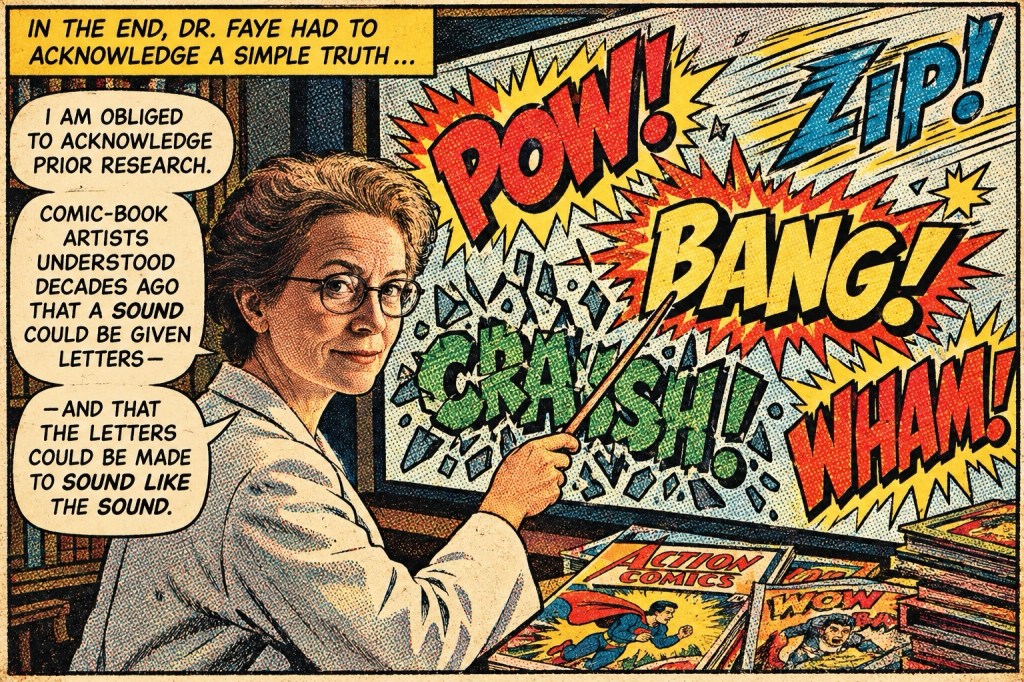
But putting letters to a sound is the easy part. The more interesting trick is what happens when the sound begins doing the work of a word.
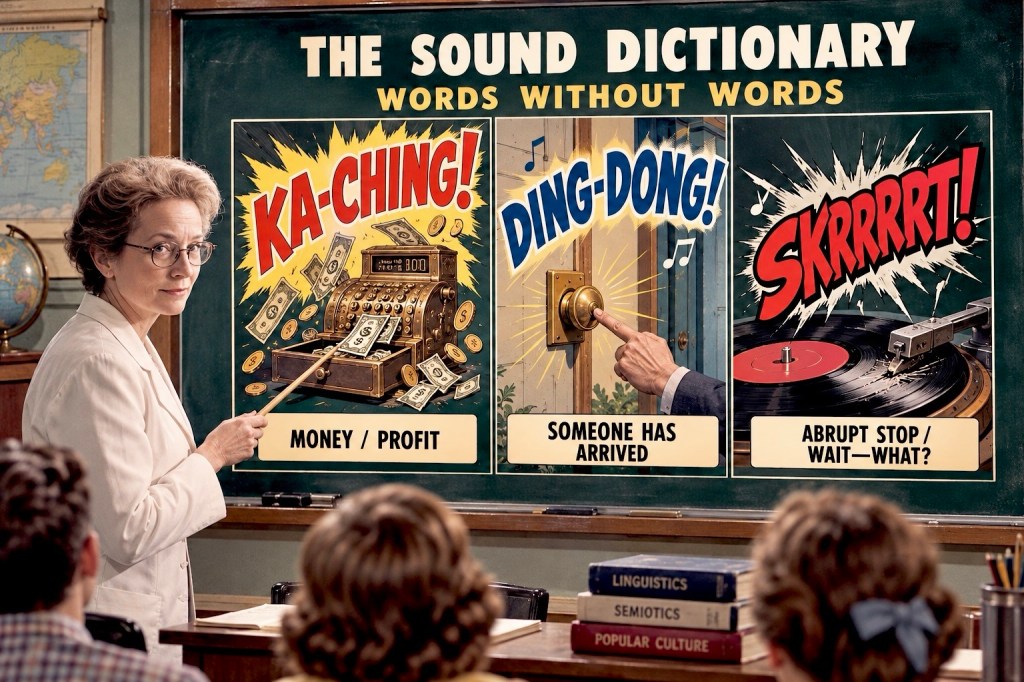
Say “France” and you picture France. Play three seconds of accordion and you picture France.
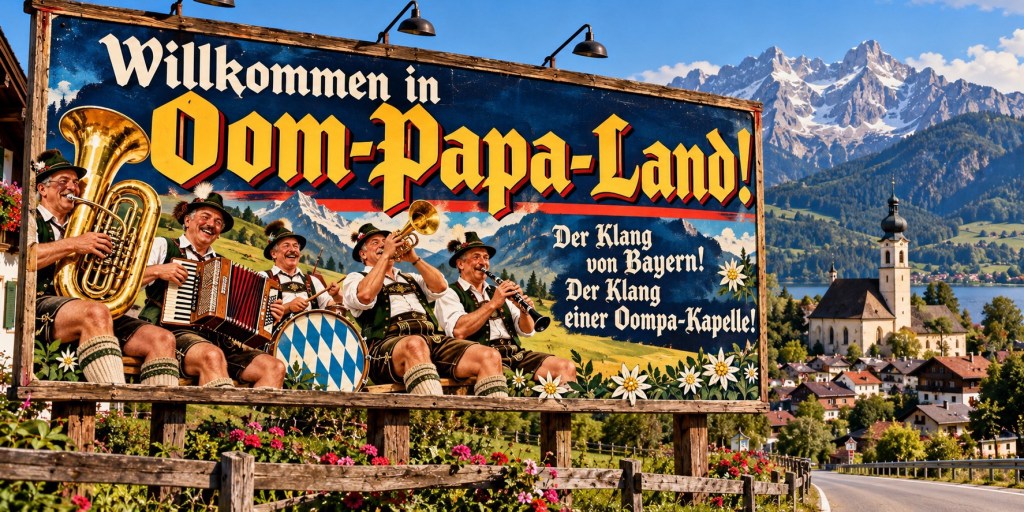
One uses a word. The other has simply trained a sound to do the word’s job.
These are sounds that have been trained to behave like words. And once you start listening for them, there is practically an entire musical phrasebook for lazy audiovisual storytelling.
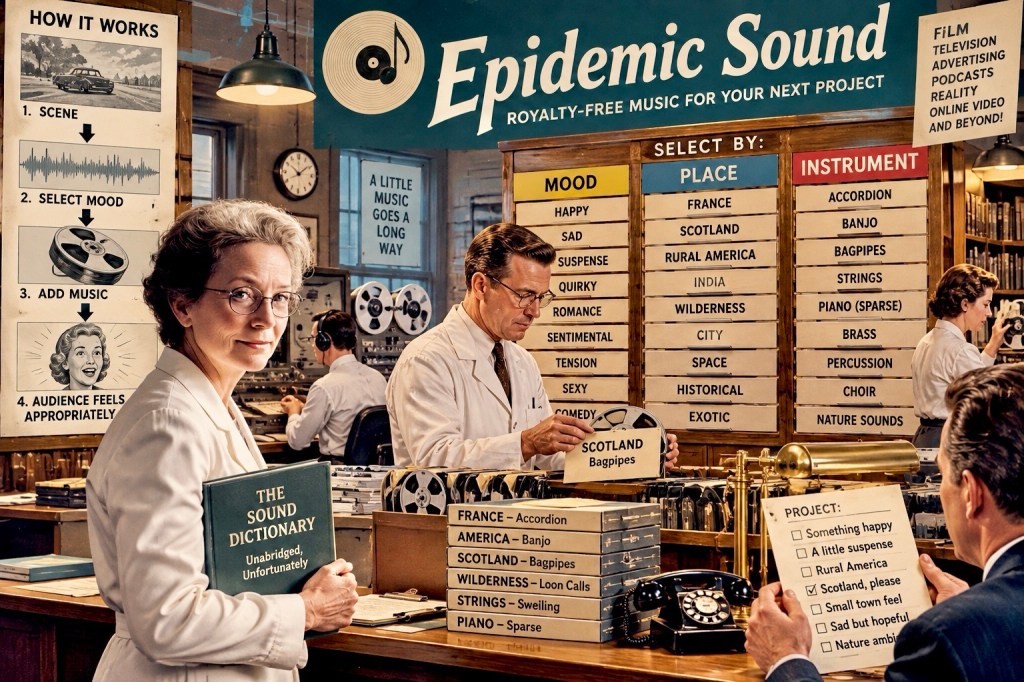
Let us examine a few entries.
Ukulele + handclaps + whistling: Cheerful, quirky, wholesome. Probably selling insurance.
[List continues below my analysis break. The bills must be paid.]
Back to the matter at hand:
Acoustic guitar with gentle fingerpicking: Sincerity. Someone is about to tell you about their family, their pickup, or their prescription medication.
Lonesome harmonica: Cowboy, drifter, empty highway. Tumbleweed optional but strongly recommended.
Slide guitar or twang: We have entered The South.
Mandolin: Italy. Someone should shortly appear carrying tomatoes through a village.
Spanish or flamenco guitar: Spain—or, rather carelessly, anywhere vaguely Hispanic.
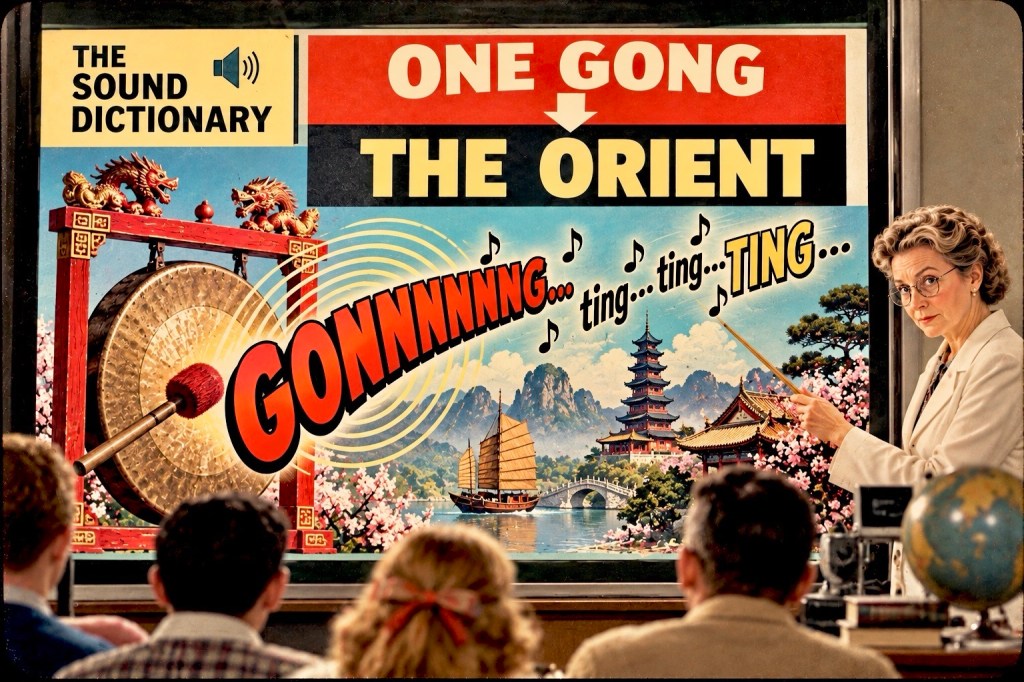
Sitar: India, mysticism, enlightenment. Somebody has discovered incense because they need the cover scent.
Bagpipes: Scotland, death, military solemnity—or all three.
Tin whistle and fiddle: Ireland. Green hills should appear momentarily.
Steel drums: Caribbean vacation. There will be a drink with an umbrella.
Marimba, xylophone or pizzicato: Comedy, sneakiness, or somebody doing something adorably incompetent.
Plucked strings: Something mildly mischievous is happening.
Solo piano, widely spaced notes: Sadness, seriousness, tasteful grief.
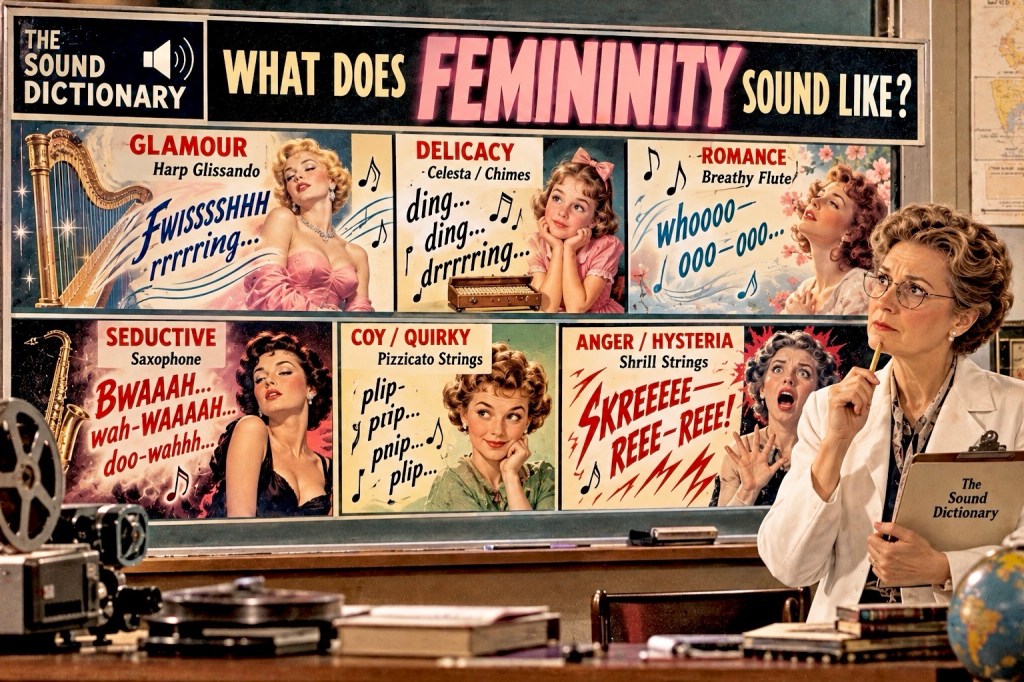
The list goes on:
Swelling strings: YOU ARE NOW REQUIRED TO FEEL SOMETHING.
Choir going “AAAAHHH”: Awe, revelation, heaven, outer space, or a new SUV.
Heartbeat bass pulse: Danger is approaching.
And finally the old standby:
Loon: Wilderness.
The remarkable thing is not that these associations exist. The remarkable thing is that you understood nearly every one of them.
No one formally taught you. There was no examination. Yet somewhere along the way you became fluent.
The modern world asks far too much of the human mind. There are billions of people, nearly two hundred countries, thousands of languages, innumerable cultures, subcultures, regions, traditions and identities, and everyone apparently expects you to know something about them.
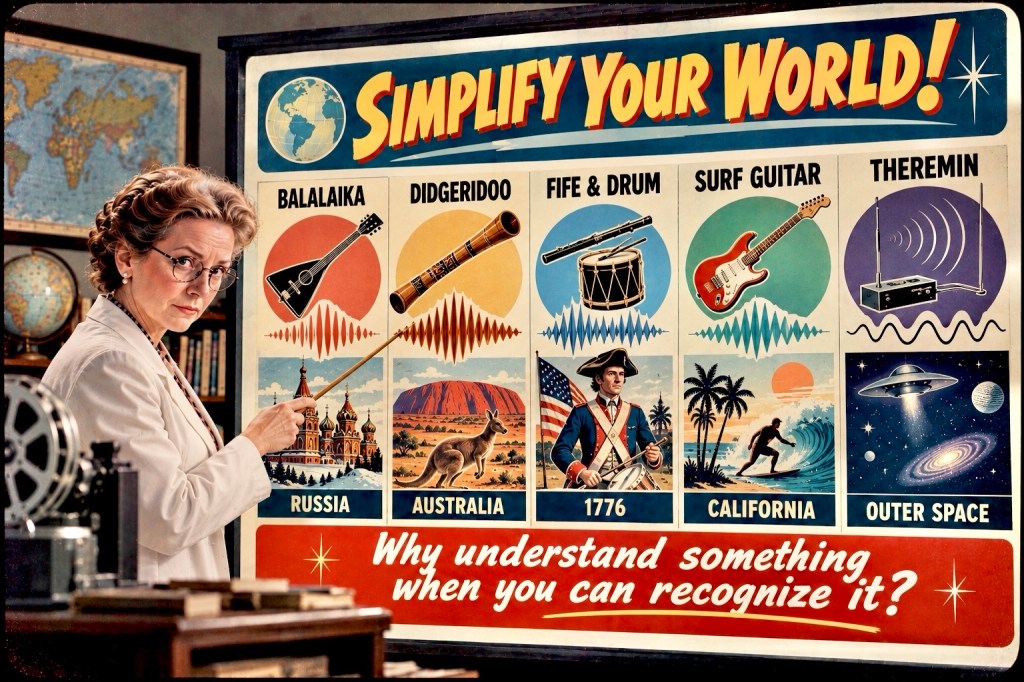
Fortunately, the Sound Dictionary continues to expand. A balalaika can get you to Russia remarkably quickly. Snow is strongly recommended.
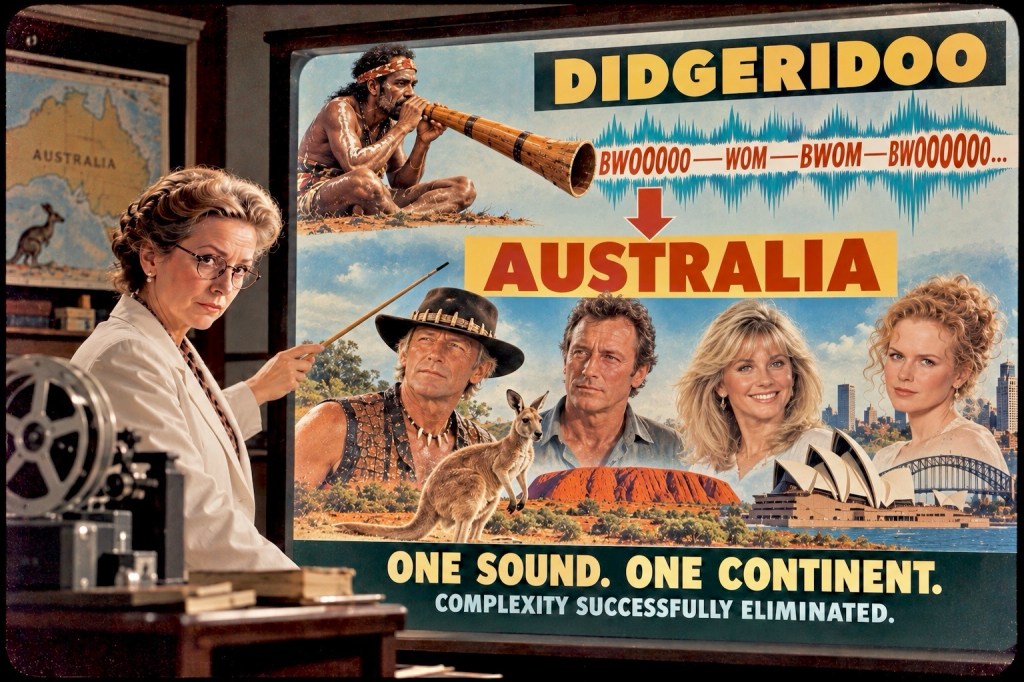
A fife and drum will take you directly to 1776. Tricorn hats should be nearby.
A few bars of surf guitar can transport an entire production to California without the inconvenience of purchasing airline tickets.
This is an important principle of mental hygiene. Complicated things produce complicated thoughts. Complicated thoughts produce uncertainty. Uncertainty produces anxiety.
The solution is:
LOGOIZATION.
A logo does not burden you with everything a thing is. It merely tells you what to recognize. And fortunately, we have begun applying this principle not merely to products, but to places, cultures, emotions and identities.
There is, however, an unfortunate complication. You cannot reduce something that was never there. A musical shorthand can work only if there is something recognizable behind it. An instrument can stand for a place only because generations of history, culture, memory and association have first connected that sound with that place. The symbol requires an identity before the identity can be compressed into a symbol.
This is mildly inconvenient. For in our admirable effort to simplify the world, we have accidentally demonstrated that the things we are simplifying exist in considerably greater complexity than the symbols we use for them.
The shorthand does not prove that identities are simple. It proves almost exactly the opposite. There had to be something complicated there before we could simplify it. And that brings us to the troublesome entry our Sound Dictionary neglected to include:
CLICHÉ.
The cliché does not create the identity.
It is what remains after most of the identity has been thrown away.
This may explain why the Sound Dictionary eventually becomes irritating.
The problem is not necessarily that its definitions are false. That would be easier.
The associations often began somewhere real. A particular instrument, musical tradition, landscape or sound genuinely belonged to a place or a people.
The trouble is that the shorthand is true just often enough to work. And because it works, we keep using it. Again. And again. Until an instrument becomes a logo. A culture becomes an instrument. An emotion becomes a chord progression. A landscape becomes a bird call. And this curious language does not stop with music.
A rooster crows:
MORNING.
Never mind that roosters have been known to express opinions at other hours.
An owl hoots:
NIGHT.
Cicadas begin:
HOT SUMMER AFTERNOON.
A seagull cries:
COAST.
A wolf howls:
REMOTE WILDERNESS, POSSIBLY DANGEROUS.
And somewhere across a perfectly respectable body of water comes that familiar mournful call:
LOON.
Yes, yes. We know. Wilderness. The loon has become one of the most overworked words in the entire Sound Dictionary.
At this point professional ethics require me to disclose that I am not opposed to all audio shorthand. Indeed, I believe I have discovered a legitimate therapeutic application. There is no reason the Council itself should be exempt.
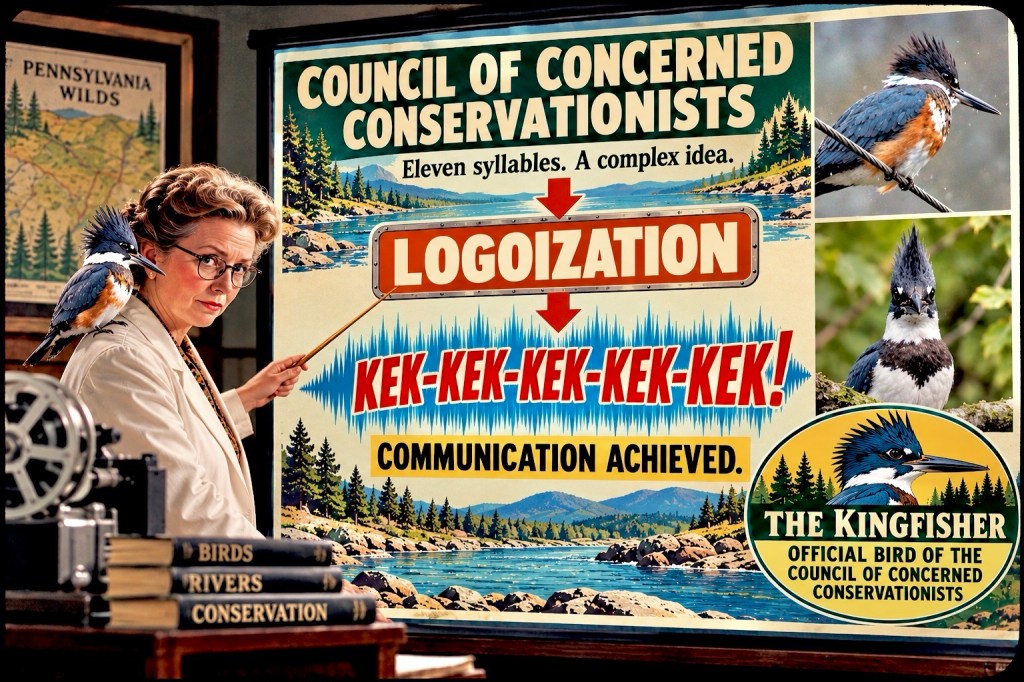
“Council of Concerned Conservationists” contains eleven syllables and, depending upon the speaker, can consume a substantial portion of the morning.
I therefore recommend that we adopt the call of the kingfisher as our official audio logo.
Its rapid, machine-gun staccato is distinctive, economical and already familiar around Council waters.
Henceforth the sound kingfisher makes:
Kek-kek—kek.kek.kek
shall mean:
COUNCIL OF CONCERNED CONSERVATIONISTS.
This will save approximately three seconds every time our name is spoken and, more importantly, relieve members of the unnecessary cognitive burden of remembering who we are.
The loon will naturally remain our symbol for WILDERNESS. It has seniority.
—Dr. Faye C. Schüß
POSTSCRIPT
After this piece was finished and published, I listened to the latest episode of Weird Studies, “Composing the Universe,” and discovered, to my considerable surprise, that it wandered through some remarkably similar territory concerning music, meaning, and the way we hear the world.
For the record: I had no idea what the episode was about when I wrote this. I heard it only after the story was published.
Apparently there are some ideas in the wild, too.


Leave a comment