—Mrs. Begonia Contretemps interviews the Backward Scholar
The Council recently received a memorandum from its Backward Scholar proposing an unusual remedy for the world’s political difficulties: instead of electing another government, perhaps we ought to elect another people.
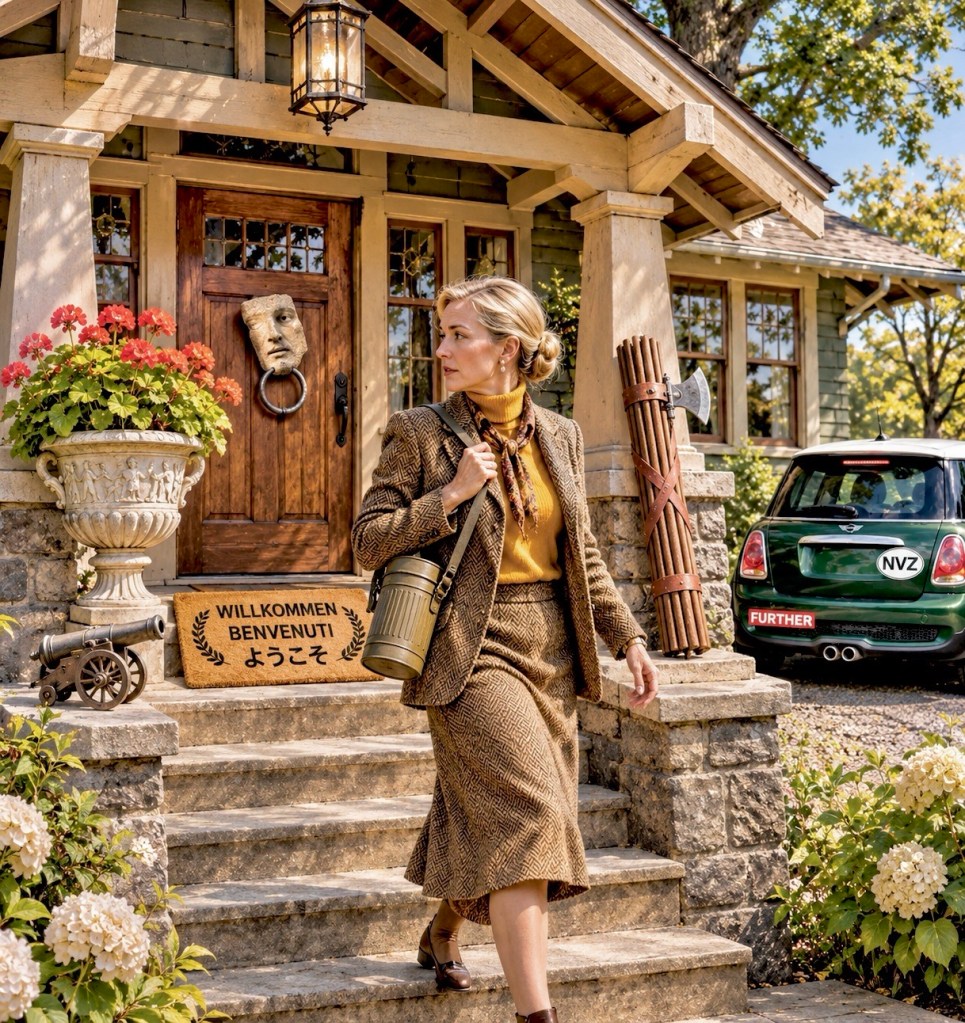
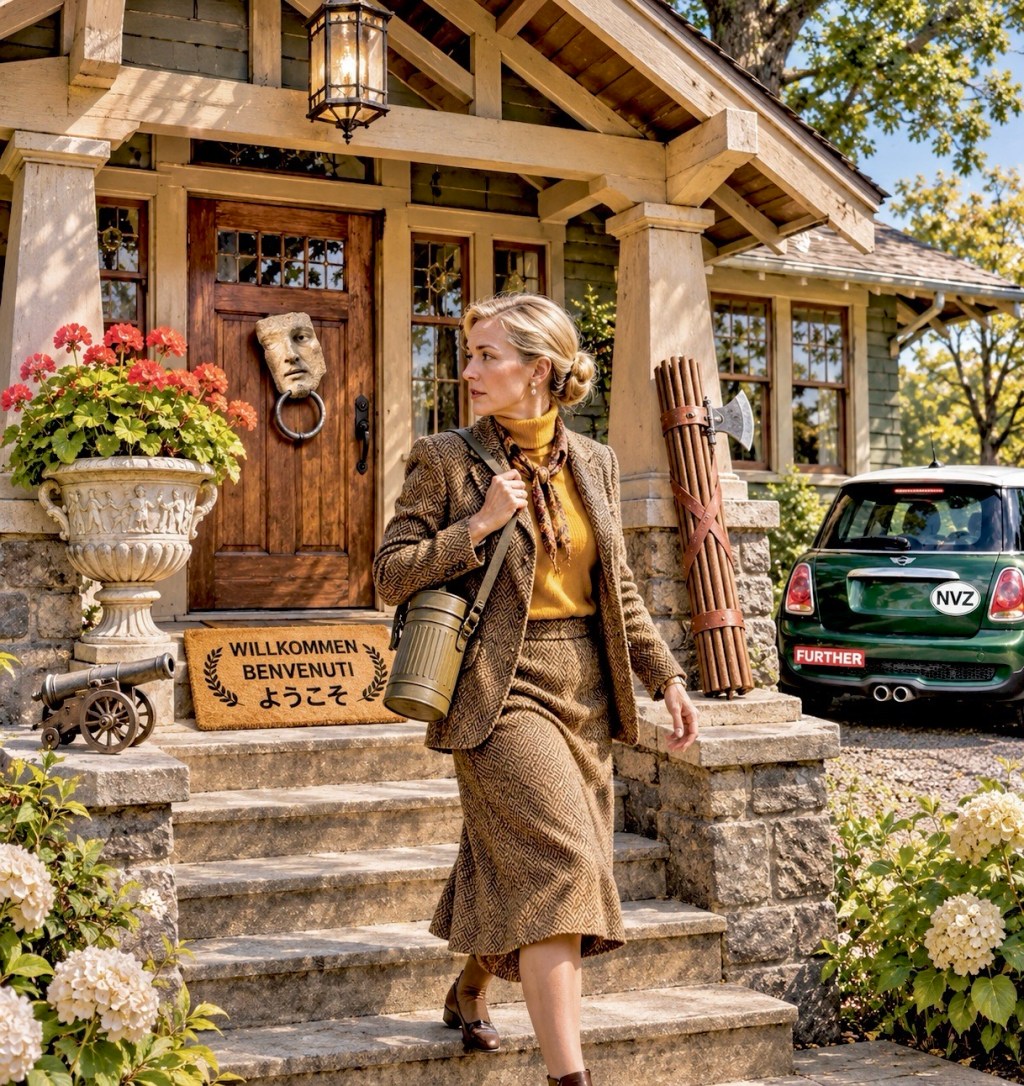
The Scholar declined an invitation to the Council offices, explaining that his reference library was at home. Mrs. Begonia accordingly called upon him at the modest residence he had inherited from his grandmother.
The editor dispatched Mrs. Begonia Contretemps to investigate.
MRS. BEGONIA: “Now, Professor, before we get into this business of electing a new people, what on earth prompted the idea?”
BACKWARD SCHOLAR: “A little girl skiing in North Korea.”

MRS. BEGONIA: “Good heavens. Was she any good?”
BACKWARD SCHOLAR: “Apparently. But her skiing was incidental. Her great-grandfather founded the regime, her grandfather succeeded him, her father presently rules, and she is being discussed as a possible successor. Four generations of one family in a workers’ paradise.”
MRS. BEGONIA: “Perhaps she’s simply following in the family business.”
BACKWARD SCHOLAR: “Precisely! And consider Communist China. There, too, the descendants of revolutionary leaders have occupied influential positions. They even have a name for them—princelings. The revolution abolishes the old aristocracy, and before long another aristocracy appears.”

MRS. BEGONIA: “So the revolution has succeeded in changing the ownership?”
BACKWARD SCHOLAR: “Without necessarily changing the merchandise.”
MRS. BEGONIA: “But surely the object of these revolutions was to establish a different form of government.”
BACKWARD SCHOLAR: “And there’s the difficulty. We spend centuries arguing about forms of government, as though the arrangement of offices and the wording of constitutions could somehow transform human nature. Yet someone always rises to the top. Even societies proclaiming equality discover that some comrades are considerably more equal than others.”
MRS. BEGONIA: “Or have better skiing instructors.”
The Scholar nodded approvingly.
BACKWARD SCHOLAR: “My old high school history teacher had something to say about all this.”
MRS. BEGONIA: “You studied German history?”
BACKWARD SCHOLAR: “No. He was a German.”
MRS. BEGONIA: “Oswald Spengler?”
BACKWARD SCHOLAR: “By correspondence, so to speak. He died before I was born.”
MRS. BEGONIA: “But wasn’t Spengler actually a schoolteacher?”
BACKWARD SCHOLAR: “Well yeah. He taught history, mathematics, and science in German secondary schools. I only read his quotes. Quite a funny guy at times in the tradition of Herman Melville.”
MRS. BEGONIA: “And did you receive a diploma?”
BACKWARD SCHOLAR: “No. But I did receive a rather pessimistic education.”
Mrs. Begonia was about to inquire further when something on the table caught her eye.
It was a ceramic piggy bank, decorated with little pink roses. Across its ample belly, in carefully painted lettering, appeared the inscription:
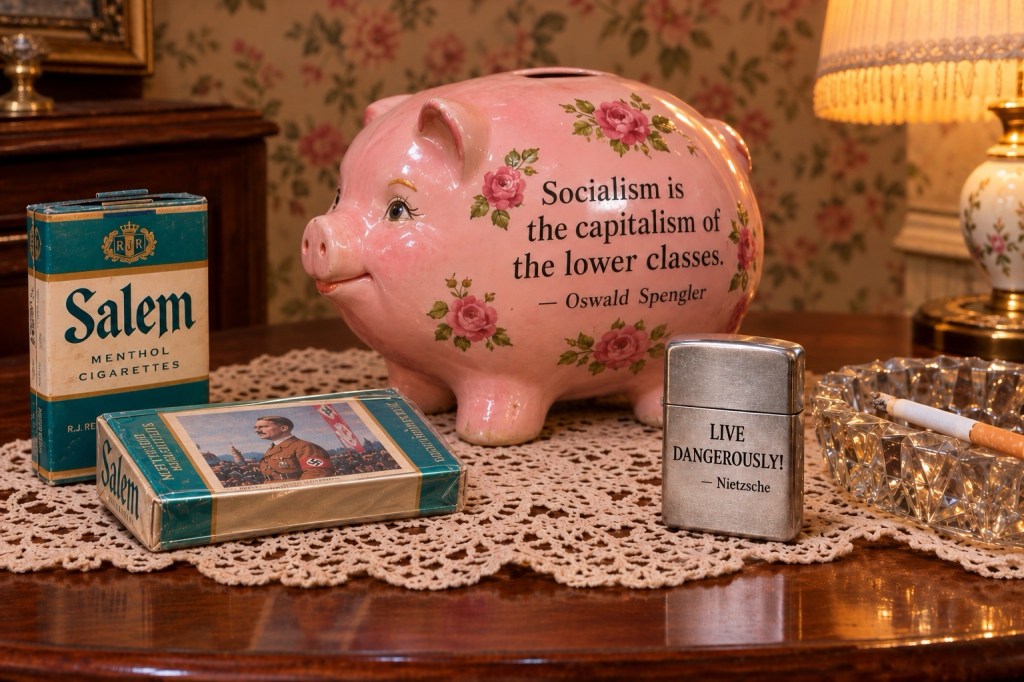
MRS. BEGONIA: “Good heavens! Is that part of your reference library?”
BACKWARD SCHOLAR: “Indeed. Grandmother’s.”
MRS. BEGONIA: “Your grandmother was a socialist?”
BACKWARD SCHOLAR: “Certainly not. She was a saver.”
Mrs. Begonia looked around the room. There were embroidered cushions, framed samplers, decorative plates, porcelain figurines, and several pieces of needlework bearing inscriptions of a decidedly unusual character.
MRS. BEGONIA: “I begin to see why you insisted upon conducting the interview at home.”
BACKWARD SCHOLAR: “All my principal references are here.”
MRS. BEGONIA: “And your books?”
BACKWARD SCHOLAR: “Those are mostly footnotes.”
He rose from his chair.
BACKWARD SCHOLAR: “Perhaps you’d care to see the rest of Grandmother’s collection.”
THE GRANDMOTHER’S COLLECTION
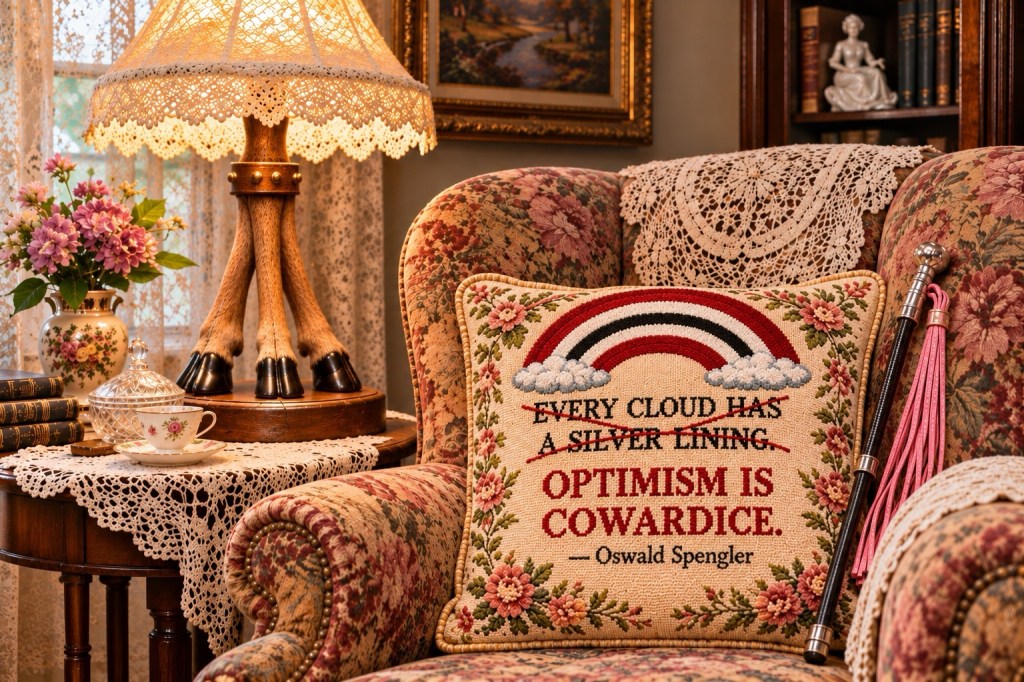
The Backward Scholar: “Not horses.”
MRS. BEGONIA: And, “Optimism is cowardice? Your grandmother embroidered that?”
BACKWARD SCHOLAR: “Indeed. She was an optimist for most of her life.”
MRS. BEGONIA: “What changed her mind?”
BACKWARD SCHOLAR: “She died.”
The Backward Scholar dusted a decorative porcelain figurine..
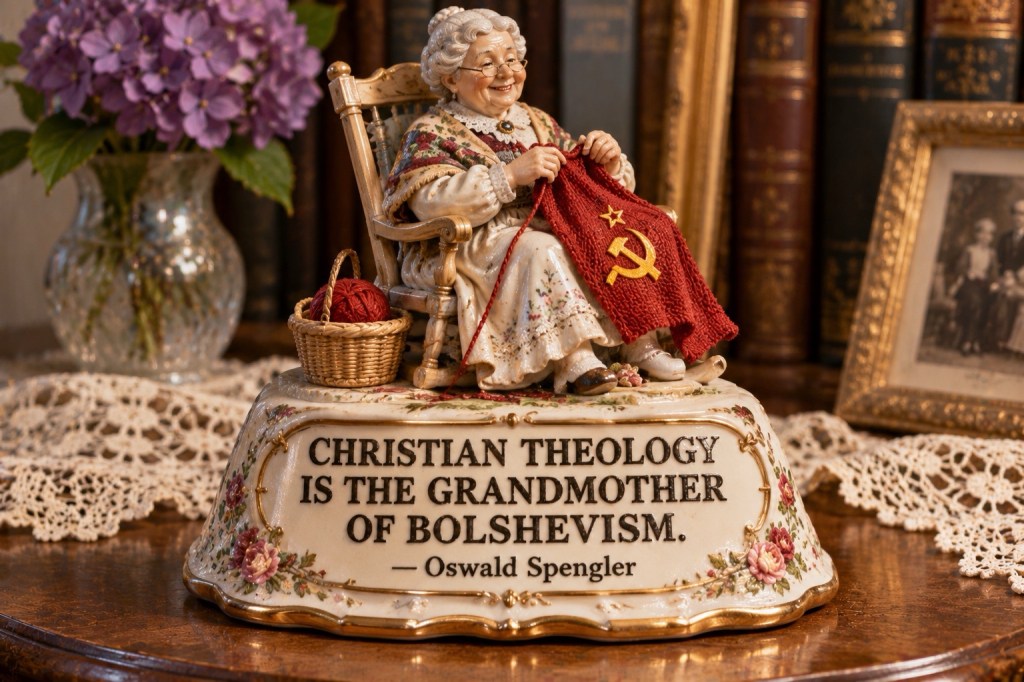
MRS. BEGONIA: “Another Spengler! Did your grandmother have something against Christianity. Was she a Bolshevik?”
BACKWARD SCHOLAR: “Certainly not. She was considerably more concerned about what the Bolsheviks did to grandmothers.”
MRS. BEGONIA: “Then why the quotation?”
BACKWARD SCHOLAR: “It interested her. You recall Mario Savio, the Berkeley free speech radical? When a reporter asked his father where the boy had acquired his revolutionary ideas, the father produced the book responsible.”
MRS. BEGONIA: “Marx?”
BACKWARD SCHOLAR: “The family Bible. Grandmother thought that was worth remembering, too, if only for the way some people use it.”
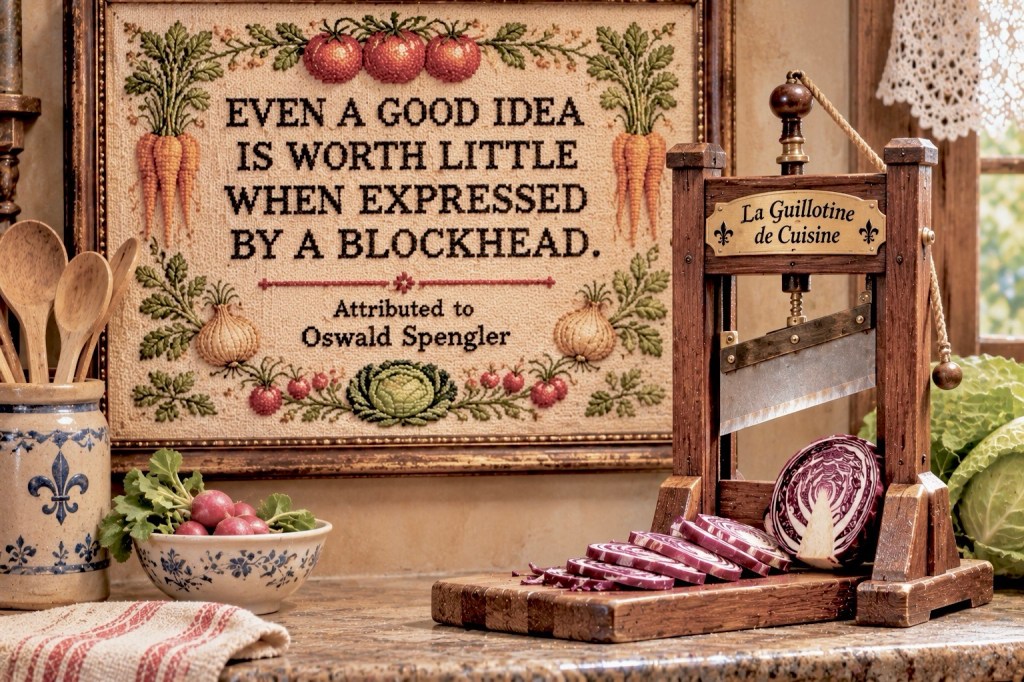
MRS. BEGONIA: “Was your grandmother referring to politicians as blockheads?”
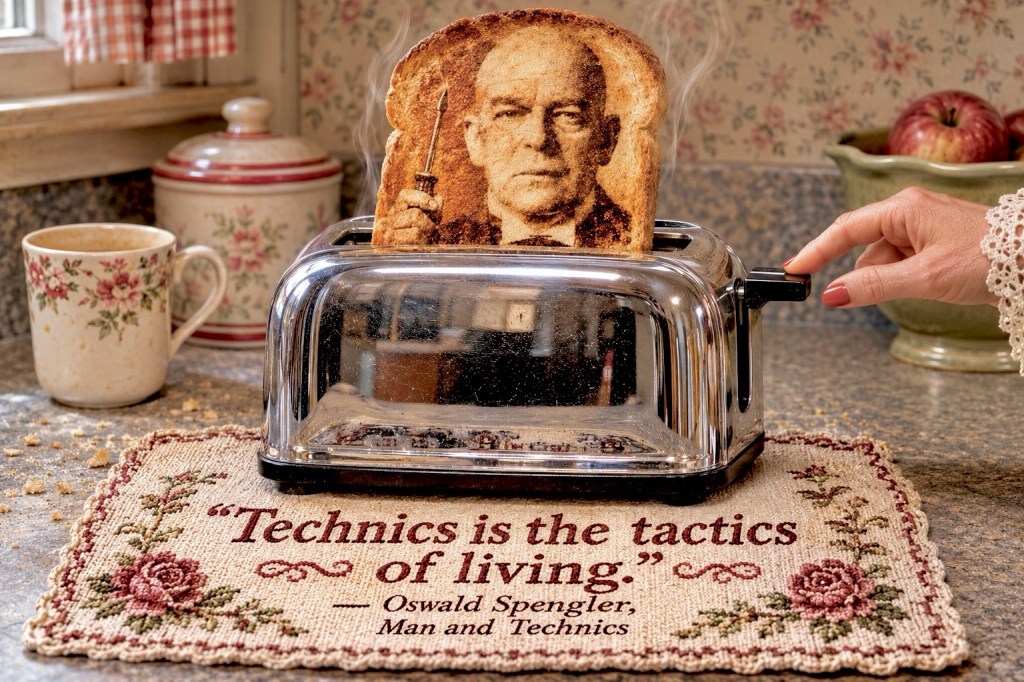
BACKWARD SCHOLAR: “Not exclusively. She hung that one after Grandfather repaired the toaster. It wasn’t the repair she objected to, but his method. He spread enough crumbs around the kitchen to suggest he’d dismantled a bakery. The toaster, incidentally, worked perfectly afterward.”
Further on in the kitchen a post-it note carried the inscription:
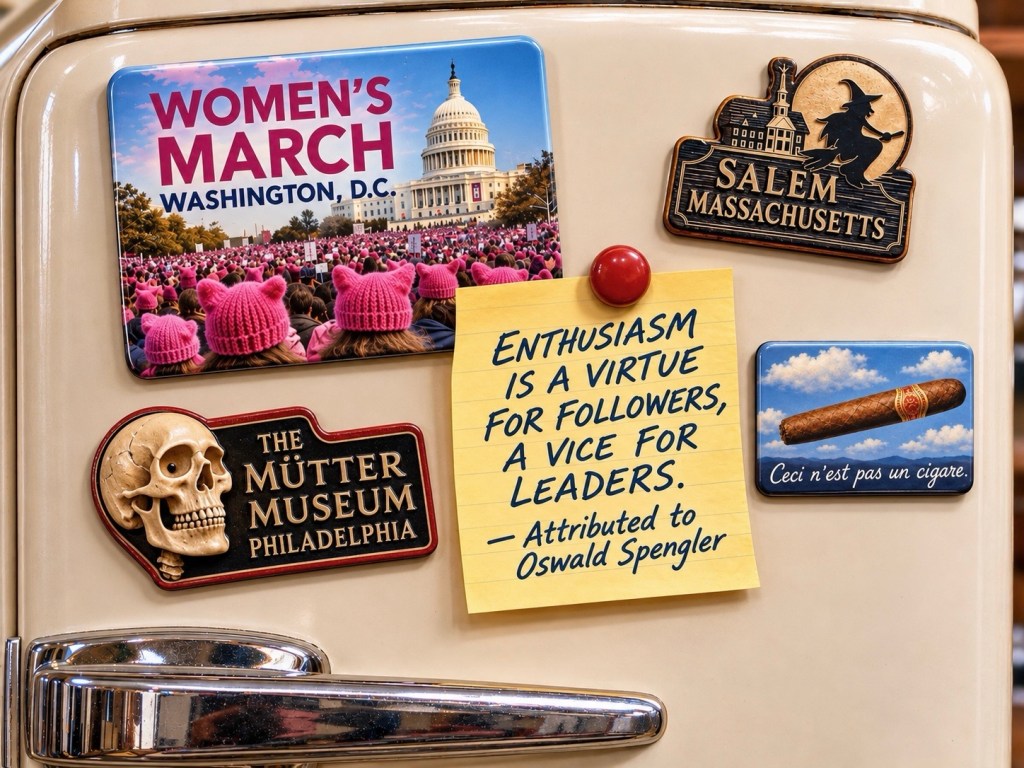
MRS. BEGONIA: “That seems rather severe.”
BACKWARD SCHOLAR: “Grandmother preferred a man who knew where he was going to one who was merely delighted to be going there.”
MRS. BEGONIA: “And did she apply that principle to Grandfather?”
BACKWARD SCHOLAR: “She generally supplied the directions.”
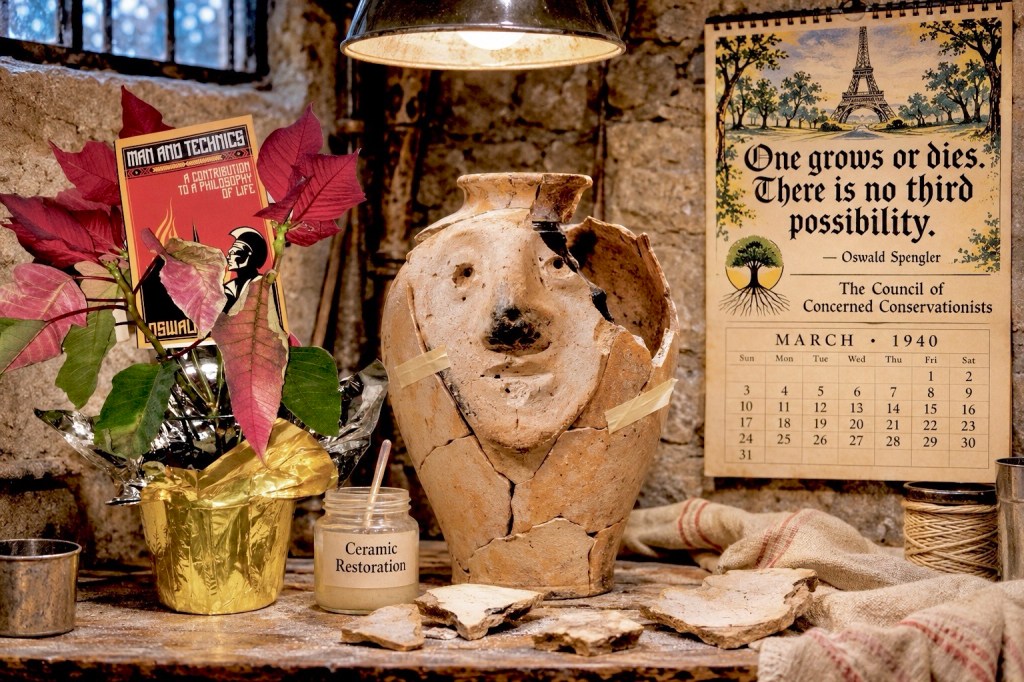
“Grandmother maintained a basement workshop, Mrs. Begonia. It was devoted to the preservation and reconstruction of things that had outlived their original purpose. She understood that what is broken is not necessarily finished, and that what survives may deserve another examination before being discarded. I suspect her interest extended well beyond pottery.”
THE TWO GERMANS
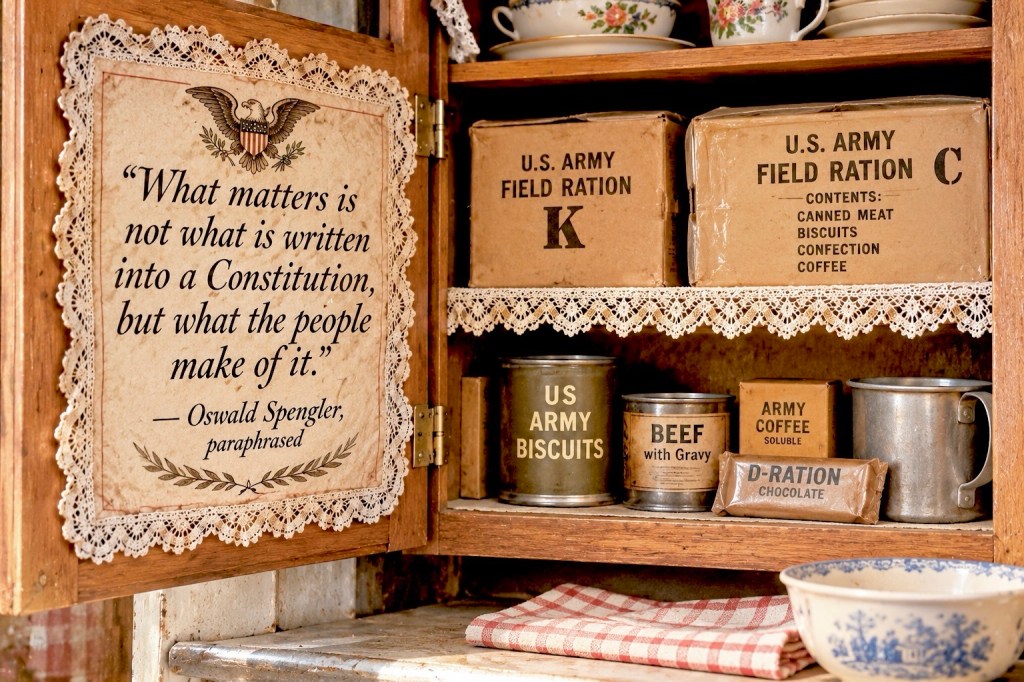
Mrs. Begonia opened Grandmother’s pantry cupboard and discovered an unusual assortment of American military K-rations and C-rations, apparently pilfered during the Second War. Affixed to the inside of the cupboard door was an elaborate, lace-bordered parchment, its lettering modeled on the United States Constitution. It bore a saying attributed to Spengler :
Beside the pantry stood Grandmother’s old cream-colored enamel pedal trashcan, decorated with a patriotic eagle and a rather unexpected quotation from Bertolt Brecht:
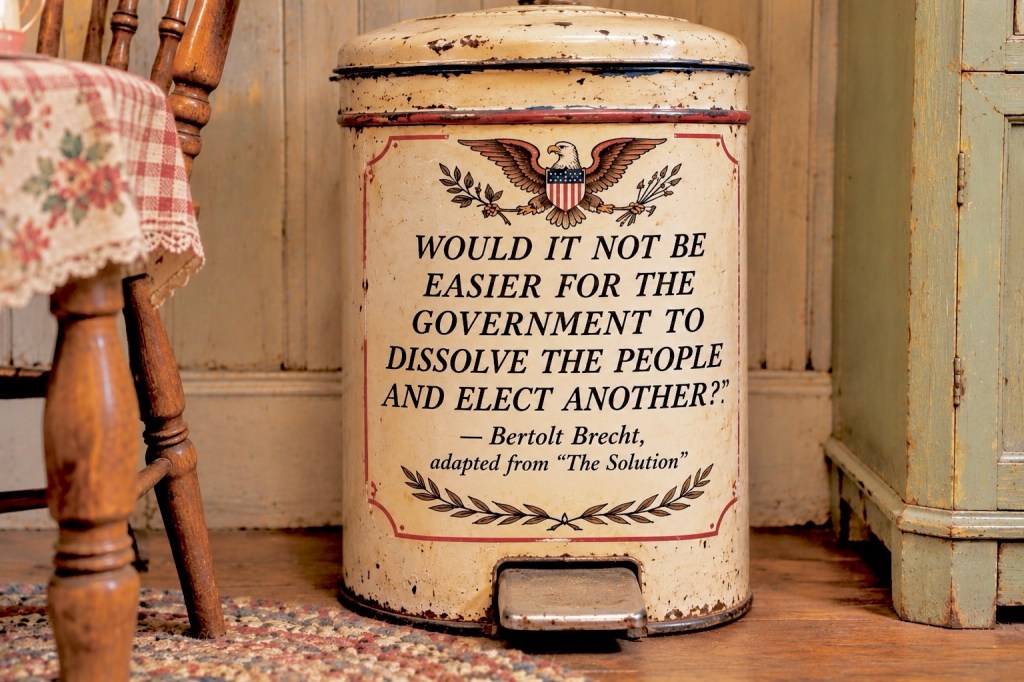
MRS. BEGONIA: “Spengler and Brecht? In the same kitchen? Surely your grandmother knew they were political opposites.”
BACKWARD SCHOLAR: “Of course. She arranged them that way deliberately.”
MRS. BEGONIA: “Whatever for?”
BACKWARD SCHOLAR: “She believed that if two Germans of such different political persuasions arrived at the same difficulty, it might be worth investigating.”
MRS. BEGONIA: “And what difficulty was that?”
BACKWARD SCHOLAR: “The people.”
MRS. BEGONIA: “But Brecht was a Marxist!”
BACKWARD SCHOLAR: “Indeed.”
MRS. BEGONIA: “And your grandmother admired him?”
BACKWARD SCHOLAR: “Only that once.”
Mrs. Begonia studied the two embroideries again.
MRS. BEGONIA: “But Brecht was mocking the East German government for its dissatisfaction with the people. You’re proposing that the people themselves be replaced.”
BACKWARD SCHOLAR: “Quite so. Grandmother considered it an interesting reversal.”
MRS. BEGONIA: “And what about Spengler?”
BACKWARD SCHOLAR: “He supplies the difficulty with constitutional reform. You may write whatever you please into a constitution, but the people who live under it will make something of it according to their own character.”
MRS. BEGONIA: “Then perhaps we ought to improve the people rather than replace them.”
BACKWARD SCHOLAR: “An excellent suggestion. Grandmother tried that with Grandfather.”
MRS. BEGONIA: “Was she successful?”
BACKWARD SCHOLAR: “She eventually took up embroidery. But Grandmother and Grandfather remained loyal to one another to the very end. Rather like that Roman sentry at Pompeii, who stood his post while Vesuvius erupted because nobody had relieved him. Neither ever deserted the other, despite the occasional burnt offering and the considerable accumulation of ashes and crumbs.”
THE ELECTORAL PROBLEM
Mrs. Begonia returned to her chair.
MRS. BEGONIA: “Then let us return to your memorandum. What exactly do you mean by electing a new people?”
BACKWARD SCHOLAR: “We have devoted extraordinary attention to the machinery of government. Monarchies, republics, democracies, socialist states, constitutional arrangements of every imaginable description. Yet all require human beings to operate them.”
MRS. BEGONIA: “A regrettable necessity.”
BACKWARD SCHOLAR: “And perhaps we’ve mistaken the machinery for the operator. Different peoples may develop different political traditions. But whatever the arrangement, someone must exercise authority. The question is whether that person possesses the character to exercise it well.”
MRS. BEGONIA: “And you propose to find such people through an election?”
BACKWARD SCHOLAR: “That was my original thought.”
MRS. BEGONIA: “Who would be eligible?”
BACKWARD SCHOLAR: “Persons of virtue, judgment, courage, and a proper sense of responsibility.”
MRS. BEGONIA: “Who determines whether they possess those qualities?”
BACKWARD SCHOLAR: “An electoral commission.”
MRS. BEGONIA: “Appointed by whom?”
BACKWARD SCHOLAR: “The existing people.”
Mrs. Begonia stared at him.
MRS. BEGONIA: “Professor, haven’t we returned to the very difficulty we began with?”
BACKWARD SCHOLAR: “Yes. Grandmother would have called that progress. We’ve identified the difficulty twice.”
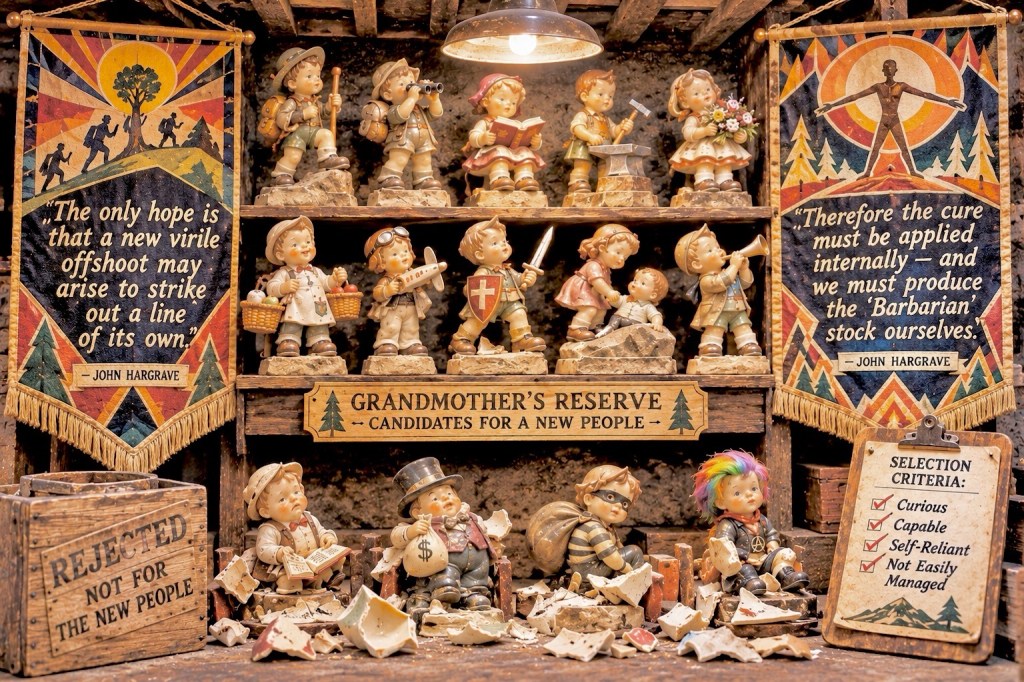
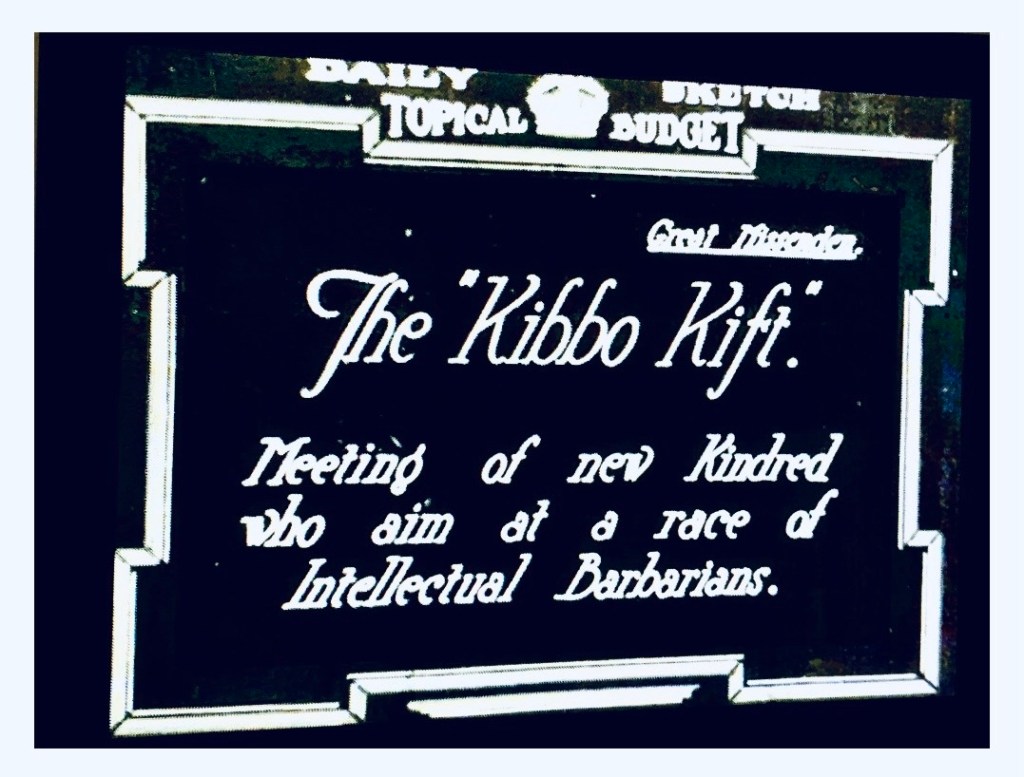
MRS. BEGONIA: “Those two banners bear quotations from John Hargrave, founder of the Kindred of the Kibbo Kift! Why, Mr. Scholar, they’re practically cousins of the NVZ! John Hargrave’s extraordinary experiment in bohemian conservatism. Woodcraft, ancient ritual, modernist art, and the regeneration of civilization. A thoroughly British way of going about it, naturally.”
BACKWARD SCHOLAR: “Grandmother recognized the family resemblance. She admired Hargrave’s ambitions, particularly his belief that civilization could no longer rely upon invading barbarians to sweep away the old order. Modern civilization had left no such outsiders, so we would have to produce our own. Grandmother evidently took this as a practical suggestion, though she preferred to begin on a smaller scale. She was assembling a civilization, Mrs. Contretemps, one porcelain citizen at a time. Those on the floor apparently failed the entrance examination.”
THE ORIGINAL BACKWARD SCHOLAR
Mrs. Begonia glanced around the parlor once more.
MRS. BEGONIA: “Tell me, Professor, did you inherit all your political opinions from your grandmother?”
BACKWARD SCHOLAR: “Certainly not. I arrived at them independently.”
MRS. BEGONIA: “And discovered she had anticipated you?”
BACKWARD SCHOLAR: “Rather irritating, actually.”
MRS. BEGONIA: “Did she read all these philosophers?”
BACKWARD SCHOLAR: “She was familiar with some of them. But she didn’t consider it necessary to wait for a philosopher before forming an opinion.”
MRS. BEGONIA: “And when she discovered one who agreed with her?”
BACKWARD SCHOLAR: “She embroidered him.”
MRS. BEGONIA: “So your celebrated scholarly method—arriving at the conclusion first and discovering the footnotes afterward—was actually your grandmother’s?”
BACKWARD SCHOLAR: “I prefer to say that we reached the same methodological conclusions independently.”
MRS. BEGONIA: “And she got there first?”
BACKWARD SCHOLAR: “She had a considerable head start.”


Leave a Reply