—A Words In The Wild investigation assigned to Mrs. Begonia Contretemps
A Note from the Editor:
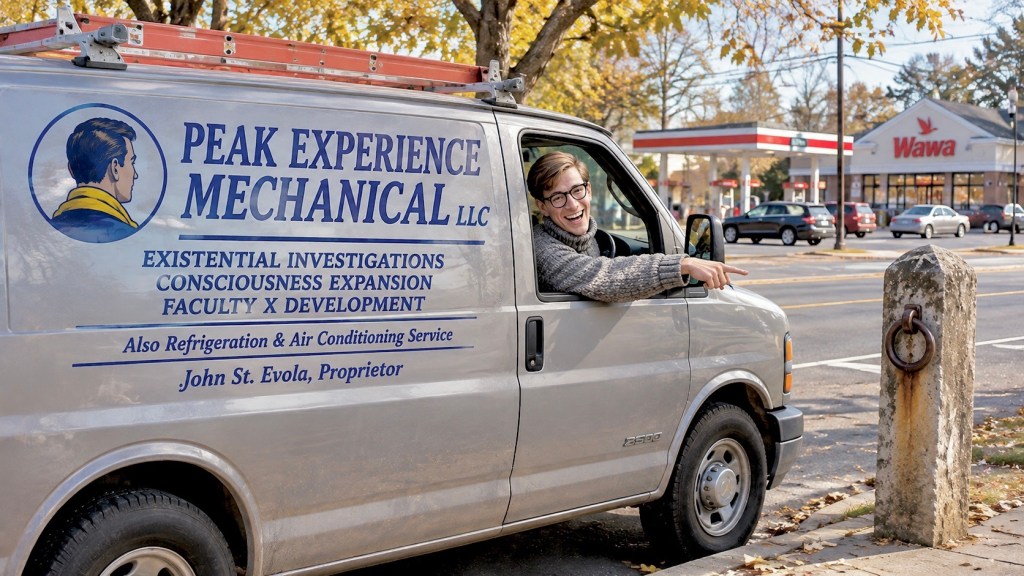
During my years traveling the roads of central New Jersey as a refrigeration service technician, I developed an affection for the remnants of its earliest European settlements. It was, in part, a means of escaping the modern New Jersey in which I found myself trudging and struggling during my working days.
I had immersed myself in books about precolonial and colonial New Jersey, particularly the history of the very towns and countryside through which my work took me. Armed with that knowledge, I could travel through an entirely different landscape from the one visible through my windshield.
An old stone foundation glimpsed through the trees, or more often still supporting a modern structure that had been remodeled beyond recognition, could transport me backward several centuries.
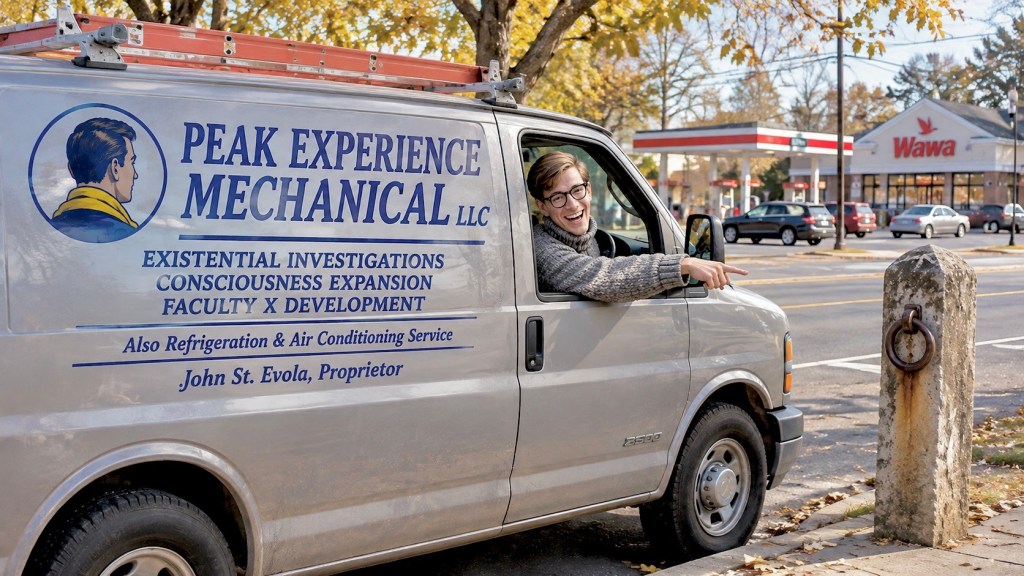
Now picture, if you will, the old cemeteries, their weathered gravestones preserving names and dates from another world. And the surviving colonial-era buildings, not nearly so uncommon as one might imagine, standing amid the developments, shopping centers, and traffic of modern New Jersey.
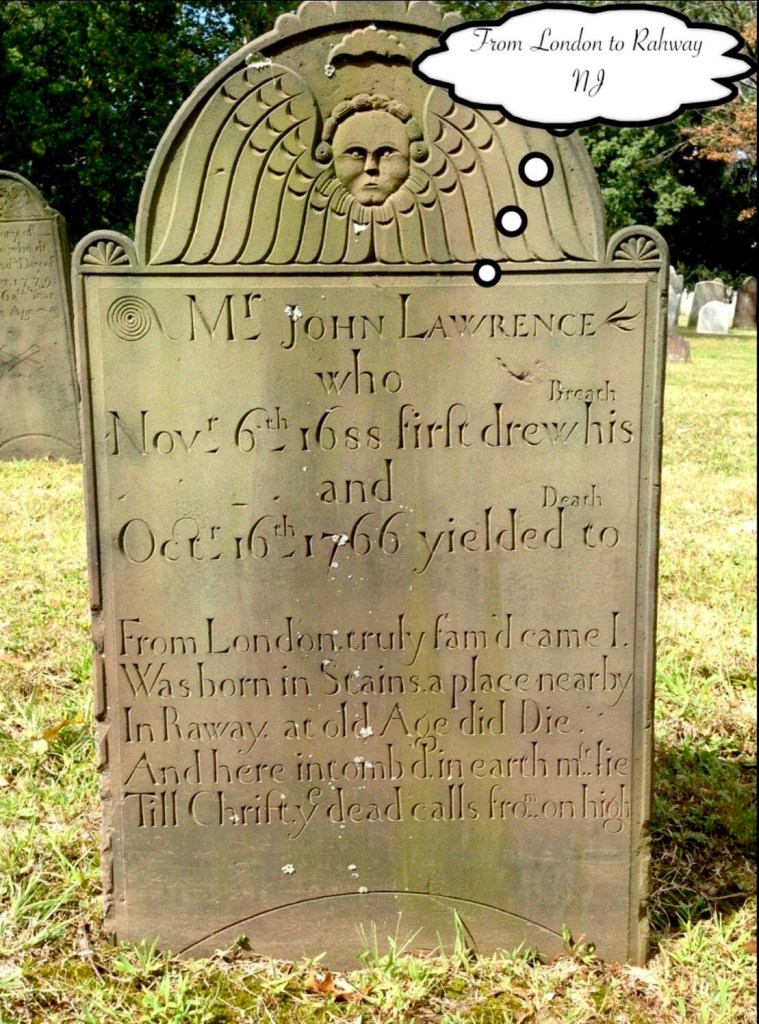
We haven’t altered this photograph, but what if we had? After all, these images are merely pixels passing through time, and as Heraclitus might have observed, you cannot step into the same stream of pixels twice. Even eternity, it seems, is subject to a software update.
These remnants provided a welcome escape. I could look past the present and imagine the people who had inhabited those places long before the highways and subdivisions arrived.
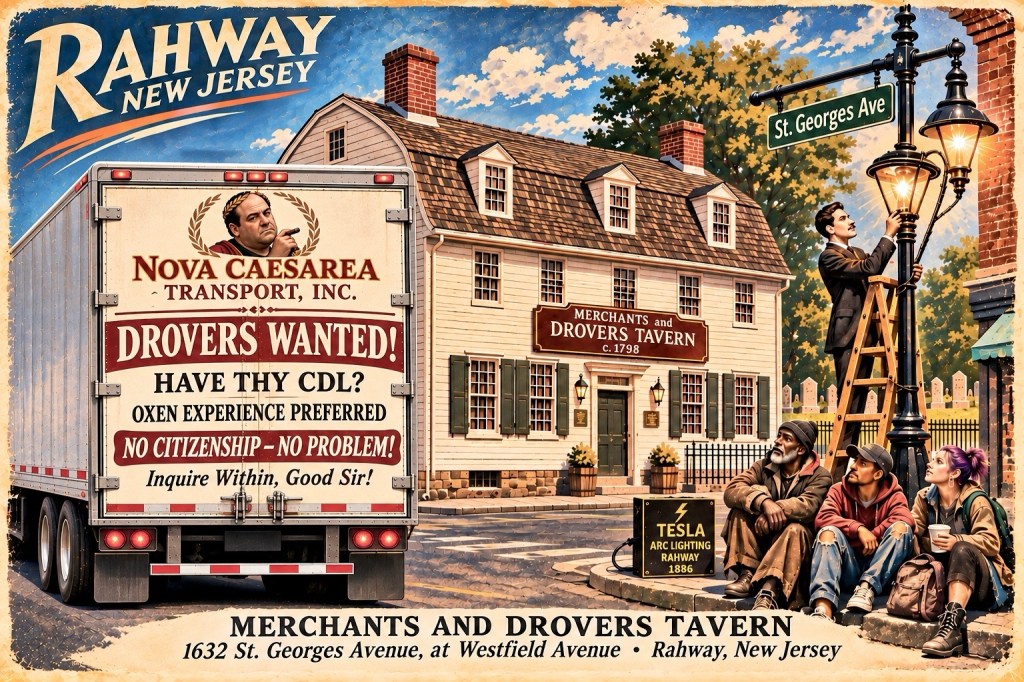
Consequently, even an ordinary road sign could set my imagination wandering.
One such sign was Goodman’s Crossing, in Scotch Plains.
I don’t know whether the road was named for an early settler or some fellow named Goodman who came along much later. But the name always caught my attention because Goodman was a word I recognized from my reading.
It sounded as though it belonged to another century.
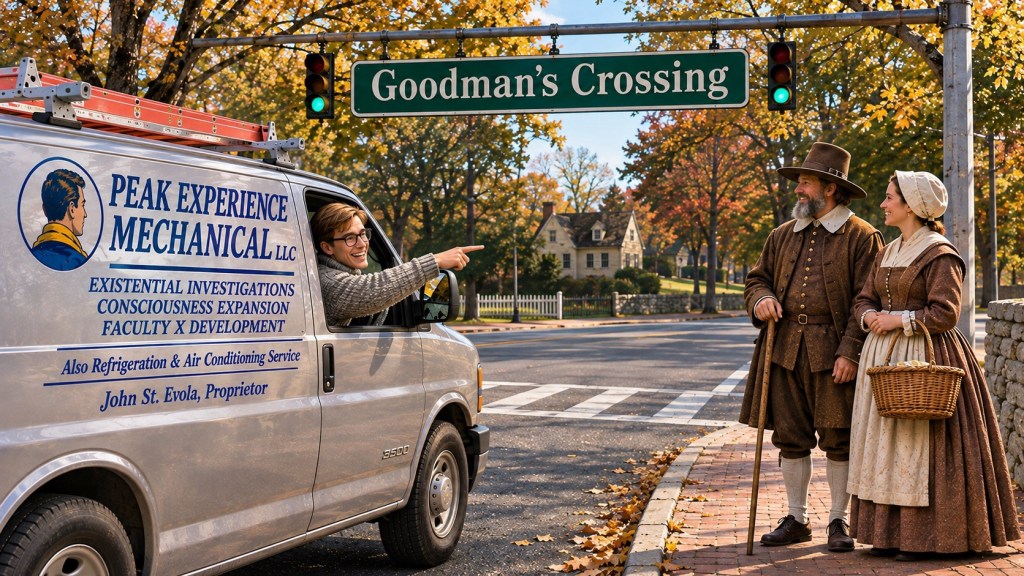
And there were other names.
Galloping Hill Road, for example. The British troops marched through that part of New Jersey during the Revolution, and the road itself figures in accounts of the fighting around Springfield in 1780.
Then there was Gallows Hill Road, in the Cranford-Westfield area. Now there’s a name that ought to make somebody curious!
There were stories of hangings associated with that hill, and at least one documented execution following the murder of the Reverend James Caldwell, the Revolutionary War chaplain.
Caldwell himself had been shot by an American sentry named James Morgan in 1781. Morgan was subsequently tried, convicted, and hanged.
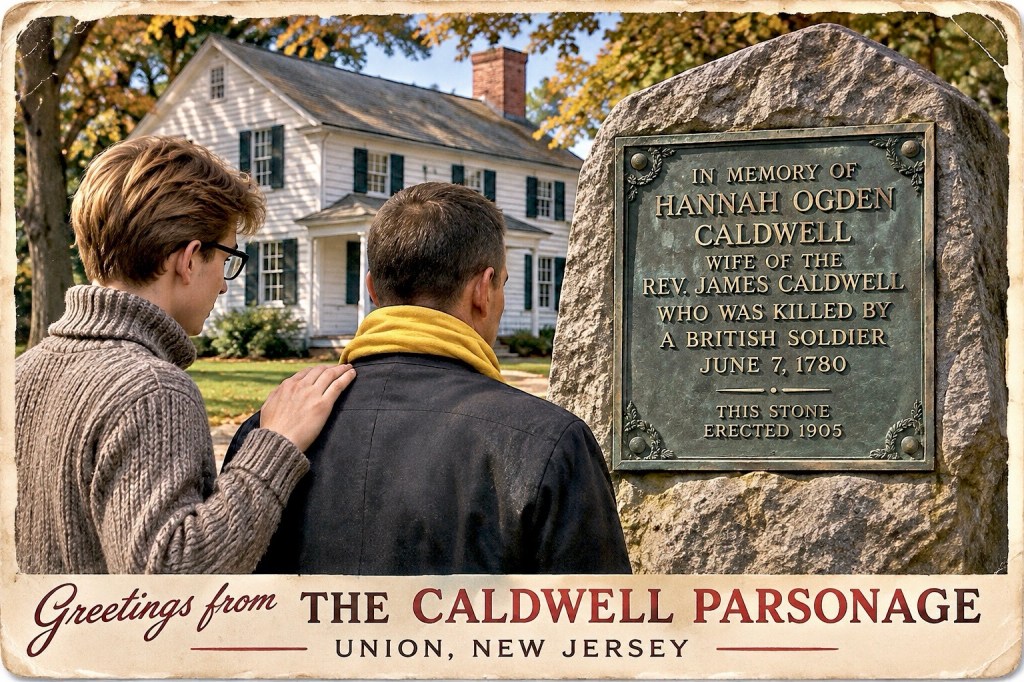
And here’s something else. Caldwell’s wife, Hannah, had been killed by a British soldier the previous year.
Imagine that poor family!
There’s a stone monument commemorating her death at the old Caldwell Parsonage site in Union. It was one of those historical places that could be passed a thousand times without most motorists having the slightest idea what happened there.
And then there were historical markers standing in the most improbable places.
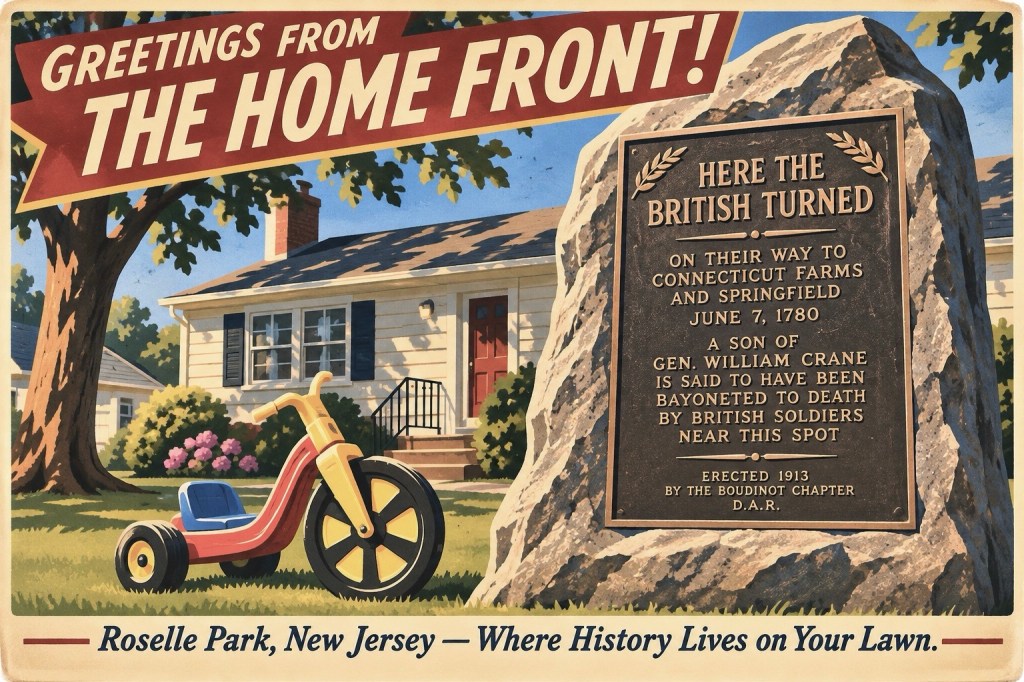
I remember one in particular, somewhere in central New Jersey, along a busy road lined with suburban houses. It was a substantial stone monument commemorating a man who had been killed at or near that very spot during the American Revolution.
I actually pulled over during one of my service calls to read the inscription.
What fascinated me almost as much as the event itself was the monument’s location.
It stood on somebody’s freaking front lawn!
There was an ordinary suburban house behind it, and I wondered whether the monument had been there long before the house was built. Perhaps the builders had simply worked around it.
Here was a reminder of a violent episode in American history, apparently incorporated into somebody’s landscaping.
I have long since forgotten the name on the stone and even the precise location, but I have never forgotten the incongruity.
I wondered whether the homeowners ever gave the matter a thought, or whether they simply mowed around it.
But back to Goodman’s Crossing.
As I said, the name reminded me of those old forms of address that appeared in the books I was reading.
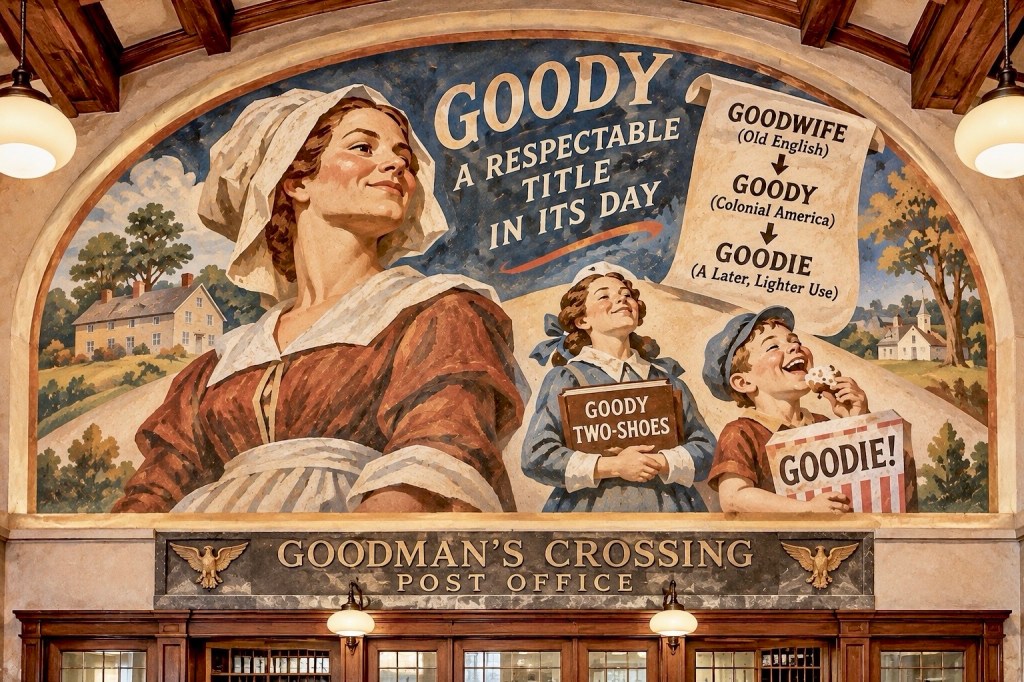
There was Goodman, and there was Goodwife, frequently shortened to Goody.
These weren’t titles reserved for the wealthy or the aristocracy. They were ordinary forms of respectful address, particularly for married householders of modest standing.
A man might be known as Goodman Smith, and his wife as Goody Smith.
Now think about that.
A society that used Goodman and Goodwife as titles of respect must have considered those positions worthy of respect. The words themselves tell us something about what people valued.
Of course, being called Goodman didn’t mean the fellow was necessarily good. He might have been a miserable character for all we know. And I suppose there were a few Goodwives who weren’t particularly good either. But that’s beside the point.
The titles were respectable. And I think that says something about the society they lived in. Being a good husband or a good wife was something to be respected.
It was a good thing!
I was reminded of all this recently while reading a review of the new film Wicker, which takes place in a fanciful medieval village where women are frequently identified through their husbands’ occupations.
The film concerns a woman who commissions a husband made of wicker.
I haven’t seen it yet. Apparently, the fellow turns out to be a rather satisfactory husband, although I have some reservations about the idea of a man being manufactured to meet a woman’s specifications.
I suppose one advantage is that he wouldn’t leave his socks lying around.
On the other hand, I wouldn’t care to be a husband whose wife could threaten to throw him on the fire. But wait a minute. Considering the way our laws are written nowadays, haven’t we simply dispensed with the fire?
But I digress.
Now, where was I? Oh yes. Goody.
The word turns up repeatedly in accounts of the Salem witch trials. Goody Nurse, Goody Proctor, and others.
These women weren’t called Goody because somebody suspected them of witchcraft. It was simply a conventional form of address. But the title gradually disappeared from ordinary usage.
And what do we have today?
Goody Two-Shoes!
Goody-goody!
Neither expression is generally intended as a compliment.
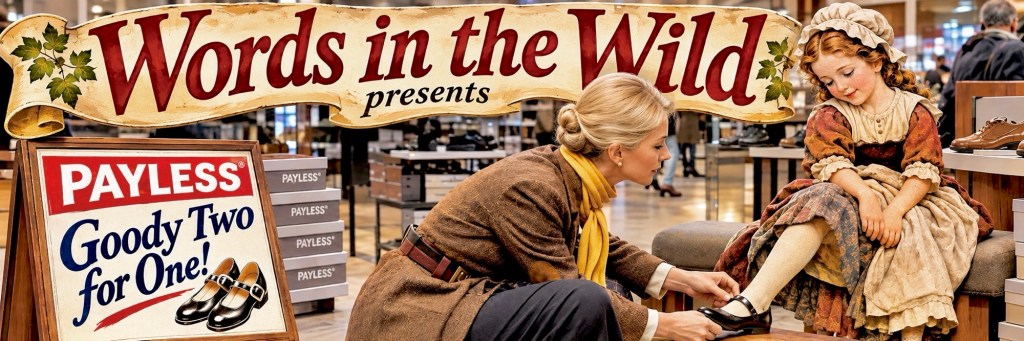
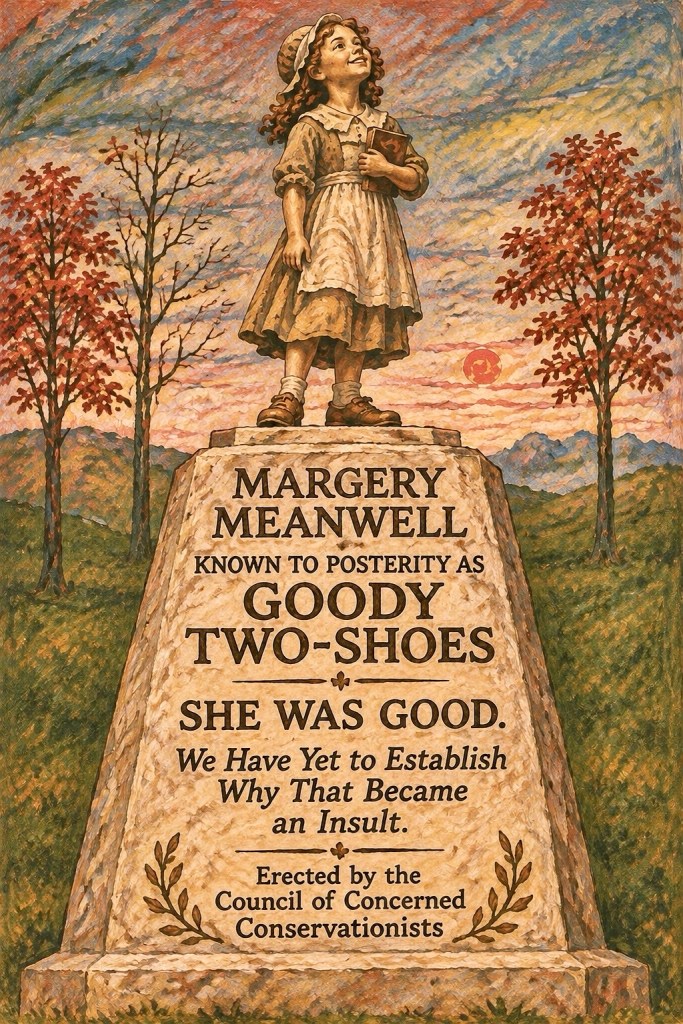
And here’s something else. The original Goody Two-Shoes was a poor little girl in an eighteenth-century children’s story who had only one shoe. When she finally received a second shoe, she was so delighted that she acquired the nickname.
Her name was Margery Meanwell. She went on to become educated and prosperous through industry and good conduct.
Imagine that! A children’s story in which goodness, education, and hard work were actually rewarded.
And somehow her name eventually became an insult.
How the heck did that happen?
Now, I’m not suggesting that every use of goody has the same origin. The English language is more complicated than that.
But isn’t it interesting that we once had respectable titles such as Goodman and Goodwife, while today we can call somebody a goody-goody and everyone understands that we’re making fun of them?
We’ve managed to take something that was once admirable and turn it into something to be embarrassed about.
I suppose that’s what they call progress.
Remember George Costanza on Seinfeld?
“You know, we’re living in a society!”
Well, George, sometimes I wonder.
And perhaps that’s what bothers me about the disappearance of these old words. Not that everybody ought to go around calling his neighbor Goodman or his wife Goody. That would be ridiculous. Although I rather like the sound of it.
It’s the idea that being a respectable husband or wife was once important enough to be acknowledged in the way people addressed one another.
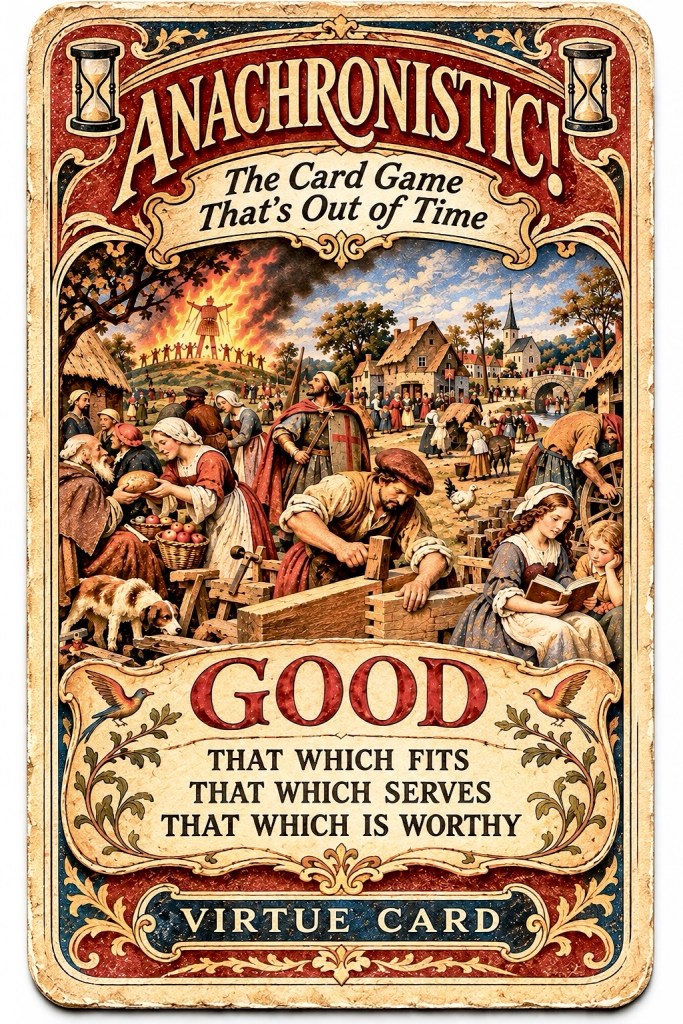
And now we have a culture in which even being conspicuously good can get you laughed at.
I don’t know. Maybe I’m making too much of it.
Anyway, this whole business began with my recollection of Goodman’s Crossing, which brings me back to the reason for this article.
Since the word Goodwife originated in England, and since Mrs. Begonia Contretemps is herself British, I thought she would be the ideal person to investigate the history of Goody, its various meanings, and what happened to it over the centuries.
I’ve therefore assigned her the word GOODIE for this installment of Words in the Wild.
I believe I’ve provided enough background for her to get started.
— John St. Evola, Editor
Mrs. Begonia Contretemps Reports:
“I should be delighted to investigate the matter, John, if you would be so good as to leave me something to investigate.”
FURTHER.
The complete list of WORDS IN THE WILD can be found : HERE


Leave a Reply