—An Investigation into the Geography of Longing
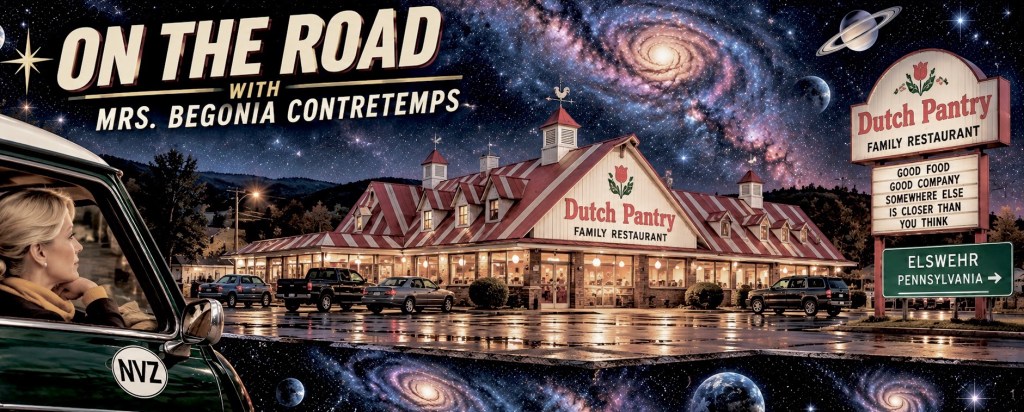
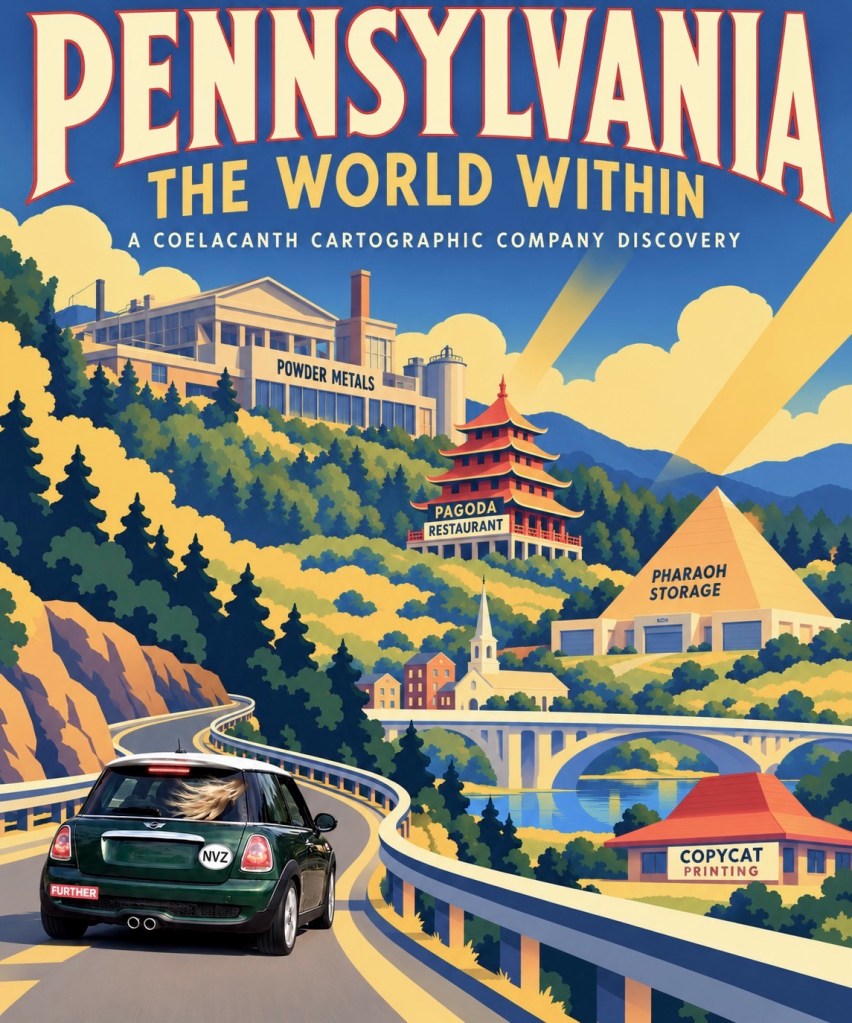
Mrs. Begonia Contretemps, experiencing another of her periodic bouts of homesickness, took her green Mini on an aimless drive through Pennsylvania. What began as an attempt to relieve her longing for the Old World resulted in an unexpected discovery concerning the geographical ambitions of the Commonwealth. She subsequently reported her findings to René Séance, her superior at the NVZ.
Parking Lot, Olympia Shopping Center
Versailles, Pennsylvania
October 22, 2026
289 years and 33 days after the Walking Purchase—Pennsylvania’s first land-acquisition marathon.
Dear René,
I must confess to another bout of homesickness, although you will be pleased to learn that it has not yet resulted in my return to Britain. Instead, I took the Mini for a leisurely drive through Pennsylvania, hoping to find something reminiscent of the historical and geographical richness of Europe.
I found the ruins of America’s industrial empire readily enough. Abandoned mills, rusting furnaces, and derelict factories are scattered across the landscape, although the inhabitants seem rather less enthusiastic about them than a visiting European in search of antiquity.
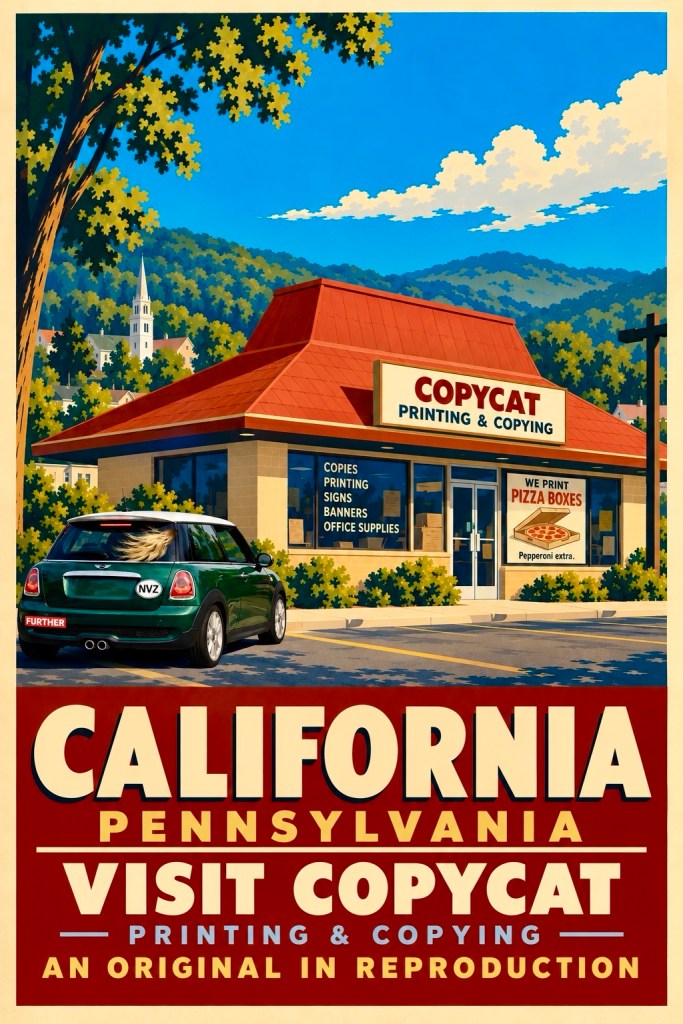
But it was in California that I made my most interesting discovery.
California, Pennsylvania, I hasten to add.
There I encountered a copy shop called Copycat, occupying a building unmistakably first constructed as a Pizza Hut. A copy shop in a standardized building whose design had been copied thousands of times, situated in a town named after somewhere else.
It occurred to me that the copying of California might be a rather more ambitious undertaking than the copying of a pizza restaurant.
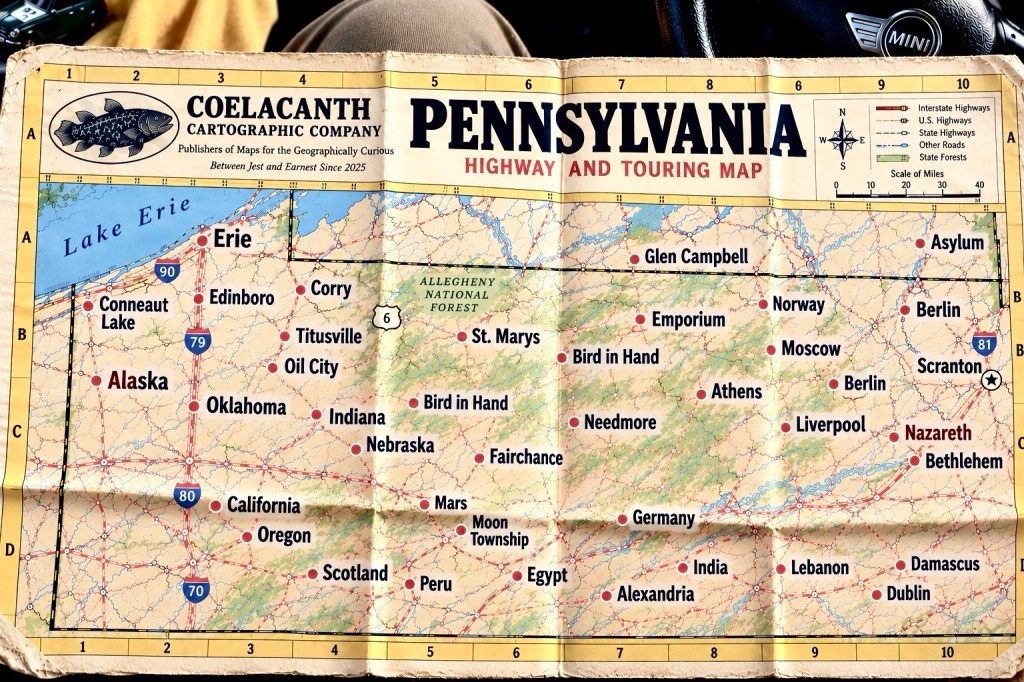
I consulted my map.
Pennsylvania, it appeared, had been helping itself to the names of other places for quite some time.
The American collection of Pennsylvania communities alone was impressive:
California, Indiana, Nebraska, Oklahoma, Oregon, and Alaska
Having settled in Pennsylvania, the inhabitants apparently saw no reason to deprive themselves of the rest of the United States.
Nor had Europe escaped their attention. There were Pennsylvania localities named :
Berlin, Moscow, Athens, Rome, Liverpool, Dublin, Scotland, Norway, and Germany.
One might have expected the occasional European town, René, but entire countries seemed rather extravagant.
The ancient and biblical world was equally well represented among the Commonwealth’s settlements:
Egypt, Alexandria, Lebanon, Bethlehem, Nazareth, and Damascus.
Beyond these lay Pennsylvania’s own
Mexico, Peru, India, and Japan.
— The Council’s LLM Wrangler
I was particularly taken with Mexico, Pennsylvania. The prospect of encountering Mexico without leaving the Commonwealth seemed an economical alternative to international travel, although I suspected the local climate might prove disappointing.
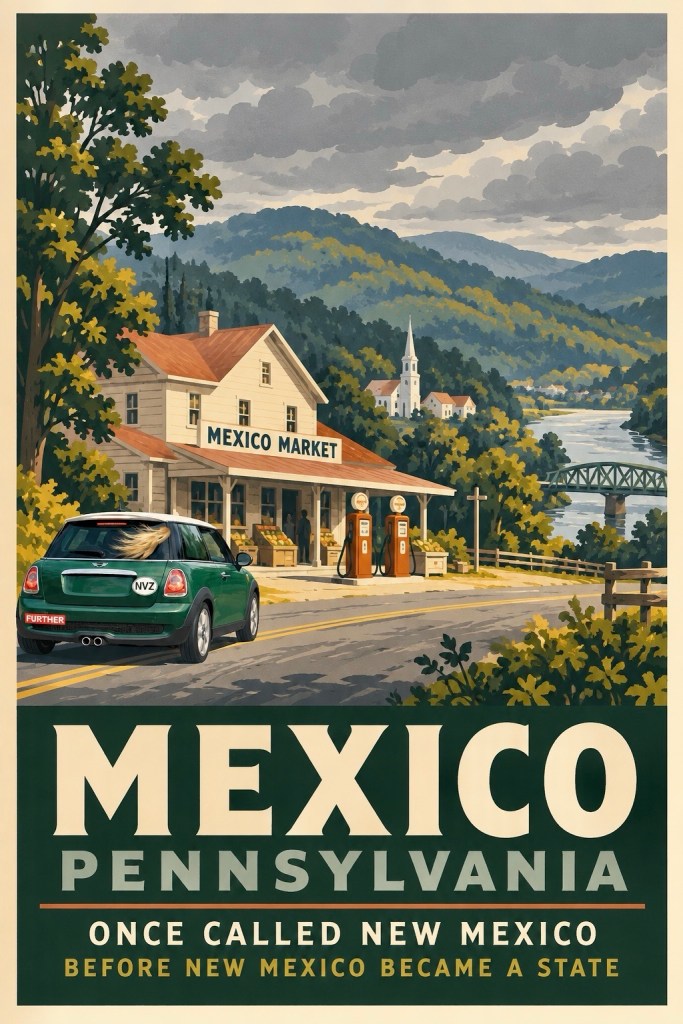
Then I discovered Glen Campbell, an actual Pennsylvania borough.
For a moment I imagined an entire Pennsylvania community devoted to the celebrated American country singer. Further investigation revealed that the town had acquired its name long before Mr. Campbell acquired his fame. I was beginning to suspect that Pennsylvania’s geography had a mischievous streak of its own.
Yet these were merely the geographical borrowings.
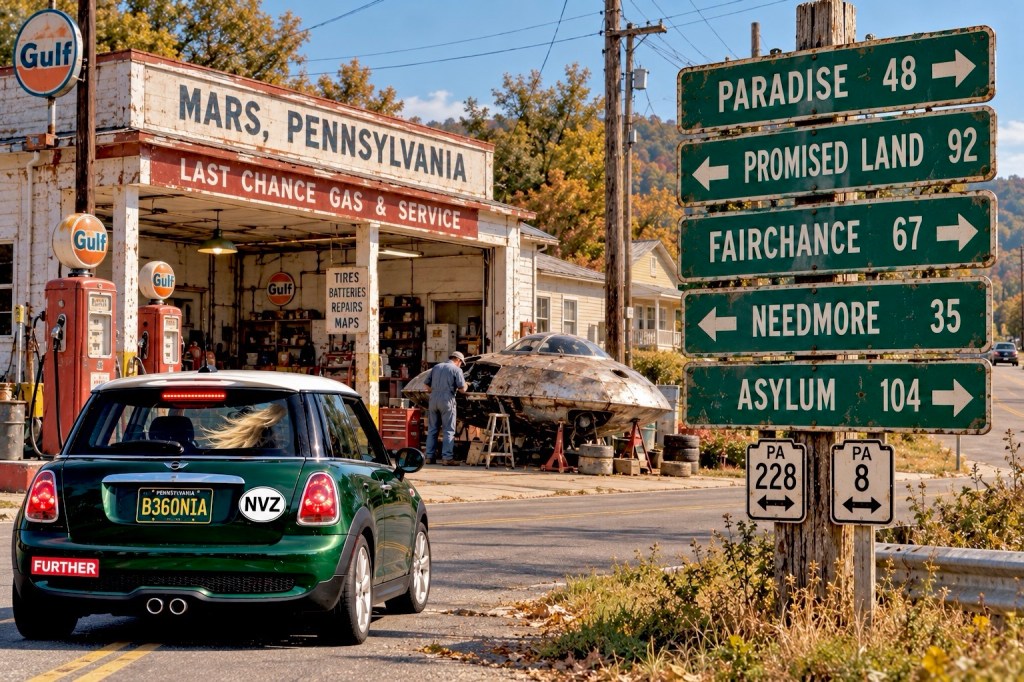
A second category of Pennsylvania place names proved even more intriguing:
Paradise, Promised Land, Fairchance, Needmore, and Asylum.
Here, surely, was something beyond homesickness. These names seemed to express not where their inhabitants had come from, but where they hoped they might have arrived.
The Germans have a particularly expressive word, Sehnsucht, for that peculiar longing which may attach itself to distant places, imagined possibilities, or things one has never experienced at all.
And here, René, I began to suspect that I had stumbled upon something more than a collection of amusing names.
Pennsylvania, after all, was settled by enormous numbers of Germans, who brought with them not merely their language and customs, but presumably their longings as well.
Could it be entirely coincidental that a land so thoroughly acquainted with the Germans should possess such an extraordinary geography of elsewhere?
I do not suggest that every Pennsylvania village was christened by a homesick Jerry. The historical explanations are often disappointingly practical. But I could not help wondering whether the impulse to name a new home after an old one—or after some distant place one had only imagined—might itself be a modest expression of Sehnsucht.
Was it possible, René, that Pennsylvania had been settled by people who, having arrived somewhere, immediately began thinking of somewhere else?
I was becoming quite sympathetic to them. But my theory encountered a difficulty when I discovered Mars.
Mars, Pennsylvania, is an actual borough in Butler County. Not content with appropriating much of the Earth, Pennsylvania had evidently extended its geographical interests beyond the planet. Moon Township suggested that the enterprise was already well underway.
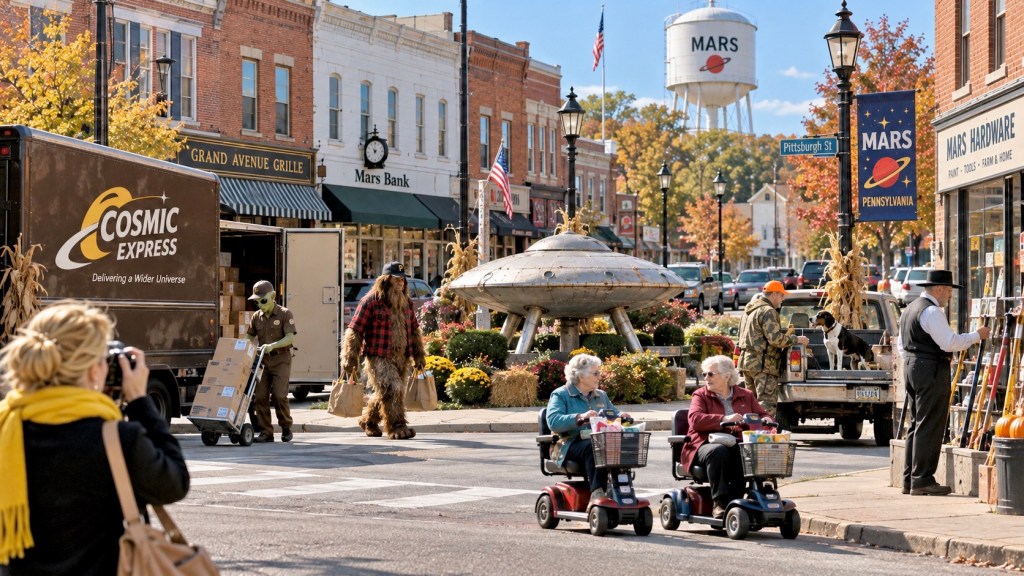
Butler County, Commonwealth of Pennsylvania
Population: 1,458 (2020 U.S. Census)
GPS: 40.69695° N, 80.01410° W
Incorporated: March 1895
ZIP Code: 16046
An actual place on Earth.
And it was then that I experienced a most unexpected improvement in my condition.
Why, I wondered, should anyone wish to leave Pennsylvania at all? It contained much of the United States, a generous selection of Europe, several ancient civilizations, the Holy Land, and enough distant countries to satisfy the most ambitious traveler.
With Mars included, the Commonwealth had even made a modest beginning on the universe.
I had set out longing for somewhere else, only to discover that somewhere else was already here.
The distances, it seemed, were largely a matter of nomenclature.
Yours sincerely,
Mrs. Begonia Contretemps
REPLY FROM RENÉ —
NVZ Headquarters, FRANCE
Chère Madame Contretemps,
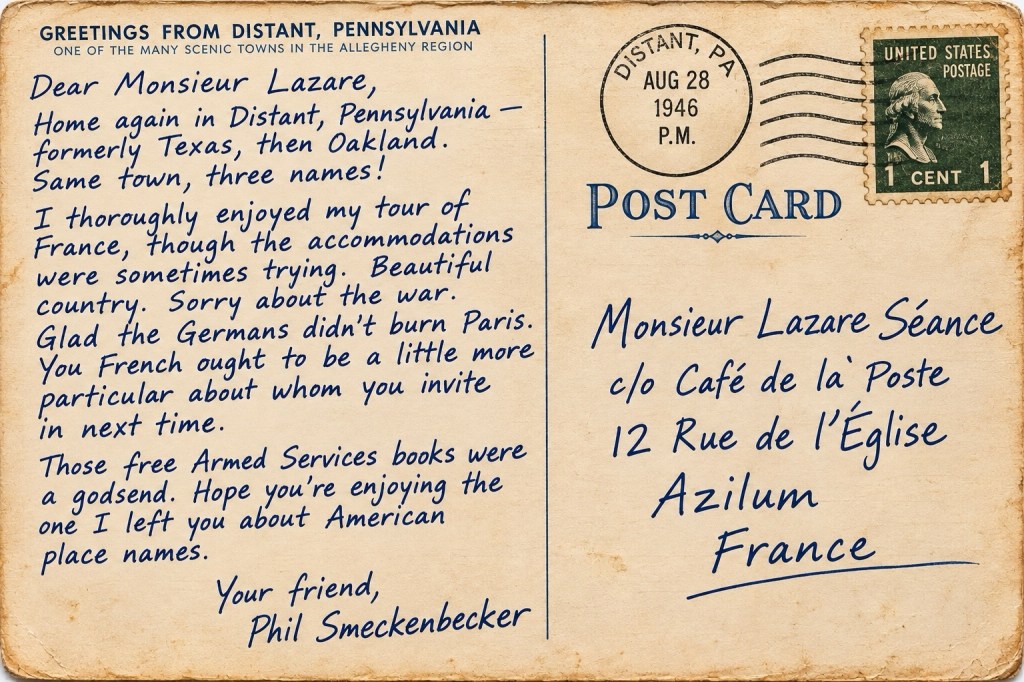
Your letter inspired me to undertake a little investigation of my own. I remembered a small American book, left behind in France by one of my country’s liberators, entitled Names on the Land, by George R. Stewart. It was published in an Armed Services Edition, intended to fit into a soldier’s pocket. Evidently, the Americans carried their geography with them even when they went abroad.
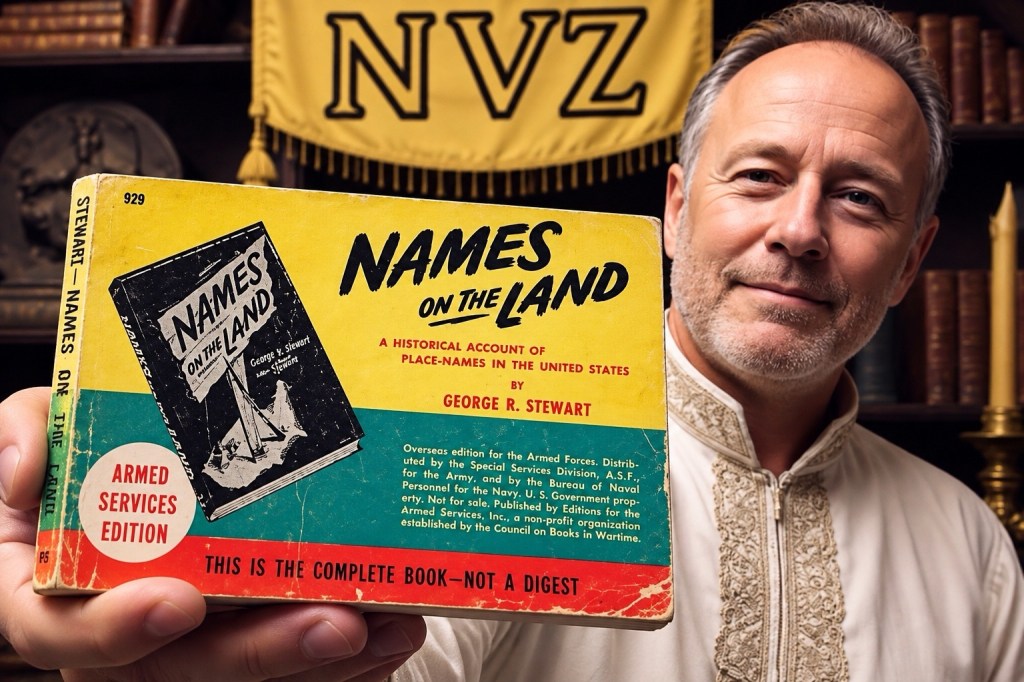
My inquiries led me to Ono, Pennsylvania, reportedly so named because every proposed name for the settlement was greeted with the objection, “Oh, no!”
I confess I laughed aloud.
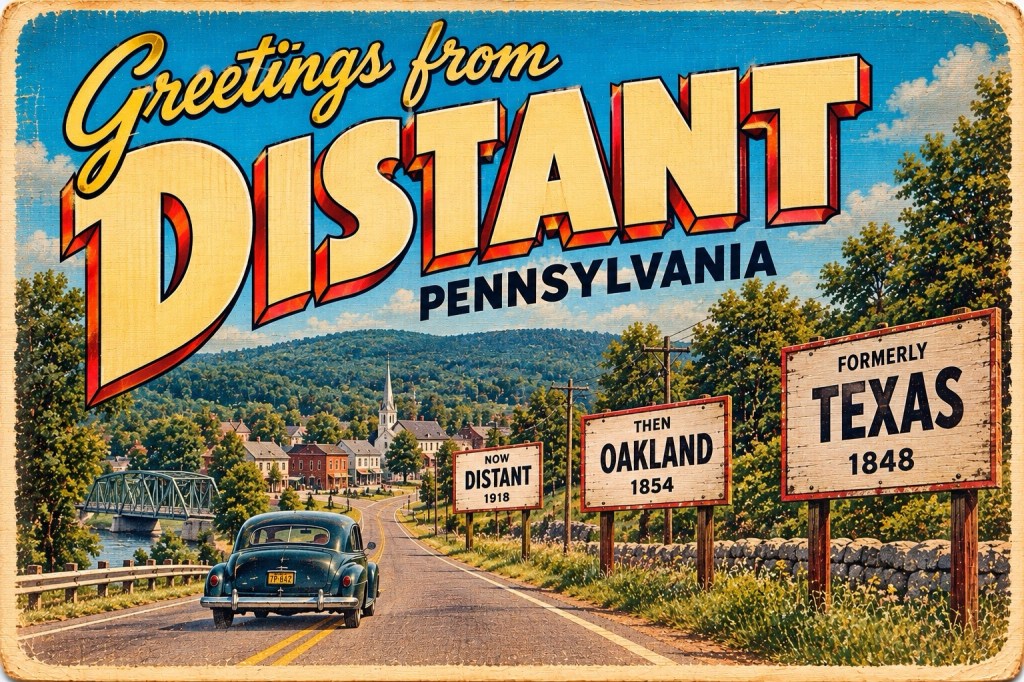
But my favorite discovery was Distant, Pennsylvania. It began life as Texas, subsequently became Oakland, and eventually settled upon Distant. A community that had already been somewhere else twice before deciding to become distant from everywhere.
As it happens, I still have a postcard from Distant, sent to my father, Lazare Séance, in 1946 by Phil Smeckenbecker, the American soldier who left him the book. I believe you will find that Mr. Smeckenbecker’s observations on France are every bit as interesting as his hometown’s geographical history.
The Germans have a word for longing to be elsewhere. The Americans, apparently, have a ZIP code.
I have always admired the American sense of humor. The French would have written a philosophical treatise on the subject. The Americans put up a road sign—and laughed while doing it.
Bien à vous,
René
The Further Writings Of Mrs. Begonia Contretemps Will Be Found: HERE


Leave a Reply