
My first interview with the gentleman known as the Backward Scholar (B.S.) had left me with the uncomfortable suspicion that I had learned something without being instructed in what I was supposed to learn.
This seemed sufficiently contrary to contemporary educational practice to warrant a second interview.
I therefore invited him back to the show, where I proposed that he demonstrate his educational method rather than merely explain it.
The Backward Scholar accepted immediately, although he objected to my suggestion that a successful demonstration ought to produce a conclusion.
“That,” he said, “is precisely the difficulty with education. Everyone expects the student to arrive somewhere. Preferably somewhere the instructor has already been.”
I asked where he proposed to take us.
“Nowhere in particular. But we shall take a good look around.”
He had brought no lesson plan, no textbook, and no examination papers. Instead, he produced three quotations.
“Three witnesses,” he announced.
“Witnesses to what?”
“That remains to be established.”
The First Witness: Kurt Vonnegut
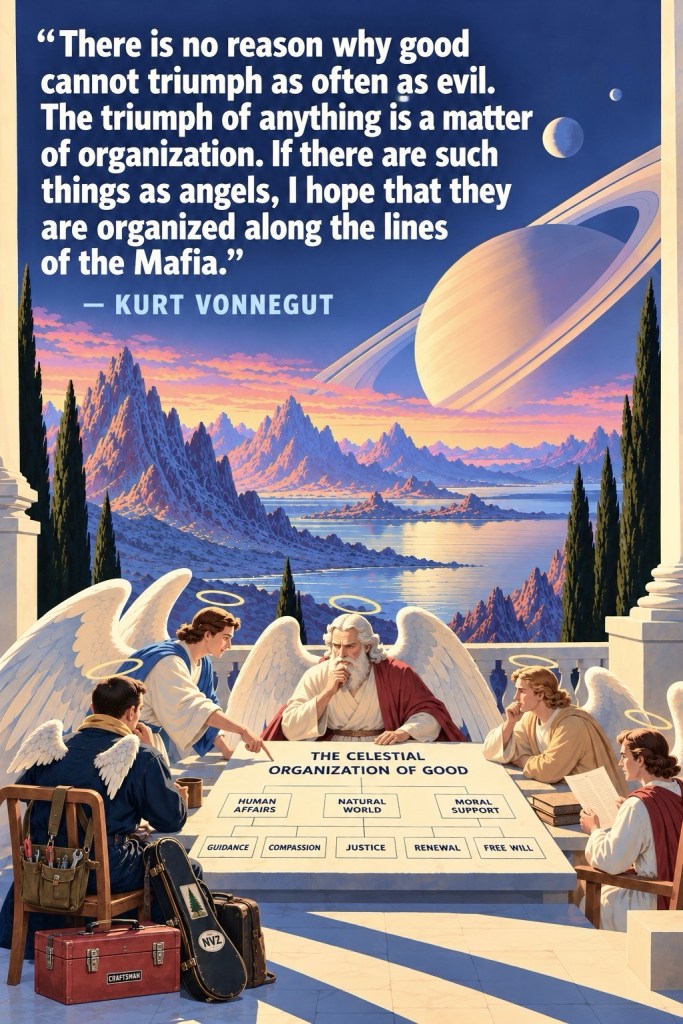
Kurt Vonnegut entertained the possibility that good might triumph as often as evil if only it were sufficiently organized. He went so far as to hope that angels, should they exist, might operate along the lines of the Mafia.
I remarked that this was an unusual endorsement of organized crime.
“Not necessarily an endorsement,” replied B.S. “An observation about organization.”
“But surely good and evil are distinguishable without consulting their administrative arrangements?”
“Certainly. But can either prevail without them?”
I considered the matter.
“And if evil is better organized?”
“Then perhaps goodness ought to pay more attention to management.”
The Second Witness: Mother Nature
Our second witness was Mother Nature, appearing through the offices of the Canadian singer-songwriter Gordon Lightfoot.
In his short composition Redwood Hill, the narrator climbs a hill in the rain to consult Mother Nature, who expresses both her affection for her children and her grave concern for their conduct.

Mother Nature also declares that she cannot change what she is for the benefit of mankind.
“An uncompromising lady,” I observed.
“Or an entirely candid one,” replied B.S.
“But she has produced children who can question her ways. And children who can organize themselves to change the world around them.”
“Precisely.”
“Then she has produced the very creatures capable of challenging her authority.” I said.
The Scholar smiled.
“Mrs. Contretemps, you are beginning to interfere with the lesson.”
“I thought that was the object.”
“So did I.”

— MOTHER NATURE, CEO of Natural Affairs
At this point, Ray Pierre-DeWitt, the Council’s Chaos Coordinator, who had been listening with an expression of increasing professional interest, suggested that Mother Nature might have organized her own opposition.
“Perhaps,” said B.S., “but whether she intended to do so is another question.”
“Then,” I asked, “is her opposition really opposition at all?”
“An excellent question. We shall not answer it yet.”

— Nature, traditionally attributed to Johann Wolfgang von Goethe
*
“Come closer. You have learned some of my secrets. Surely you don’t imagine they are all I possess.”
— MONICA BELLUCCI (pardon us, MOTHER NATURE)
The Third Witness: Destiny
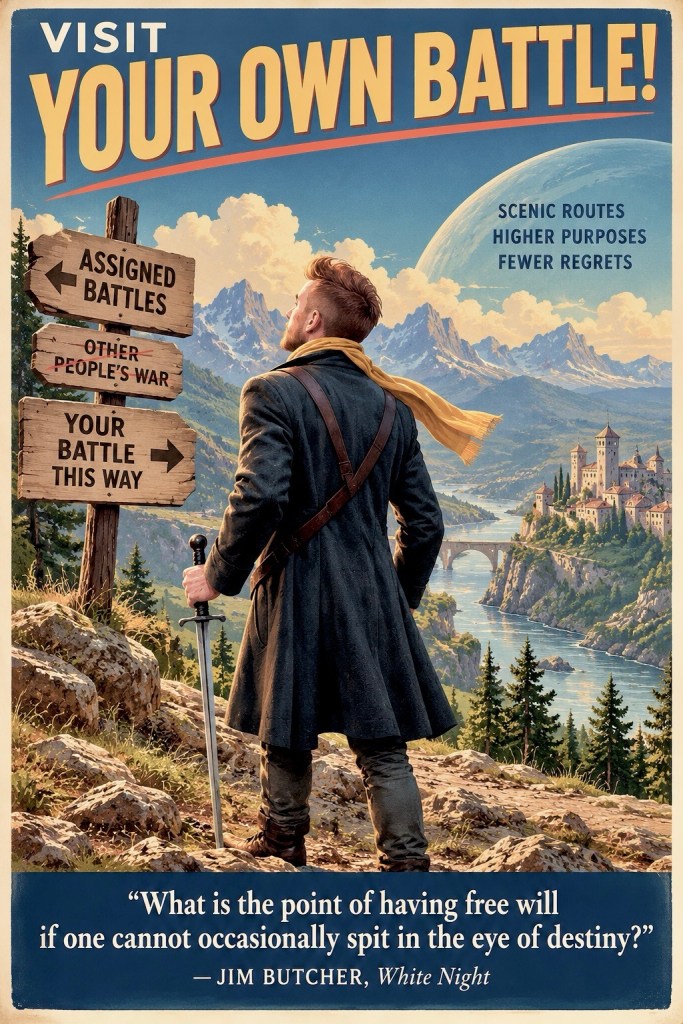
It arrived courtesy of Jim Butcher’s novel White Night, with a character who considers the occasional act of defiance against destiny a perfectly reasonable exercise of free will.
“Now,” said the Scholar, “what does this gentleman add to our discussion?”
“An unfortunate tendency toward expectoration,” I suggested.
“No, beyond that.”
“He believes he can defy destiny.”
“And can he?”
“That depends upon whether destiny permits it.”
The Scholar appeared delighted.
“Then if destiny permits him to defy it, has he defied destiny?”
“And if destiny prevents him,” I replied, “what becomes of his free will?”
“Exactly.”
“Exactly what?”
“We have reached the difficulty.”
An Education in Disagreement
I now demanded to know what these three quotations had in common.
“Perhaps nothing,” replied B.S.
“Then why have you assembled them?”
“Because each introduces a difficulty into the others.”
He explained that the conventional use of quotations in education is frequently to reinforce a proposition already established by the instructor. The student is shown an authoritative statement and invited to admire its wisdom.
His method reverses the arrangement.
Not quotations selected to confirm an established lesson, but quotations arranged to make the lesson itself debatable.
Vonnegut raises the question of whether moral purposes can prevail without organization.
Mother Nature raises the question of whether human beings can escape the conditions of their own existence.
And Butcher introduces the possibility that freedom consists in resisting those very conditions.
“But surely,” I protested, “you must have some conclusion in mind.”
“Several. Unfortunately, they disagree.”
“With one another?”
“And occasionally with me.”
A Matter of Nature
Ray Pierre-DeWitt, who had remained unusually quiet, now proposed that perhaps human beings were not rebelling against Mother Nature at all.
Perhaps their ingenuity, organization, and appetite for defiance were themselves products of nature.
“In which case,” I observed, “even our attempts to escape her are undertaken with equipment she has supplied.”
“Quite so,” replied B.S.
“And if we succeed?”
“Then we shall have another question.”
“And if we fail?”
“Likewise.”
I began to understand why his students might find examinations difficult.
“How,” I asked, “do you grade such an exercise?”
“By the quality of the questions.”
“And the answers?”
“Those are frequently available in the back of the book.”
The Final Examination
As our meeting concluded, I asked whether the three witnesses had reached a verdict.
“Not at all,” replied the Scholar. “They have barely begun their testimony.”
Outside, the weather had turned disagreeable. A wind had risen, and rain was sweeping across the pavement.
I opened my umbrella. The Scholar looked toward the sky.
“Mother Nature appears to have an objection.”
“To what?”
“Possibly the entire proceeding.”
A gust of wind turned my umbrella inside out. Ray Pierre-DeWitt, who had followed us to the door, offered his assessment.
“An organizational failure.”
The Scholar considered the ruined umbrella.
“Or an exercise of free will.”
I suggested that Mother Nature might have the final word after all.
“Perhaps,” replied B.S. “But she has not prevented us from discussing it.”
Yours Between Jest and Earnest.
— Mrs. Begonia Contretemps

— Council Bureau of Intellectual Tourism
COUNCIL TANGENT WITHIN THE GIST
The Council makes no claim that the three quotations are mutually contradictory. Indeed, their capacity to coexist may be what makes them troublesome.
Readers who have reached a definitive conclusion are invited to submit it to the Backward Scholar, who will endeavor to find a quotation that disagrees.

For showing us where to look before we knew how to get there.
The Council gratefully acknowledges his inspiration throughout this excursion into the universe of ideas.


Leave a Reply