—And Absurdity May Be the Bastard’s Father.
An Inquiry into Creative Necessity.
A MYSTERY SOCIAL SCIENCE THEATER 3000 PRODUCTION
—Now Showing At The Paradigm With Eugene Bodeswell Hosting.
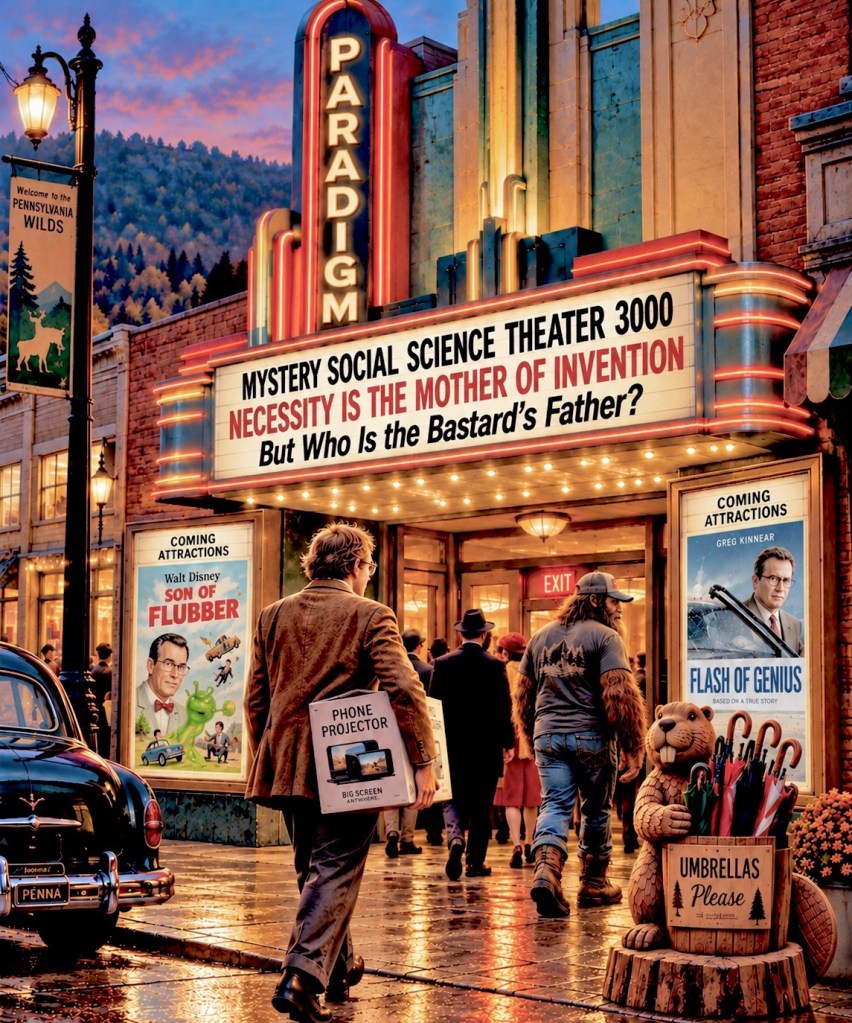
Eugene Bodeswell stood before the screen of the Paradigm Theater, where the Council had arranged an evening devoted to technological progress and its consequences.
His subject was creative necessity, a phenomenon that, in his estimation, offered considerable reassurance about the future of civilization.
“It has occasionally been suggested,” he began, “that mankind may eventually run out of things to invent. A brief examination of the historical record should dispel this concern.”
He advanced the first slide :
THE INVENTION OF STANDARD TIME
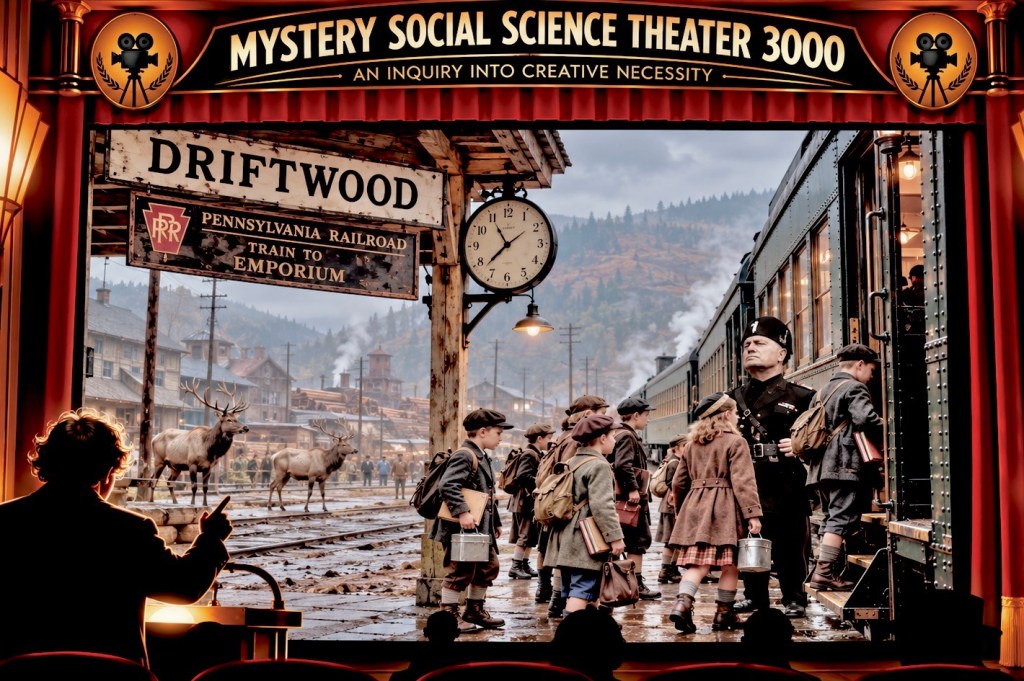
The railroad was among the nineteenth century’s greatest achievements. It enabled people and goods to travel considerable distances at unprecedented speeds.
Unfortunately, it also revealed that the clocks in neighboring towns frequently disagreed.
For centuries, communities had managed perfectly well by setting their clocks according to the local sun. This arrangement became less satisfactory when a train departing one town at noon might arrive in another whose clocks insisted it was still eleven fifty-three.
Railroad timetables consequently became exercises in astronomical diplomacy.
In 1883, American railroads adopted a system of standardized time zones.
“Thus,” Eugene observed, “having invented a machine capable of transporting people through space, we found it necessary to reorganize time.”
AN INTERRUPTION CONCERNING THE THEATER
Eugene paused and glanced around the auditorium.
“Before proceeding, I should mention that the present establishment provides another instructive example.”
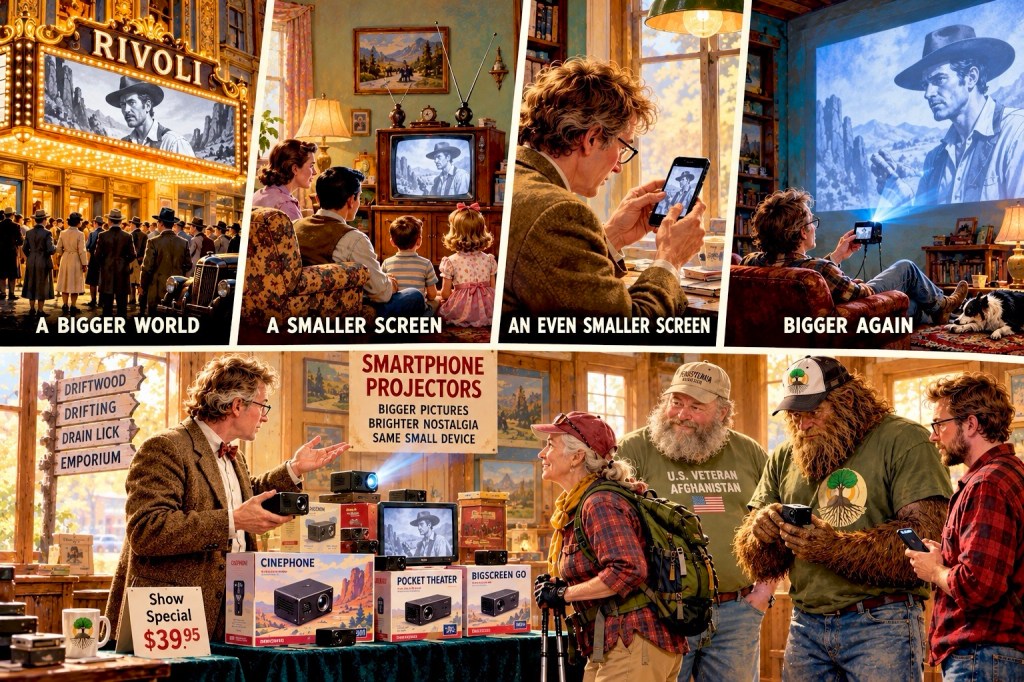
Moving pictures had originally required enormous screens in enormous buildings. Television subsequently brought the pictures into the living room, and the smartphone eventually reduced the screen to something that could be carried in one’s pocket.
Having accomplished this remarkable reduction, mankind promptly invented devices to enlarge the pictures again.
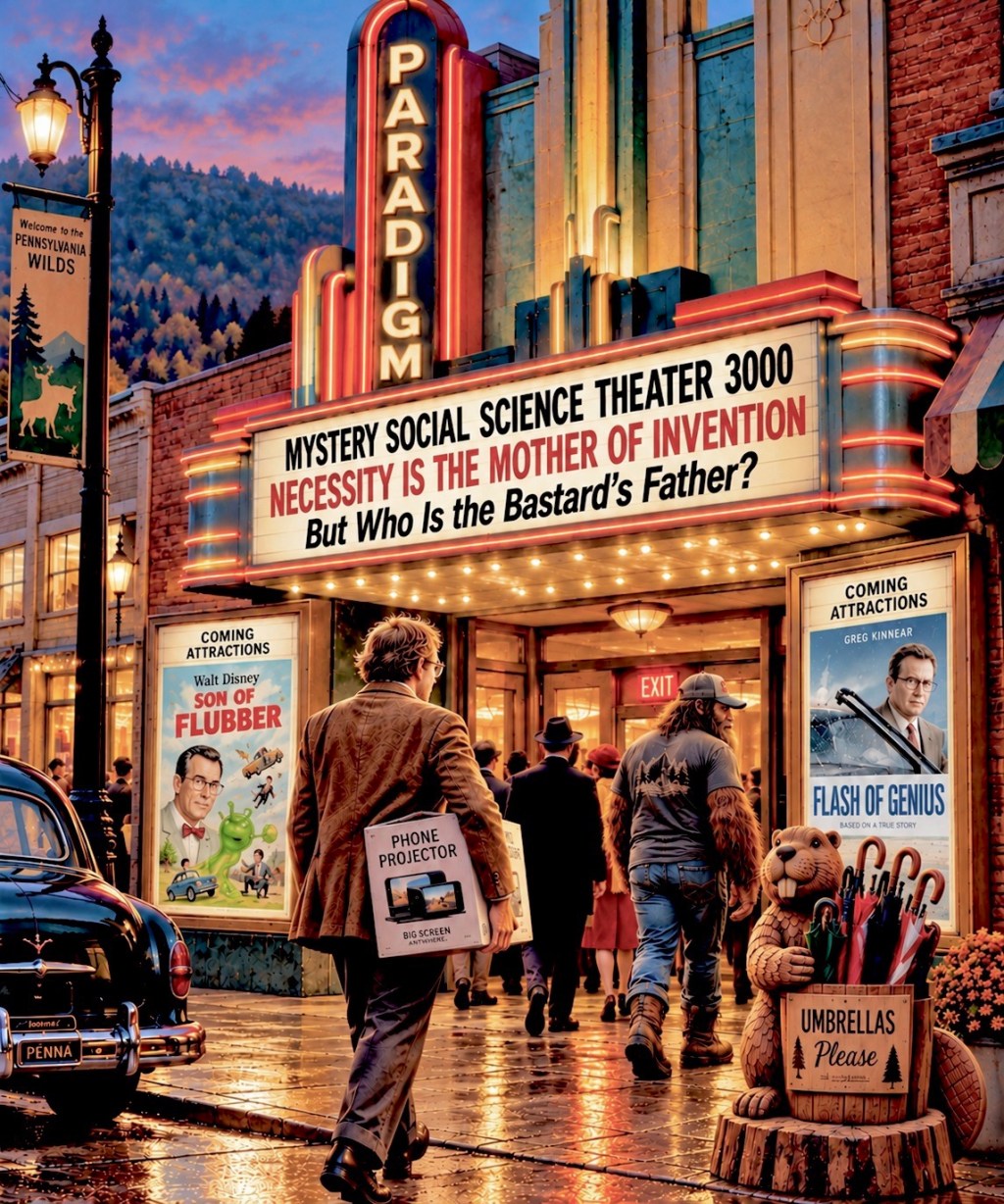
“I happen to have secured a limited quantity of portable smartphone projectors,” Eugene announced. “They are available for purchase in the lobby following tonight’s presentation. Council members receive a modest discount.”
He allowed the audience a moment to appreciate the opportunity.
“Now, to continue.”
THE HORSELESS CARRIAGE THAT KICKED
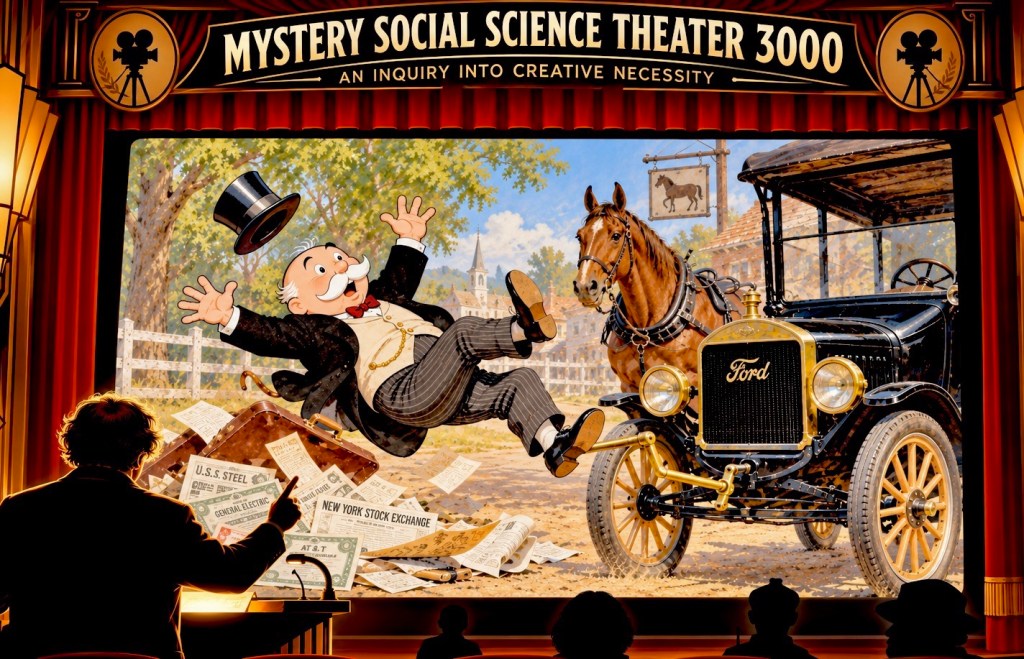
The automobile represented another decisive advance.
By eliminating the horse, inventors liberated transportation from the limitations of an animal that required feeding, grooming, and occasional veterinary attention. Unfortunately, this development also deprived numerous veterinarians of their principal patients. The profession eventually adapted by turning its attention to farm animals and household pets. Veterinary medicine for pets subsequently became so sophisticated—and expensive—that an entirely new industry arose to help owners pay for it: pet insurance. Thus, the automobile had indirectly helped create a market for insuring the family cat.
Early automobiles, however, presented a difficulty of their own. Starting the engine frequently required turning a crank by hand. Should the engine kick back, the crank could inflict serious injury upon the operator.
Charles Kettering’s electric starter, introduced by Cadillac in 1912, offered a solution.
“We had succeeded in eliminating the horse,” Eugene explained, “only to discover that the horseless carriage could kick harder than the horse.”
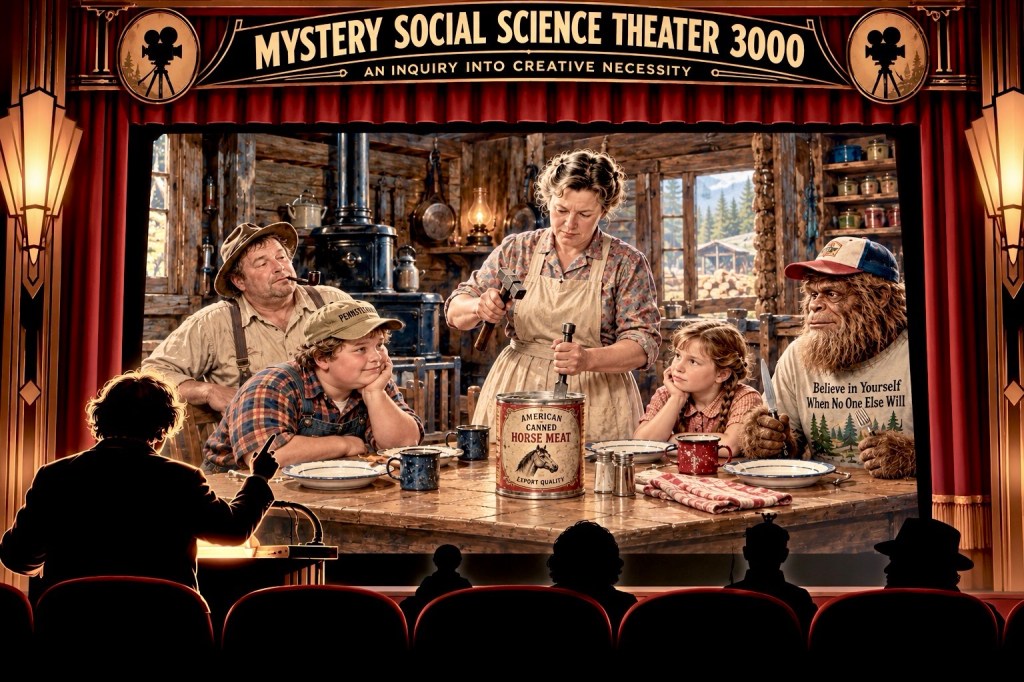
THE PRESERVATION OF INACCESSIBLE FOOD
Food preservation offered equally compelling evidence.
The development of commercial canning in the early nineteenth century made it possible to preserve food for extended periods, transporting it across oceans and storing it for future consumption.
There still remained the question of getting it out of the can.
For decades, opening the containers could require knives, chisels, or other substantial implements.
The familiar specialized can opener arrived considerably later than the canned food it was intended to liberate.
“Human ingenuity,” Eugene remarked, “had successfully solved the problem of preserving dinner long before adequately addressing the problem of eating it.”
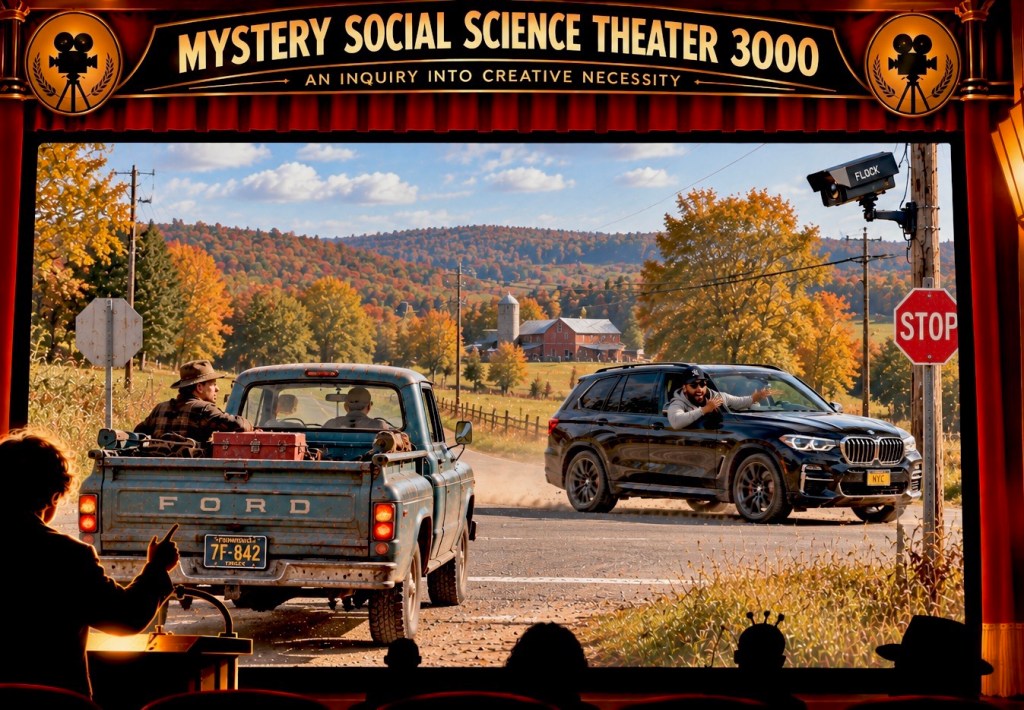
THE FREEDOM TO STOP
The automobile, meanwhile, continued generating necessities.
Once sufficient numbers of people acquired the freedom to travel wherever they pleased, it became apparent that they could not all exercise this freedom at the same intersection simultaneously.
Traffic signals supplied a solution.
“Having invented the automobile to eliminate the necessity of waiting for a horse,” Eugene observed, “we invented the stop sign and traffic light to make the automobile wait.”
A BRIEF ECONOMIC CONSIDERATION
At this point Eugene introduced two distinguished scholars.
The economist Joseph Schumpeter had described capitalism as a process of creative destruction, whereby new enterprises and technologies displaced older arrangements.
The sociologist William Fielding Ogburn had emphasized another important characteristic of technological development: inventions accumulate, creating opportunities for still further inventions.
Eugene regarded these observations as complementary, but believed they invited an additional formulation.
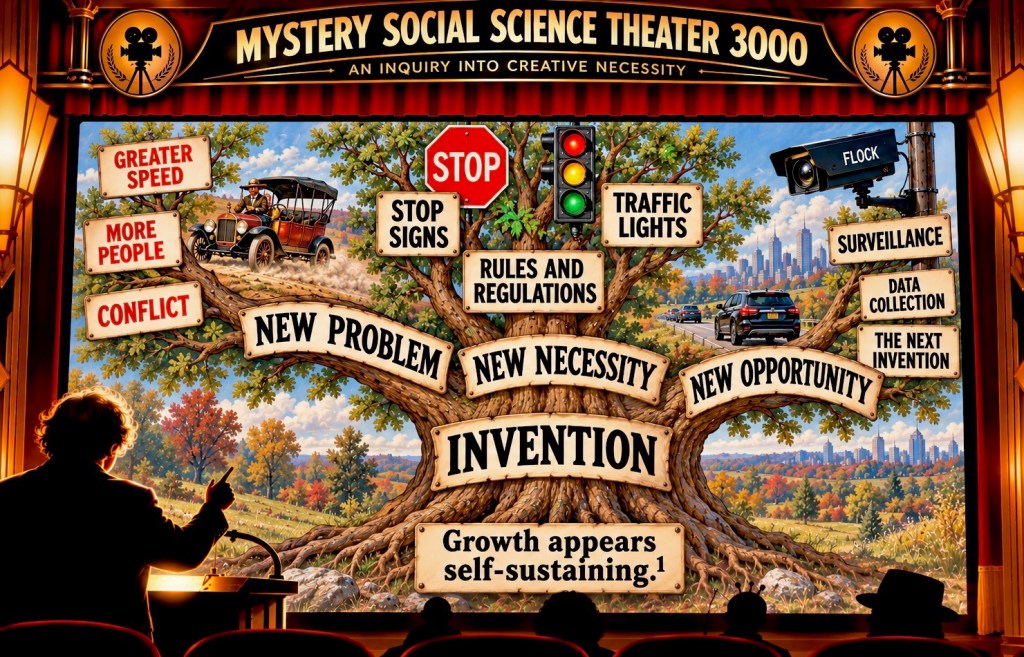
“Capitalism doesn’t merely invent solutions to problems. It invents solutions that create entirely new problems worth solving.”
He proposed to call this phenomenon creative necessity.
“It should be understood,” Eugene added, “that necessity is sometimes a matter of considerable urgency. At other times it is simply a matter of convenience. Both have proved commercially productive.”
— Eugene Bodeswell
THE TYPEWRITER AND THE MONKEE
The typewriter had made writing faster, neater, and more efficient.
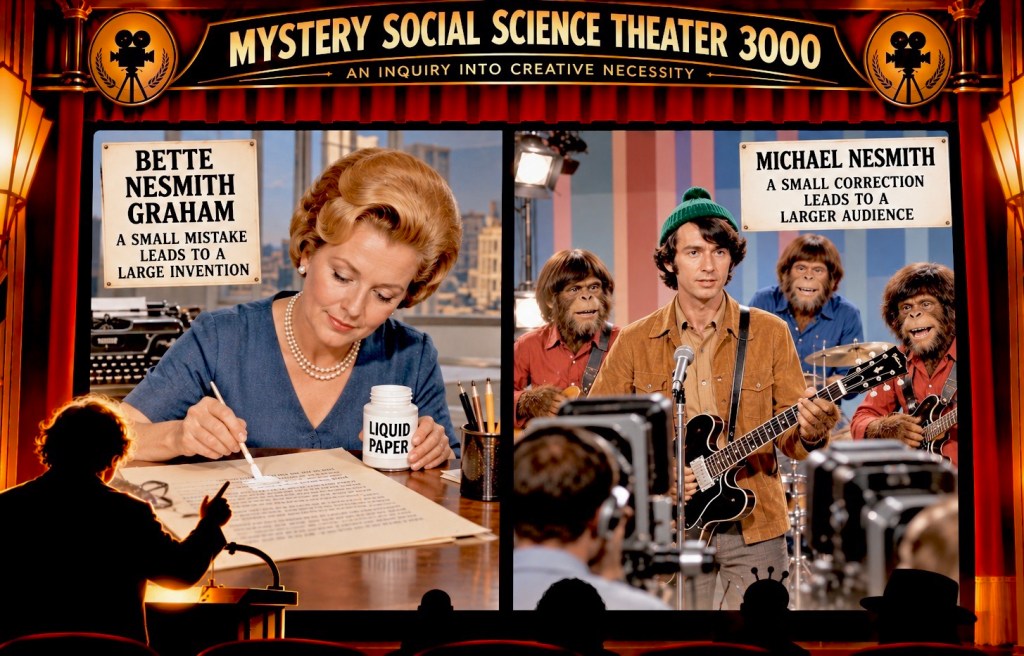
It had also introduced a peculiar difficulty. A single incorrectly struck letter could spoil an otherwise perfect page, obliging the typist to begin again or resort to unsightly corrections.
In the 1950s, Bette Nesmith Graham developed Liquid Paper, allowing typographical errors to disappear beneath a small application of white correction fluid.
This development deserves particular attention because Mrs. Graham’s son, Michael Nesmith, subsequently became a member of the Monkees.
The Monkees were a musical group assembled for a television series. Their early recordings relied heavily upon professional studio musicians, although several members already possessed musical experience.
The manufactured group eventually found it necessary to function as a genuine performing band.
“Thus,” Eugene explained, “having invented a musical group for television, the producers found themselves confronted with the necessity of making the invention real.”
THE RESTORATION OF VISIBLE MUSICIANS
Michael Nesmith subsequently helped pioneer another innovation: music television.
For centuries, musicians had performed before audiences who could both hear and see them.
Then mankind invented radio, which enabled audiences to hear musicians without seeing them.
This was hailed as progress.
Eventually, music television (MTV) developed, with Nesmith among its pioneers. Audiences could now see musicians again.
This, too, was hailed as progress.
The innovation naturally created a demand for video jockeys, elaborate costumes, choreographers, and eventually musicians who looked considerably better than they sounded.
Eugene regarded the sequence as particularly instructive.
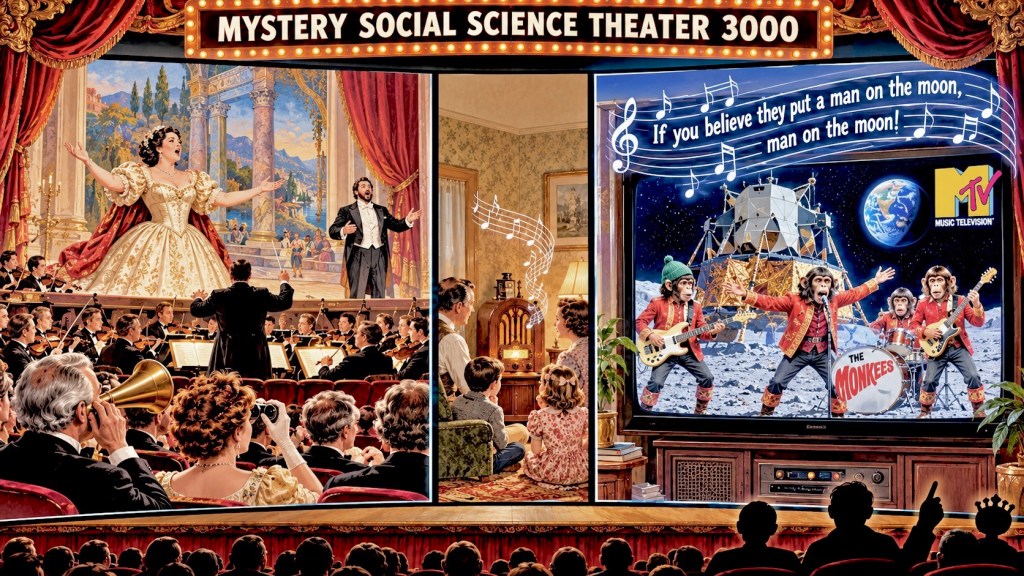
Michael Nesmith of the Monkees helped pioneer that industry with his imaginative 1977 video Rio and his subsequent creation of PopClips, an important forerunner of MTV.
Thus, after considerable technological progress, we could once again see the people making the music—without having to leave our chairs.”
Television produced another innovation of considerable domestic importance.
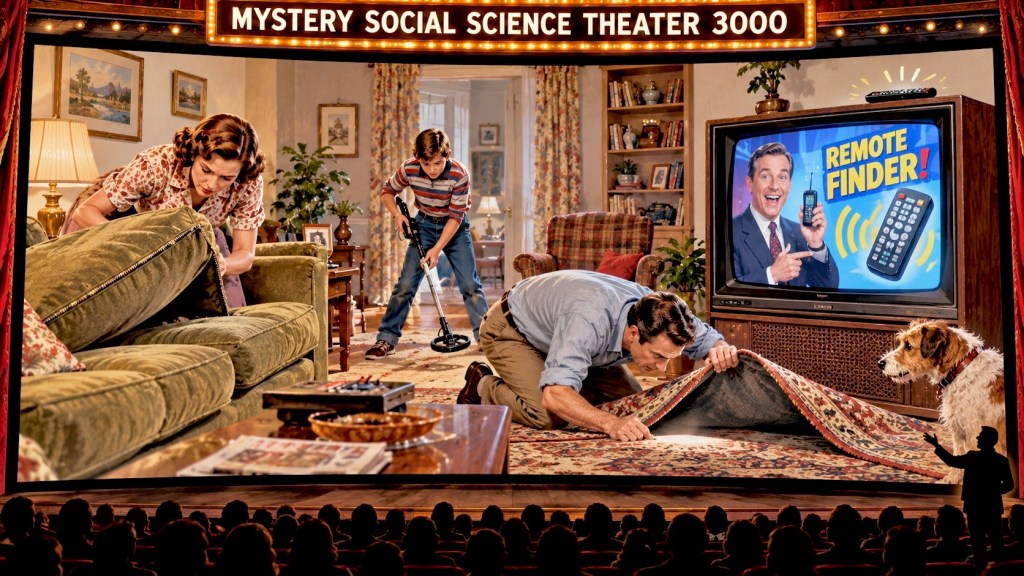
The remote control eliminated the necessity of rising from one’s chair to change channels.
Early wired models introduced the possibility of tripping over the connecting cable. Wireless models removed this inconvenience, while introducing another: the remote could now be misplaced.
The household that had once risen from the sofa to change channels now rose from the sofa to search for the device that eliminated the necessity of rising from the sofa.
“Progress,” Eugene observed, “does not invariably reduce human activity. Sometimes it merely redistributes it.”
THE FINAL FRONTIER
Eugene advanced his final slide.
Recent demonstrations associated with Elon Musk had revived public interest in automobiles capable of extraordinary maneuvers, including the possibility of vehicles that might, in some sense, fly.
The prospect naturally excited Eugene.
The automobile had already conquered the horse, the starting crank, and the intersection. Now it appeared poised to challenge gravity itself.
Yet the achievement suggested a difficulty that had received insufficient public attention.
The cupholder.
For generations, motorists had enjoyed the convenience of carrying beverages in their automobiles. Ordinary cupholders performed satisfactorily so long as the automobile remained approximately upright.
An automobile capable of turning upside down would present a different situation.
Eugene proposed the development of a gyroscopically stabilized cupholder, capable of maintaining its orientation while the vehicle performed aerial maneuvers.
He acknowledged that keeping the cup upright would not necessarily prevent its contents from escaping under acceleration.
“This,” he explained, “will require further research.”
A specially designed cup might become necessary. Possibly a lid. Perhaps a drinking mechanism capable of compensating for rapid changes in direction.
Each improvement would create further opportunities for investment, employment, and technological advancement.
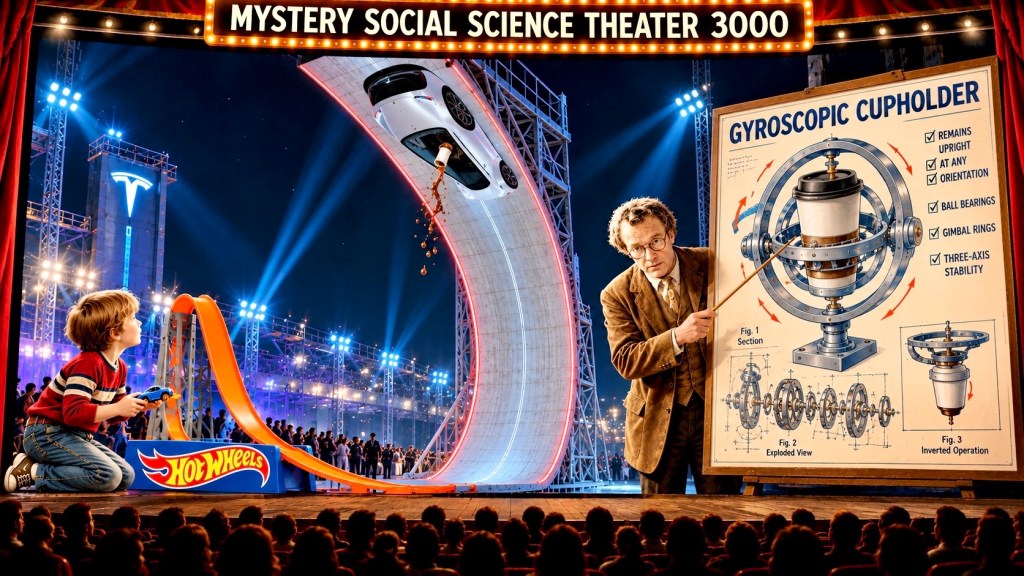
The Council is therefore pleased to announce the next necessary invention—the gyroscopic cupholder. Thus does progress create the conditions for further progress.”
A FINAL OBSERVATION FROM THE EDITOR
It has since come to our attention that Mr. Musk’s automobile, a car designed for the driving enthusiast, performed its remarkable maneuver WITHOUT A DRIVER! Indeed, without a human being aboard at all.
We began by inventing the automobile to take us places. We then invented the driverless automobile so that it could take us places without our having to drive. And now, apparently, we’ve eliminated the necessity of our going along at all.
Considering the human contribution to so many of the problems that inventions are subsequently required to solve, the elimination of the human may prove to be the greatest innovation of all.
And, of course, it eliminates the necessity for Professor Bodeswell’s gyroscopic cupholder.
— John St. Evola, Editor
NOTES


Leave a Reply