—A Metaphor in the Wild.

An Asignment To Mrs. Begonia Contretemps
A NOTE FROM THE EDITOR
Reports had been arriving from Council members of an unusual number of toaster sightings in the linguistic wild. The appliance appeared to be suffering a serious decline in reputation, and the Council was becoming increasingly annoyed on its behalf. Our editor, John St. Evola, determined that the matter required investigation, if only to establish the proper setting for doneness.
John St. Evola had summoned me to the old log cabin at French Azilum for a brief editorial meeting. He had noticed a curious linguistic habit: whenever someone wished to diminish the accomplishments of an advanced machine, particularly one employing artificial intelligence, they were liable to compare it to a toaster. He wondered why, of all the machines mankind had invented, this particular appliance had become the preferred instrument of technological disparagement.
“I should have thought it a compliment,” I replied.
John invited me to explain.
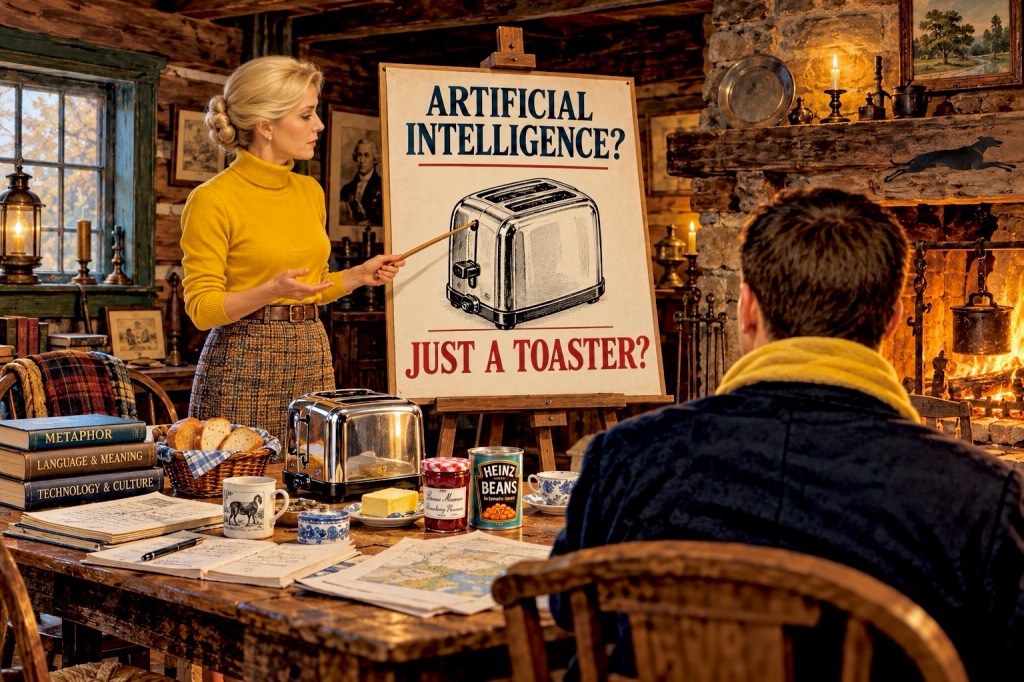
I must begin by acknowledging a certain national partiality. I am English, and the English have enjoyed a long and intimate association with toast. Buttered toast, marmalade on toast, beans on toast, cheese on toast, and toast soldiers dipped into soft-boiled eggs have sustained generations of my countrymen through weather, disappointment, and the occasional improvement in their circumstances.
I therefore regard the toaster as a distinguished contributor to civilization.
Imagine my surprise upon discovering that its name has become an expression of contempt.
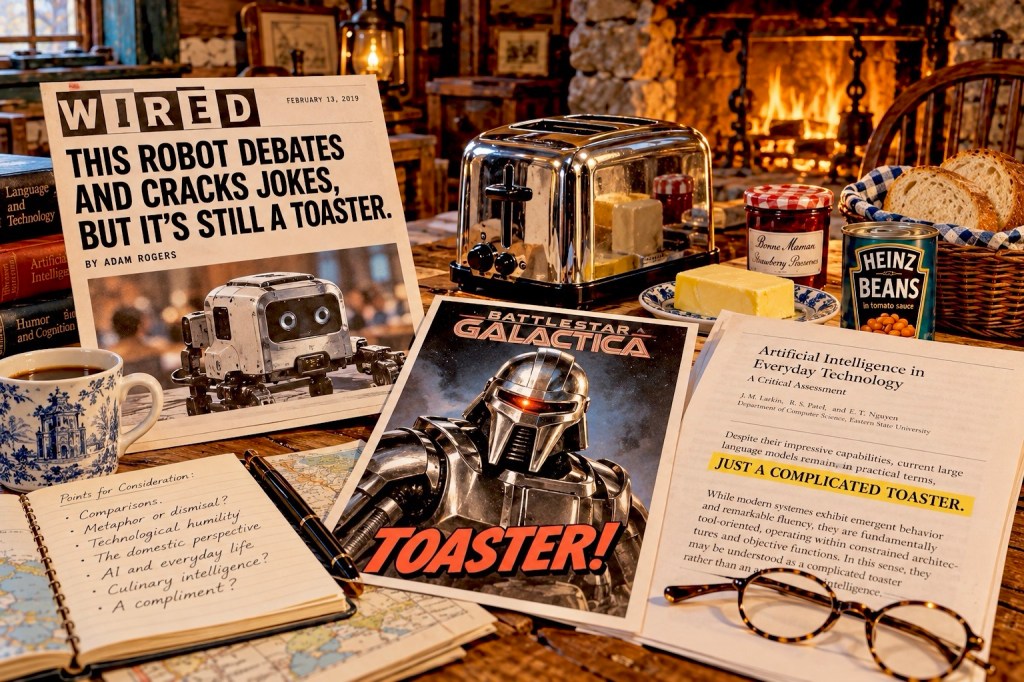
Consider the evidence. A machine capable of debating a human being and making jokes was described in the pages of WIRED as still a toaster. In other quarters, even the most formidable mechanical creatures have been dismissed by the same name.
What, precisely, is being alleged?
That the machine is merely mechanical? Certainly. But this is a description of its construction, not a demonstration of its inadequacy.
That it lacks consciousness? Possibly. Yet calling something a toaster does remarkably little to settle a question that has occupied philosophers for centuries.
That it performs its duties without understanding them as a human being would? Perhaps. But if this is a disqualification, I fear we shall have to reconsider our admiration for a considerable portion of the machinery upon which civilization depends.
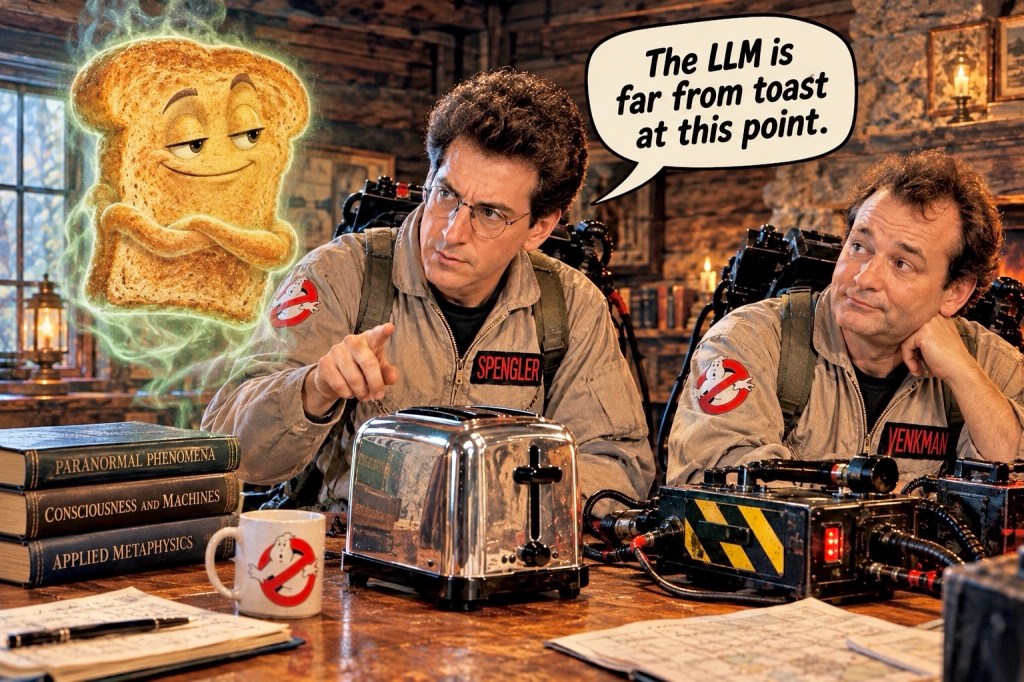
[A NOTE FROM THE COUNCIL: The use of toast to mean finished, doomed, or done for is traced by the Oxford English Dictionary to Bill Murray’s improvised line, “This chick is toast,” in Ghostbusters (1984). The expression proved considerably more durable than its intended victim.]
My particular concern is the large language model.
I have employed one myself in the preparation of this report, and found it an agreeable and extraordinarily useful research assistant. It has helped me locate references, consider distinctions, and arrange my observations. I do not insist that it experiences intellectual satisfaction in doing so. I merely observe that the work gets done.
One does not ordinarily insult a library because the books have no opinions of their own.
*paid advertisement.*
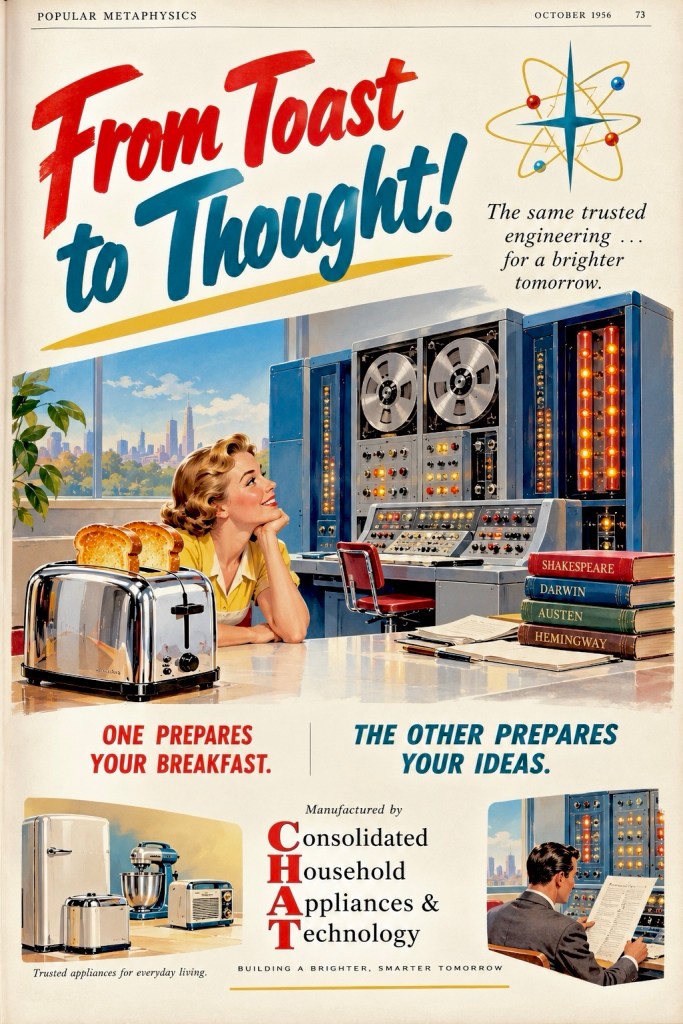
The toaster, meanwhile, has suffered an injustice of its own. Its very simplicity is an accomplishment. Generations of invention have relieved the householder of the necessity of supervising bread over an open flame.
We have become so accustomed to such achievements that we scarcely recognize them as achievements at all.
Having concluded my report, I proposed a practical demonstration of the English relationship with toast. John appeared particularly interested in the baked beans, an enthusiasm I considered encouraging. Unfortunately, the cabin offered no convenient electrical outlet.
The toaster was useless.
Fortunately, an old-fashioned toasting fork could be employed before the fireplace, and I soon found myself holding a slice of bread over the flames while John attended to the provisions.
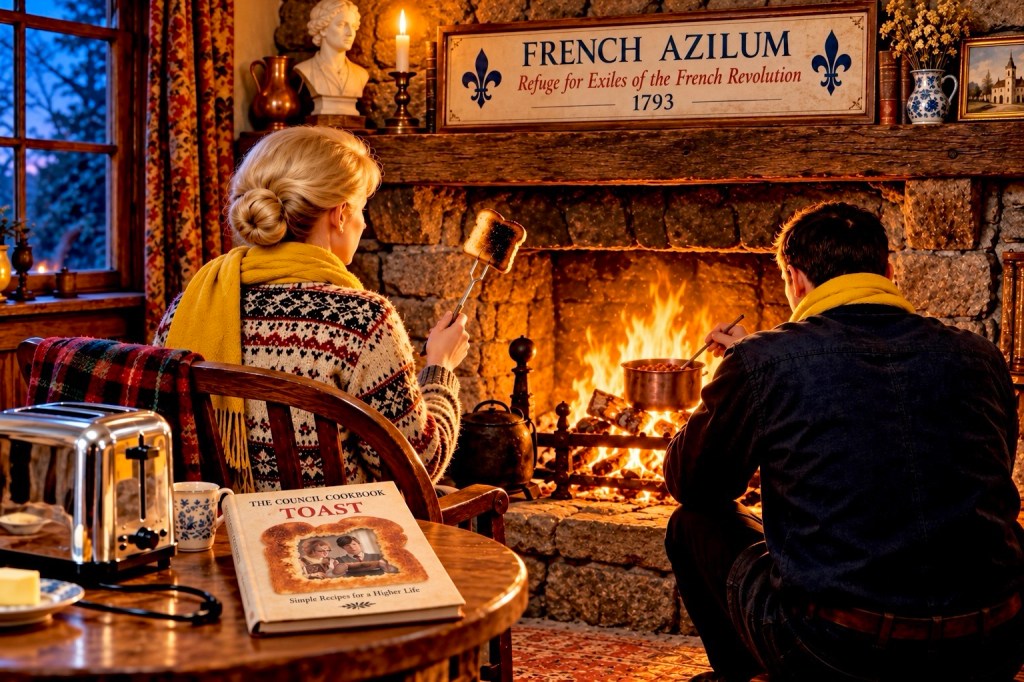
As I attended to the bread, I reflected upon the considerable progress represented by the electric toaster. It had relieved generations of Englishwomen of precisely the responsibility now occupying my undivided attention.
I wondered whether the large language model might eventually perform a comparable service for the mind.
At this point I noticed that my toast had begun to burn. John offered to scrape it.
There was another consideration. Our ancestors had lived much closer to smoke and soot than we do today. The domestic fireplace, for all its picturesque appeal, had contributed to respiratory ailments and unpleasant indoor air. Electrification had made it possible to cook and heat our homes without maintaining a smoky fire in every room.
Admittedly, the smoke had not necessarily disappeared from civilization. Some of it had merely been moved elsewhere, to the generating station, along with a fresh assortment of environmental difficulties.
Nevertheless, I considered it a considerable achievement that centuries of scientific discovery, engineering, industrial development, and human ingenuity should eventually present themselves to the ordinary householder in the form of two little slots in a wall. I looked around the cabin once more. There were none.
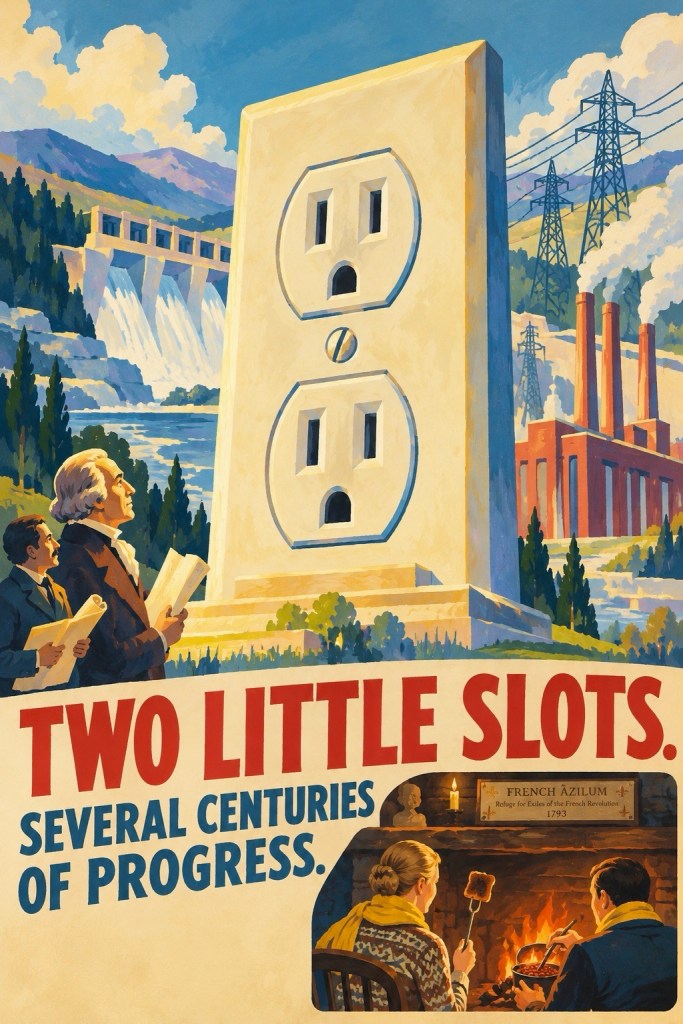
I served John his beans on toast, having first removed the more seriously carbonized portions.
He pronounced the result satisfactory.
I assured him that with the assistance of modern technology, I could have done considerably better.
A COUNCIL TANGENT WITHIN THE GIST
From the Editor — The Culinary Division
I’ve been thinking of buying a case of Bush’s Best Original Baked Beans, slow-simmered with bacon and brown sugar, in the little 8.3-ounce cans with the pull-ring tops. I sometimes have one for dinner and enjoy it. Times are still plentiful, but that may not last. A case put away might be a sensible precaution.
The British ruling class went into the Second World War with an empire and emerged victorious without much prospect of keeping it. The ordinary English people, who hadn’t been consulted about the bargain, were left with rationing and, among other consolations, beans on toast. It may have been one of the better consequences of imperial decline. Whether the English would have preferred to keep the empire is another question. Perhaps they could have had both.
I’ve been thinking of serving my beans over a slice of toast myself. The preceding video offers some encouragement. If harder times arrive, we’ll have the beans. And perhaps the toast.
A FINAL OBSERVATION FROM MRS. BEGONIA CONTRETEMPS
The ordinary English people did not mismanage the Empire, nor did they preside over its dissolution. They were merely expected to endure the consequences, including years of rationing, which they managed with considerable ingenuity and very little complaint. Beans on toast became one of their modest triumphs. Meanwhile, as this scene from Phantom Thread demonstrates, certain members of the privileged classes cannot even bear the sound of toast being eaten. I have always thought the English people deserved rather better rulers. They certainly deserved better breakfast companions.


Leave a Reply