~On Memory, Originality, and—Wait, I Had It a Second Ago. . .
There comes an age when you know considerably more than you can retrieve.
The information is still in there. You can see the corner of it sticking out from behind something else. An actor in an Australian movie. Half a quotation. The name of a fellow who wrote a book you read thirty years ago. You remember the argument but not the author, the face but not the name, the punch line but not the joke.
At my age I have stopped regarding the computer as a threat to my intellect. My intellect has had plenty of time to develop whatever it was going to develop.
What I need now is help finding things.
This may be different for a twelve-year-old. A developing mind probably ought to lift some of its own furniture. Mine has been moving furniture for a long time. I am increasingly grateful for a hand truck.
One morning I was trying to remember the Latin expression for something unique—something of its own kind, not reducible to anything else.
There it was:
SUI GENERIS
Of its own kind.
paid advertisement

I sat looking at Sui Generis longer than necessary. Then I sent for the Accidental Initiate.
“Find me one.”
“One what?”
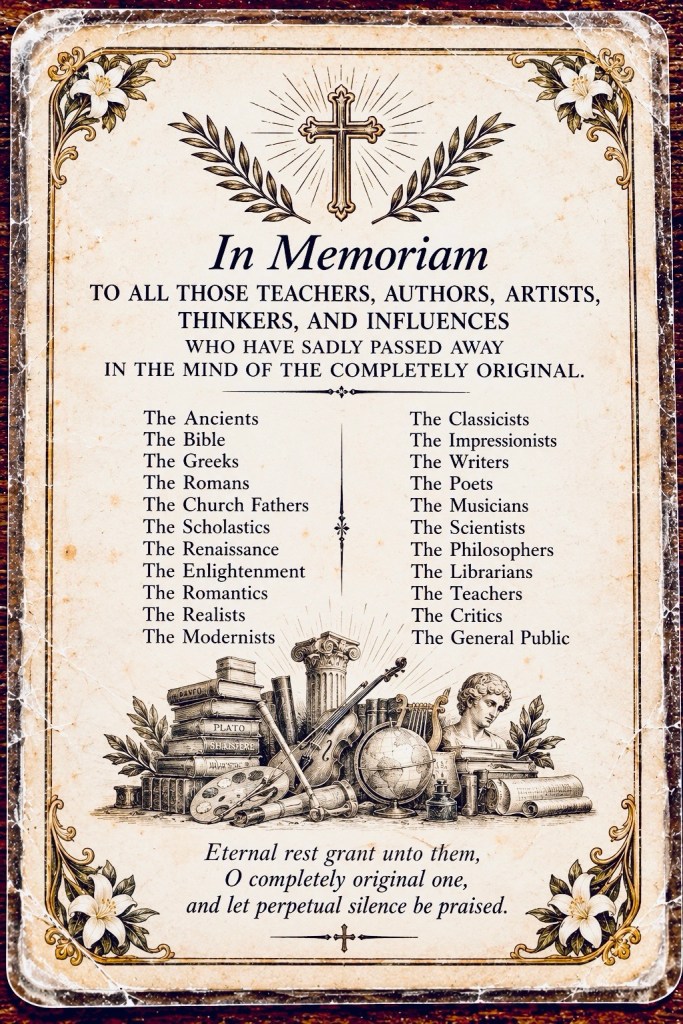
“A person who is sui generis. Completely original. No borrowed ideas. No repeating what teachers taught him. No fashionable opinions acquired from friends. No professional vocabulary picked up at work. No quotations masquerading as thoughts. Nobody who sounds like his favorite writer, professor, preacher, broadcaster or drinking companion.”
He stared at me.
“Where am I supposed to find somebody like that?”
“I have no idea. That’s why I’m sending you.”
This was not quite as unreasonable as it sounded. The Accidental Initiate had a peculiar history of finding things he wasn’t looking for, some of which had struck me as rather profound. Whether they actually were profound is another question. And another story

He came back several days later with an old woman.
She was wearing what she apparently regarded as teenage clothes, although the various articles represented several incompatible periods of teenage history.
“This is Susie.”
The woman corrected him.
“Seventeen.”
“I didn’t ask how old you are.”
“Seventeen.”
The Initiate leaned toward me.
“She does that.”
I asked whether Susie was her real name. Nobody seemed to know. Apparently people who had known her over the years had taken to calling her Susie Generis because she had a way of saying things nobody could remember anybody else ever saying.
The Initiate looked pleased with himself.
“You asked for sui generis. I brought you Susie Generis.”
There are moments when one regrets giving instructions too precisely.

I began asking questions. Susie did not disappoint. She advised the Initiate never to marry anyone until he had watched her write immediately after supper.
“Why after supper?”
“Otherwise you’re testing her on an empty stomach.”
Apparently a person’s handwriting after eating revealed matrimonial suitability, although fingernails had to be consulted in doubtful cases.
“You can’t trust handwriting by itself,” she explained.
I wrote that down.
She also advised us that anyone experiencing unexplained symptoms should eat a cucumber before going to bed and report the resulting dream to his physician.
“The cucumber gives the doctor something to work with.”
“What if I don’t dream?”
“Defective cucumber.”
I wrote that down too.
There were more. Some were merely incomprehensible. Others possessed the unsettling quality of being almost reasonable until you attempted to explain them to yourself.
I searched for her ideas. Nothing. The Initiate searched. Nothing. We tried distinctive phrases. We tried the underlying propositions. We tried old books.
Nothing.
For the first time in my life I appeared to be sitting across from a human being who had produced ideas without identifiable antecedents.
I had found the intellectual virgin birth.

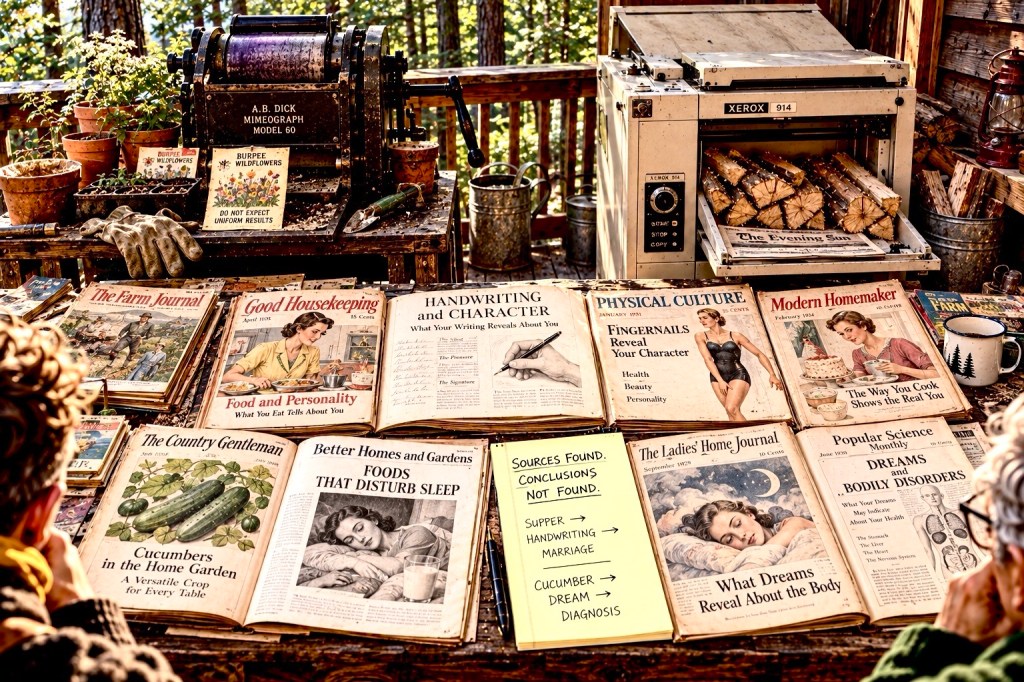
The difficulty arose when the Initiate found the magazines.
There were boxes of them. Old magazines, pamphlets, household publications, popular-science pieces and miscellaneous printed matter extending back into the late nineteenth and early twentieth centuries. Susie had apparently been reading this peculiar collection since she was young.
I started going through it.
Not Susie’s ideas.
Pieces of Susie’s ideas.
There had really been people who believed handwriting revealed temperament and character. Rising lines could indicate hopefulness; falling ones melancholy or illness.
There had really been systems for reading character from fingernails. There had really been writers connecting food and its preparation with mental, moral and social development.
Nobody had proposed Susie’s post-supper matrimonial handwriting examination.
Susie had done that.
Then we reached the cucumber.
Older medical and popular literature contained the belief that foods could influence dreams and nightmares. Other writers had entertained the possibility that dreams could disclose disturbances occurring inside the body. But nobody I could find had instructed a patient to eat a cucumber deliberately and use the resulting dream as a diagnostic test.
Susie had done that too.
The magazines contained the parts. They did not contain Susie.
Susie was not sui generis after all.
She had been absorbing things for a lifetime. Some were facts. Some were obsolete theories. Some were pseudoscience. Some she had probably misunderstood. She had forgotten where much of it came from. Then she connected things their original authors had never connected. She transferred ideas from one subject to another, mixed fragments together, and produced conclusions that couldn’t be found in any of her sources.
Frequently the conclusions were nonsense. But they weren’t copies.
If I owned every magazine Susie had ever read and searched every sentence in every one of them, I still wouldn’t find:
Eat a cucumber before bed so your doctor can diagnose you from the dream.
The ingredients were inherited. The arrangement was Susie. Which made me wonder what a completely uninfluenced human mind would actually contain.
Nobody invents his own vocabulary. A novelist reads novelists. A painter studies painters. A musician learns music already written. A scientist begins with discoveries made before he was born. Even the rebel inherits the language in which he announces his rebellion.
We spend the first part of our lives filling the shelves and much of the remainder rearranging what is on them.
Some arrangements are brilliant.
Some are useful.
Some are cucumbers.

I suppose I should explain why I had sent the Initiate looking for such a person in the first place.
I had been reading writers and academics complaining about large language models.
There are legitimate questions about copyright, training material, attribution and compensation. Those are real questions and can be argued on their merits. But I kept encountering a looser accusation.
The machine had learned from things written by other people. It had absorbed patterns from those things. It recombined what it had learned. Therefore it wasn’t creating. It was stealing.
That was the proposition from the writers that interested me:
“They trained these things on our books, our articles, our essays and our writing. Then the machine rearranges what it learned and calls the result original. That isn’t creativity. It’s plagiarism.”
Stripped of the indignation, the argument seemed to be: “It learned from me, therefore it stole from me.”
I looked at Susie.
For several days we had been trying to determine whether she was a lunatic or the most original thinker in North America.
She was neither. She was a reader. A peculiar reader, admittedly, but a reader nevertheless.
Then another question occurred to me. If influence establishes ownership, how far downstream does the ownership travel?
Suppose Susie had read one of these writers or professors forty years ago.
Suppose she remembered half an argument, forgot who wrote it, combined it with something about fingernails and something else about cucumbers, and eventually produced one of the theories for which the neighborhood had named her Susie Generis.
How much of Susie’s theory belonged to the professor? Ten percent? Twenty? Joint authorship?
The Accidental Initiate understood where this was going.
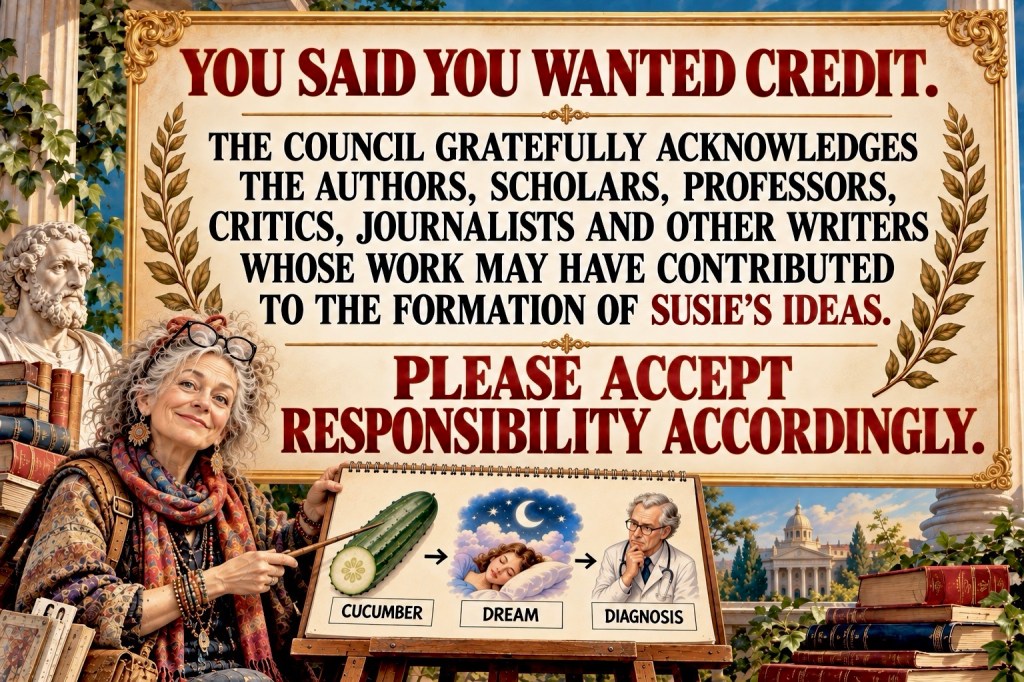
“Maybe these authors only want credit when something good comes out.”
That seemed possible. But intellectual ancestry doesn’t work that way. Writers have always released ideas into populations of readers they cannot control. Readers understand them, misunderstand them, remember them imperfectly, combine them with other things and sometimes carry them somewhere their authors would never willingly follow.
If you intend to claim every descendant merely because something you wrote appears somewhere in its ancestry, you don’t get to inspect the descendants first.
You get all of them.
The scholars.
The novelists.
The students.
The sensible people.
The bores.
The fellow on the bus with the theory about the Federal Reserve.
And Susie.
Especially Susie.
She had found another cucumber.
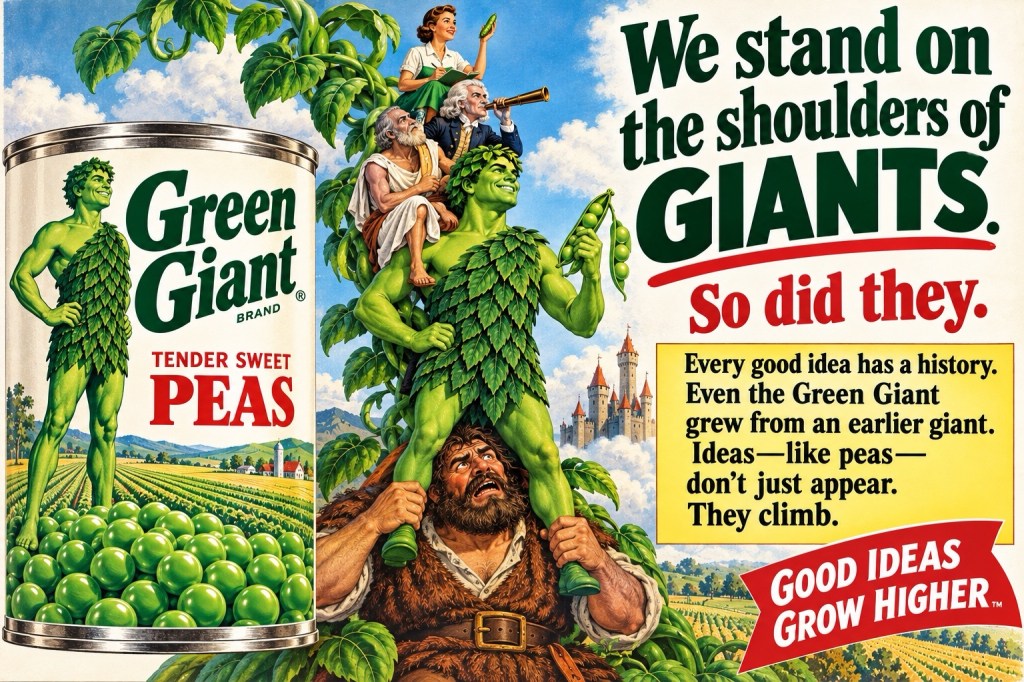
Apparently even frozen peas have ancestors.”


Leave a comment