—An Inquiry Into A Bicameral Mind.
A NOTE FROM THE EDITOR
The Council originally intended to publish the following inquiry under its own banner. Upon reviewing the manuscript, however, we concluded that it might find a more congenial home in our sister publication, The Perennial Sophomore. The subject is serious enough. It is the author’s approach to it that gave us pause. We leave it to our readers to decide whether the transfer constitutes a promotion, a demotion, or a precautionary measure.
— The Editor, C-of-C-C
I came to Mrs. Begonia Contretemps with another idea. Hesitating to call it a revelation, that’s what it seemed like at the time. I hadn’t found any footnotes to support it yet, but that’s usually the order in which these things happen to me.
It began with Karl Marx and Ayn Rand.
Two sides of the same coin, I thought. On one side, the collective; on the other, the individual. Two competing promises of human liberation, both assigning extraordinary importance to the material circumstances of human existence.
And both, I noticed, rather short on good-natured humor.
Now, I don’t mean they couldn’t make jokes. As I’ve read, Marx could be viciously funny, and Rand certainly knew how to make someone look foolish. But that’s not quite what I mean by humor. I mean the good-natured kind. The kind that includes oneself among the possible objects of amusement.
I began wondering whether either of them could laugh at his or her own philosophy. And then I wondered whether the inability to do so might tell us something about the philosophy itself.
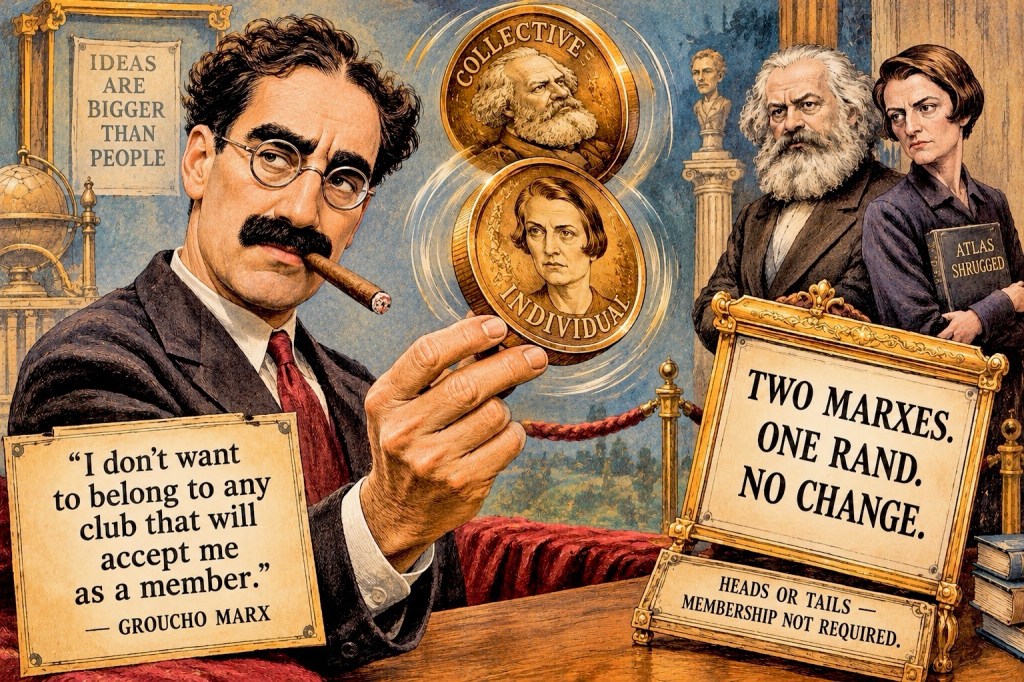
Karl Marx, Ayn Rand, and Groucho Marx. Perhaps we need a three-sided coin. Groucho might have joined the other two, although he famously refused to belong to any club that would accept him.
And Groucho wasn’t always jesting. When he finally met T. S. Eliot, the comedian wanted to discuss King Lear, while the poet wanted to discuss Duck Soup.
Apparently, even Jest and Earnest occasionally mistake each other for the other fellow.
This is where I began to lose sight of Marx and Rand, which was probably just as well. I had started with political economy and somehow found myself wondering about laughter.
Not merely what makes us laugh. I was interested in what happens when we laugh, and whether it tells us something about the way we think.
You see, irony requires us to entertain two meanings at once. We recognize what is being said and what is actually meant. And much humor seems to involve something similar. Two interpretations of the same reality suddenly occupy our attention.
And then we laugh. Why?
I put this question to Mrs. Begonia, who seemed to think I was asking her to explain laughter. I assured her I wasn’t. I was beginning to suspect that laughter might explain something about us.
She suggested that I consult Mark Twain. I wasn’t entirely certain whether she meant his writings or his example. With Mrs. Begonia, one can never be quite sure whether one has been offered a reference or a reprimand.
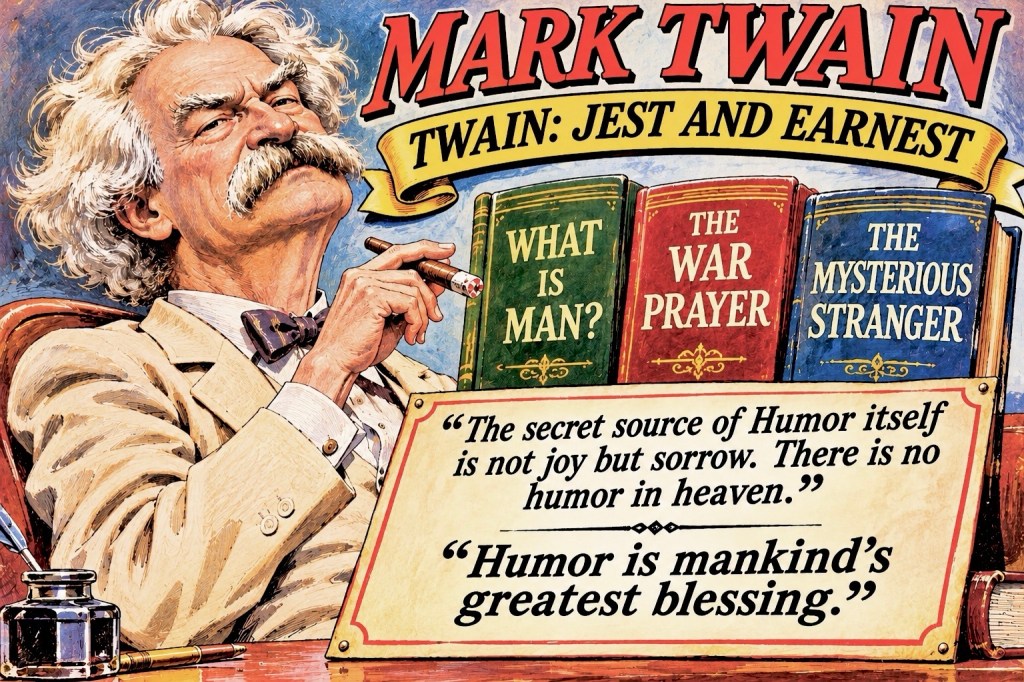
“Samuel Clemens knew sorrow intimately. He buried his wife, three of his four children, and a beloved younger brother. He suffered financial ruin and wrestled with some of the darkest questions of human existence.
Yet the gentleman who declared sorrow the secret source of humor also called humor mankind’s greatest blessing.
I rather think Mr. Twain understood that Jest and Earnest are not opposites. They are two ways of confronting the same world.
And sometimes the distance between them is no greater than a smile.
A distinction I trust our dear Backward Scholar will eventually appreciate.”
— Mrs. Begonia Contretemps
The Council’s Toast of the Town, 2025–2026
And that was when I remembered Julian Jaynes and his bicameral mind.
Not that I was proposing two separate chambers devoted to jest and earnestness. That would be ridiculous. Although, come to think of it, the ridiculous was precisely what I was investigating.
I was thinking instead about the remarkable ability of consciousness to recognize two apparently incompatible interpretations of the same thing.
Perhaps laughter was not merely a reaction to this ability. Perhaps it was one of its most revealing expressions.
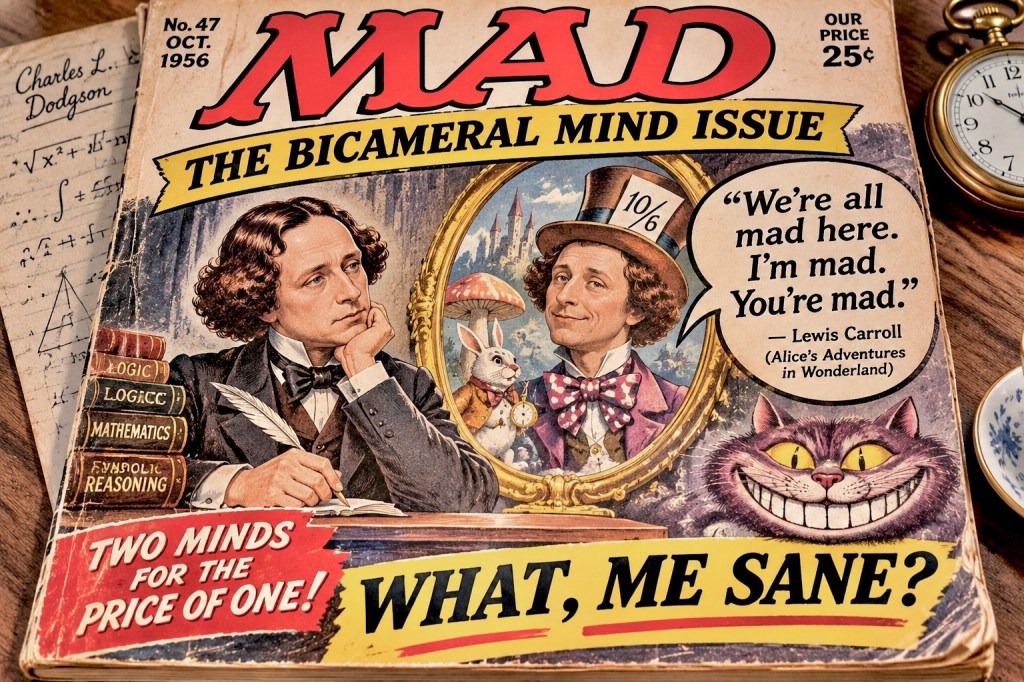
But Wonderland wasn’t an escape from logic. Much of its nonsense was logic pursued to perfectly ridiculous conclusions.
The same mind could be entirely earnest and outrageously funny. It could recognize the rules of reason and then discover what happened when those rules were taken a little too seriously.
Perhaps the bicameral mind wasn’t quite what Julian Jaynes imagined. But Dodgson and Carroll offer the Council a useful illustration: two ways of thinking, one head, and a grin that occasionally remained after the thinker disappeared.”
— Paige Turner
C-of-C-C Sub-Sub-Librarian
And then, rather embarrassingly, I remembered the Council’s emblem.
I’d been looking at it for years.
There was the brain, resembling the leafy crown of a tree, representing consciousness arising from the Earth itself. And beneath it, our motto:
BETWEEN JEST AND EARNEST.
I had been thinking about the two as opposites. But perhaps they were not opposites at all. Perhaps laughter was where they came together.
The earnest gives the jest something to work upon. The jest reveals something the earnest may have overlooked. And laughter, when it comes, seems to recognize both at once.
Nature had produced a creature capable of contemplating nature, questioning its own conclusions, and occasionally finding the entire arrangement ridiculous.
I wondered whether this was one of the more remarkable developments in the history of consciousness.

“Jean Shepherd’s famous declaration was “Flick Lives!” But the flock lives, too.
For generations of late-night listeners, Shepherd was a guide through the absurdities of American life. Among those who acknowledged his influence were Donald Fagen and cartoonist Bill Griffith. Shel Silverstein, his friend, may even have found inspiration for A Boy Named Sue in Shepherd’s own first name.
Shepherd possessed that rare gift of finding the Jest within the Earnest, and the Earnest within the Jest. His stories made us laugh at human foolishness without forgetting the humanity of the fools.
A Shepherd by name, a shepherd by nature.
And some of his flock are still following.”
— Eugene Bodeswell
C-of-C-C Ethnographer
It was only afterward that I began looking for footnotes.
Henri Bergson, in his essay Laughter, had argued that much comedy arises when human behavior becomes rigid and mechanical. That seemed relevant to my original suspicion about ideological certainty.
Chesterton had observed that a man secure in his convictions can afford to joke about them. A man dances on a rock, not a tightrope.
And Jaynes, although he was investigating something quite different, had at least encouraged me to consider consciousness from an unfamiliar direction.
I should emphasize that none of these gentlemen had established my proposition. Bergson, in particular, regarded laughter as a social corrective, not necessarily an expression of affectionate understanding. And Jaynes’s bicameral hypothesis was not a theory of humor. Still, I found their company reassuring.
I had begun with two philosophers and a coin, wandered through irony, laughter, and consciousness, and ended by discovering something that had been printed beneath the Council’s emblem all along.
Perhaps I had been looking for an explanation of laughter when I ought to have been laughing.

“Our subject is a gentleman of advancing years and apparently arrested adolescence. A lifelong student of human folly, he has never allowed the acquisition of knowledge to interfere with his capacity for nonsense.
His personal motto, which he first encountered on the spare tire cover of a custom van in 1974, is: “You’re only young once, but you can be immature forever.” He has apparently regarded it as sound philosophical advice ever since.
He also finds considerable inspiration in an observation attributed to Philomena Cunk:
“The ancient Greek philosophers get way too much credit.
They weren’t smart, they were just early.
I could think of stuff too if nobody knew anything yet.”
I suspect this explains his scholarly method rather better than he would care to admit.
He approaches the world as an open sanatorium, freely wandering its corridors, examining its inmates, and occasionally mistaking the attending physicians for patients.
He is also fond of declaring, “I may be crazy, but I don’t do crazy.” This distinction has yet to receive formal recognition in psychiatric literature.
Although his methods are unconventional, his observations are frequently illuminating. I therefore see no immediate reason to interfere with his work.
Besides, he appears quite comfortable in the jacket.”
— Dr. Faye C. Schüß
C-of-C-C Mental Hygiene Specialist
I had finished explaining all this to Mrs. Begonia, including the footnotes I’d subsequently discovered. She had listened patiently, occasionally smiling, but had offered no particular opinion.
Finally, she looked at me with that peculiar mixture of affection and amusement I’ve come to recognize.
“My dear Professor,” she said, “it’s all pure B.S.”
And she smiled.
I was about to object when I realized that she had just demonstrated my entire thesis.
I laughed.
So did she.
More From The Backward Scholar Can Be Found: Here


Leave a Reply