The Perennial Sophomore Presents:
History Written in Advance
—By the Backward Scholar (B.S.)
Introducing The Perennial Sophomore
The Perennial Sophomore is a brother publication of the Council of Concerned Conservationists Newsletter, dedicated to the proposition that intellectual curiosity need not end with graduation—or even with the acquisition of wisdom. Its contributors remain perpetual students, occasionally learning something and frequently discovering how much they have yet to learn.
Our banner features a Native American figure from Mr. Pynchon and the Settling of Springfield, a mural painted in 1937 by Umberto Romano. The figure appears to be examining a small mirror, although modern eyes have famously mistaken it for a smartphone—a particularly appropriate example of retrospective futurology.
Romano was born in Bracigliano, in the province of Salerno, southern Italy, making him something of a paesan of the Council. We are pleased to discover that the artist responsible for this apparent glimpse of the future was one of our own.
Two illustrations recently came to our attention which, taken together, suggested a possibility we had not previously considered.
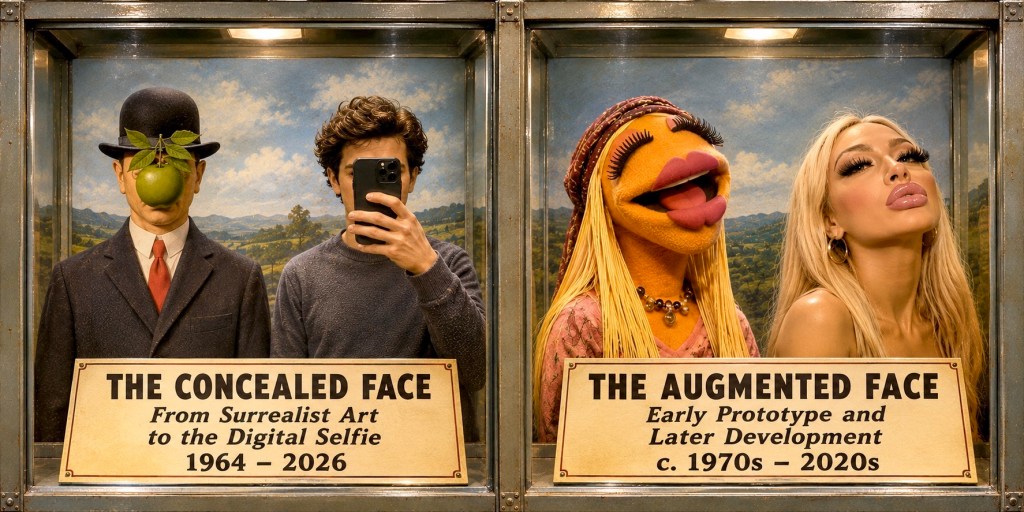
The first involved René Magritte’s 1964 painting The Son of Man, in which a gentleman’s face is obscured by a green apple. Six decades later, the painting bears an uncanny resemblance to the modern mirror selfie, with a smartphone replacing the apple.
The second involved Janice, the extravagantly featured member of the Muppet orchestra, whose appearance in the 1970s now seems to anticipate certain developments in cosmetic fashion, particularly those involving lips, eyelashes, and the increasingly ambitious reconstruction of the human countenance.
Neither Magritte nor the creators of the Muppets were necessarily attempting to predict the future.
Nevertheless, the future appears to have taken certain liberties with their work.
This suggested an interesting possibility.
If we can look backward and discover that yesterday’s artistic absurdities anticipated today’s ordinary realities,
why should we not examine today’s absurdities for evidence of tomorrow’s ordinary realities?
We began looking around. And almost immediately, we encountered the furries.
The Great Return to Hunting
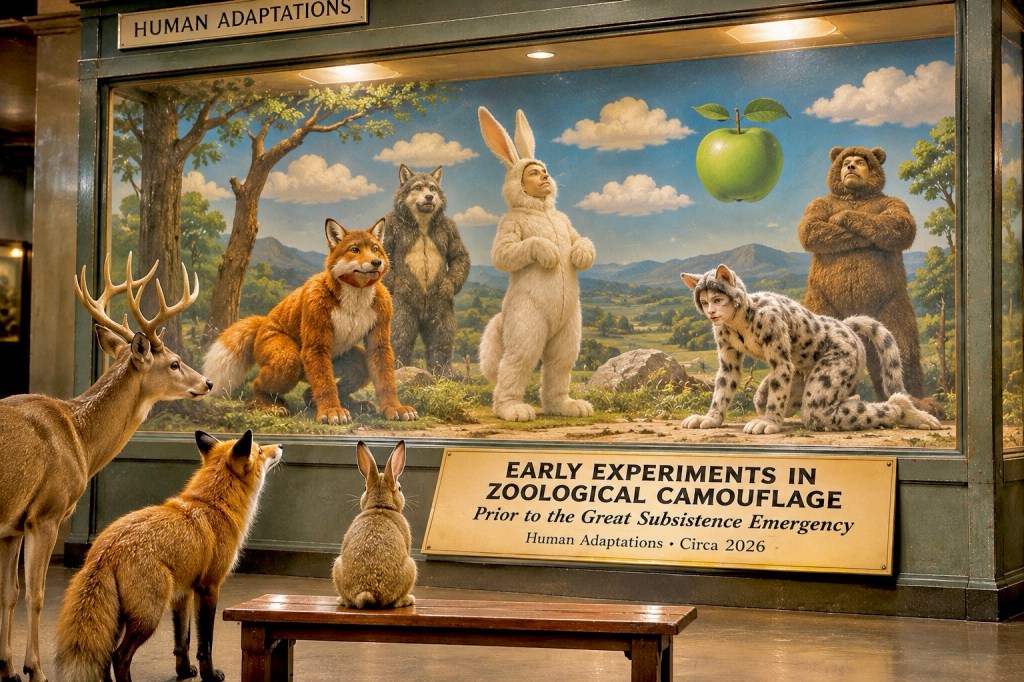
Furries are enthusiasts who sometimes dress themselves in elaborate animal costumes, appearing at conventions as foxes, wolves, bears, rabbits, and assorted creatures whose precise zoological classification remains uncertain.
Their costumes are often expensive, meticulously constructed, and surprisingly convincing, provided one has never encountered the corresponding animal in the wild.
But what if these people are unconsciously preparing for a future in which civilization has collapsed, supermarkets have disappeared, and humanity must once again hunt for its daily sustenance?
What appears to be extravagant recreation may eventually be recognized as humanity’s earliest organized experiments in animal camouflage.
Admittedly, certain difficulties remain. A six-foot rabbit may attract unwanted attention in the forest, while a hunter disguised as a deer risks becoming the object of another hunter’s attention. Nevertheless, the instinct appears sound, even if the execution requires refinement.
It was at this point that we suspected we had stumbled upon an entirely new academic discipline.
We propose to call it :
Its purpose is to examine contemporary customs, fashions, amusements, and eccentricities as evidence of historical events that have not yet occurred.
Ordinary historians reconstruct the past from the evidence it has left behind. The Retrospective Futurologist reconstructs the future from evidence that has arrived prematurely.
Armed with this method, we resumed our investigation.
The Textile Famine
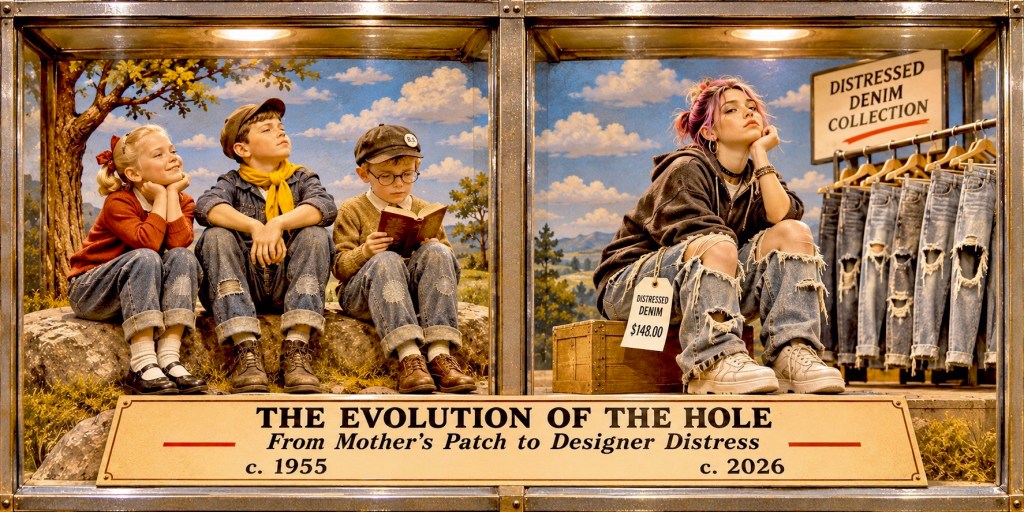
Young people now purchase trousers that have been torn, shredded, and otherwise subjected to treatments that earlier generations associated with poverty and prolonged misfortune.
Frequently, the more extensively damaged the garment, the higher its price.
We suggest that these young people are preparing psychologically for the Great Textile Famine, when replacement clothing will no longer be manufactured.
Indeed, they have gone beyond mere preparation. They have learned to regard deprivation as desirable and to pay a premium for its simulation.
Future generations, obliged to wear genuinely deteriorating garments, will have much to learn from their example.
The Housing Question
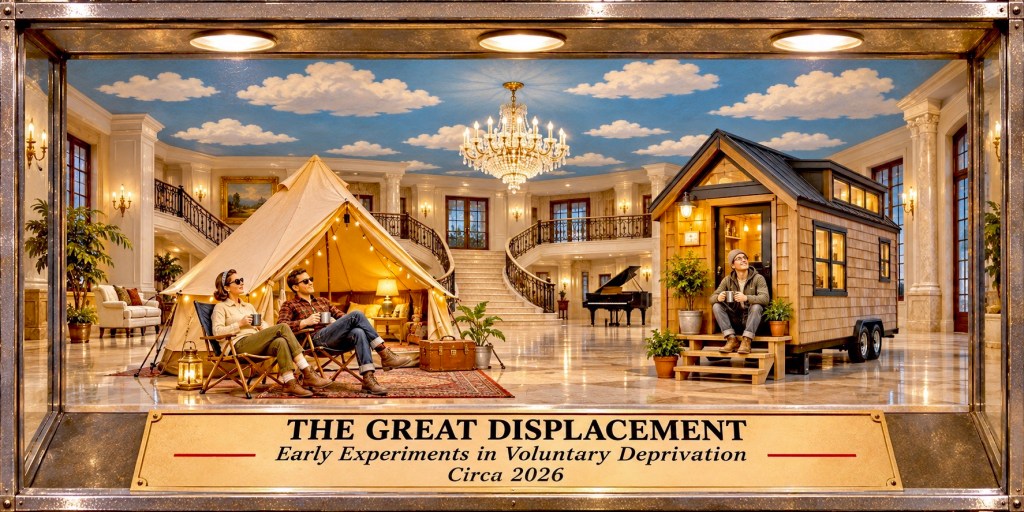
Consider glamping, in which affluent citizens pay considerable sums to occupy temporary shelters while enjoying amenities intended to disguise the fact that they are sleeping in tents.
Or the tiny-house movement, whose adherents voluntarily exchange conventional residences for dwellings resembling enlarged storage cupboards.
Both appear to be preparations for a future in which permanent housing becomes unavailable to large portions of the population.
The glampers are learning to appreciate temporary accommodation. The tiny-house enthusiasts are learning to appreciate the absence of space.
That some participants have invested their life savings in these experiments demonstrates an admirable seriousness of purpose.
The Great Silence
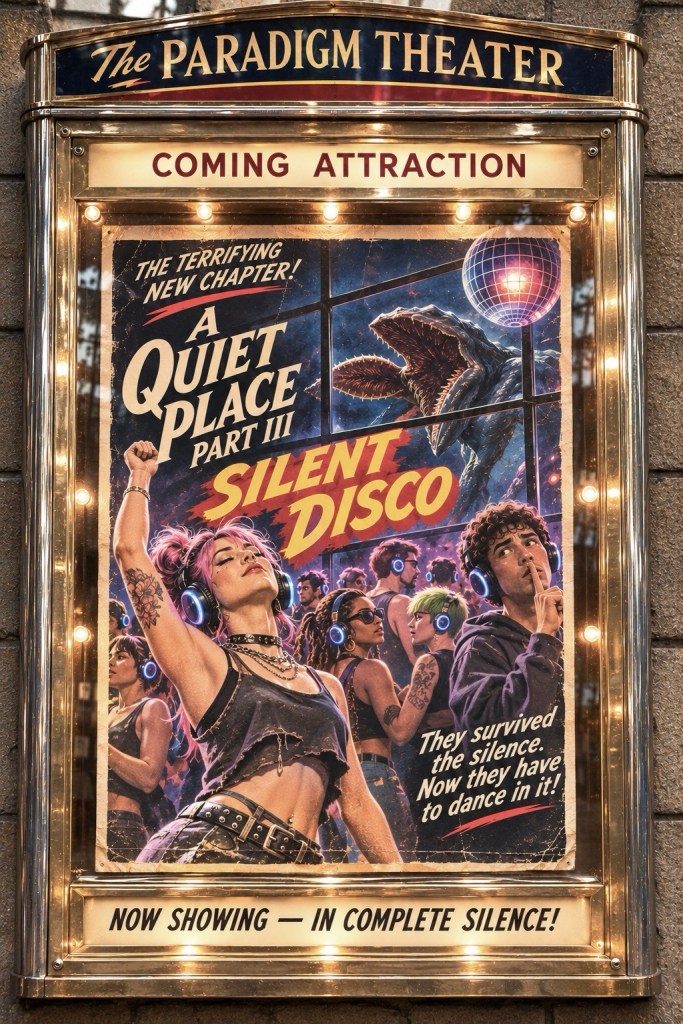
At silent discos, hundreds of people dance together to music that nobody outside their headphones can hear. The spectacle resembles a communal outbreak of involuntary movement without audible explanation.
We suspect these gatherings are rehearsals for a future in which making noise attracts dangerous predators, as depicted in the film A Quiet Place and its sequel.
The silent disco enthusiast will already have mastered the essential art of celebrating without announcing his location.
The Return of the Axe
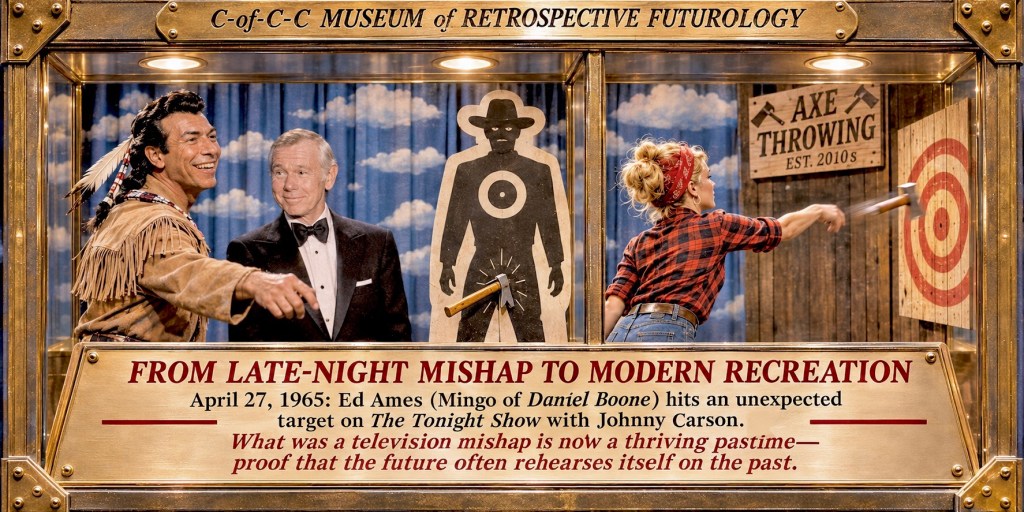
Across the civilized world, recreational establishments invite customers to throw axes at wooden targets, frequently while enjoying refreshments.
What appears to be an eccentric alternative to bowling may actually anticipate the exhaustion of ammunition and the collapse of modern weapons manufacturing.
The axe, unlike many contemporary weapons, requires neither batteries nor an internet connection.
The presence of alcoholic beverages at some of these establishments suggests that the training curriculum remains incomplete.
The Great Cooling
Devotees of the cold plunge voluntarily immerse themselves in freezing water, ostensibly for improved health, discipline, and personal transformation.
We suggest they are preparing for the eventual collapse of central heating.
As electrical grids deteriorate, those already conditioned to endure freezing temperatures will enjoy a distinct advantage.
We are particularly impressed by participants who purchase expensive equipment to reproduce conditions that future generations may experience free of charge.
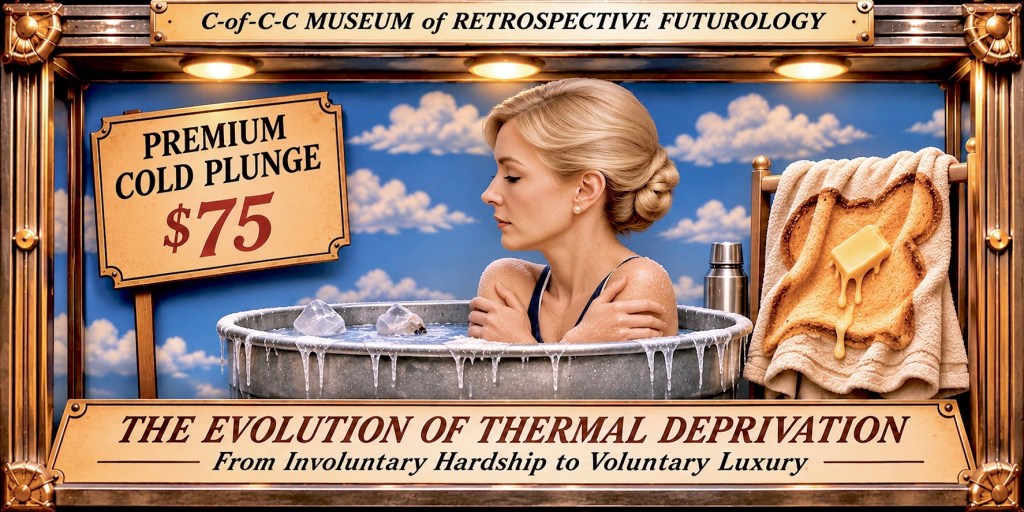
— Mrs. Begonia Contretemps
Additional Evidence
Space does not permit a full examination of every phenomenon that has attracted our attention. Nevertheless, several deserve mention.
Artificial fingernails: Elaborate nail extensions may anticipate the development of specialized human claws, particularly useful in a future requiring excavation without mechanical assistance.
Escape rooms: Participants voluntarily submit themselves to confinement and attempt to discover a means of release. Elementary preparation, perhaps, for escaping the detention facilities of some future authoritarian regime.
Competitive eating: A useful skill in an age when food becomes available only at unpredictable intervals and must be consumed before it disappears.
Pajamas in public: Anticipation of a society in which the distinction between domestic, professional, and civic life has disappeared entirely.
Rage rooms: Preliminary training in the dismantling and salvage of abandoned technological infrastructure. We are particularly intrigued by this last development.
For centuries, civilization devoted considerable effort to teaching people how to manufacture things. It now appears to be teaching them how to break things. We hesitate to speculate upon the significance of this reversal.
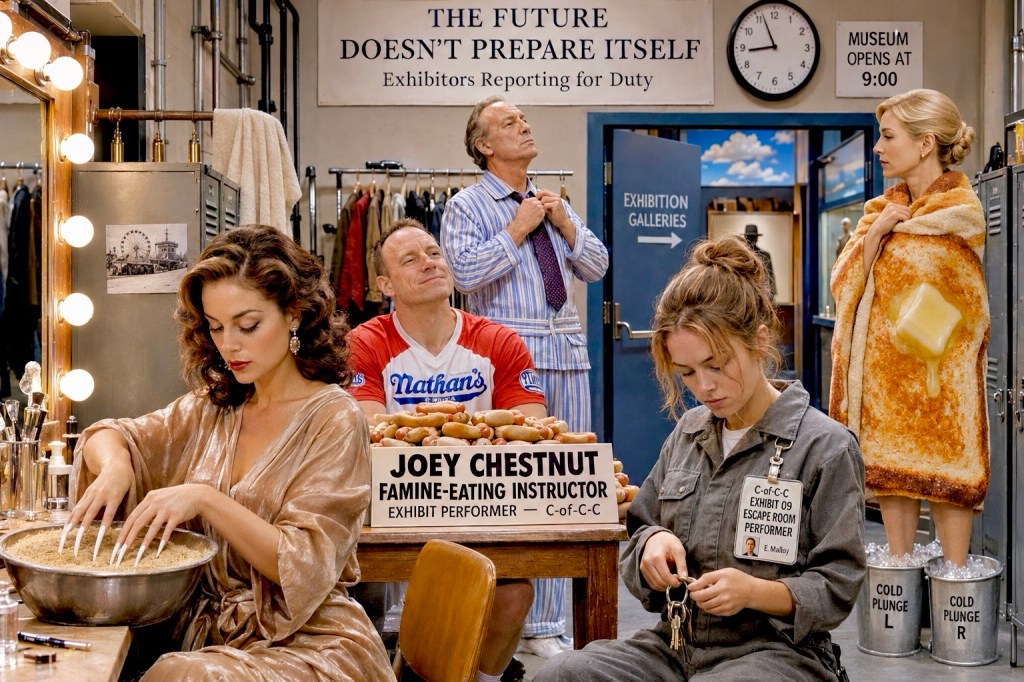
Before the doors open at the C-of-C-C Museum of Retrospective Futurology, the living exhibits report for duty, preparing to demonstrate tomorrow’s catastrophes at yesterday’s wages. Unlike most museums, where the exhibits are dead, ours merely wish they were.
A Search for Predecessors
Having developed our theory and assembled what we consider a respectable body of evidence, we naturally turned to the scholarly literature.
This is generally the point in our investigations at which we discover that someone else has already thought of the idea.
We regret to report that the present inquiry has proved no exception, although the precedents are not exact.
The French philosopher Henri Bergson, in The Possible and the Real, explored the curious manner in which events, once realized, seem to create their own possibilities retrospectively. What had previously appeared unimaginable becomes, after the fact, something that we persuade ourselves was waiting to happen all along.
This bears a certain resemblance to our investigation, although Bergson does not appear to have devoted much attention to furry conventions.
We also discovered David Macaulay’s delightful 1979 illustrated book Motel of the Mysteries, in which archaeologists of the distant future excavate an American motel and interpret its ordinary furnishings as mysterious artifacts of a vanished civilization.
Macaulay’s scholars are looking backward from the future, while we are looking forward from the present. Nevertheless, the resemblance is sufficient to cause us some professional discomfort.
Nor was Macaulay the first to explore such possibilities.
As early as 1812, the architect Sir John Soane imagined future antiquarians examining the ruins of his own residence and attempting to reconstruct the civilization that had produced them.
Finally, we encountered Ossip K. Flechtheim, who helped establish the modern concept of futurology as a systematic investigation of possible futures.
We acknowledge these predecessors with the customary scholarly mixture of gratitude and resentment.
But none appears to have proposed precisely our method: the interpretation of contemporary eccentricities as unconscious preparations for future conditions.
We therefore retain some hope of originality.
A Provisional Conclusion
It would be premature to claim that our investigations have established Retrospective Futurology as a legitimate academic discipline. Further research is plainly required, although we are uncertain what form such research should take.
Ordinary scholars can test their theories against the historical record. Our difficulty is that the relevant historical record has not yet been written. We must therefore await the arrival of the events that will either confirm or discredit our conclusions.
In the meantime, we advise readers against dismissing any contemporary custom merely because it appears ridiculous, extravagant, or wholly without practical purpose. The people engaging in such activities may be preparing for circumstances that the rest of us have not yet imagined.
Indeed, it is entirely possible that the most absurd-looking members of our civilization will eventually prove to have been its most farsighted.
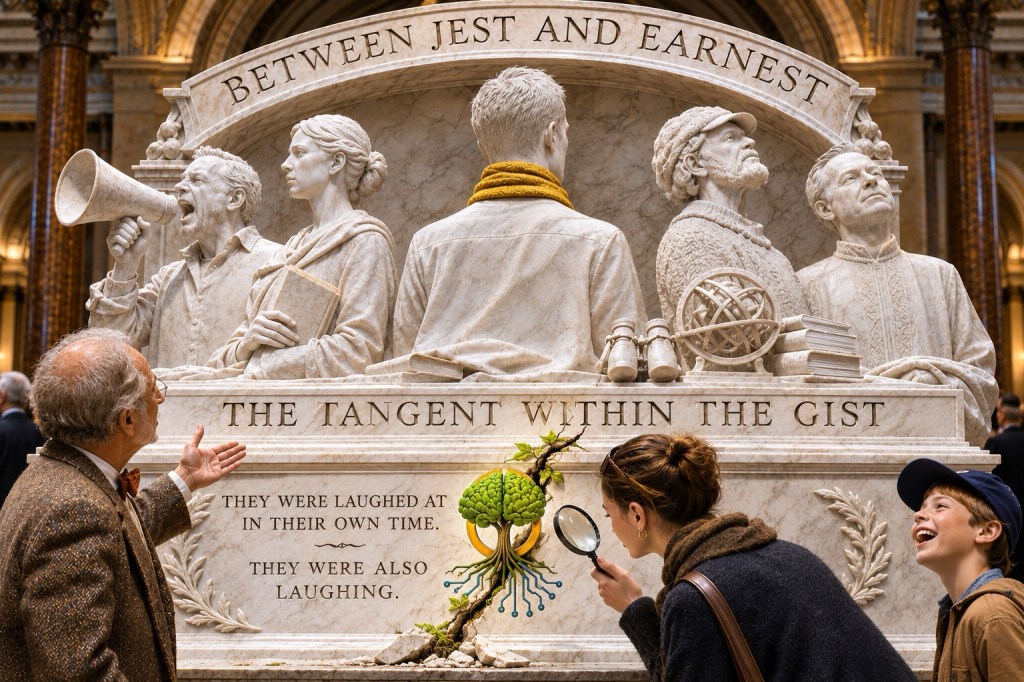
The Council of Concerned Conservationists, as posterity may someday remember it. For further evidence that yesterday’s cranks have a curious habit of becoming tomorrow’s visionaries, see Paul Laity’s A Brief History of Cranks.
We would find this conclusion more reassuring if we had not already examined the evidence.
After all, my great misfortune is that whenever methinks of something original, I eventually discovered that somebody else has already thought of it.
But this time I have an advantage.
Nobody can accuse me of getting the future wrong. Not yet.
The Backward Scholar (B.S.) respectfully submits these findings to his colleagues, including those he hasn’t necessarily met yet.
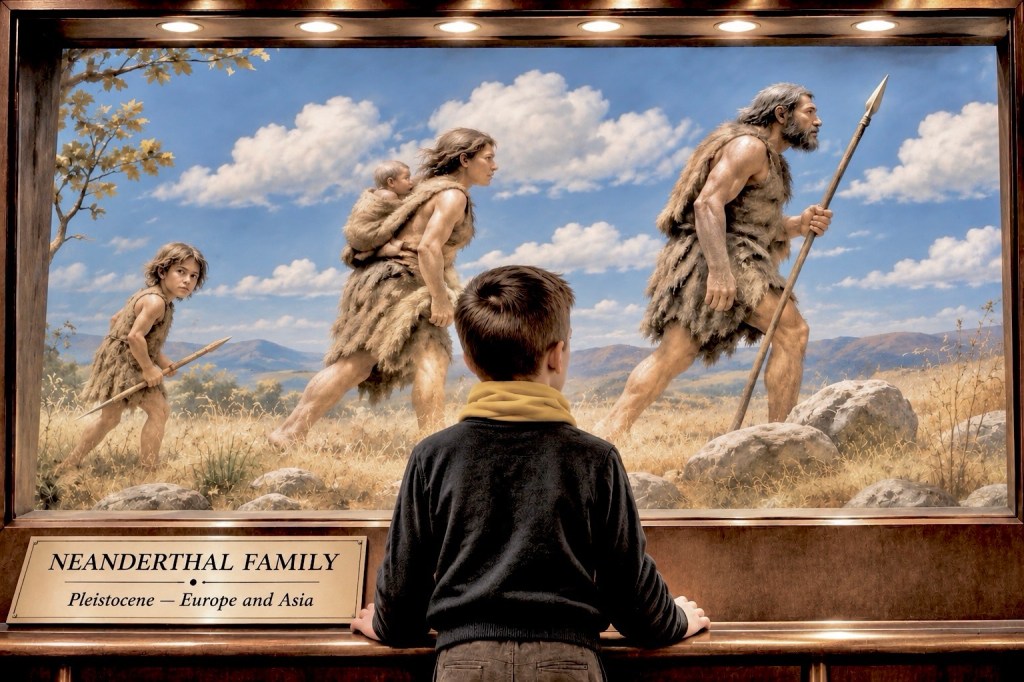
At the age of five, John St. Evola was taken to New York City’s American Museum of Natural History by an aunt and uncle determined to introduce the boy to the finer accomplishments of civilization.
Their efforts were not wasted. Among the museum’s many wonders, one exhibit left an impression bordering on the numinous: a three-dimensional diorama depicting a Neanderthal family making its way across a prehistoric landscape. Beneath the carefully illuminated heavens, these distant human relatives seemed almost alive, momentarily arrested in their journey through an otherwise vanished world.
The little boy stood transfixed. Something about those figures, separated from him by tens of thousands of years and a pane of glass, stirred a sense of recognition he could neither explain nor forget.
Many decades later, a commercial genetic test informed St. Evola that he possessed more Neanderthal ancestry than 97 percent of the people tested.
It is a curious experience to discover, so many years afterward, that one may have been visiting relatives.
And perhaps an even more curious one to wonder whether, on that long-ago afternoon, the recognition had been mutual.
More From The Backwards Scholar Can Be Found : HERE


Leave a Reply