—Mrs. Begonia Contretemps Begins A Sentence.
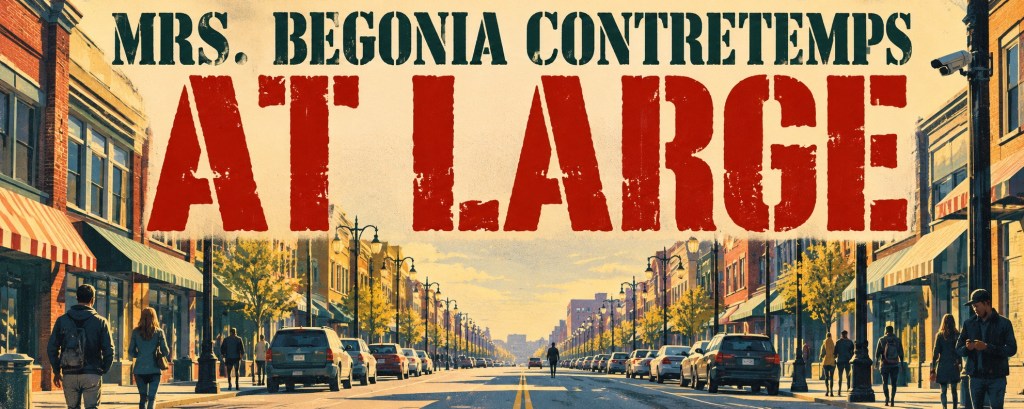
Mrs. Begonia Contretemps is an observer by temperament and a writer by unfortunate consequence. Give her an ordinary day, a few errands and somewhere to sit with a cup of coffee, and sooner or later she will notice something.
And once Mrs. Begonia notices something, she generally begins writing it down.
I had three things to do: petrol for the Mini, several things from the shops and coffee somewhere along the way. It was not, I should emphasize, an assignment.
At the filling station there were three cameras above the pumps, another over the door and something on a pole at the entrance whose purpose I could not determine but whose attitude was unmistakable. The machine wanted my ZIP code, the camera wanted my face, and something somewhere presumably identified the registration number of the Mini Cooper
The automobile merely wanted petrol.

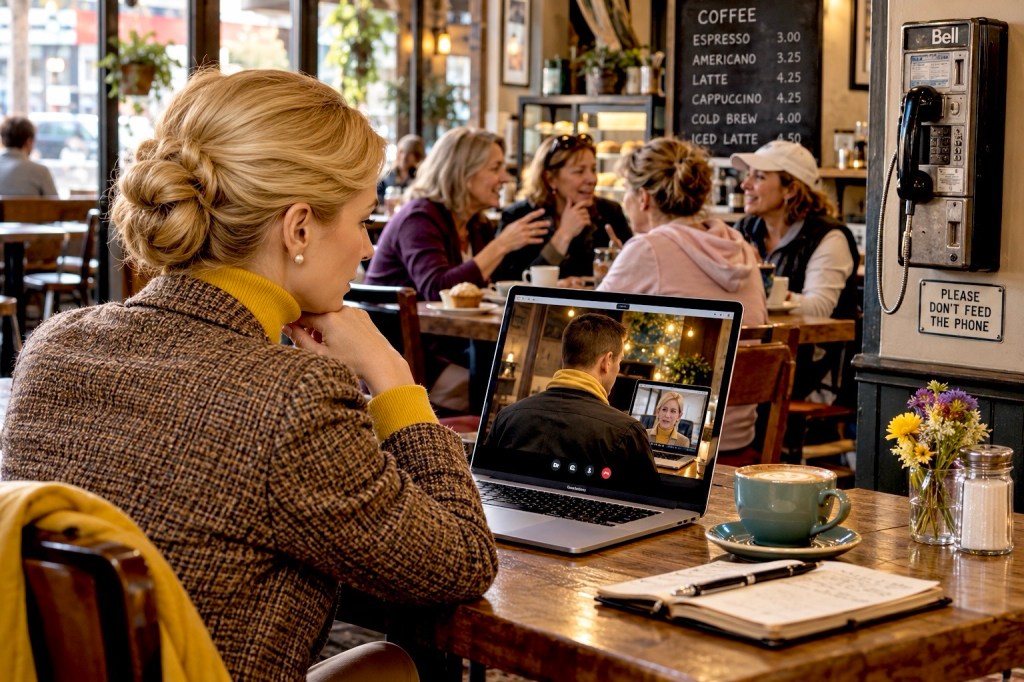
At the coffee shop I found a table beside four middle-aged women dressed as though they had either just exercised or wished it understood that they could.
“I’m not ratting her out.”
“She snitched on herself.”
“I did my time on that committee.”
“You got out. I’m still stuck there.”
“Stay out of it. It’s a turf war.”
I looked over. One was dividing a blueberry muffin into quarters. Another was showing photographs of her granddaughter. A third wore a sweatshirt from a charity walk.

I opened my laptop and made the mistake of looking at social media. Several hundred people were fighting. Factions had formed, allies were being summoned, old grievances produced and screenshots passed around as evidence. Everyone seemed to know who belonged with whom and who had crossed whom.
Then John St. Evola appeared on my screen.
“Morning, Begonia.”
“Morning, John.”
“Raining there?”
“A little.”
“Here too.”
He wanted to know whether I had seen a folder he’d left at the pub. I hadn’t. I asked whether Vito had found his bullhorn. He hadn’t. John said he was making eggs. I told him not to overcook them. We said goodbye, and John’s face vanished from behind the glass.
I sat looking at the blank screen for a moment. After listening to the women at the next table talk about rats, snitches, doing time and turf, I had just spent several minutes speaking to a familiar face through a sheet of glass about nothing in particular.
It had the unmistakable quality of prison visitation. The only thing missing was a telephone handset bolted to the wall.
I looked up. There was one. Granted, it appeared to be there ironically.
This was becoming troublesome.
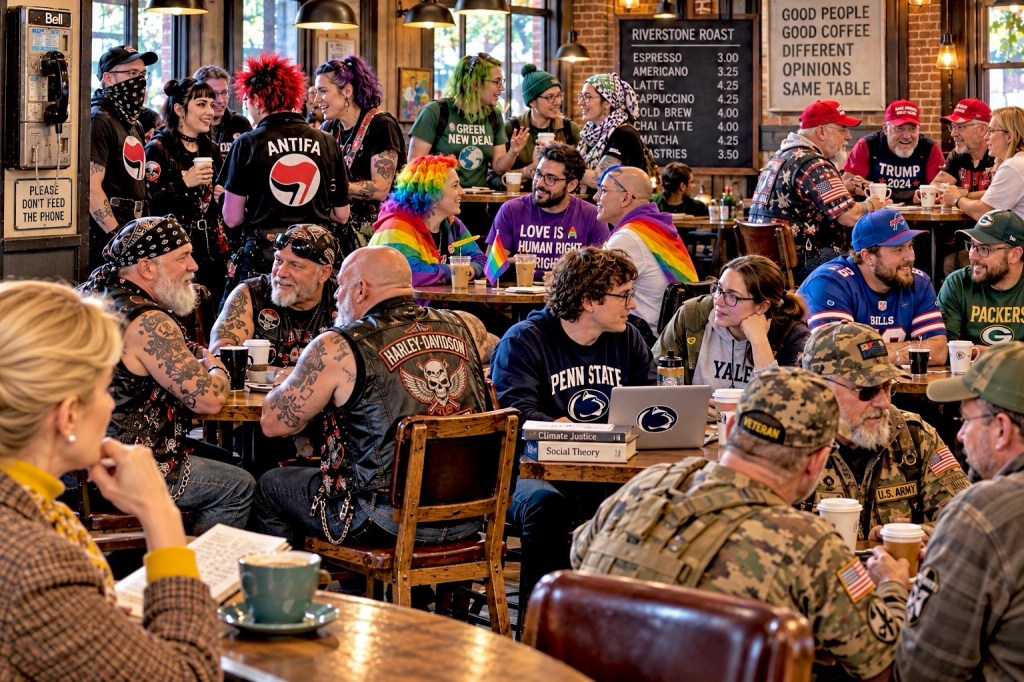
At the chemist I noticed tattoos. The cashier had flowers from wrist to elbow, the man ahead of me had a bird across his neck, and an elderly woman studying greeting cards had one on her ankle.
There was a time when a tattoo suggested sailor, soldier, biker, prisoner, or someone who had awakened in Singapore or Portland without a satisfactory account of the previous evening. Now it indicated principally that the owner possessed skin.
Then came the colors: football jerseys, a rainbow bag, a red political cap, college insignia, motorcycle patches, military emblems, causes and slogans. Americans no longer seemed to require introductions. One could simply read them as gangs.
On the way to lunch I began noticing cameras everywhere: shops, houses, doorbells, car parks, intersections. By now I had been photographed buying petrol and entering the chemist; my bank knew where I had spent money, my telephone knew where I was, and a number-plate reader had taken an interest in the Mini.
If I disappeared, an investigator could probably reconstruct my morning more accurately than I could.
At lunch a man photographed his sandwich before eating it. A delivery driver consulted a telephone telling him where he must go next. Someone nearby had been “blocked,” another “reported,” and somebody else “banned.”
And suddenly the morning rearranged itself :
Rat. Snitch. Doing time. Turf.
The tattoos. The colors. The cameras. The factions milling around my laptop.
Good Lord.
The Internet was the yard. The cameras were the watchtower. And apparently I had already had visitation. We had simply improved upon the old system by carrying much of it around in our pockets.
I was tired of my own observations and stopped for lunch. An intrusive thought occurred to me: perhaps the fast-food industry, having exhausted every other theme, will at last discover prison cuisine.
I really had to stop doing this.

Once I had seen all this, other things became troublesome.
Bail reform in places such as New York meant that for whole categories of charges, defendants who might once have waited behind bars were instead released pending trial. This did not make them criminals; an accused person is not a convicted one, and in many cases the law rather than the judge determined what forms of detention were available. As one streetwise acquaintance once put it, “They’re usually not there for nothing.”
Still, from the narrow standpoint of my theory, it represented another movement from inside to outside.
Nor was prison the first institution to accomplish this. The great mental hospitals had been emptied decades earlier as psychiatric care moved into the community. The walls disappeared; treatment increasingly followed the patient outside. The lobotomy had gone out of fashion. The prescription bottle was considerably more portable.
We called that deinstitutionalization.

I began to wonder whether we had deinstitutionalized the institutions or merely externalized them.
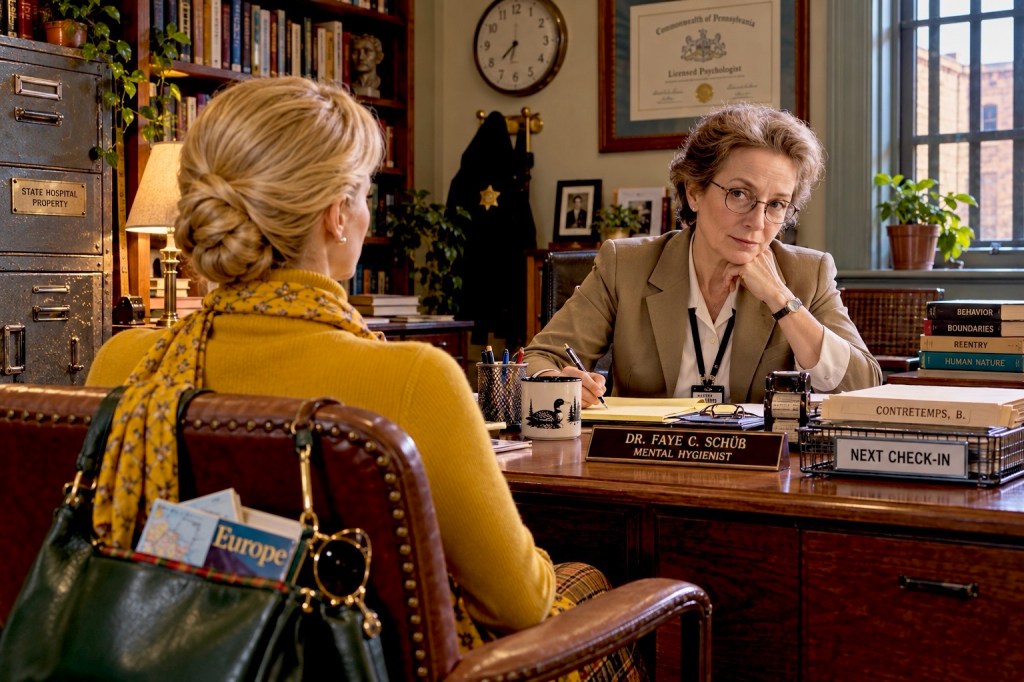
I made a note to think about this further, then noticed another note in my diary reminding me of my appointment with my analyst the following morning.
For the first time it struck me that I reported to the same person at regular intervals, sat in the same chair and gave an account of what I had been thinking and doing since our previous meeting. But now I pay for it instead of the state!
Parole officer, I wrote beside the appointment. Then crossed it out.
There are limits.
Begonia glanced toward the window.
“It’s being released back into society that worries me.”
I drove home after what had been, by any reasonable standard, a pleasant day. Nobody had detained me. I had bought petrol, drunk coffee, spoken to John, done my shopping and eaten a satisfactory lunch.
That was what made the thing interesting.
The language had come outside. So had the markings, the colors, the yard, the visitation and the surveillance. Even confinement itself seemed less certain about where its boundaries belonged.
I thought I had finished with the matter. Then I turned on the television.
The President of the United States appeared. Donald Trump had been convicted by a New York jury on thirty-four felony counts. Whatever one thought of the prosecution, that particular fact was not a political opinion.
Then came Congress.
Members of Congress could buy and sell shares while holding offices capable of exposing them to information unavailable to the ordinary investor. Insider trading was illegal, of course, and Congress had thoughtfully passed a law specifically affirming that insider-trading laws applied to Congress.
I found this reassuring in much the same way I would find a notice in a bank reassuring which read :
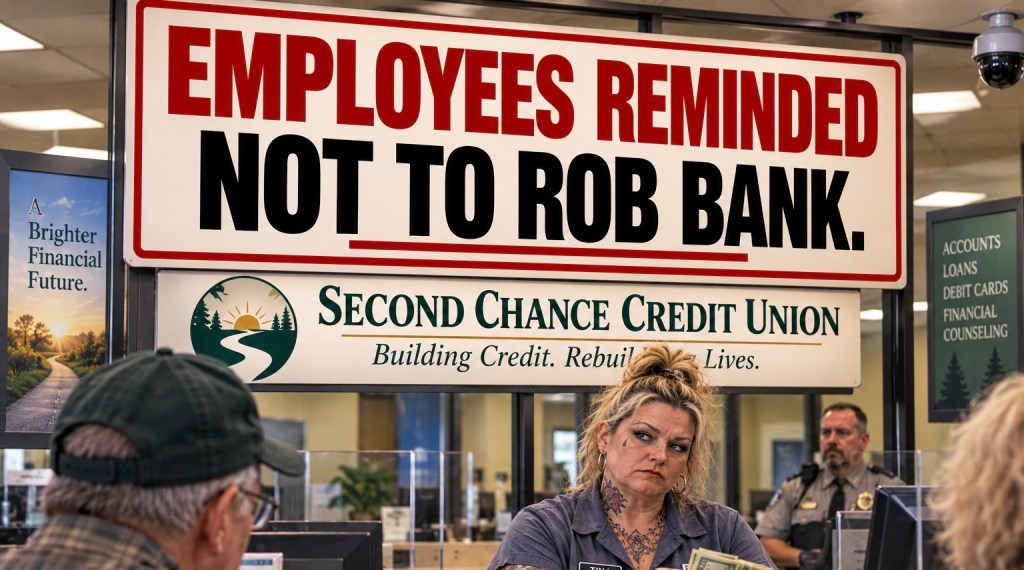
I switched off the television.
All day I had been wondering how prison culture had managed to escape into ordinary society. Perhaps I had the arrangement backwards. Perhaps the remarkable thing was not that the prison had been externalized.
Perhaps we were living in the yard, and the people running the place were merely the inmates who had acquired offices.
I considered this for a moment.
There remained one important distinction between prison and the world outside.
The fence.
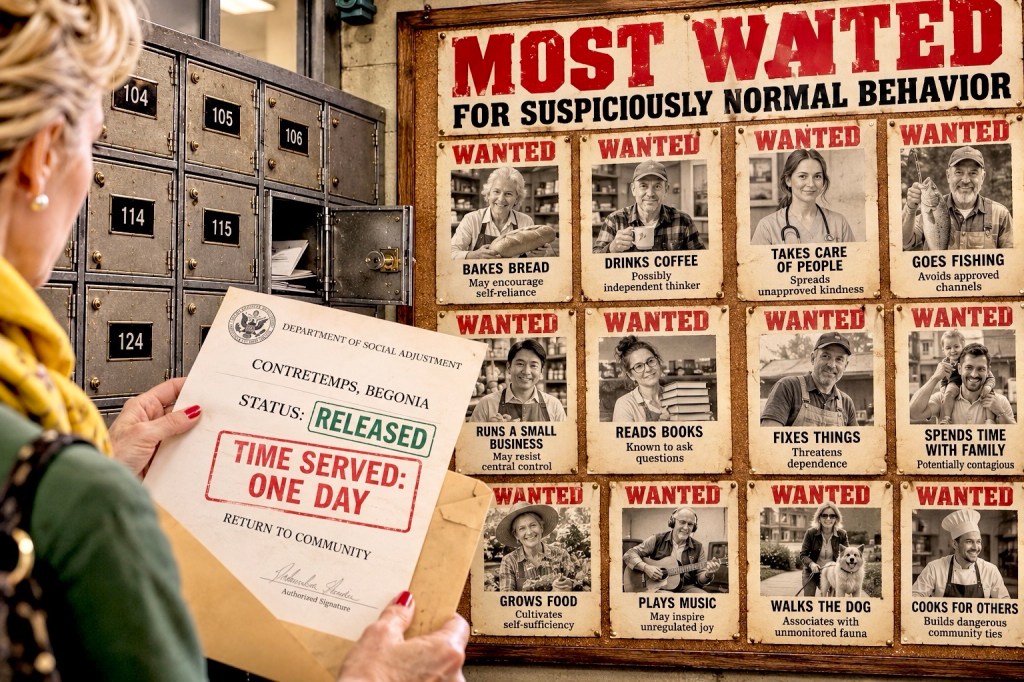
I picked up my mail, went to my temporary domicile and began knitting.
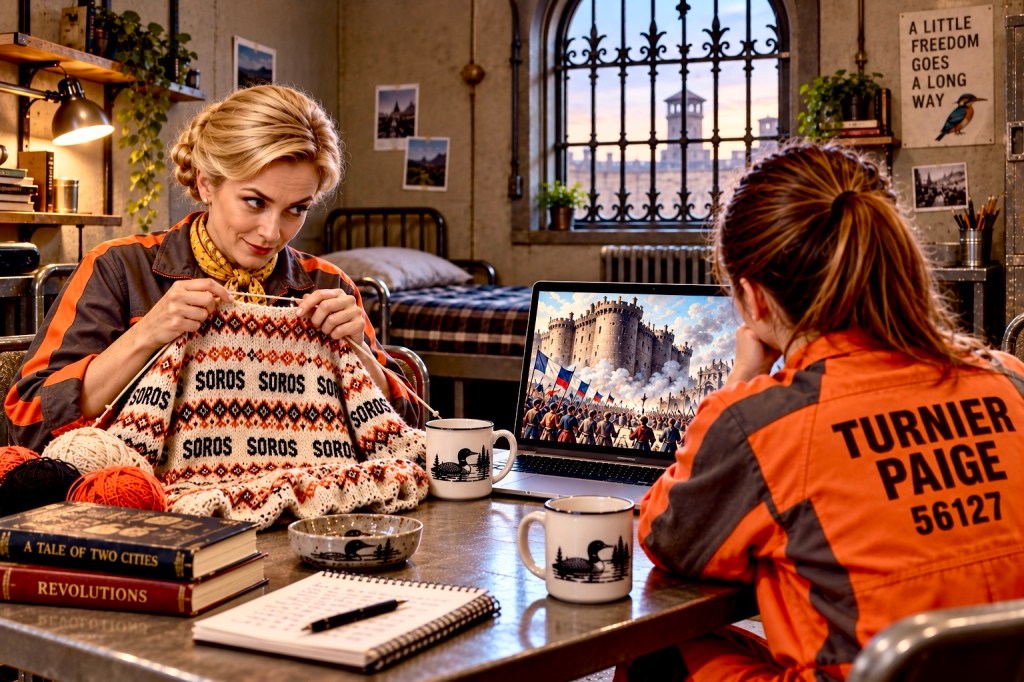
Paige looked back at her laptop.
“You know, Mrs. Begonia, the French Revolution began when they opened up the Bastille.”
The Compleat Writings of Mrs. Begonia Contretemps Will Be Found: HERE


Leave a comment