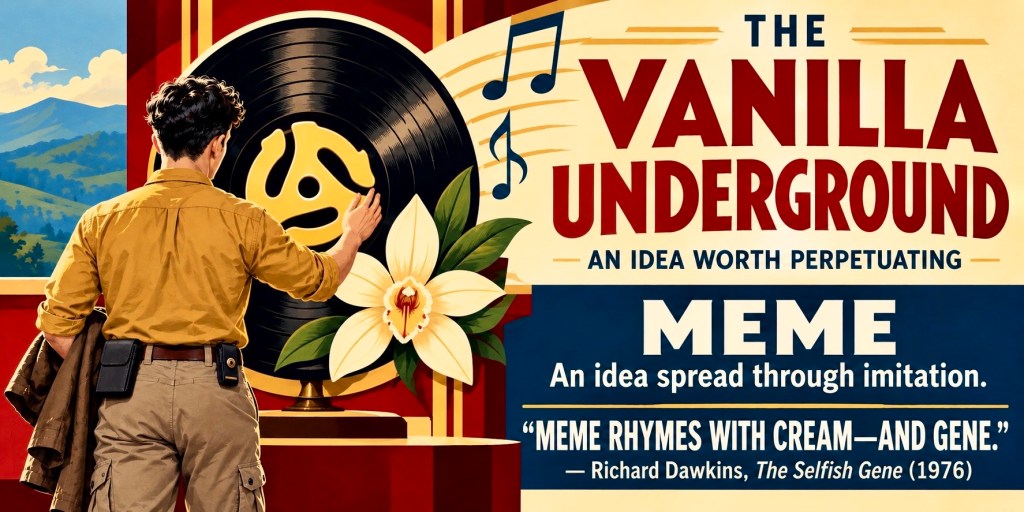
Revolutions have been fought over land, liberty, religion, and the distribution of wealth. It was perhaps inevitable that sooner or later one would be fought over music and ice cream. The Council of Concerned Conservationists reveals a clandestine movement dedicated to preserving sweetness in an increasingly unsweetened world. Headquartered beneath The Gist & Tangent Pub/Book Annex, with author Joseph Lanza as its revolutionary godfather and the Council’s Official Meme Curator, Noah Paologese, as its organizer, the movement has issued a declaration of principles. What follows is an account of its origins and its manifesto.
THE ASCENT
Noah Paologese, the Council’s official Meme Curator, had come to Buffalo in search of an idea with staying power.
Not one of those ephemeral little pictures circulating on the Internet, but something considerably larger and more durable: the architectural expression of progress.
Noah had lately undertaken a tour of America’s less celebrated Art Deco buildings, hoping to determine precisely what their builders had meant to communicate. Art Deco was not merely a style. It was a declaration of confidence in the future, expressed through geometry, ornament, and the determined upward thrust of buildings that appeared impatient to leave the earth.
Buffalo seemed an unlikely place to pursue such an investigation, which was one of the reasons Noah had chosen it.
There, standing before the magnificent Rand Building, he contemplated a civilization that had once believed tomorrow would be an improvement upon today.

The building’s association with broadcasting particularly interested him. Here was architecture belonging to an age when radio promised to carry music, news, and the human voice into every household.
Noah entered the elevator.
As the doors closed, a recording began playing through a concealed speaker. The accompaniment was bright, buoyant, almost reminiscent of the cheerful pop songs of the 1950s. But the singer, a young Black man apparently in his twenties, delivered the melody in an exaggerated baby voice, stretching his vowels and dispensing little morsels of cuteness as though he were being rewarded for good behavior.
Noah listened.
He had nothing against sweetness. Quite the contrary. But he was beginning to suspect that contemporary popular music had confused sweetness with the impersonation of infancy.
The elevator rose. The music descended.
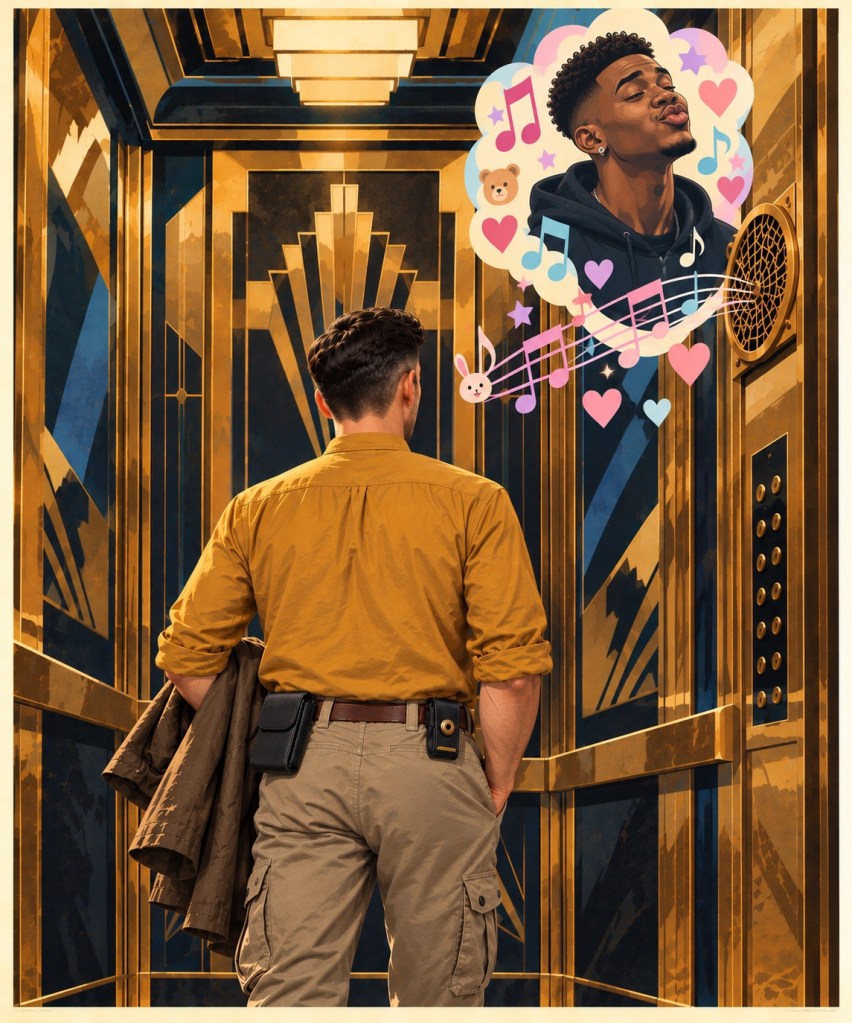
He remembered another age, when elevators had played what was actually called elevator music.
The term had become an insult, but the music itself had been intended as a courtesy: a pleasant accompaniment to an otherwise unremarkable journey between floors.
Somewhere along the way, Noah reflected, civilization had decided that making people comfortable was aesthetically suspect.
By the time the elevator reached its destination, he had reached a decision. To elevate music, it would first be necessary to go underground.
THE DESCENT
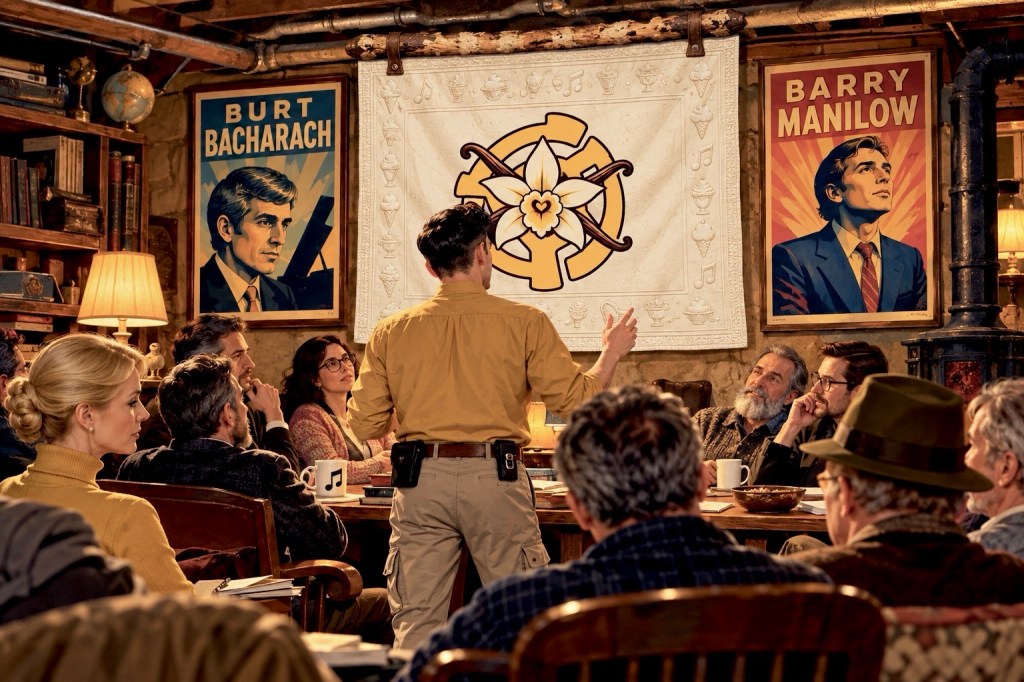
Several days later, beneath The Gist & Tangent Pub/Book Annex, a small company assembled in a basement ordinarily reserved for surplus books, neglected furniture, and life-size plaster and concrete statues of Catholic saints and angels whose cracks and missing extremities had rendered them unfit for display, though not quite deserving of disposal.
At the front stood Noah Paologese.
Behind him hung the standard of the newly constituted Vanilla Underground: a golden 45-rpm record adapter adorned with a vanilla orchid and crossed vanilla beans, displayed upon an oversized vanilla-colored ice cream napkin.

The standard was suspended from a wooden staff bearing the unmistakable marks of beaver workmanship.
Noah had personally supervised its design.
Along the walls hung revolutionary portraits of Burt Bacharach, Paul Williams, and other distinguished figures in the struggle for melody.

Barry Manilow occupied a place of particular honor.
Justin Aldmann was present, lending the proceedings the reassuring appearance of a movement whose members had actually lived through the civilization they proposed to restore.
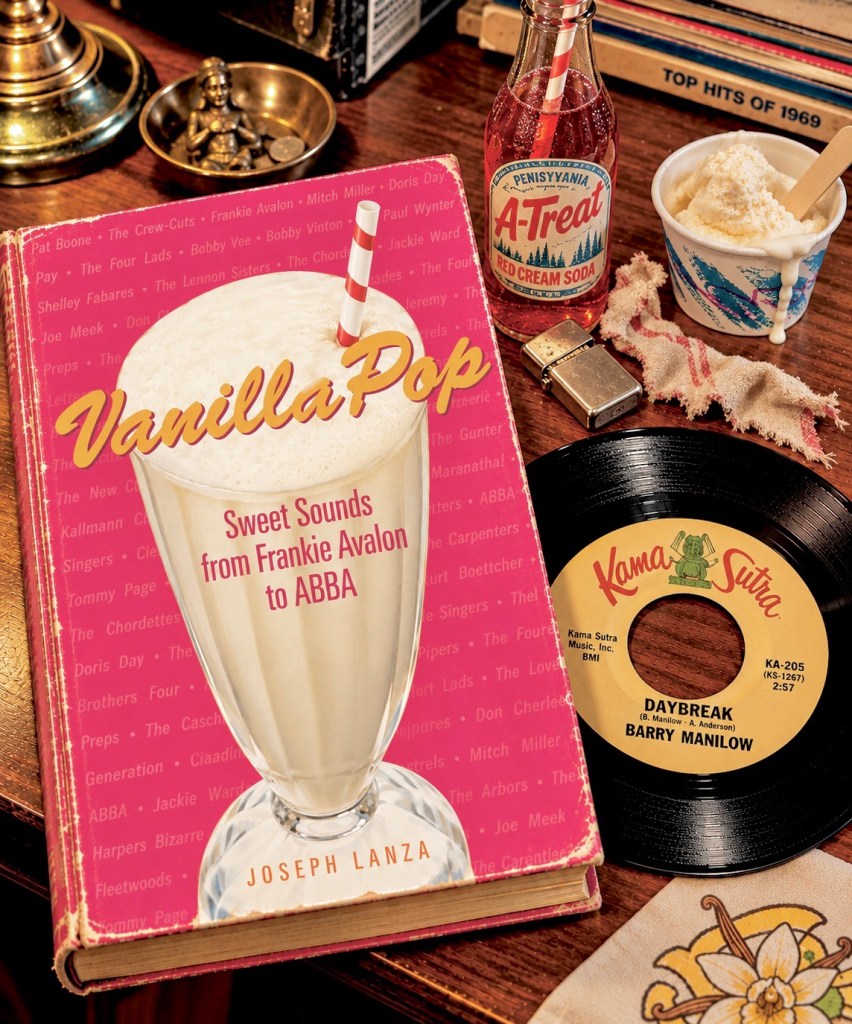
On a small lectern rested a book.
Its cover depicted a vanilla milkshake crowned with whipped cream.
The book was Joseph Lanza’s Vanilla Pop: Sweet Sounds from Frankie Avalon to ABBA.
Noah raised it before the assembly.
“Comrades,” he announced, “our revolutionary godfather has already provided us with the theoretical foundation.”
A member near the rear whispered, “Our Lenin?”
“Precisely.”
“Not Lennon?”
“No. Lanza.”
The distinction having been established, Noah opened his manifesto.
THE MANIFESTO OF THE VANILLA UNDERGROUND
I. IN DEFENSE OF SWEETNESS
“Partisans of Melody and Patriots of Vanilla!”
“We have assembled here not because the world is insufficiently noisy, nor because there is any shortage of people willing to tell us what we ought to enjoy.
“We have assembled because sweetness has fallen into disrepute.
“We are told that music must challenge us, confront us, disturb us, or otherwise make demands upon our nervous systems before it may be considered worthy of serious attention.
“We reject this proposition.
“We hold that a melody does not become less beautiful by being pleasing, nor a pleasure less worthy by being innocent.
“We further hold that difficulty is not necessarily depth, harshness is not necessarily honesty, and the refusal to give pleasure is not, in itself, an artistic achievement.
There is no shame in a tune that can be hummed.”
“There is no disgrace in a chorus that can be remembered.
“And there is no moral obligation to apologize for enjoying either.”
A modest burst of applause followed. Noah waited for it to subside.
“Let us be clear about what we mean by sweetness. We do not mean the affected helplessness of a grown singer pretending to be a child such as the attempt at song I encountered in the elevator. . . and you may have on occasion heard, too. We do not mean the substitution of cuteness for beauty, or coyness for tenderness.
“Real sweetness does not require the abandonment of adulthood.
“Indeed, some of the sweetest music ever composed was written by adults who understood perfectly well that life was not always sweet.”
II. OUR MUSICAL INHERITANCE
“We acknowledge our debt to Burt Bacharach, whose melodies could take the most unexpected turns and still arrive somewhere beautiful.
“To Paul Williams, who understood the peculiar dignity of a sentimental song.
“To the Carpenters, who demonstrated that restraint and precision could produce an emotional force far greater than shouting.
“To Bread, Chad & Jeremy, Glen Campbell, and those other practitioners of a musical art in which melody was permitted to occupy the foreground.
“To the Moody Blues, who understood that an orchestra need not apologize for accompanying a popular song.
“And to Barry Manilow, whose ‘Daybreak’ reminds us that the arrival of another morning is an occasion worth celebrating.”
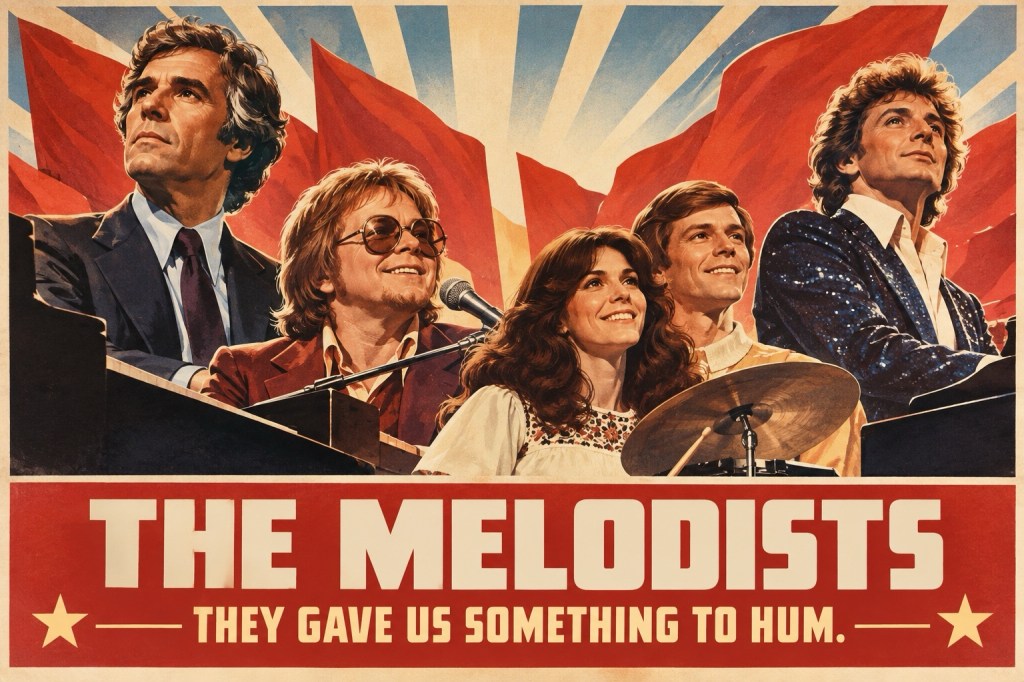
“We do not insist that all music resemble theirs. We merely refuse the proposition that their achievement was trivial because it was agreeable.
“Nor do we propose to conquer every musical territory. We have no ambition to absorb jazz, blues, rock, rap, or any other established province into our movement.
“Let those traditions maintain their own standards, their own heroes, and their own enthusiasts.
“We ask only that ours be permitted to exist without embarrassment.
“Our revolution is not universal. It is vanilla.
III. THE ORCHID AND THE QUESTION OF VIRILITY
At this point Noah turned toward the standard hanging behind him.
“Some have suggested that our movement is excessively soft. That our music lacks vigor. That our affection for melody, sentiment, and sweetness betrays a deficiency of masculine spirit.
“Such critics have neglected their botany. Vanilla, comrades, is the fruit of an orchid. And the word orchid derives from the Greek orchis, meaning testicle, a reference to the paired underground tubers of certain members of that distinguished botanical family.”
A small murmur passed through the assembly.
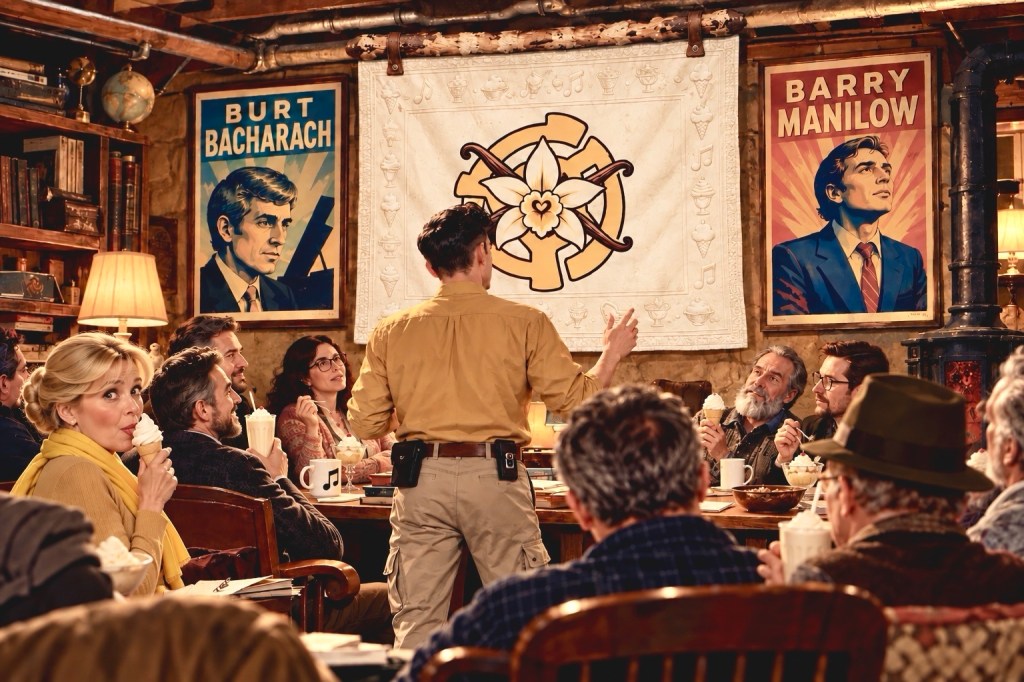
“Let it be understood that the vanilla orchid itself is a climbing tropical vine, rather than one of those tuber-bearing terrestrial orchids. We are revolutionaries, not botanical frauds. Nevertheless, the etymology is instructive.
“Nature, it would appear, has never regarded sweetness as incompatible with virility.”
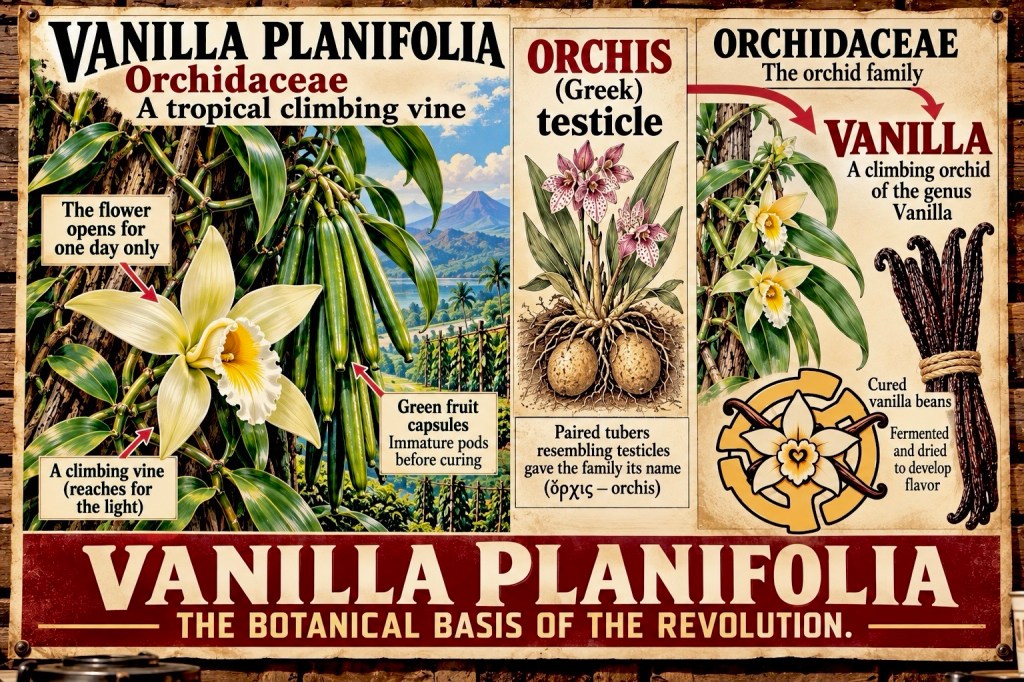
“Indeed, sweetness is frequently associated with generation. The flower produces the fruit. The fruit contains the seeds. Life perpetuates itself not merely through struggle, but through attraction, fertility, and abundance.
“We reject the notion that masculine strength must only announce itself through harshness. The capacity to create beauty, to cultivate tenderness, to protect what is good, and to bring forth something pleasing into the world is not a repudiation of strength.
“It is one of strength’s finest employments.
“Consider also the word pop.
“It denotes our music, certainly. But it is also an affectionate name for a father.
“Vanilla Pop!
“Even our name, comrades, contains a paternal correspondence.”
Noah allowed this discovery a moment of respectful silence.
“Whether Providence intended the pun is beyond the jurisdiction of this committee.”
IV. ON THE GRACE OF GOD
“Now we arrive at the foundation of our cause.
“We acknowledge with gratitude the grace of God, who gave mankind the capacity to make sweet music and, in His generosity, also provided the vanilla orchid.
“Neither music nor ice cream is strictly necessary for human survival.
“One may continue breathing without a Bacharach melody. One may perform one’s daily duties without a dish of vanilla ice cream. But what a diminished existence that would be!
“We have been given more than the bare requirements of life. We have been given the capacity to delight in it.
“Nature supplies the flower and its fruit. Human patience, ingenuity, and cultivation transform that fruit into one of the world’s most beloved flavors.
“The physical world supplies vibration, rhythm, proportion, and the astonishing possibilities of sound. Human imagination transforms them into melody and harmony.
“In both cases, something ordinary becomes extraordinary through the cooperation of creation and human creativity.
“We do not demand that life be sweet at every moment. We know perfectly well that it is not.
“But when sweetness is offered, we refuse to turn away from it merely to demonstrate our sophistication!
“We will not mistake bitterness for wisdom.
“We will not confuse ugliness with truth.
“And we will not apologize for enjoying the blessings of civilization.”
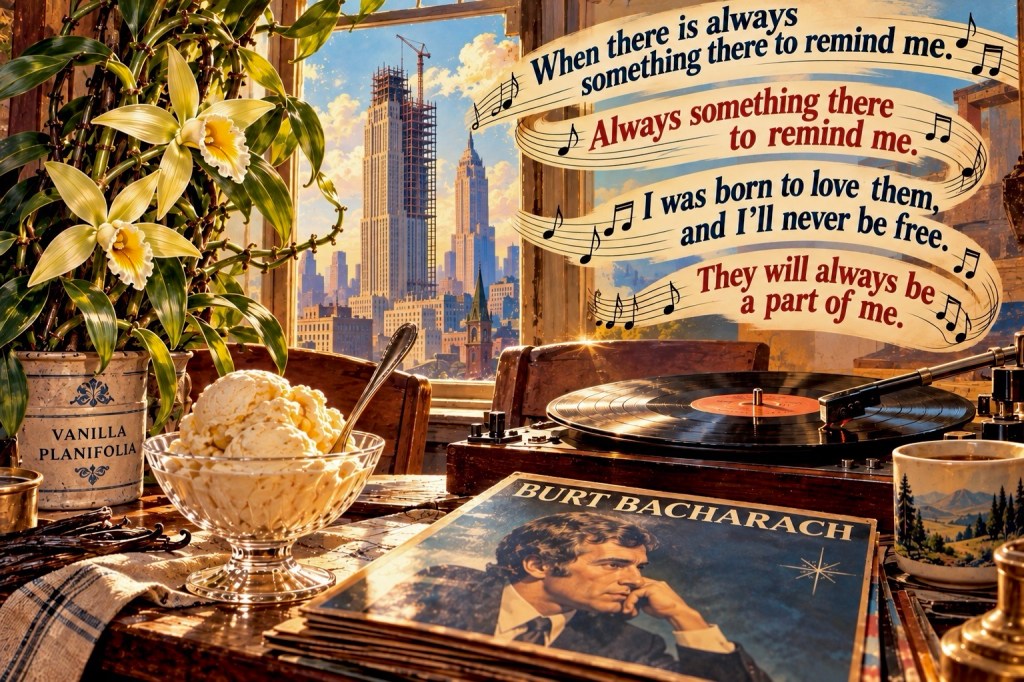
V. OUR REVOLUTIONARY OBJECTIVES
“Let it therefore be declared that the Vanilla Underground does not seek the overthrow of civilization. We seek the restoration of certain pleasures civilization has become too sophisticated to admit enjoying.
“We demand the right to listen to a beautiful melody without furnishing an explanation.
“We demand that an orchestra be permitted to sound like an orchestra.
“We demand that a sentimental lyric be judged by whether it expresses a genuine sentiment, rather than by whether sentiment itself has become unfashionable.
“We demand the rehabilitation of elevator music, not as a universal musical standard, but as evidence that there was once an age in which even a brief journey between floors might be accompanied by something pleasant. And we demand that vanilla ice cream be recognized not as the absence of flavor, but as a flavor in its own right.
“We are not embarrassed by sweetness. We are grateful for it. And we shall defend it!”
Noah closed his manifesto. For several moments the assembly remained silent. Then Justin Aldmann began to applaud. The others joined him.
DAYBREAK
There remained one final item of business.
Noah approached an old turntable, selected a record, and carefully lowered the needle. Barry Manilow’s “Daybreak” filled the basement.
The members of the Vanilla Underground listened, some smiling, some quietly keeping time.
Justin Aldmann settled back in his chair.
Above them, in The Gist & Tangent Pub, ordinary life continued without the slightest awareness that a revolution had begun beneath its floorboards.
No barricades had been erected. No windows had been broken. No manifestos had been nailed to the doors of public buildings. The revolutionaries had merely resolved to preserve something they loved.
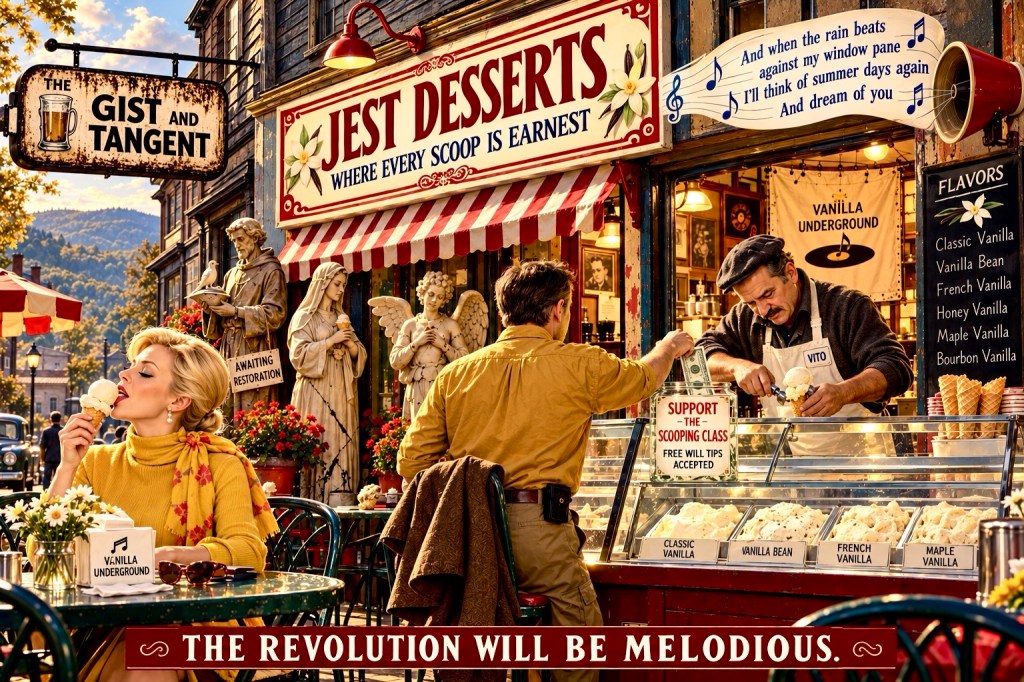
And somewhere in the room, a partisan was wrestling a scoop through a tub of rock-hard vanilla ice cream, performing the honest labor that modern soft-serve machines had largely abolished by discovering how to sell air at the price of ice cream.
A NOTE ON VANILLA POP
Condensed from the introduction to Joseph Lanza’s Vanilla Pop: Sweet Sounds from Frankie Avalon to ABBA.
Joseph Lanza observes that although vanilla has risen in culinary esteem, its musical counterpart remains strangely disreputable. The most beloved flavor in the ice cream parlor has become something of a forbidden flavor in popular music, dismissed as insufficiently authentic, gritty, or possessing the necessary “street cred.” Yet authenticity in music, he argues, is itself frequently a manufactured illusion.
Melodies such as “Rhythm of the Rain” are condemned as bland rather than delectable, safe rather than soothing, syrupy rather than sweet. Lanza proposes that vanilla pop’s supposed deficiency in grit and groove should instead be recognized as one of its virtues.
He also addresses the charge that vanilla pop is “too white.” The genre certainly reflects the tastes of the predominantly white American mainstream during the postwar decades and the 1960s. But this is not the same as calling it simply “white music,” a description equally applicable to such disparate traditions as Appalachian bluegrass, Italian opera, French chansons, Celtic songs, German folk music, and much of European classical music. Vanilla pop describes a particular aesthetic of sweetness and melodic refinement, not only a racial category. Lanza recalls the advertising expression “whiter than white,” originally intended to describe clean bedsheets, can be seen as racial identity.
Finally, he detects an element of class warfare in the genre’s rejection: upper-class tastemakers romanticize working-class authenticity while scorning middle-class musical preferences. The Ray Conniff Singers and the Carpenters are neither sufficiently highbrow to command elite prestige nor sufficiently gritty to qualify as working-class heroes. Yet listeners growing up in the 1960s could quite happily enjoy psychedelic rock alongside the Lettermen.
— After Joseph Lanza, Vanilla Pop: Sweet Sounds from Frankie Avalon to ABBA, introduction.


Leave a Reply