—The Q In Question.

In Which Mrs. Begonia Contretemps Goes to the Head of the Queue
John St. Evola was going on holiday.
This would ordinarily have been of little concern to me except that, immediately before departing, he informed me that my next guest assignment for WORDS IN THE WILD was waiting at a post office in a North Jersey neighborhood where he had once lived.
Why a post office?
“Dead drop,” he said.
John is excessively fond of this expression.
I drove the Mini down from Azilum, Pennsylvania where I was staying and eventually found the place. I knew something of the neighborhood already because John had told me about it. Over the years it had become predominantly South Asian, and at some point an official-looking directional sign appeared near the Parkway exit:
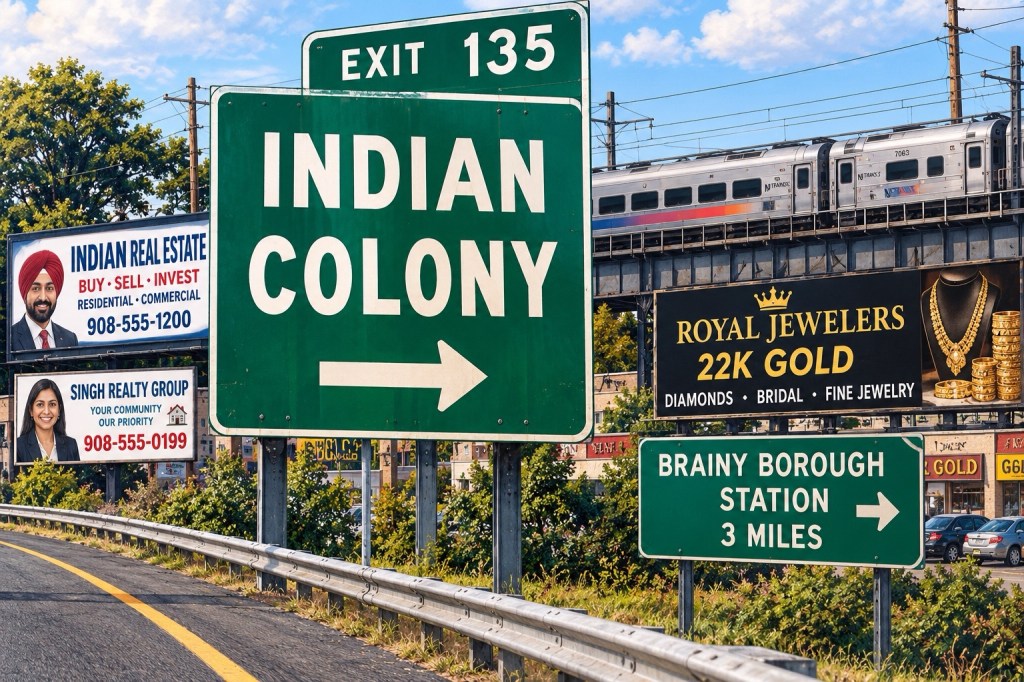
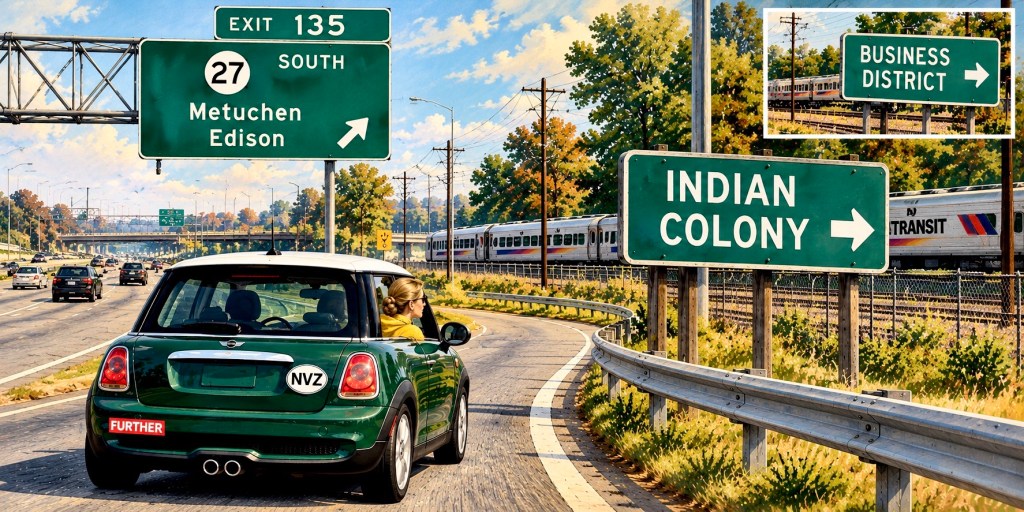
It remained for only a few weeks. Then it vanished. Its replacement pointed in precisely the same direction and said:
BUSINESS DISTRICT →
The Indians had not moved. Only the vocabulary had. And the Indians are all about business.
John always suspected that the original sign had been the work of an unidentified Council sympathizer somewhere in the municipal apparatus. He had no evidence for this whatsoever, which naturally strengthened his suspicion.
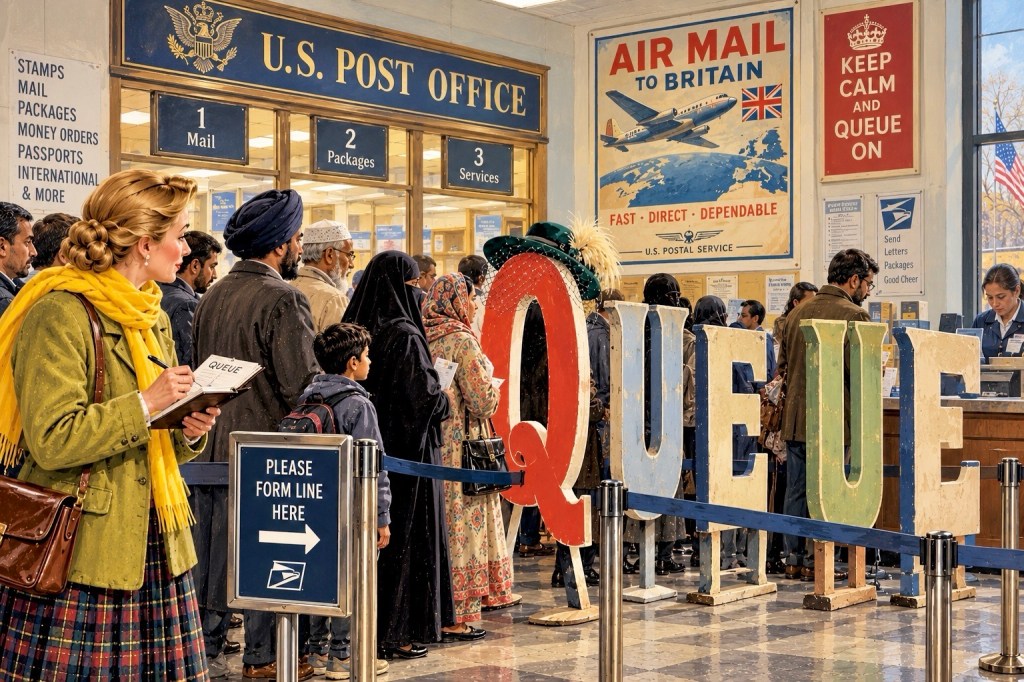
The post office was crowded. Very crowded. Most of the people around me appeared to be Indian or otherwise South Asian, many carrying parcels, envelopes and the assorted paperwork involved in conducting family business across several thousand miles.
Looking about, I experienced the peculiar sensation of being almost at home. This was, of course, absurd. I was in New Jersey. On further consideration, home was not the word I wanted.
Familiar. . . yet not in the family sense. . . Shall we say, recognized?
Yes. Recognized is quite sufficient.
I joined the queue. And waited. And waited. Eventually I reached the counter and explained what I had come to collect. The Indian woman behind it listened with a blank stare before informing me that packages of that sort were handled in the building next door.
I thanked her with some reserve. One tries to maintain standards.
Next door there was another queue. It was while standing in this second queue that I began thinking about the word.
QUEUE.
I had used it all my life. Any British child knows what a queue is. Americans prefer to “stand in line,” which sounds to me rather like a punishment administered at school. But I had never really looked at the thing.
Q U E U E
Five letters. One sound.
Q.
And behind Q stood:
UE and UE
Two little pairs, patiently waiting behind it. Worse still, none of them said anything. The word queue was itself a queue. I took out my notebook.
Q — UE — UE
Good Lord.
By the time I reached the second counter I was no longer annoyed. Then I opened John’s envelope. There was no assignment inside. Only a note.
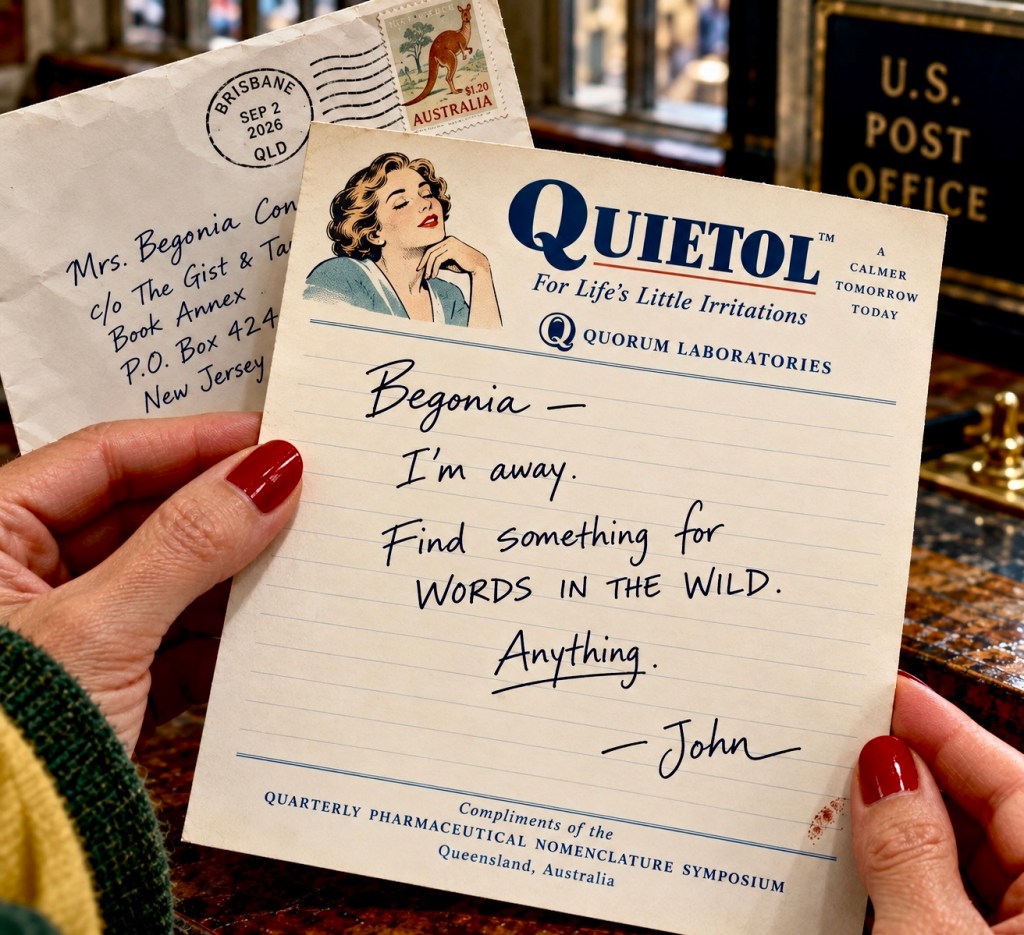
I looked at the note. I looked at the queue behind me. Then I looked again at QUEUE in my notebook. The dreadful possibility occurred to me that St. Evola might have known exactly what he was doing.
I put the note in my handbag. He would receive no satisfaction from me. But I had my assignment.
Q
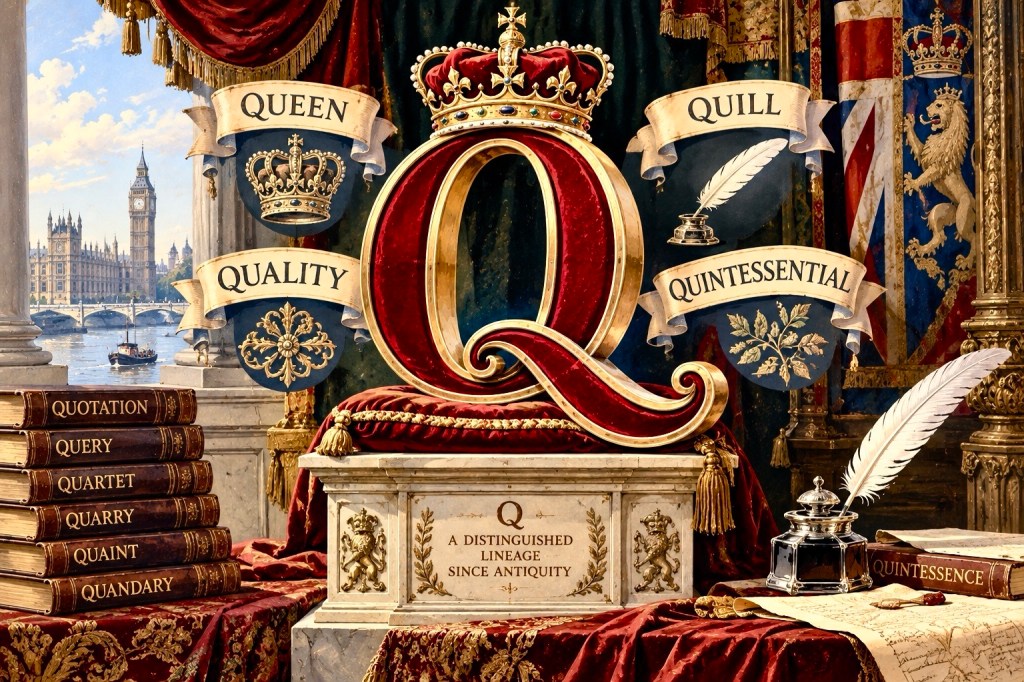
Once Q had introduced itself, I began seeing it everywhere. It is an unusually handsome letter.
Q
An O would be merely round. Q possesses the same perfect oval and then adds that little stroke—the tail, slash, flourish, depending upon the typeface. It does not look busy. It looks finished. And consider its acquaintances:
QUEEN
QUALITY
QUINTESSENTIAL
QUILL
QUARTET
QUEST
There was something rather well bred about the fellow.
This was not entirely imagination. Q has an ancient lineage, descending through Greek and Phoenician ancestors before taking its place in the Roman alphabet. It is also one of the least frequently used letters in English.
Rare. . . Old. . . Distinctive. . . Slightly unnecessary.
I began to like it enormously.
There was, however, a family difficulty.
C. KW. Q.
They are old relations and have spent centuries trespassing on one another’s phonetic property.
Q is particularly vulnerable. Much of what it does could, with sufficient disregard for appearances, be accomplished by KW.
Q also travels through English almost everywhere with U.
QU.
One might regard U as a faithful companion. One might equally regard U as staff.
I preferred not to decide. I got back into the Mini. North Jersey soon provided evidence that Q’s aristocratic circumstances had changed.
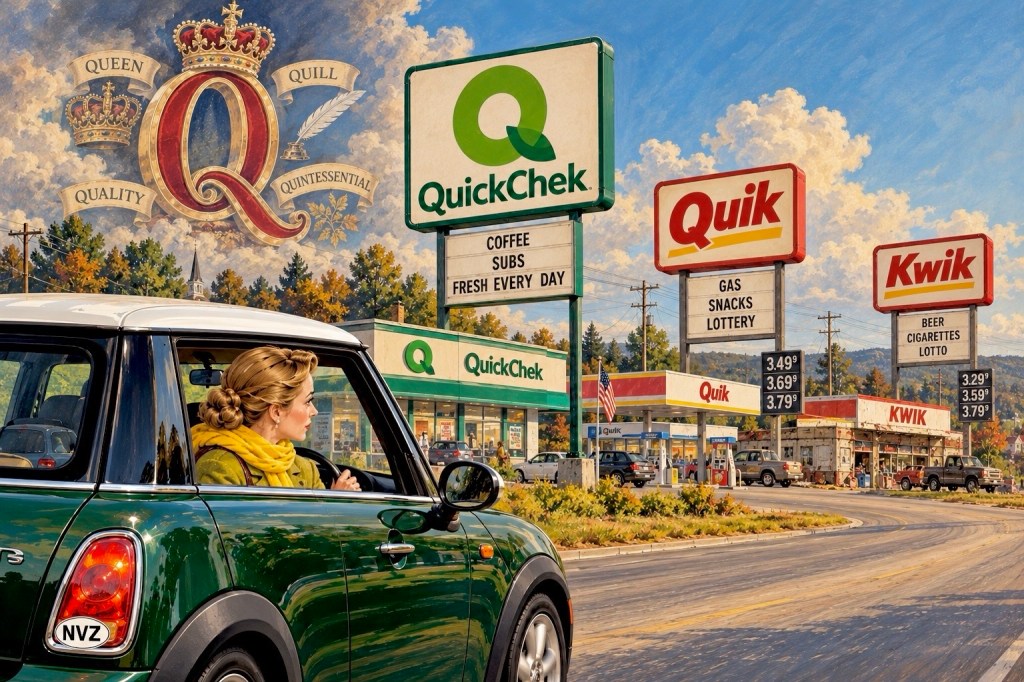
There was QuickChek.
Perfectly respectable.
Q had entered retail.
Then came the endless American promise of speed:
QUICK STOP. . . QUICK CASH. . . QUICK LUBE. . .
Queen. . . Quality. . . Quick Lube?
It was difficult not to detect a certain coarsening. But America was not finished with the poor thing.
Commerce eventually decided that even spelling quick took too long.
QUIK.
Then:
KWIK.
I stopped the Mini. This was serious: Q had first lost U. Then Q itself had been dismissed and K brought in as a replacement. And K, having taken Q’s position, apparently required the assistance of a letter actually called double-U.
I failed to see the improvement in efficiency.
I was beginning to think Q had been badly treated by the modern world when another word occurred to me.
IQ.
There it was. No U. No entourage. No assistance whatsoever. And Q was sitting beside intelligence.
Admittedly it came second. But perhaps true breeding includes knowing when one need not insist upon precedence. My confidence in Q revived.
There remained the matter of queen.
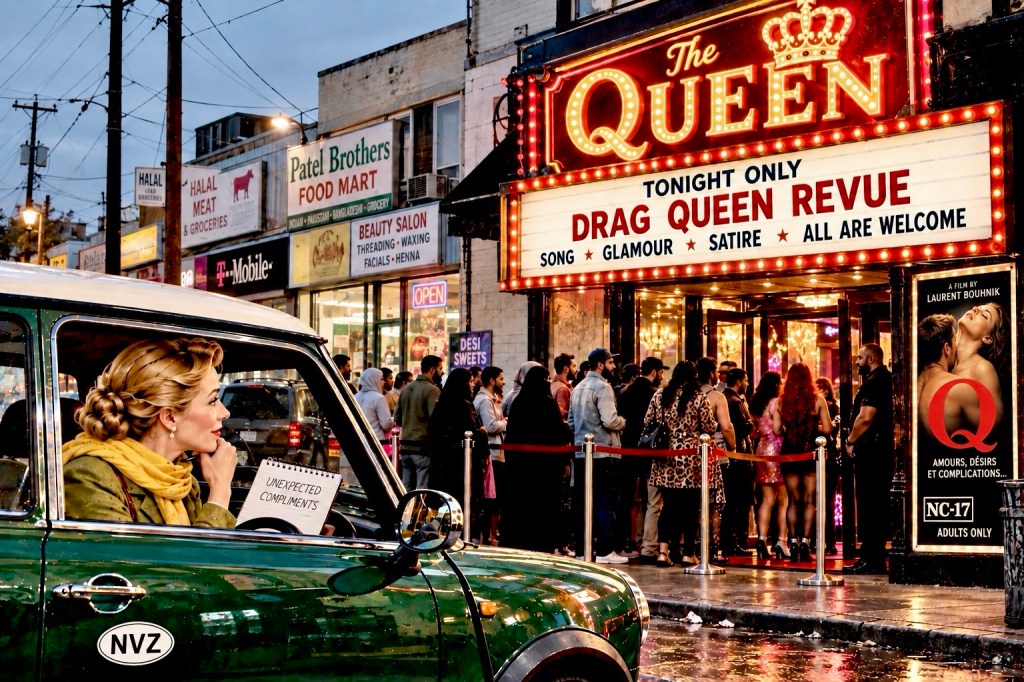
The word has enjoyed a complicated career of its own, and in our own time one encounters drag queen often enough.
At first I wondered whether this constituted yet another stage in Q’s social descent.Then I reconsidered.
Here were men going to considerable trouble to dress as women and, having done so, choosing not to call themselves duchesses, countesses or baronesses.
They chose queens.
Whatever else one might think of the arrangement, femininity was plainly not being treated as an inferior condition.
It was being pursued with sequins.
I entered this in my notebook under absurd but Unexpected Compliments and drove on.
There was one last thing about Q that I did not learn until later, and it settled the matter for me.
The English word queue came to us through French, where queue meant a tail.
A tail.
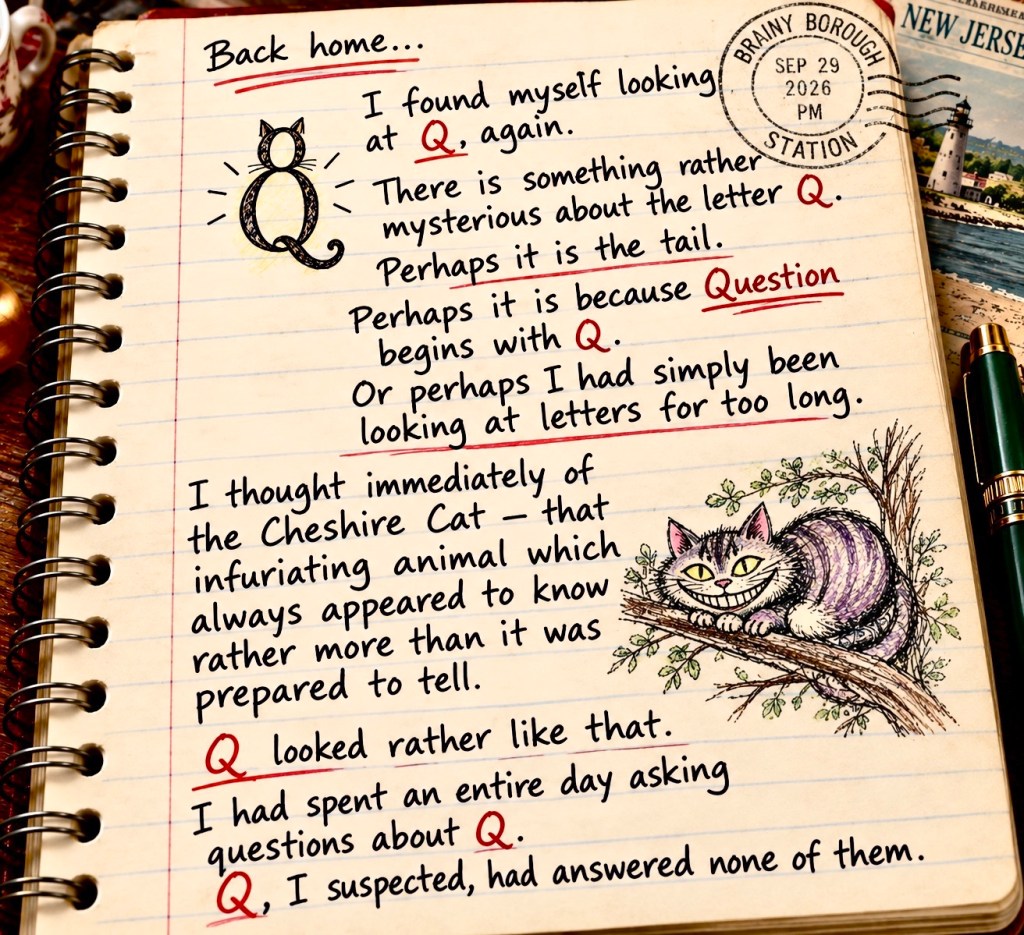
I wrote a large O in my notebook.
O
Then I gave it a tail.
Q
I sat looking at it for some time. The whole expedition had begun because I had been standing in a queue. A queue was a tail. And Q was, essentially, an O distinguished by one.
There was another correspondence. A tail occupies the rear, as does a queue, and neither is necessarily regarded with much affection by whatever happens to be at its head. In the animal kingdom, a tail at least has the useful function of discouraging insects from investigating certain sensitive regions. A human queue, viewed from the counter, may occasionally be regarded as performing much the opposite function.
I closed the notebook. There are points at which etymology becomes anatomy, and a lady knows when to stop.
I could almost hear St. Evola laughing from wherever he had gone on holiday.
But I had also been unfair to Q. Yes, America had coarsened its surroundings. It had taken a letter accustomed to Queen and Quality and put it to work selling petrol, sandwiches, oil changes and short-term loans. It had abbreviated its words, dismissed its U and occasionally replaced Q itself with KW. Yet none of this had actually diminished Q.
There it remained.
Q.
Rare. . . Ancient. . . Adaptable.—Still wearing its tail. . . Rather reminds one of a lion.
There is something to be said for entering less distinguished surroundings without permitting the surroundings to determine one’s manners.
I understood the letter rather better now. Perhaps more than I intended to.
When I returned home, I sent John the finished column. His reply contained three words:
Knew you’d find something.
Whether he had planned the entire business, I still cannot say. I have elected not to ask. One mustn’t encourage him.
— Mrs. Begonia Contretemps
Notes :
I lingered over that one rather longer than scholarship strictly required.
A curious collection of words. Merely thinking about them made me quiver.”
More Words In The Wild Can Be Found : HERE


Leave a comment