
By Guest Writer, Amber Grysz, Coelacanth Press
EDITOR’S NOTE: Amber Grysz is an employee of Coelacanth Press and is not, nor has she ever been, a member of the Council-of-Concerned-Conservationists. She was retained to provide counterbalance, a responsibility for which the Press considered her exceptionally well qualified. Whether this assessment was ideological, physical, or both is an internal publishing matter.
NOTA BENE — Words in the Wild ordinarily concerns itself with words and expressions presently roaming loose in the language. Occasionally, however, we encounter a specimen believed extinct.
I have never been particularly sympathetic toward Herman Melville.
Anyone who has endured Typee will remember Fayaway, the beautiful young Polynesian woman who becomes the particular companion of Melville’s narrator, Tommo. Melville describes her with an enthusiasm he seldom expends upon women of more substantial dimensions.

So when I recently encountered the following passage from Moby-Dick, I confess that its opening did not improve my opinion of him :
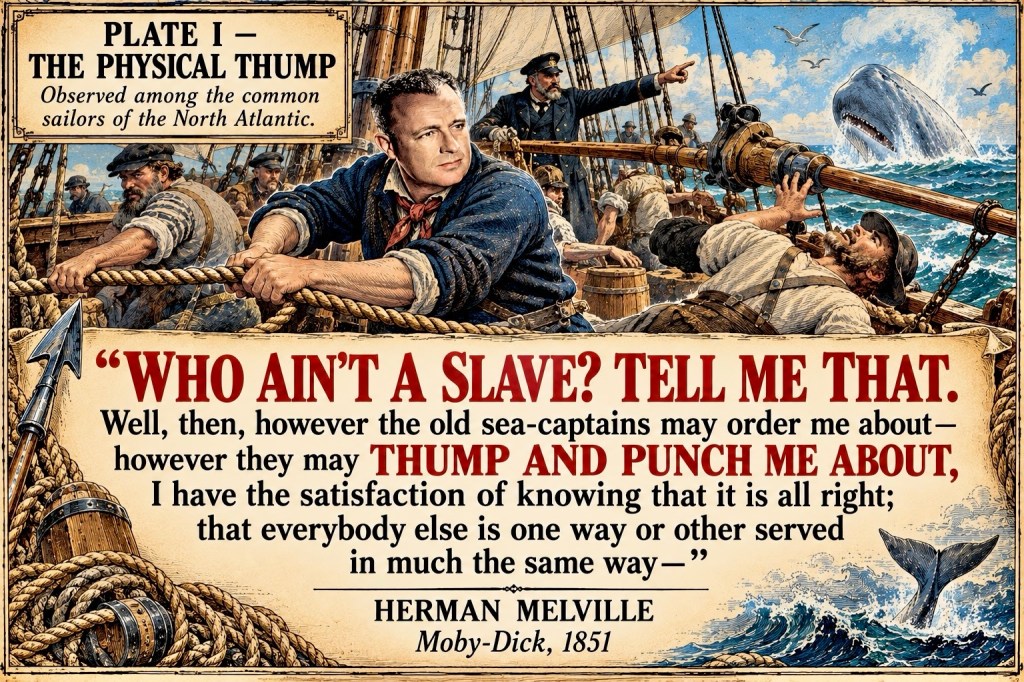
Who ain’t a slave?
Really, Herman?
Still, fairness requires reading a man beyond the sentence one wishes he had stopped at :
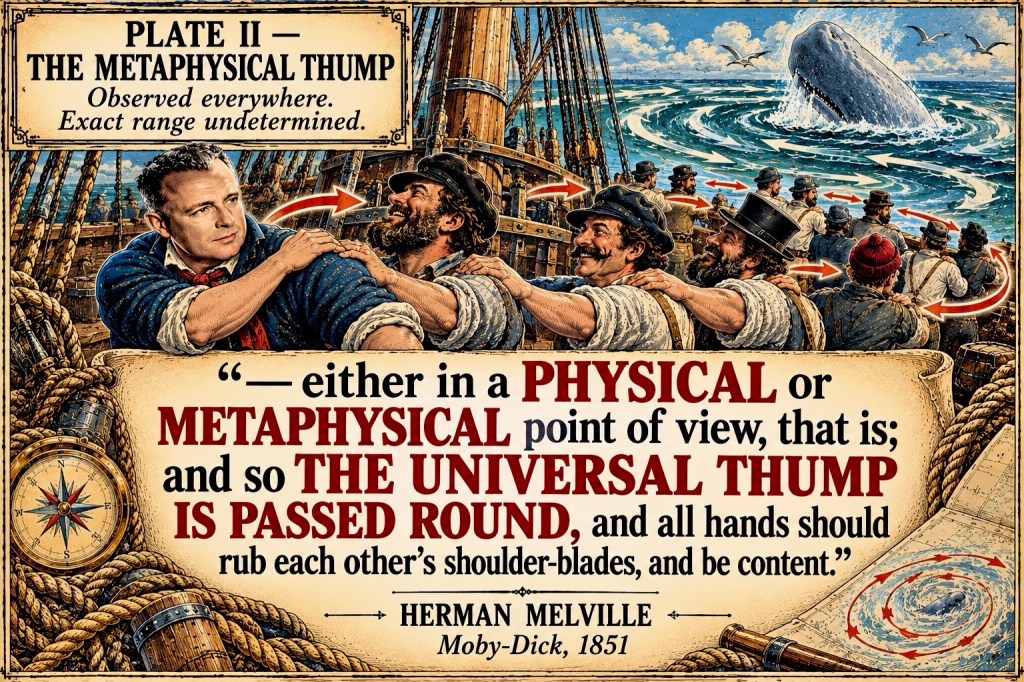
There was something in that.
Melville was not merely talking about being punched by a sea captain. The thump could be physical or metaphysical. Rank apparently offered no permanent exemption. Sooner or later, in one form or another, the universal thump was passed round. I was therefore not entirely displeased to discover that it eventually reached Herman Melville.
By 1890, the author of Moby-Dick had fallen so thoroughly out of public view that a New York newspaper found it necessary to remind its readers of one important fact concerning Herman Melville:
He was still alive.
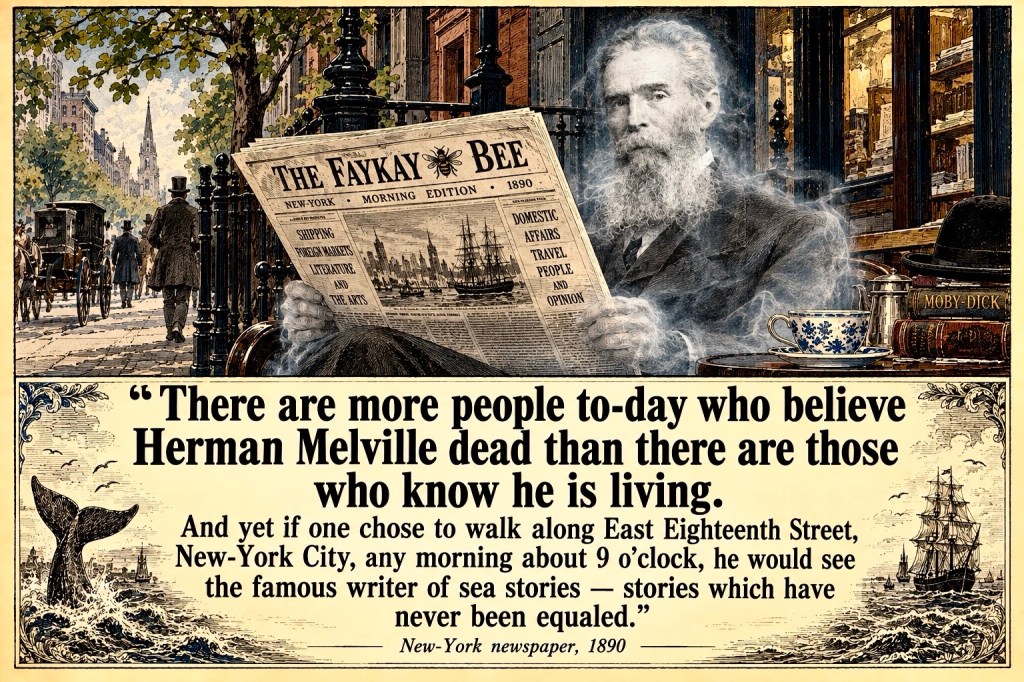
There it was. The metaphysical thump.
Herman Melville had achieved the unusual distinction of being dead without having undergone the preliminary inconvenience of dying.
I considered the account settled. Unfortunately, Nelson Mandela entered the file.

Years later, a curious shared memory became sufficiently well known to acquire a name. A number of people remembered Nelson Mandela dying in prison during the 1980s.
He had not.
Mandela was released in 1990, became president of South Africa in 1994, and died in 2013.
The phenomenon of many people confidently sharing the same false memory became known as the :

At first, I saw no difficulty. Then I went back and checked. Herman Melville had already done it. He was alive. People believed him dead.
Melville had managed this before Nelson Mandela was even born.
This left me in the professionally uncomfortable position of having to consider whether Herman Melville had been wronged.
I checked again. Unfortunately, Herman has a case.

The man had described the universal thump, received the universal thump, and then, long after his actual death, received another.
The phenomenon happened to Herman Melville. It was named for Nelson Mandela.
I began this inquiry prepared to regard that as justice. I regret to report that it looks more like plagiarism by history.
THUMP.
— Amber Grysz
Counterweight Correspondent — Council-of-Concerned-Conservationists


Leave a comment