—In Which Vito Haeckeler Discovers He Has Been Attending the Academy
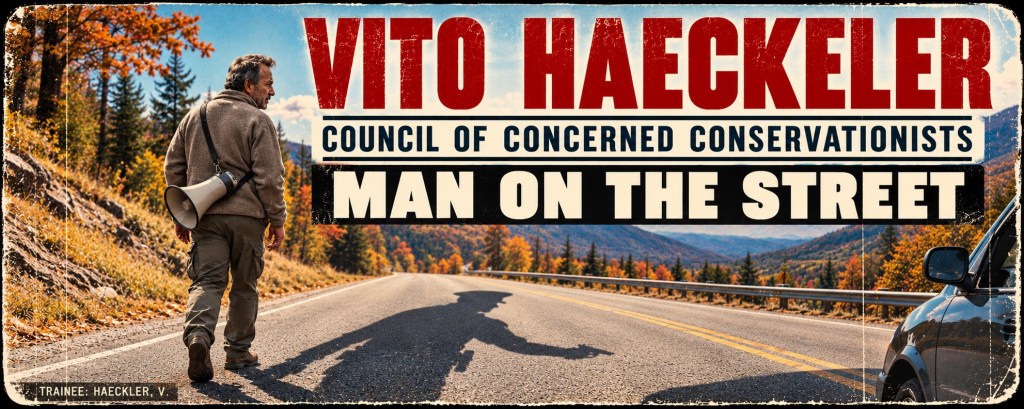
The incident you are about to read actually happened. No arrests were made. No charges were filed. The training, however, appears to have been real.
These things have a way of happening to the Council.
Only a few days after Eugene Bodeswell filed his report on the Bonus Expeditionary Force of 1932¹—the homeless and hard-up veterans who gathered in Washington and eventually got themselves driven out—I found myself trying to drive off a homeless man.
I felt a little bad about that. But I’m getting ahead of myself.
We were leaving for a fall festival when one of my granddaughters mentioned the car.
“What car?”
Apparently an unfamiliar car had been sitting down our dead-end road for most of the morning, maybe four hours. There had been loud music, but everybody assumed it was coming from the nearest house, about 150 yards away. It was loud enough to notice but not loud enough to sound an alarm.
I hadn’t known anything about it.
Now I looked.
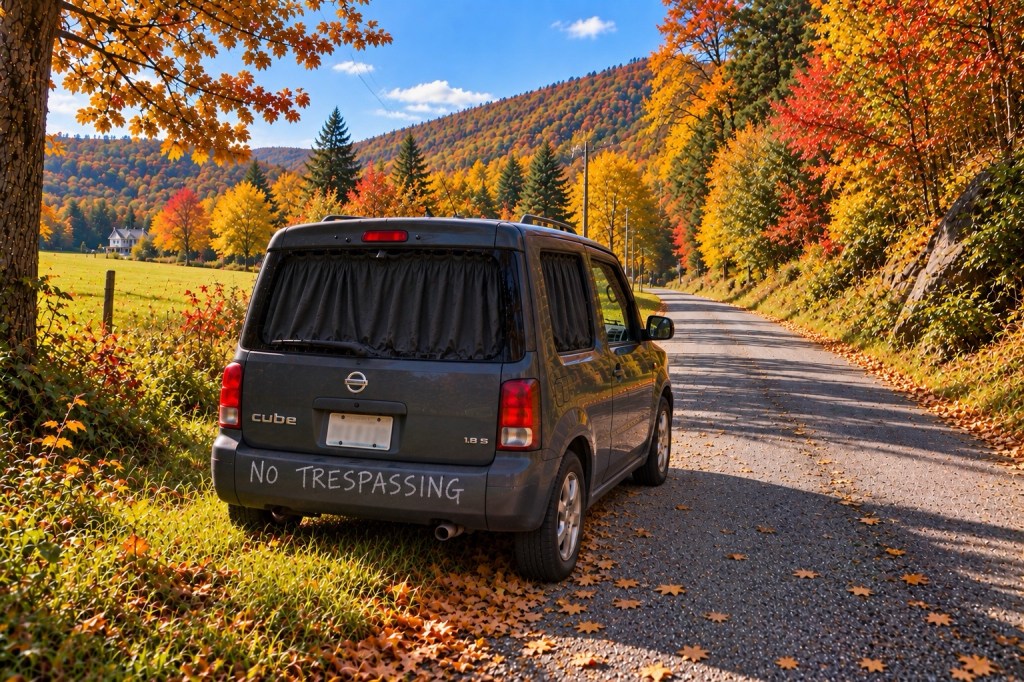
The car was parked half on the grass and half in the road. This happened to be opening day of bow season, and there is no public hunting land there. On the opposite side the ground goes straight up the mountain. If this fellow was a hunter, there was a fair chance he had gone onto my property.
Fine. A trespassing bow hunter. I understood the problem. Then I discovered he was still in the car. That changed the problem.
I had young grandchildren with me, so I pulled past him and stopped facing the opposite direction. That way, if things went badly, I wouldn’t have to turn the car around to leave.
I didn’t think anything of doing this.
I walked up toward the passenger window but stayed a little behind it rather than standing directly alongside him.
I didn’t think anything of that either.
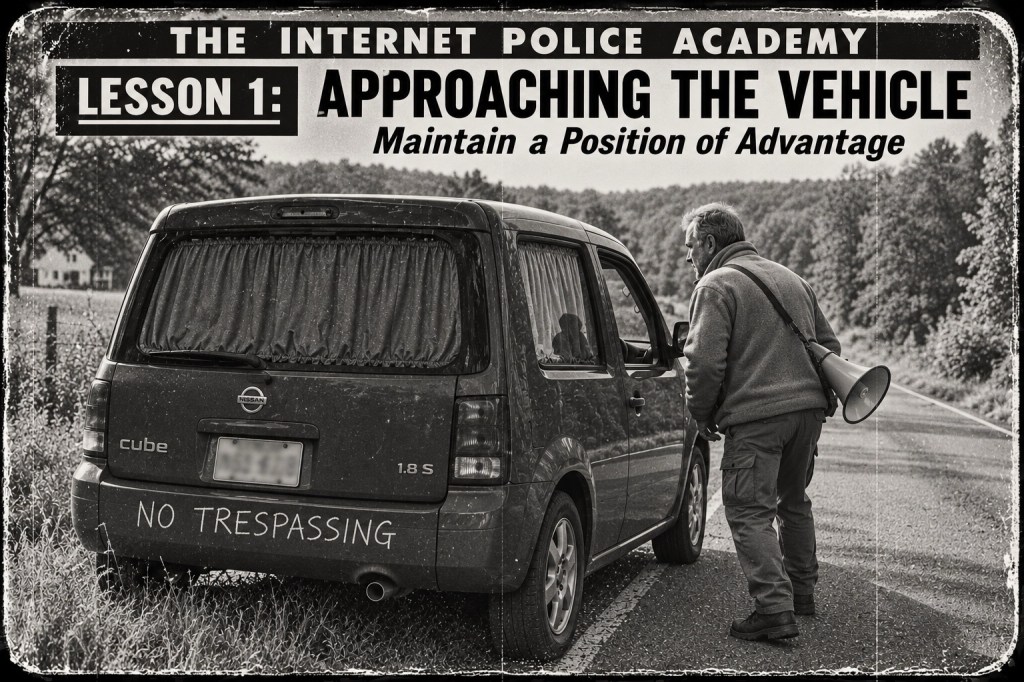
The fellow told me he was homeless and living in the car. The rear seat was completely curtained off, so there was no telling what was behind it. His conversation wasn’t entirely coherent.
And then Eugene’s damned Bonus Army story came back to me.
There I was, a man with a house, telling a homeless man to move along.
Wonderful.
The Council had spent the week contemplating what happened when society decided inconvenient people should be somewhere else, and now, through one of those little synchronicities that seem to follow the Council around, I had been assigned the practical examination.
I genuinely didn’t want to make life harder for the fellow. I suggested other places where he could park and be left alone. But there were children in my car. The benefit of the doubt had to go somewhere. I gave it to my grandchildren.
At some point the fellow himself brought up the authorities. He warned me not to call them, and there was enough of a change in his demeanor that I paid attention. I told him that wasn’t my intention.
By then two of my older grandsons had noticed that my little roadside conversation wasn’t ending quickly and apparently decided I might need backup. They arrived in their pickup and stopped a distance away, which was reassuring: there is no cell-phone signal where we live, so if things had genuinely deteriorated, I couldn’t simply have called the police. Quite by accident, I had backup. I hadn’t even called it in.
I didn’t confer with them. They remained in reserve of their own accord. Although One approached the scene. But there wasn’t anything to confer about. I’d already decided what I wanted: the fellow should move along peacefully.
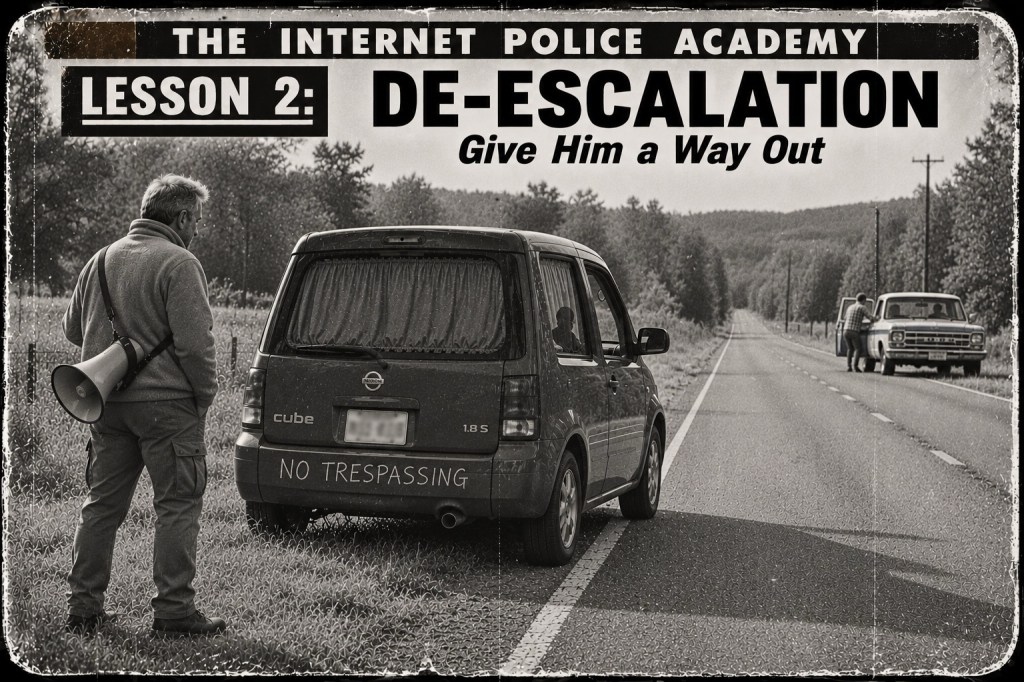
When the conversation began getting increasingly more heated on the perp side, I backed away toward the rear of his car. My older grandson took the cue and returned to his pickup.
I wasn’t conceding anything. I wasn’t telling him he could stay. I was simply reducing the pressure and giving him a little space to make the right decision without forcing the issue.
He did.
Before he pulled away, I stepped far enough back that he couldn’t see what I was doing and photographed the car and its license plate.
Then he started down the road.
My older grandsons pulled out behind him. I pulled out behind them. Nobody had discussed this arrangement. Nobody had assigned positions. Nevertheless, our little procession continued down the dead-end road until the fellow was on his way out.
Only then did we resume our original mission: the fall festival.
We hadn’t gone very far when one of my granddaughters asked me the question that apparently had been bothering her.
“Would you have been able to fight that guy?”
At my advanced age, I try not to make extravagant promises concerning hand-to-hand combat.
“I sure as hell would’ve given it all I got.”
This was apparently the correct answer.
My eleven-year-old, six-year-old and five-year-old grandchildren immediately volunteered to assist in the potential fracas.
I was touched. I was also trying not to picture it.
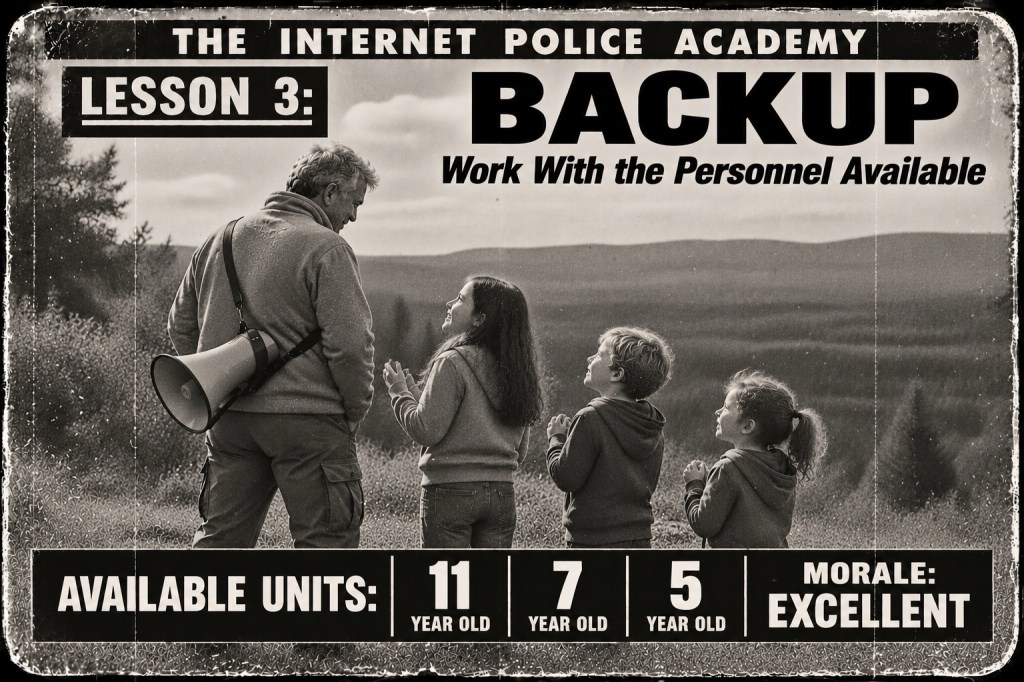
Instead of imagining all the terrible things that might have happened, I pictured myself rolling around beside the road like one of those unfortunate smaller policewomen I’ve seen on Internet videos trying to wrestle some enormous suspect while waiting desperately for another unit. Except my backup could have been eleven, seven and five.
On the positive side, morale was excellent.
Somewhere on the way to the festival, however, another thought occurred to me. Why had I parked facing out?
Why had I approached from behind the driver’s window instead of planting myself squarely beside it?
Why had I kept my voice down when his went up?
Why had I backed away without surrendering the point?
Why had I given him an easy way to comply instead of forcing him into a corner?
Why had I photographed his license plate from where he couldn’t see me doing it?
And how had the whole thing ended with one vehicle leaving, another following it and me bringing up the rear?
Then I realized.
The police videos.
I watch the things all the time. Traffic stops. Body-camera footage. Officers approaching cars. People refusing to get out. People reaching where they shouldn’t. Officers escalating situations. Officers calming them down.
I had always thought I was watching them. Apparently I had been attending the academy.
None of this went through my mind while I was standing beside that car. There was no little voice saying, Remember your training, Haeckeler.
The training just showed up.
I had learned where to stand, how to position the car, when not to argue, how to give somebody an out without giving him his way, when to increase the distance and wait, and apparently how to organize a three-car departure without holding a briefing. All without knowing I had learned any of it.
I was feeling rather amazed at my performance when I remembered something else I’d seen officers do.
They sometimes touch the rear of the vehicle as they approach, an old habit associated with leaving evidence that they had made contact with it.
Damn.
I forgot the fingerprint.
Which left me wondering what else I’ve learned without knowing I was taking lessons.
That question stopped being quite so funny when I looked at what was happening in France.
Young people weren’t merely hearing that disturbances were occurring somewhere else. Through social media they could watch them. One school could see what happened at another: how a blockade was organized, how crowds gathered, how confrontations developed, how property was attacked or burned, and which performances traveled farthest online. Distance no longer prevented one crowd from supplying another with an example.
The same Internet that had apparently taught an old man in Pennsyltuckey to stand behind a driver’s window could show somebody thousands of miles away an entirely different choreography.
Mine happened to tell me:
Stay calm. Don’t stand where you don’t have to. Don’t corner the fellow. Give him a peaceful way out. Know when to back off. Take the license plate.
Whatever else the Internet may be teaching us, I don’t know.
That’s the peculiar thing about an education you never enrolled in.
You don’t get to see the syllabus.
But next time I’m remembering the fingerprint.
[1]. Eugene Bodeswell’s Council report on the Bonus Army of 1932


Leave a comment