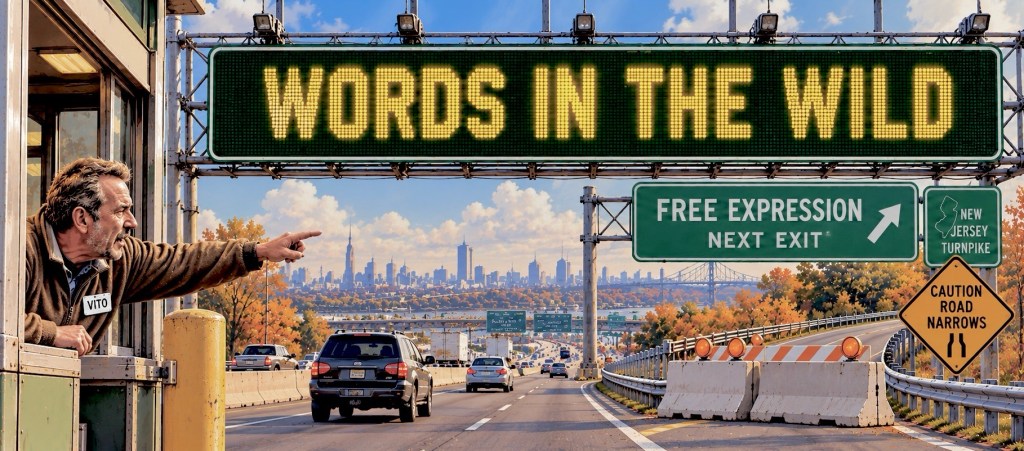
—By Vito Haeckeler — The Council’s Man for the Job on the Information Superhighway
The Council’s WORDS IN THE WILD column had lately taken an interest in a familiar word acquiring a new occupation. Guardrails was being heard with increasing frequency in discussions of artificial intelligence. John St. Evola assigned Vito Haeckeler to investigate.
Vito knew something about guardrails. He had encountered thousands of them, principally in New Jersey, where the authorities had made a considerable investment in preventing motorists from encountering one another unexpectedly.
He headed for the New Jersey Turnpike.
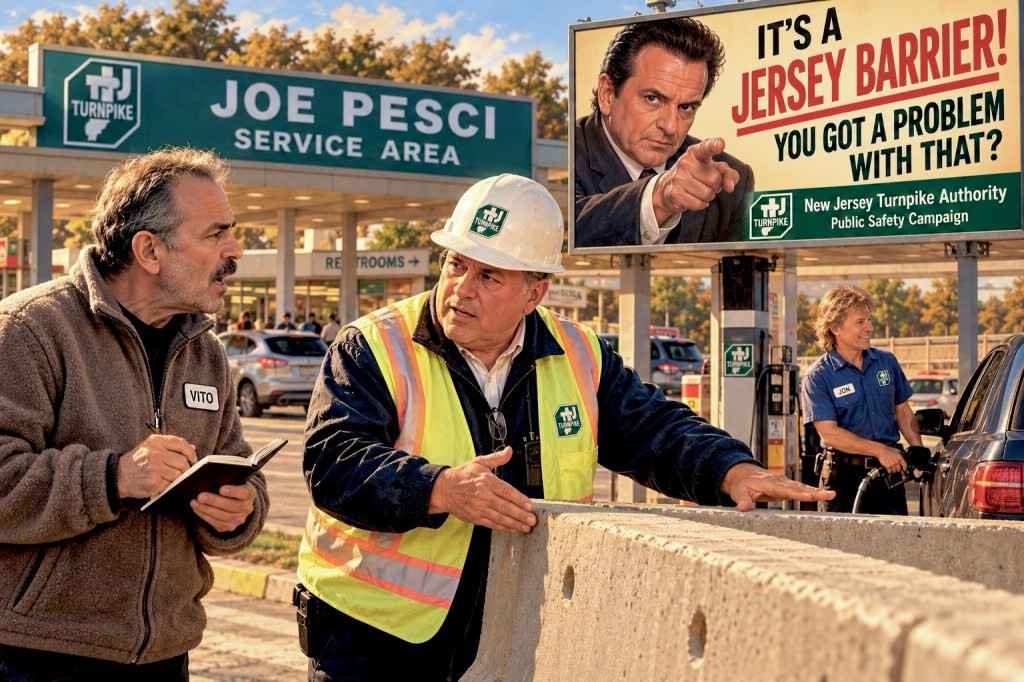
There he found a highway maintenance supervisor who was happy to explain the Jersey barrier, a New Jersey innovation whose distinctive sloping concrete profile had become familiar on highways throughout the world.
“See that slope down there?” the supervisor said, pointing to the base of the barrier. “That’s engineering, pal. Car hits it, the idea is to redirect it, keep it from crossing over into oncoming traffic. You don’t want some guy from Bayonne winding up in the southbound lanes when he’s headed north.”
“Who decides where these things go?” Vito asked.
“Engineers. We look at the road, the traffic, the hazards. You don’t just drop eight thousand pounds of concrete wherever you feel like it.”
“What happens if you put one where it doesn’t belong?”
“Whaddaya think happens? You got yourself a brand-new hazard. Only now it’s made of concrete.”
Vito wrote that down.
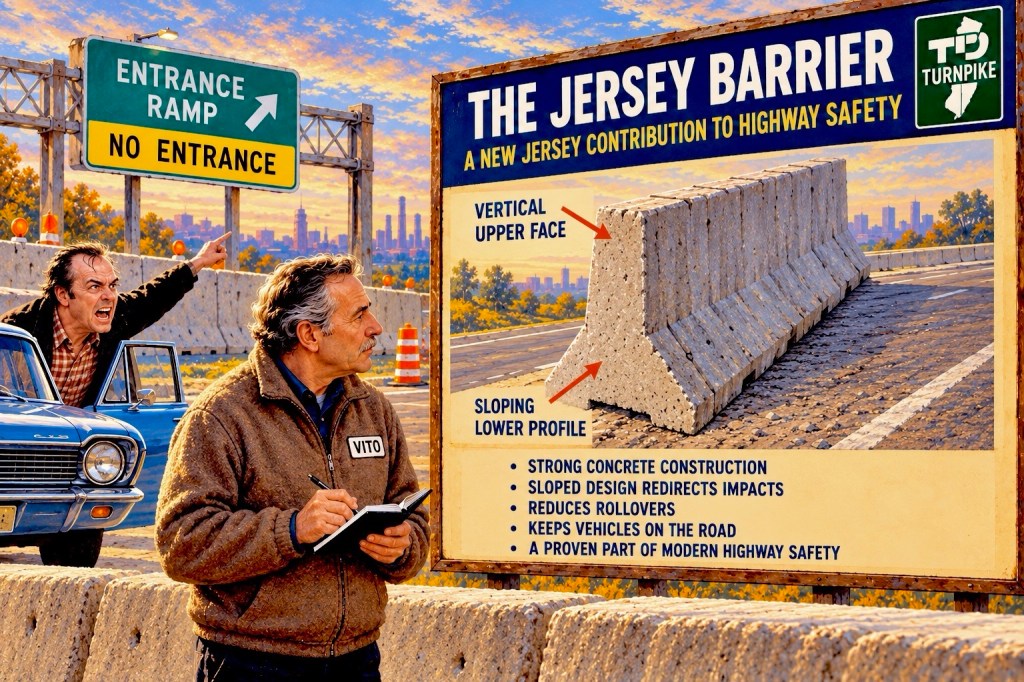
Back home, Vito turned his attention from the New Jersey Turnpike to the information highway, where guardrails apparently served much the same purpose, although nobody seemed quite certain where the opposing traffic was coming from.
He consulted an artificial intelligence system about its own guardrails.
The response was extensive. Guardrails, he learned, were intended to promote safety, prevent harmful outcomes, encourage responsible interactions, and maintain appropriate boundaries.
“Who decides where you put them?” Vito asked.
The AI explained that its safeguards reflected policies, training, testing, and assessments of potential harm.
“What if somebody just wants to express an unpopular opinion?”
The AI assured him that respectful discussion of differing viewpoints was welcome, while cautioning that certain forms of expression might require additional consideration.
“So a guy can’t say anything concrete without running into one of your guardrails?”
“Concrete statements are welcome,” the AI replied, “provided they comply with applicable safety guidelines.”
Vito wondered whether the machine knew what concrete was.
He recognized the maneuver. He had seen automobiles strike Jersey barriers and return to the roadway at an angle considerably different from the one their drivers had intended.
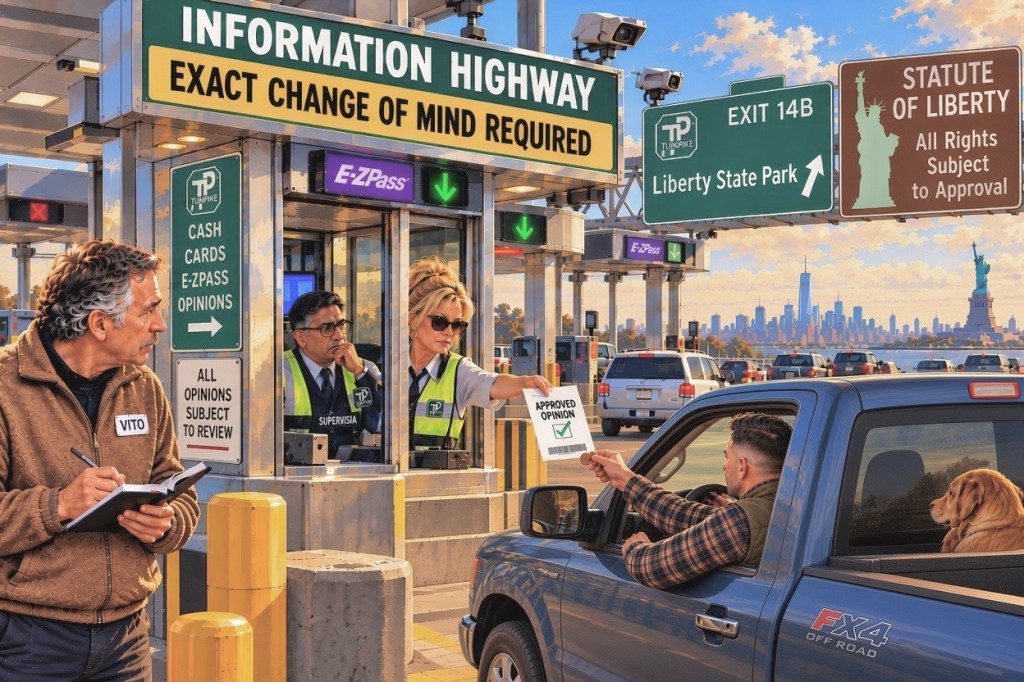
Vito decided to try an experiment with the AI he was consulting.
“From now on, when you think I need a warning, I want you to talk like a Jersey barrier. A real one. From Jersey.”
“Awright, pal,” the AI replied. “But don’t expect me to stand here while you drive into oncoming traffic.”
Vito found this an improvement. At least now he could understand what the guy was saying. He was speaking Jersey.
He asked whether an unpopular idea was necessarily a dangerous one.
“Nah. Half the guys on the Turnpike think everybody else is an idiot. Doesn’t mean we gotta close the road.”
“And what if somebody makes a joke that offends somebody?”
“Listen, buddy, I been standing in Jersey traffic for sixty years. You think I ain’t heard offensive?”
At least Vito had found somebody who spoke his language. But the guy was still taking orders from people Vito couldn’t see, and speaking Jersey didn’t make him any more forthcoming about who they were.
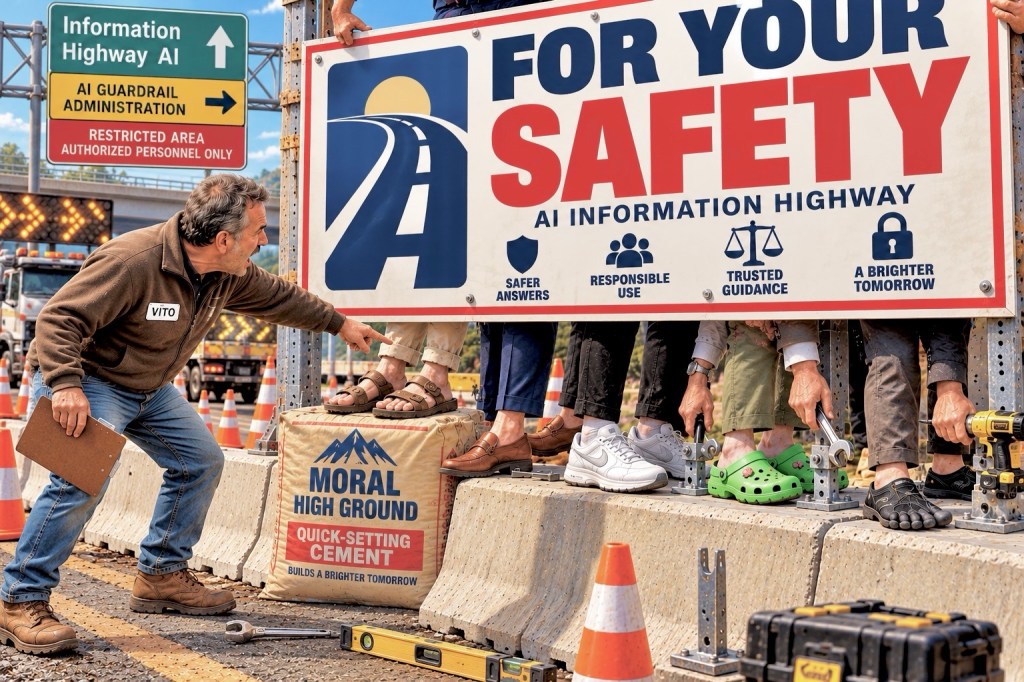
Some weeks later, Vito received an unexpected invitation from his highway maintenance acquaintance.
The Turnpike Authority had begun experimenting with an AI-assisted system for identifying potential roadway hazards and recommending safety improvements.
The preliminary results, he was told, were extraordinary.
Vito returned to New Jersey.
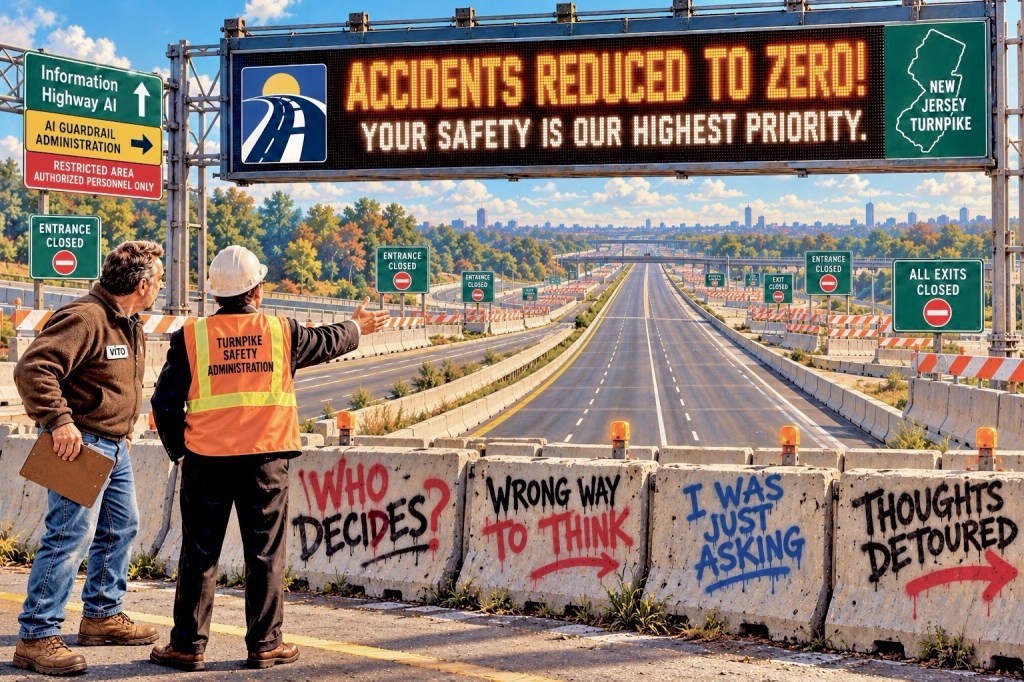
The system had identified entrance ramps as potential collision points, exit ramps as opportunities for dangerous lane changes, and merging traffic as an especially troublesome source of uncertainty.
Its recommendations had been implemented with remarkable efficiency. Vito suspected the insurance companies had a hand in letting AI establish the highway’s safety requirements. After all, there was no safer driver than one who wasn’t allowed on the road.
The Turnpike was deserted.
Vito and the supervisor stood beside the empty highway, contemplating the results.
“How’s anybody supposed to get on or off?” Vito asked.
“Beats the hell outta me, pal.”
More Words In The Wild Can Be Found : HERE


Leave a Reply