—An Investigation into Overheated Metaphors By Mrs. Begonia Contretemps
A Note from the Editor
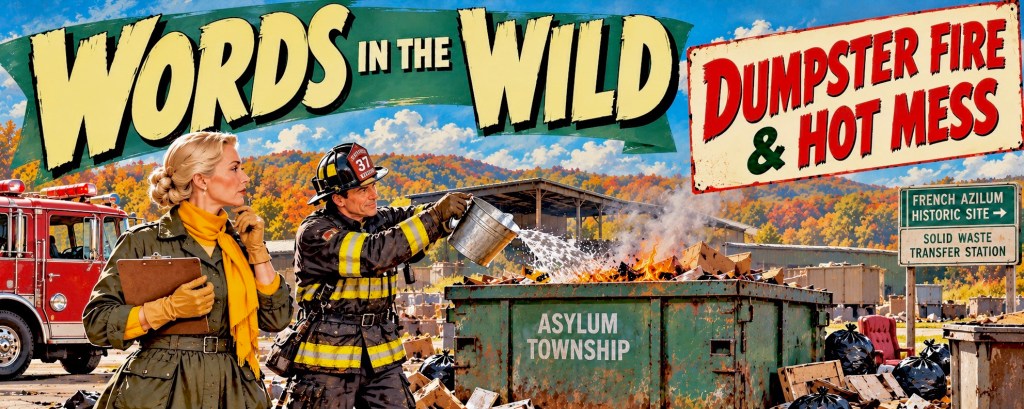
Two expressions have lately been setting the English language ablaze: dumpster fire and hot mess. Both suggest elevated temperatures.
Knowing Mrs. Begonia Contretemps’ preference for linguistic precision, I assigned her the investigation, confident that she would bring a cool head to these overheated metaphors. I had not anticipated the temperature rising quite so dramatically.
— John St. Evola, Editor
An Unwelcome Assignment
“A dumpster fire?” I repeated.
“And a hot mess,” John added.
“Must I?” Mrs. Begonia asked.
“I thought the combination might interest you. Both involve heat.”
“Then I suggest you contact the fire brigade.”
“I’m contacting you.”
I reminded John that the British possessed a perfectly serviceable collection of expressions for disorder, including a dog’s breakfast and gone pear-shaped.
“What’s wrong with the shape of a pear?” he asked.
I declined to pursue the matter.

The Contained Catastrophe
My first objection was straightforward.
A dumpster is a substantial metal receptacle intended to contain unwanted materials. If those materials should catch fire, surely one might consider the dumpster among the more suitable places for such an occurrence. Would Americans prefer the fire in their sitting rooms?
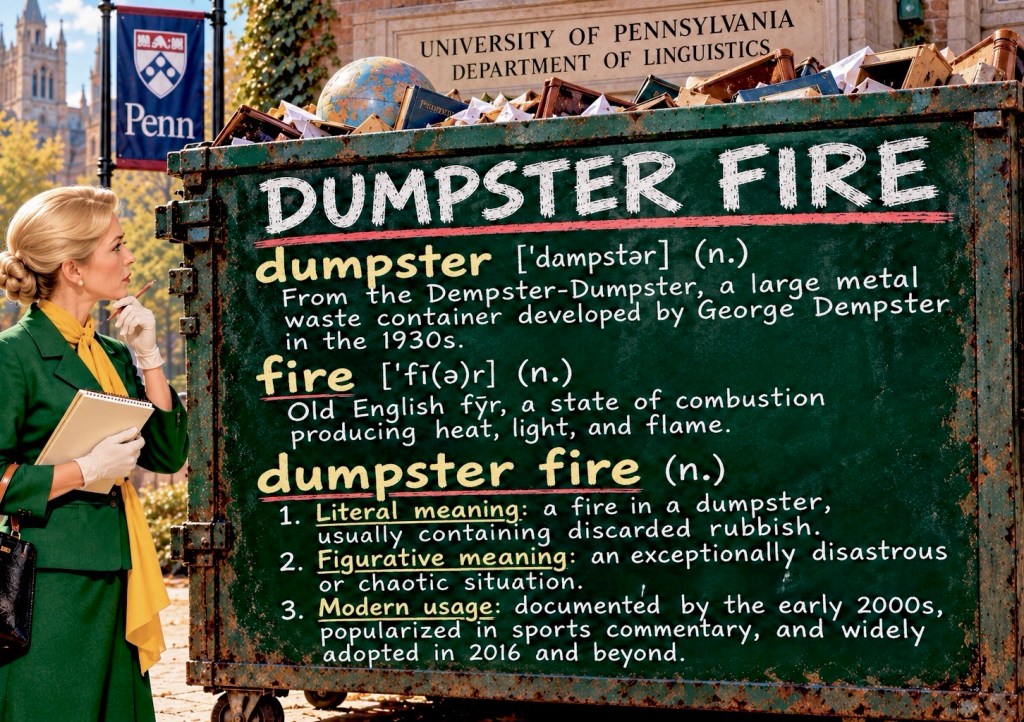
I consulted several definitions. All described a dumpster fire as an exceptionally disastrous or badly managed situation. None explained why a fire occurring in a substantial metal container should symbolize a failure of containment. Quite the opposite! If rubbish must catch fire, where better than in a receptacle designed to contain it? In the drawing room? The public library? And surely the contents had already been judged expendable, or they wouldn’t have been thrown away. Apparently, Americans had devised a sensible means of containing unwanted rubbish, discovered that it might occasionally burn, and elevated the occurrence into a metaphor for unmitigated catastrophe. Had no one considered the absurdity? I found the expression increasingly irritating, particularly since everyone seemed so delighted to repeat it!
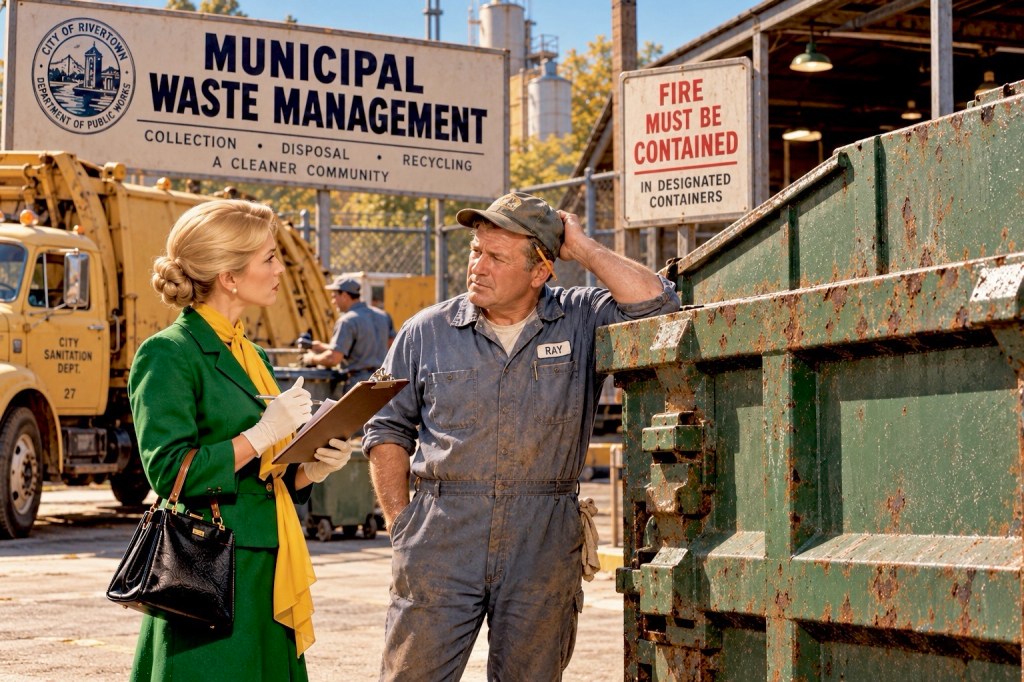
I arranged an interview at a municipal waste facility. The superintendent assured me that dumpster fires were dangerous.
“Of course they are,” I replied. “But surely less dangerous than the same fire without the dumpster?”
He regarded me for some time before suggesting that I speak to the fire chief.
A Perfectly Respectable Mess
My second assignment, the peculiarly American expression hot mess, proved scarcely less troublesome.
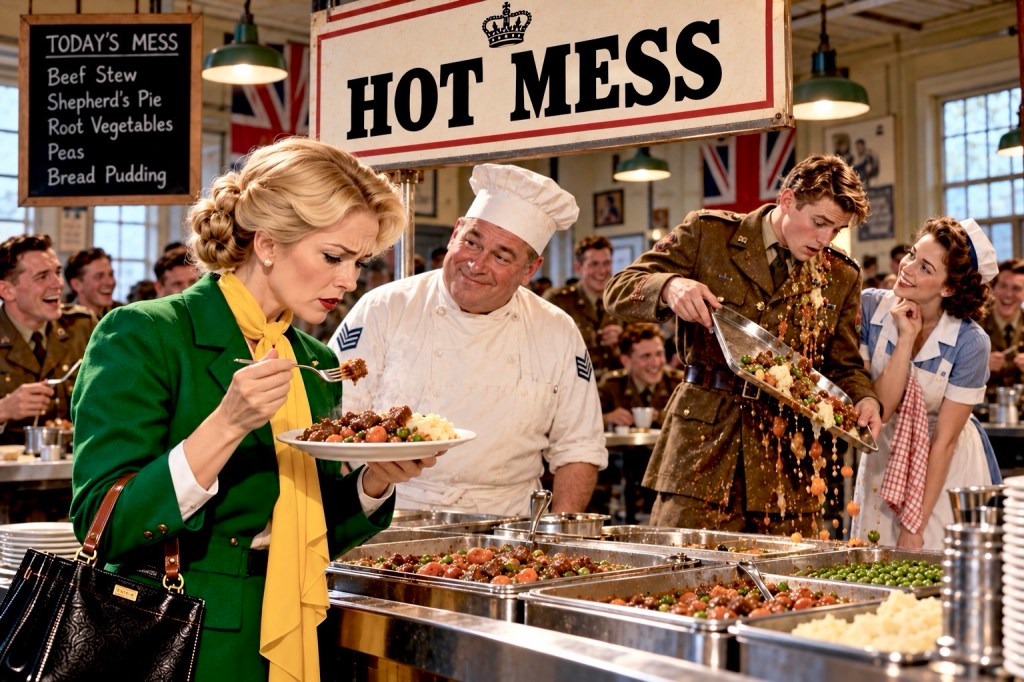
The word mess, I discovered, once referred to a serving of food. A hot mess could therefore be a perfectly satisfactory meal.
In military establishments, indeed, a hot meal might be regarded as a considerable improvement over a cold one. At what point, I wondered, had nourishment become a personal catastrophe?
Further investigation revealed that the modern American expression could describe an individual whose disorderly condition was nevertheless considered charming, even attractive.
I understood the intended meaning. I simply found its ancestry difficult to reconcile with its present employment.
The Americans had apparently discovered a way of making disorganization complimentary.
I began to suspect that my own language was not entirely innocent in this regard. After all, I had defended gone pear-shaped without establishing what objection anyone could reasonably have to a pear.
An Experiment in Containment
By the third day, my notes had multiplied beyond reasonable management.
My desk was covered with definitions, historical references, diagrams of waste containers, and several abandoned attempts to establish a coherent relationship between heat and human incompetence. I decided that further theoretical inquiry would be unproductive. A practical demonstration was required.
The municipal fire department agreed to let me observe a scheduled training exercise involving a steel waste container.
I arrived with a substantial collection of discarded drafts, some of which the firefighters agreed to use in their supervised exercise.
The fire was lit. I watched with considerable satisfaction as the flames remained within the steel receptacle.
“There!” I exclaimed. “Precisely as I expected!”
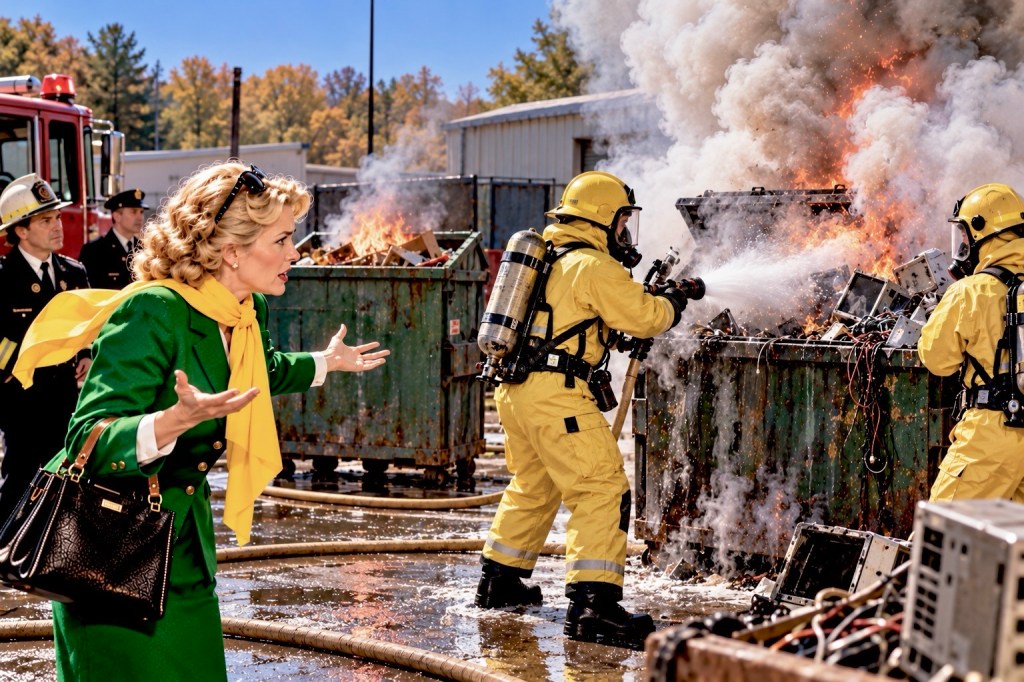
Then an unexpected gust of wind carried several burning scraps beyond the rim. They landed among waste in an adjacent dumpster. Within moments, smoke began pouring from the second container. Unknown to the crew, someone had improperly discarded electronic equipment containing lithium-ion batteries among the ordinary rubbish. The batteries began to overheat, producing an altogether more alarming fire.
The firefighters immediately suspended the exercise and began dealing with the new emergency.
“Good heavens!” I cried. “Now there are two!”
The fire chief explained that the batteries could produce intense heat and dangerous gases, and that the metal container was no guarantee of safety.
“But surely,” I protested, “the problem is not the dumpster. It’s what someone has put into it!”
He was too occupied to appreciate the distinction.
The Investigation Escapes Containment
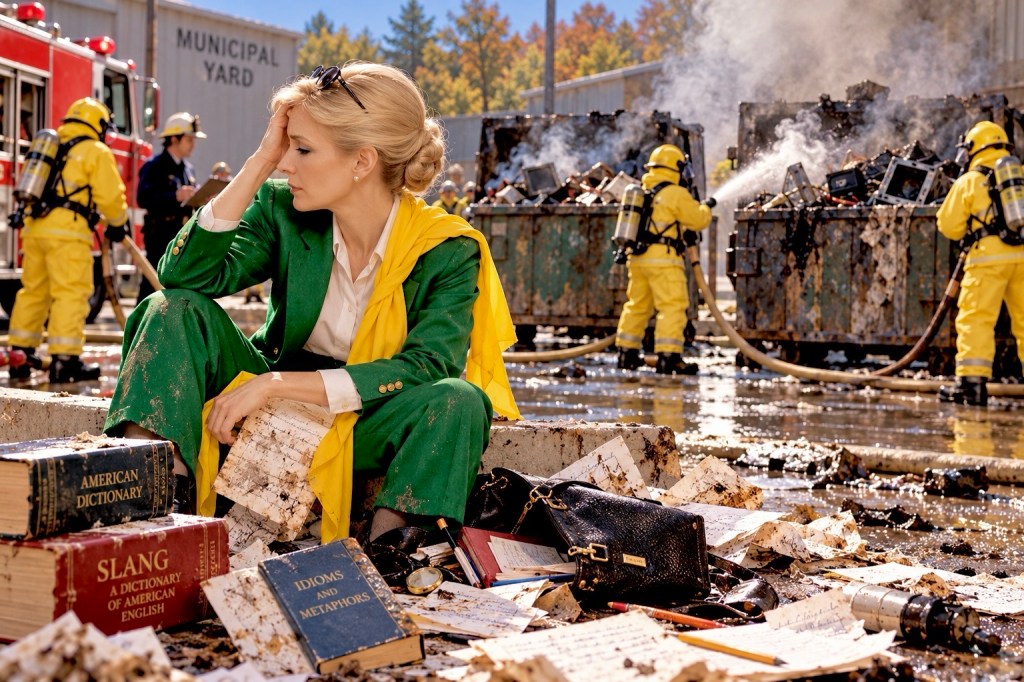
The firefighters ordered everyone away from the containers. In my haste to gather my research, I dropped my folder. Several days’ worth of definitions, diagrams, and discarded arguments scattered across the yard. My handbag overturned. A wheeled rubbish bin was upset in the confusion. My scarf became entangled in a fence. The fire brigade remained admirably professional throughout. I cannot say the same for my filing system.
Once the emergency was brought under control, I attempted to recover my notes, although not necessarily in their original order. My hair had come loose, my clothing was considerably rumpled, and I had lost all patience with the superintendent’s insistence that the incident had demonstrated the danger of dumpster fires.
It had demonstrated the danger of improperly discarded batteries. The dumpster itself was innocent.
A Matter of Interpretation
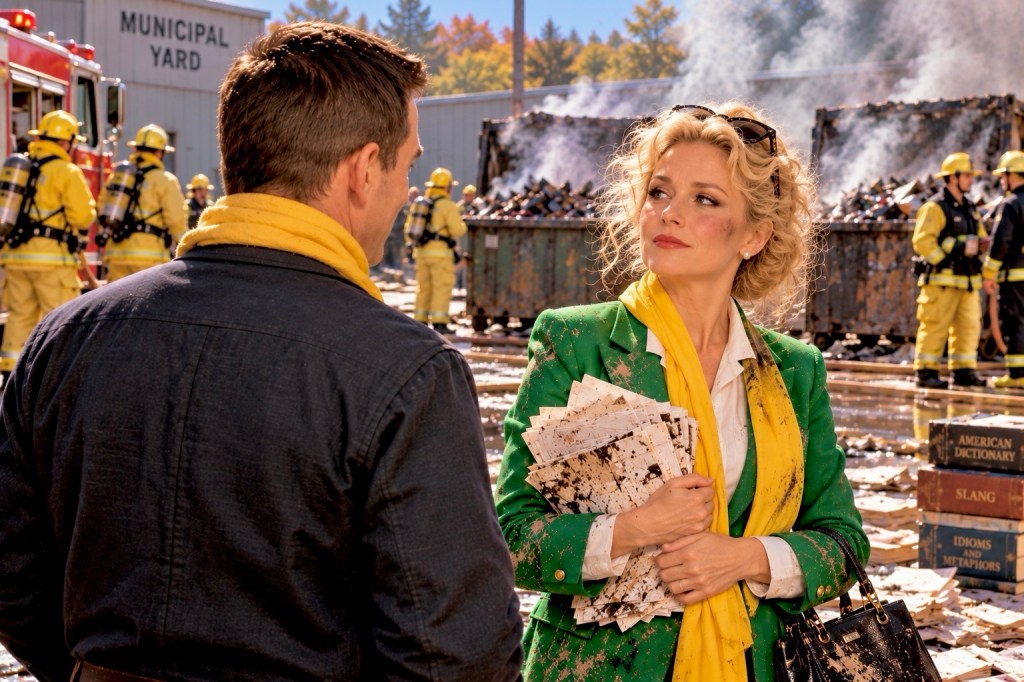
John arrived just as the firefighters were packing up their equipment. He surveyed the yard, the overturned bin, the scattered papers, and the two blackened metal containers.
“Wow, Begonia. You really turned this thing into a dumpster fire.”
“The fires were perfectly contained, John! That’s what I’ve been trying to explain!”
“Yeah, I can see that.”
He looked at me again, this time with an appreciative smile.
“You know something? You’re a hot mess.”
“John!”
“Sorry, Begonia. I didn’t mean it that way.”
He looked at me again, a little sheepishly.
“I mean it. You look fetching.”
For once, I found myself momentarily unable to reply.
— More From Mrs. Begonia Contretemps Can Be Found : Here
Go Here For More Words in The Wild


Leave a Reply