—Mrs. Begonia Contretemps investigates America’s edible archaeological record.
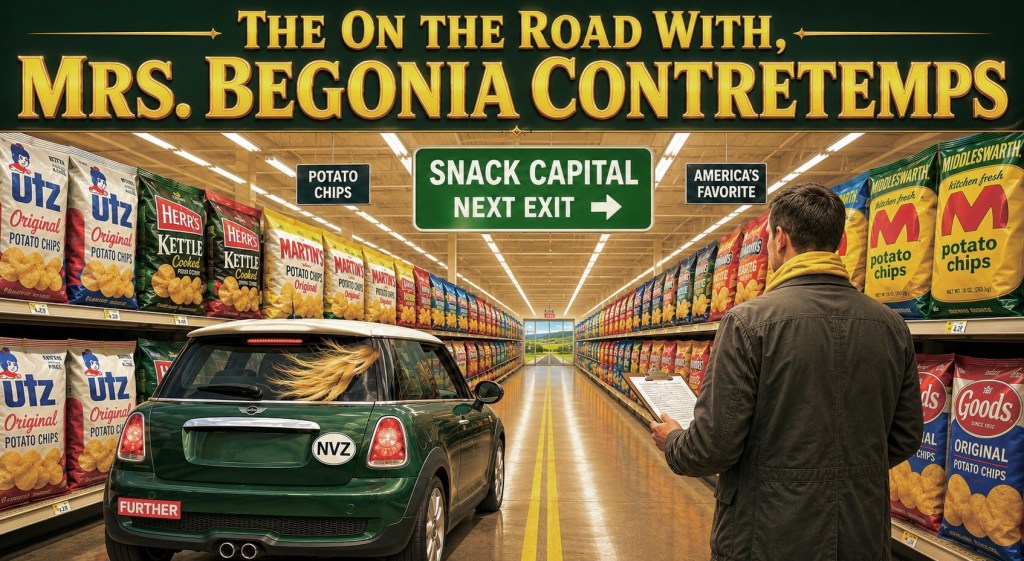
Mrs. Begonia Contretemps had scarcely returned from her investigation into America’s mysterious civilization of the sharpened edge when our editor, John St. Evola, quietly informed her that another industrial cluster of comparable importance awaited her attention.
Naturally, she imagined steel mills, locomotive works, or perhaps another forgotten manufacturing town.
“Nothing of the sort,” Mr. St. Evola replied. “This one is considerably more important.What is produced there?” He smiled.
“Cultural history.”
“I beg your pardon?”
“Aisle Seven.”
Since Council ethnographer Eugene Bodeswell had recently advanced what he called his Sedimentary Theory of Consumer Civilization, Mr. St. Evola decided the two should investigate together. The result is the following report.
From the Snack Belt, Pennsylvania
During the Season of the Crinkling Bag
Dear René,
I have now learned that Americans possess an astonishing talent for concealing extraordinary things in the most ordinary places.
My assignment, as Mr. St. Evola explained it, was to investigate what he described as :
“one of America’s great industrial clusters.”
Having recently examined the remarkable concentration of knife makers in western New York, I naturally expected another manufacturing district. Instead, Eugene drove me to an American supermarket.
“The factories are indeed in Pennsylvania,” he assured me, “but the museum is here.”
I assumed he was joking. He was not.
We rounded the corner into what Americans casually refer to as the snack aisle.
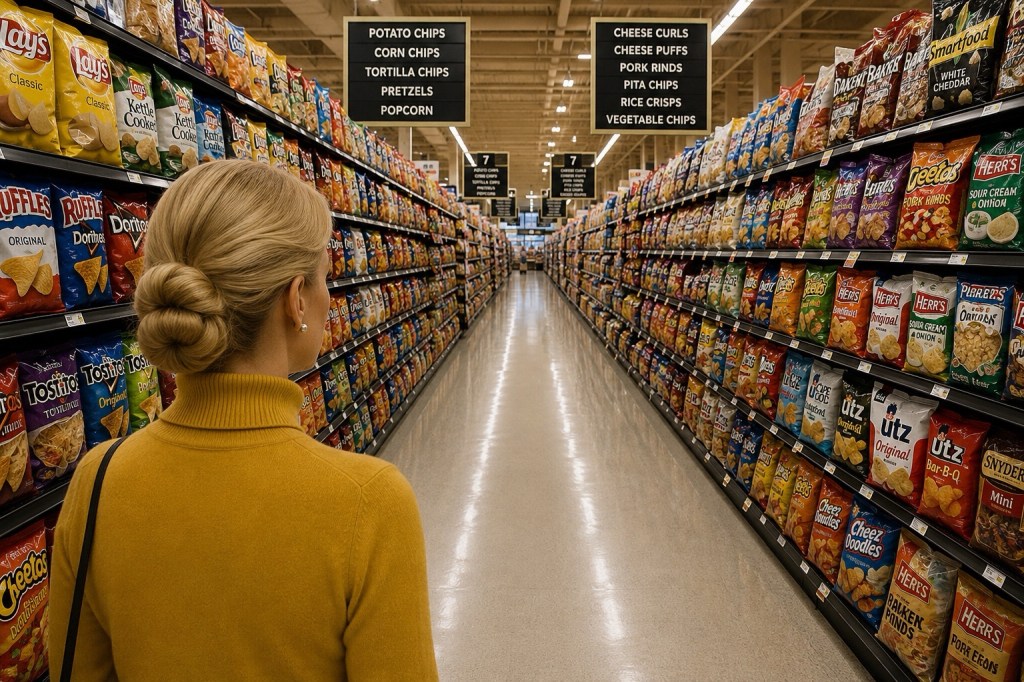
René. . . I have never witnessed anything quite like it. An entire aisle—longer than many village streets—was devoted almost exclusively to potato chips, corn chips, tortilla chips, pretzels, cheese curls, cheese puffs, popcorn, pork rinds, pita chips, rice crisps, vegetable chips, and various other edible substances that appeared to have undergone extensive negotiations with hot oil.
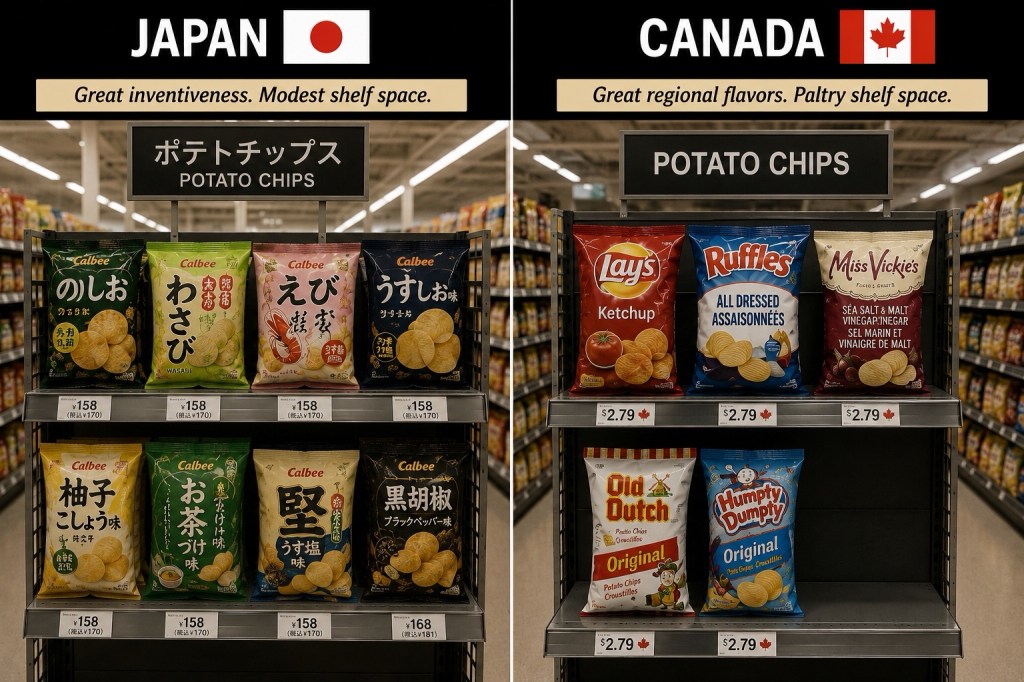
In Britain we certainly enjoy crisps. Japan, I am told, rivals America in inventiveness, delighting in seaweed, wasabi, shrimp, and other adventurous flavors. Canada contributes ketchup and all-dressed chips. Yet nowhere, so far as Eugene could determine, has another nation devoted so much shelf space—or so much imagination—to the crunchy arts.
Imagine my disappointment upon discovering that Americans had devoted an entire aisle to “chips,” only to learn that not one of them would accompany a respectable piece of cod.
The British chip remains a side dish. The American chip has become an independent civilization.
A Council Tangent Within The Gist
It was then that Eugene slowly removed his spectacles.
“Magnificent,” he whispered.
“What is?”
“The stratigraphy.”
I looked at him blankly.
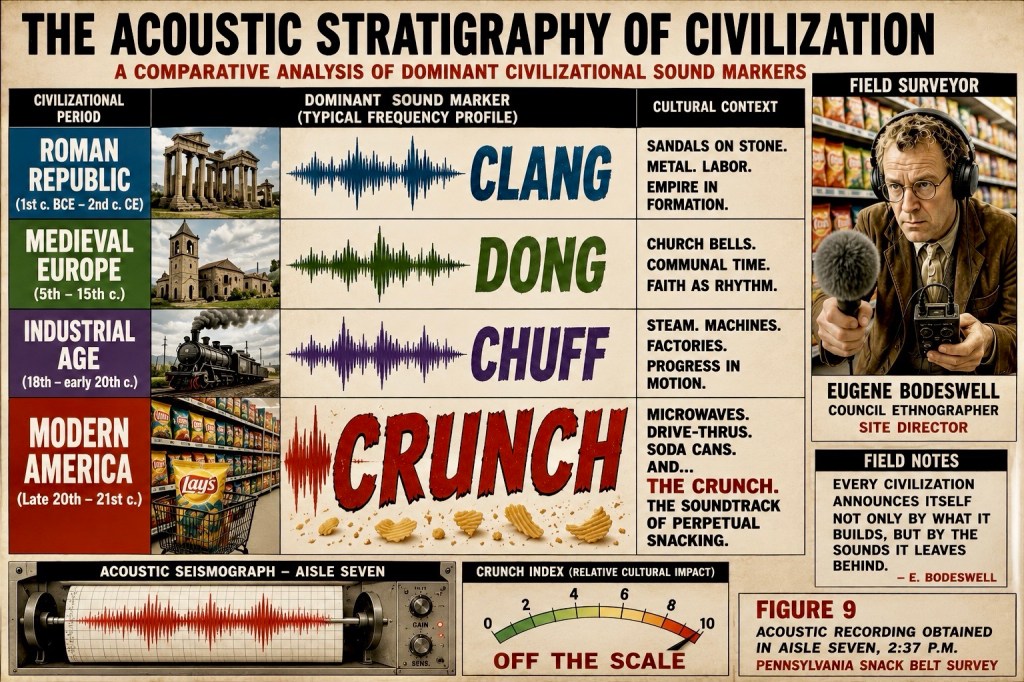
“You are standing,” he said with unmistakable reverence, “before a geological cross-section of American civilization.”
I reminded him that we were standing in a supermarket.
“Precisely.”
He then proceeded to read the shelves exactly as a geologist reads the exposed walls of the Grand Canyon.
“The lowest strata,” he explained, pointing solemnly toward the bottom shelves, “contain the oldest surviving cultural deposits.”
He indicated the familiar bags of Lay’s Classic, Utz Original, Wise, Herr’s, and Ruffles Original.
“The Republic of Salt,” he declared. “The Age of Simplicity. Potatoes, Salt. No unnecessary excitement.”
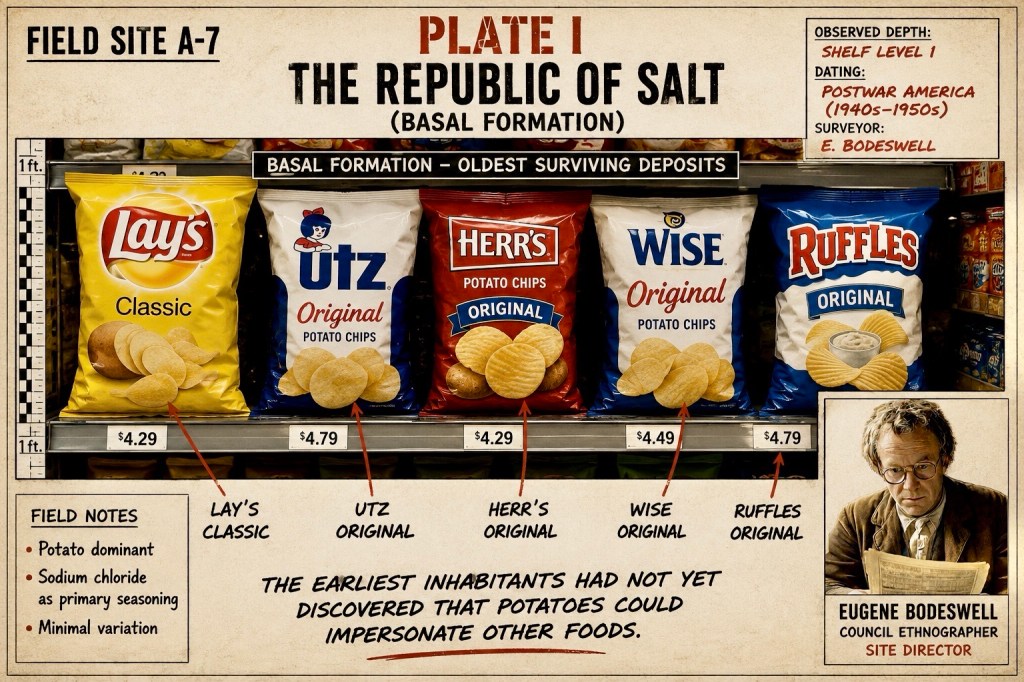
He regarded these with almost religious respect.
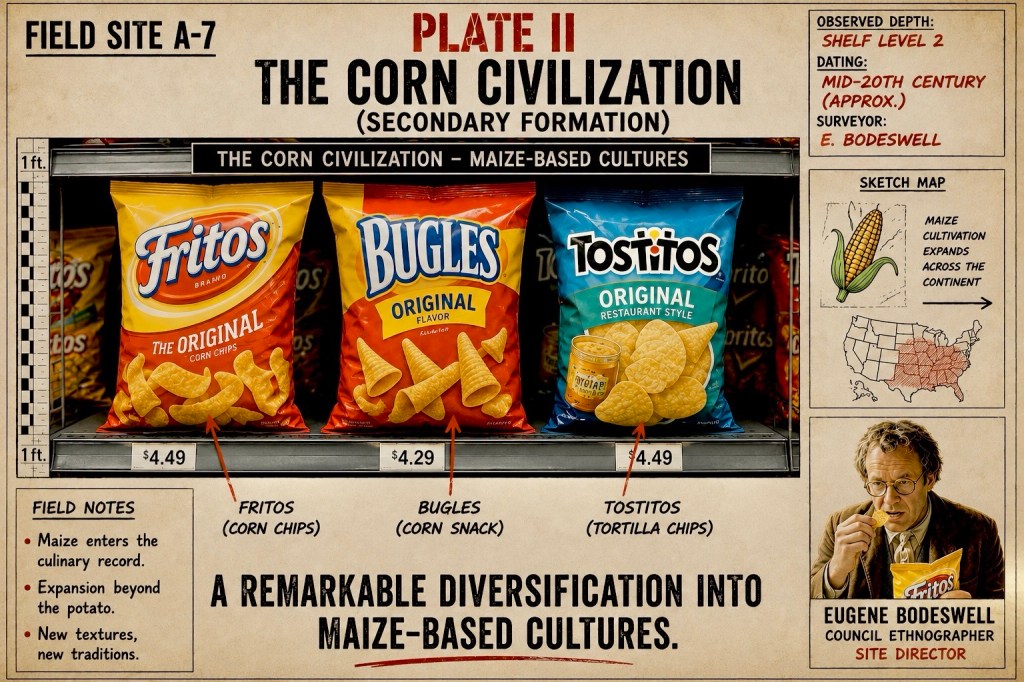
Nearby lay Fritos, Bugles, and Tostitos.
“The Corn Civilization,” he announced. “Observe the influence of maize.”
I pointed out that they were merely corn chips. He ignored me.
Ascending several shelves, Eugene suddenly became animated.
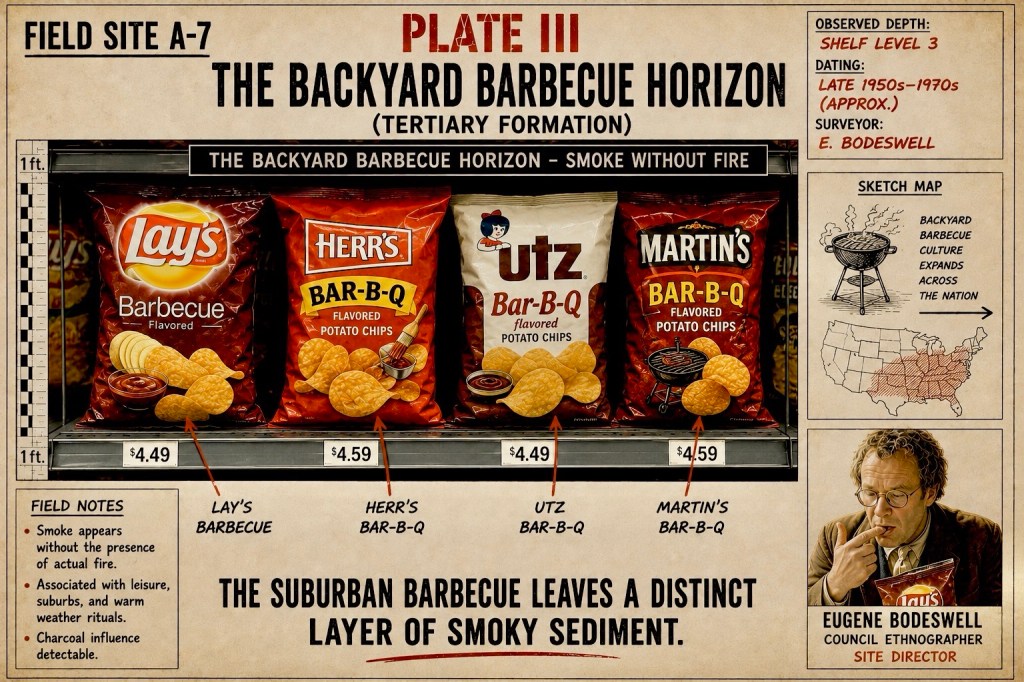
“The Backyard Barbecue Horizon!”
There before us stretched an impressive formation of Lay’s Barbecue, Herr’s Bar-B-Q, Utz Bar-B-Q, and numerous regional variations.
“Remarkable,” he said.“Smoke has appeared without the presence of actual fire.”
He insisted this layer represented suburban America at leisure—backyard grills, summer vacations, station wagons, picnics, baseball games, and fathers wearing aprons while discussing charcoal.
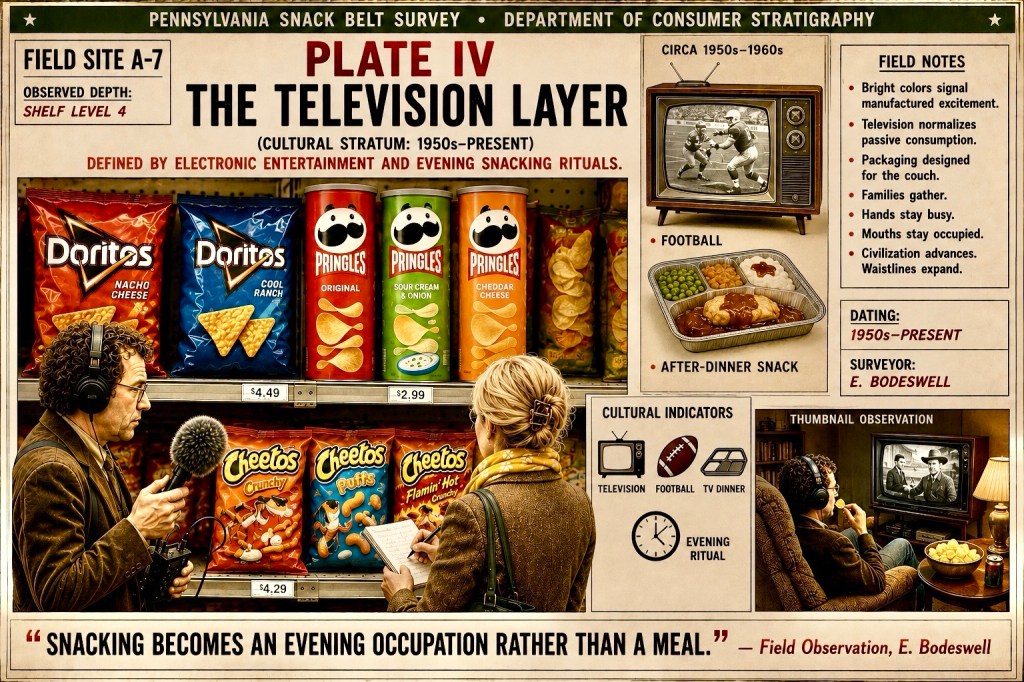
Higher still came what Eugene called The Television Layer.
There we encountered Doritos Nacho Cheese, Cheetos, Pringles, and an ever-expanding assortment of brightly colored companions.
“This,” he explained gravely, “marks the moment at which Americans ceased merely eating and began snacking as a recreational activity.”
“The invention of television,” I observed, “appears to have liberated them from the burden of plates.”
He nodded thoughtfully.
“An important cultural transition.”
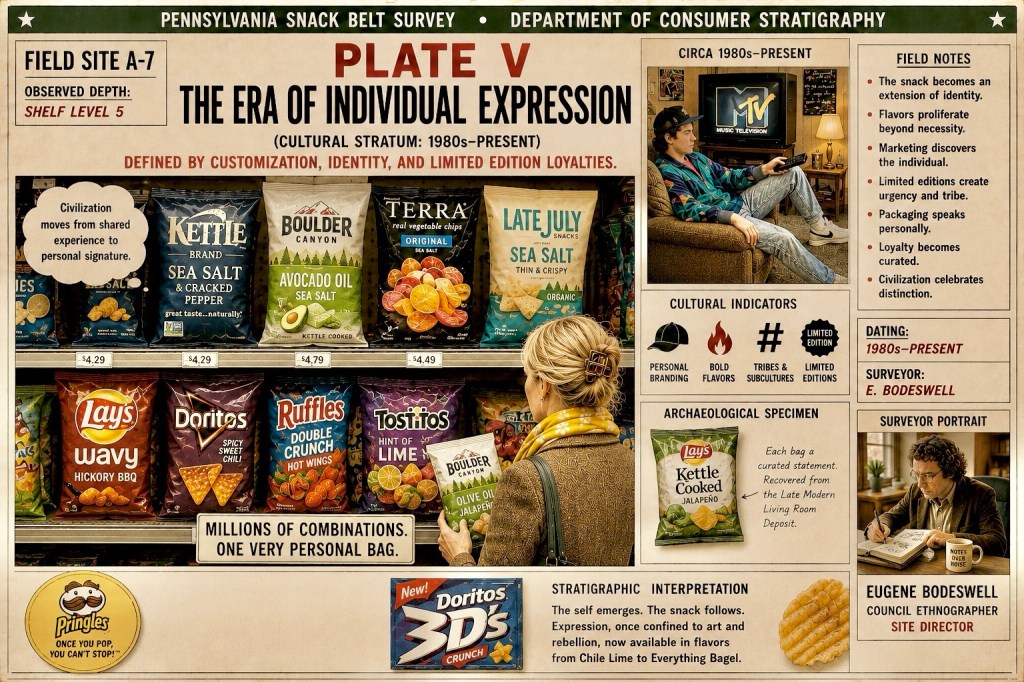
Beyond this lay what Eugene termed The Era of Individual Expression.
No longer were there merely potato chips.
There were Sour Cream & Onion, Salt & Vinegar, Cheddar & Sour Cream, Dill Pickle, and countless other declarations of personal identity.
“Observe,” he said, “consumer individualism entering the archaeological record.”
Eventually we reached the strata Eugene found most fascinating.
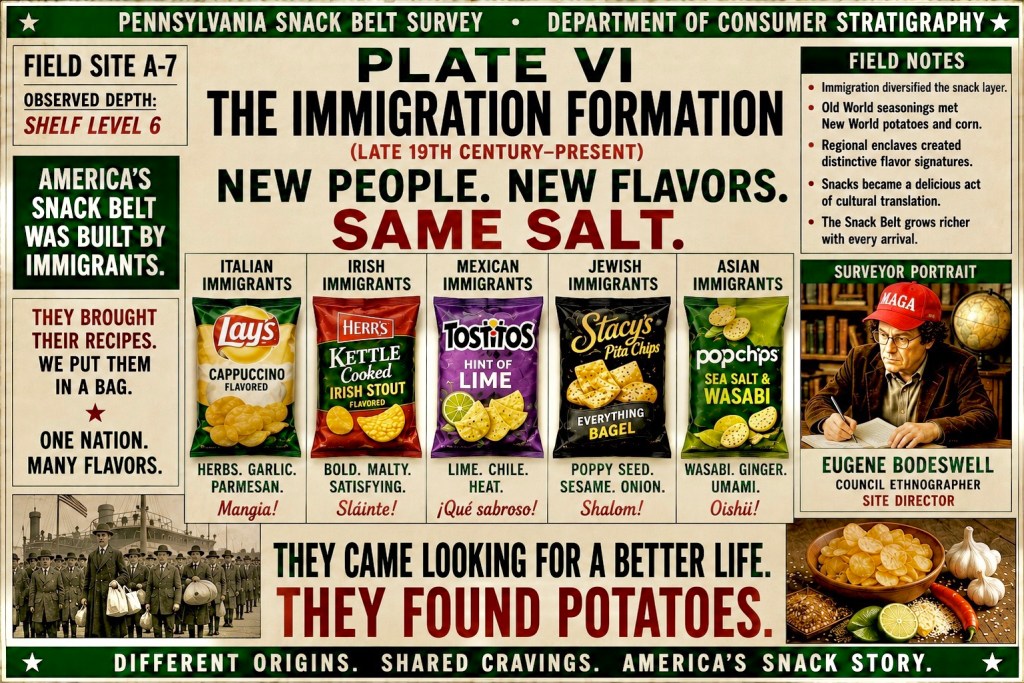
He called it The Immigration Formation.
There appeared flavors inspired by cuisines from every corner of the globe.
Korean Barbecue.
Cajun Crawtators.
Sweet Maui Onion.
Salsa Verde.
Flamin’ Hot Limón.
America, it would seem, welcomes the world one seasoning packet at a time.
“It appears,” I noted in my notebook, “that Americans first greet foreign civilizations by reducing them to powder and sprinkling them upon potatoes.”
Eugene considered this a profound observation.
Finally we arrived at the uppermost deposits.
Sea Salt. Black Pepper. Olive Oil. Rosemary. Black Truffle. Kettle Cooked. Small Batch. Artisan.
“The Caprock,” Eugene whispered. “The Potato has entered the gentry.”
By this point I had ceased laughing. For the ridiculous theory was beginning to make an uncomfortable amount of sense.
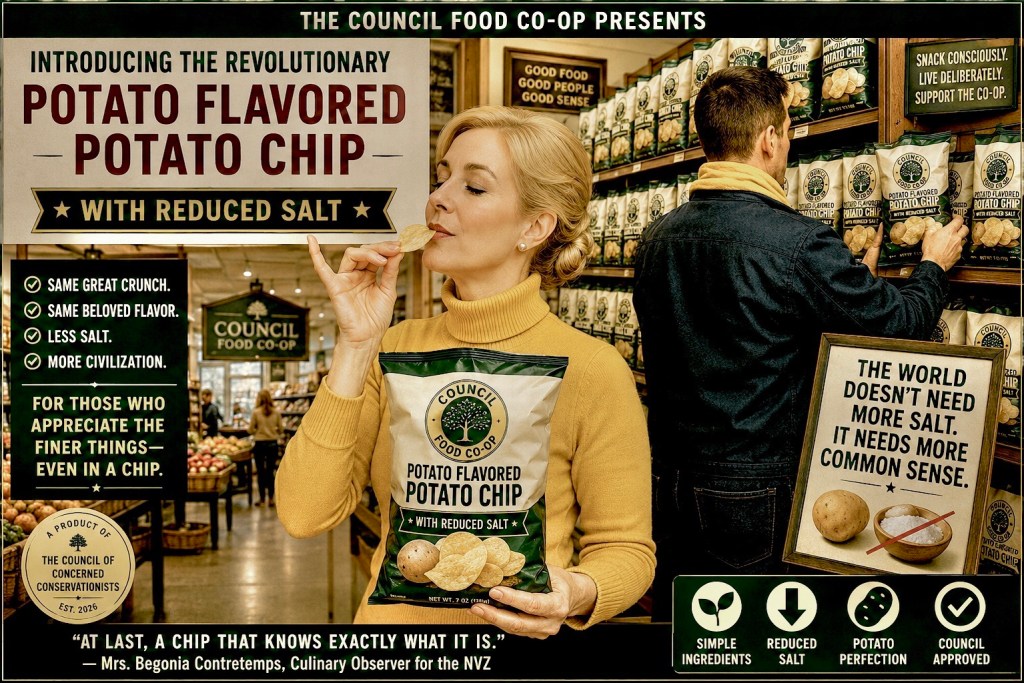
Paid Advertisement

Each new generation of flavors had accumulated without burying the older ones. Plain chips remained. Barbecue endured. Nacho cheese survived. New arrivals simply settled gently upon those that came before. The supermarket shelf had become a living cross-section of American memory.
One could almost read the country’s changing tastes, technologies, immigration, prosperity, advertising, and restless inventiveness from the orderly accumulation of snack foods.
As we left, Eugene unfolded a map of Pennsylvania.
“There,” he said triumphantly. “The evidence.”
The Commonwealth contains an astonishing concentration of snack manufacturers—Utz, Herr’s, Martin’s, Middleswarth, Good’s, Gibble’s, and others—another industrial cluster hiding in plain sight, every bit as remarkable as the knife makers of Little Valley.
I smiled. John St. Evola had done it again. He had sent me in search of another forgotten civilization.
I expected factories. Instead, I found myself reading the geological history of America one potato chip at a time.
Your affectionate correspondent,
Mrs. Begonia Contretemps
 COUNCIL-OF CONCERNED-CONSERVATIONISTS…..Between Jest And Earnest…..
Leave a comment