—Some Notes on the Collective Wisdom of Individual Ignorance

Mrs. Begonia Contretemps is presently traveling the United States at the request of Europe’s Nouvelle Vague Zwischenshaft, attempting to determine what, exactly, America is about. Alexis de Tocqueville undertook a similar inquiry nearly two centuries ago, though without the benefit—or encumbrance—of the Council.
Salamanca Antique Mall
Salamanca, New York
250 Years into the American Experiment
My dear René,
John St. Evola’s instructions were unusually straightforward.
“Mrs. Begonia, I would like you and Noor to examine the enlargement of the American voting franchise.”
Noor brightened immediately.
“From the beginning?”
“To the present.”
Noor Singha Grudj is the Council Gadfly. She is not, strictly speaking, a member. We keep her around to make certain that whenever the Council becomes too pleased with one side of an argument, the other side is still in the room. Noor takes this responsibility seriously, particularly when the other side happens to be hers. For the present assignment, she required no encouragement.
I gathered my notebook.

THE FRANCHISE
We began with the early Republic, when voting qualifications were largely left to the states and the electorate was considerably more restricted than the one Americans know today.
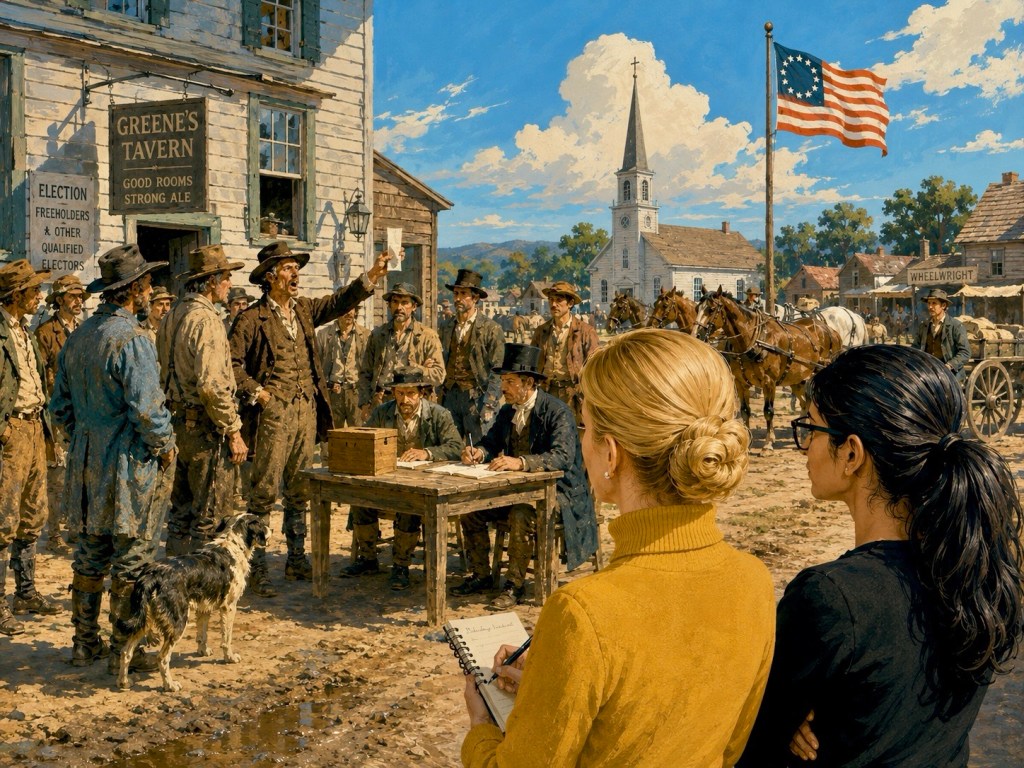
“They really didn’t let very many people vote,” Noor said.
“Apparently democracy was initially released in limited quantities.”
During the nineteenth century, property qualifications for white men largely disappeared. After the Civil War came the Fifteenth Amendment, prohibiting denial of the vote on account of race, color, or previous condition of servitude.
The electorate grew.
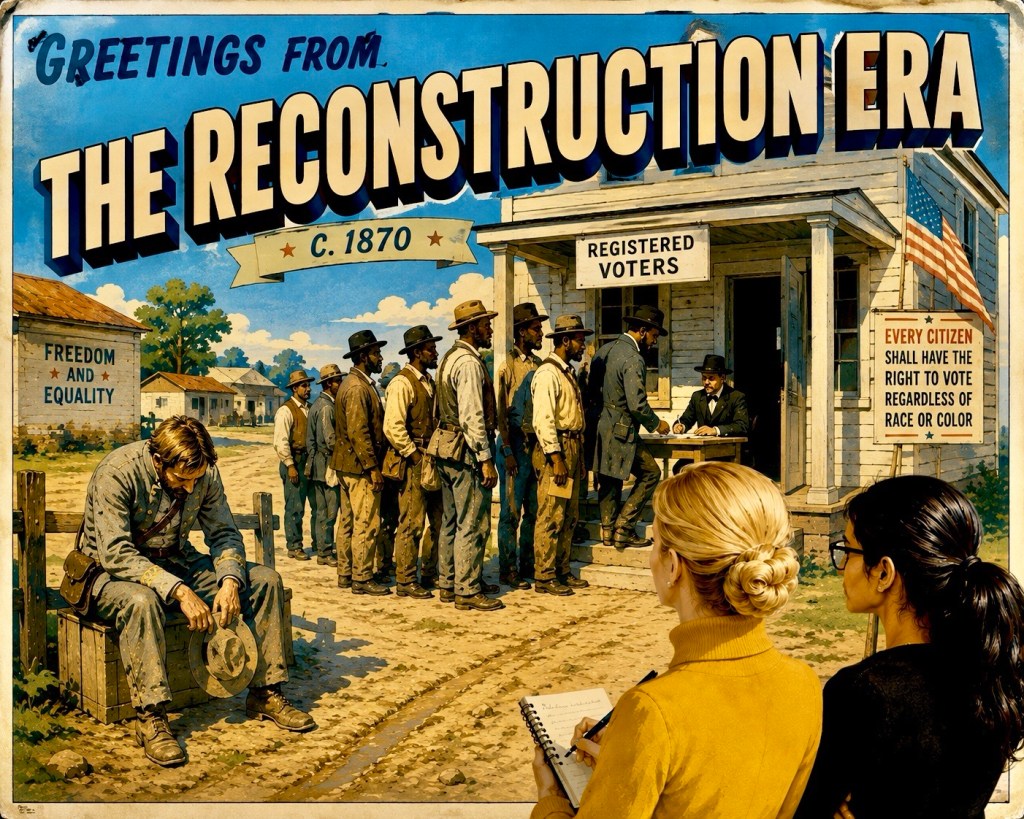
“More people,” Noor said approvingly.
“So I see.”
At Seneca Falls, Noor became considerably more animated. The long campaign for women’s suffrage would culminate nationally in the Nineteenth Amendment in 1920.
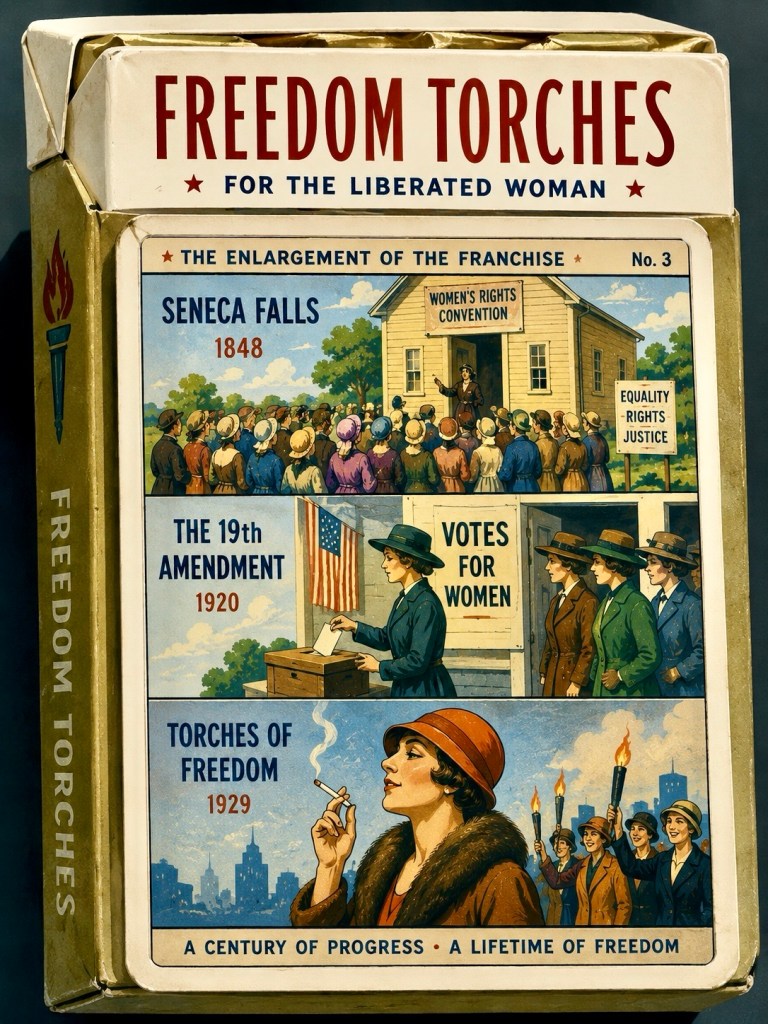
“And now women,” Noor said.
“That does rather increase the sample.” I coughed.
The process continued. Barriers to Black voting were attacked through constitutional amendment, federal law and the civil-rights movement. In 1971, the Twenty-Sixth Amendment lowered the voting age to eighteen.
And arguments over the boundaries of the franchise continue.
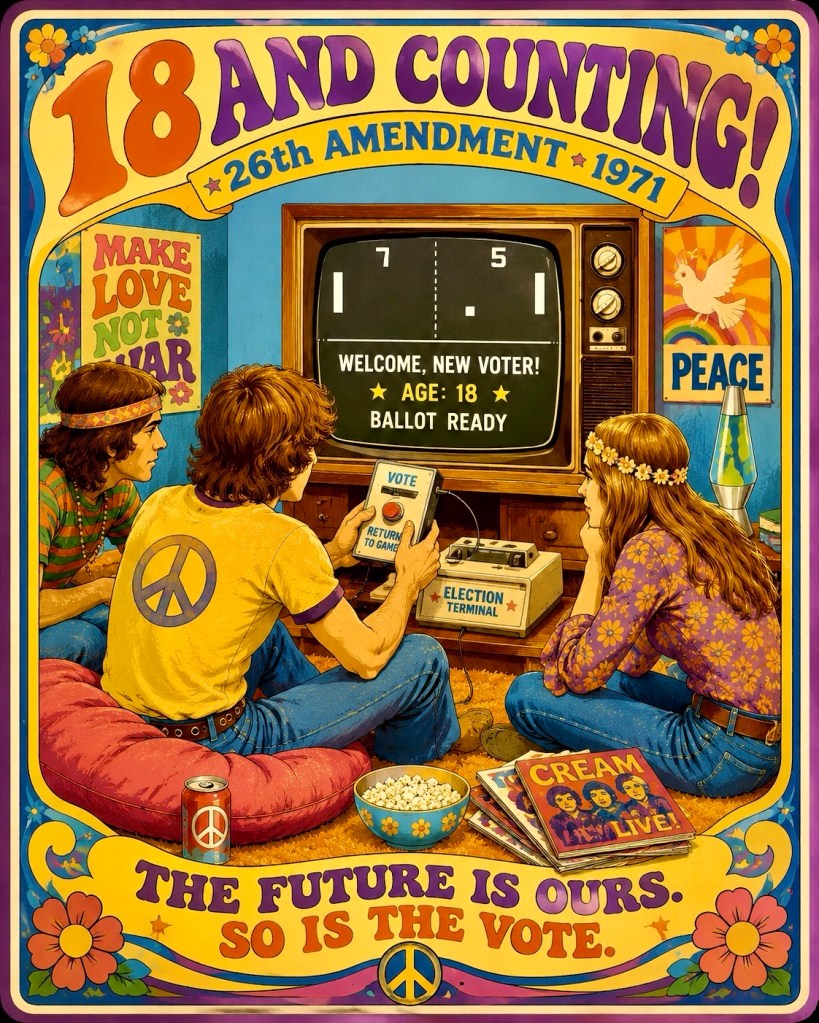
“The whole history of American democracy,” Noor said, “is really the story of bringing more people into the room.”
“Is more always better?”
“In democracy? Of course.”
I wrote this down.
THE BOOK ANNEX
We returned to Coelacanth Press main branch by way of a storefront from which the Council sells its own publications and, for reasons never adequately explained to me, those of other publishers.
John was there.
On one wall, customers were invited to assemble quotations from letter tiles. Someone had left this one intact:
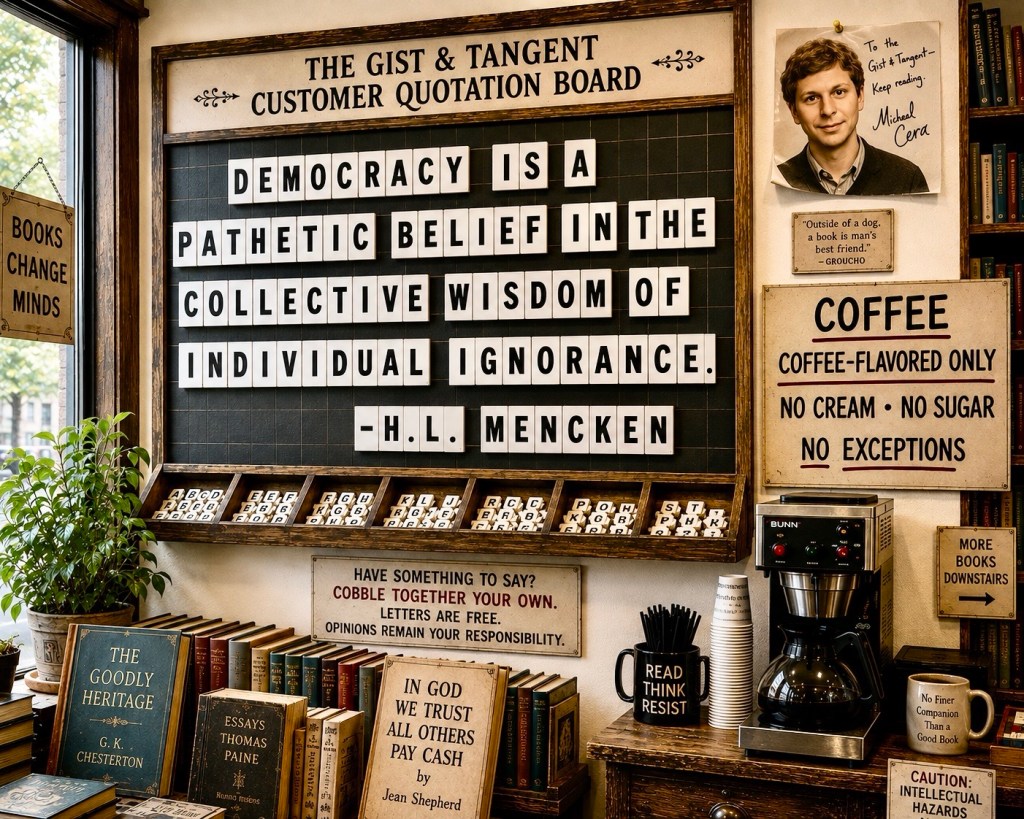
Noor turned from Michael Cera to the customer quotation board, where Mencken’s observation remained assembled in Scrabble tiles. She looked at it.
“Why do we have that quote here?”
“Dan Aykroyd put that up,” John said. “Took him nearly an hour. Would’ve been 684 points, but Mencken was a proper noun.”

John tells me artificial-intelligence companies have been buying old books for digitization. This may prove the Gist & Tangent’s only viable business model: sell the machines enough obscure books that eventually they begin thinking like us. John calls it metapolitics. I call it wholesale.
While Noor reported on our travels, I browsed.
That was when I found Eddington.
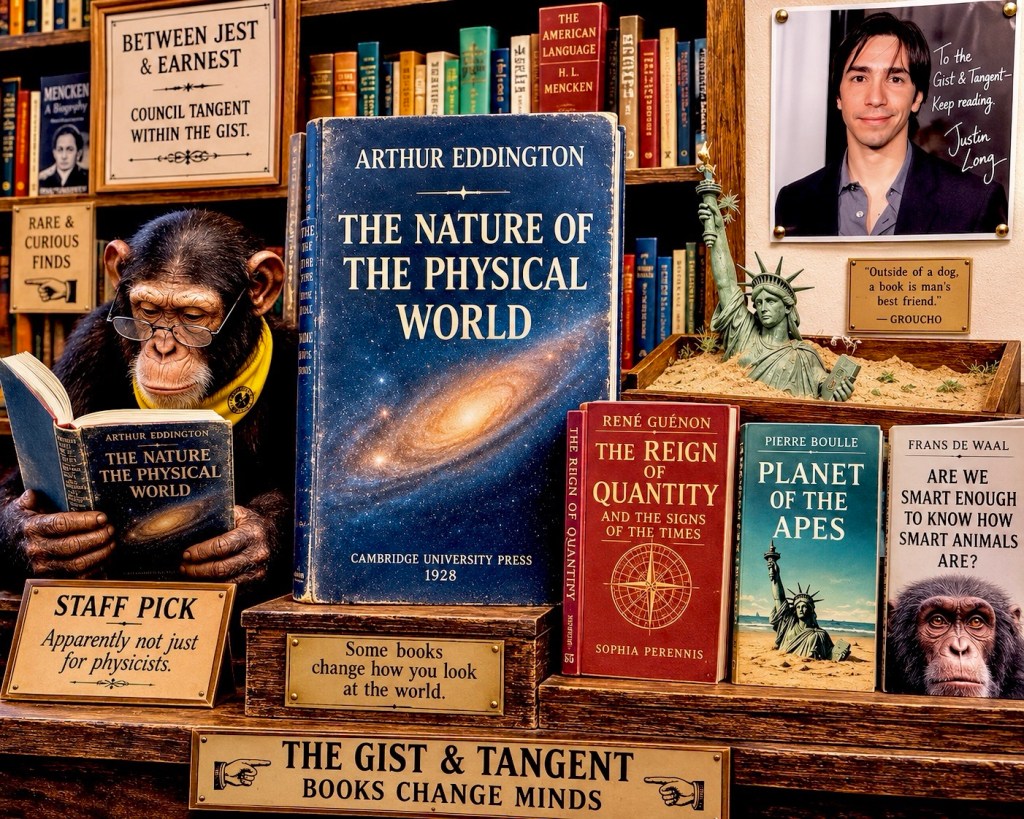
Eddington had invoked an army of monkeys randomly striking typewriter keys until, given sufficient opportunity, they reproduced the books of the British Museum. Posterity simplified the challenge: give the monkeys enough time and eventually they will write Shakespeare.
The idea has since acquired its familiar popular form :
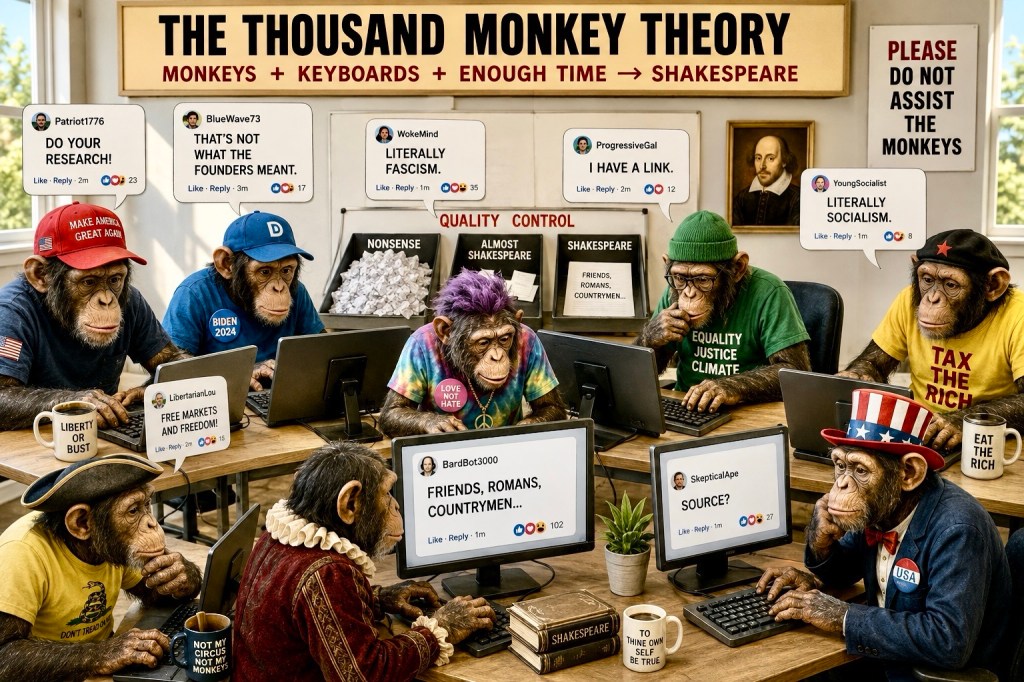
I read it twice. Then I looked at the plaque.
Collective wisdom from individual ignorance.
I looked back at the monkeys.
Shakespeare from individual randomness.
Then I looked at Noor.
Something quite dreadful had occurred to me. John noticed.
“What?”
“Nothing.”
“That is usually where our difficulties begin.”
“Noor,” I said, “do you remember telling me that the history of American democracy is the history of bringing more people into the room?”
“Yes.”
“And that more is better?”
“Yes.”
I showed her the book. She read the passage. Then she looked at me.
“No.”
“I haven’t said anything.”
“You don’t have to.”
John came over. I explained the problem.
The thousand-monkey proposition suggested that sufficient numbers, given sufficient opportunity, might eventually produce Shakespeare.
Mencken suggested that democracy expected collective wisdom to emerge from individual ignorance.
And we had just spent several days tracing the steady enlargement of the American electorate.
Noor folded her arms.
“Voters are not monkeys.”
“Obviously.”
“And democracy doesn’t guarantee that people will make the right choice.”
“I understand.”
“It guarantees their right to make the choice.”
“Quite.”
I considered this. Then walked to the literature shelf.
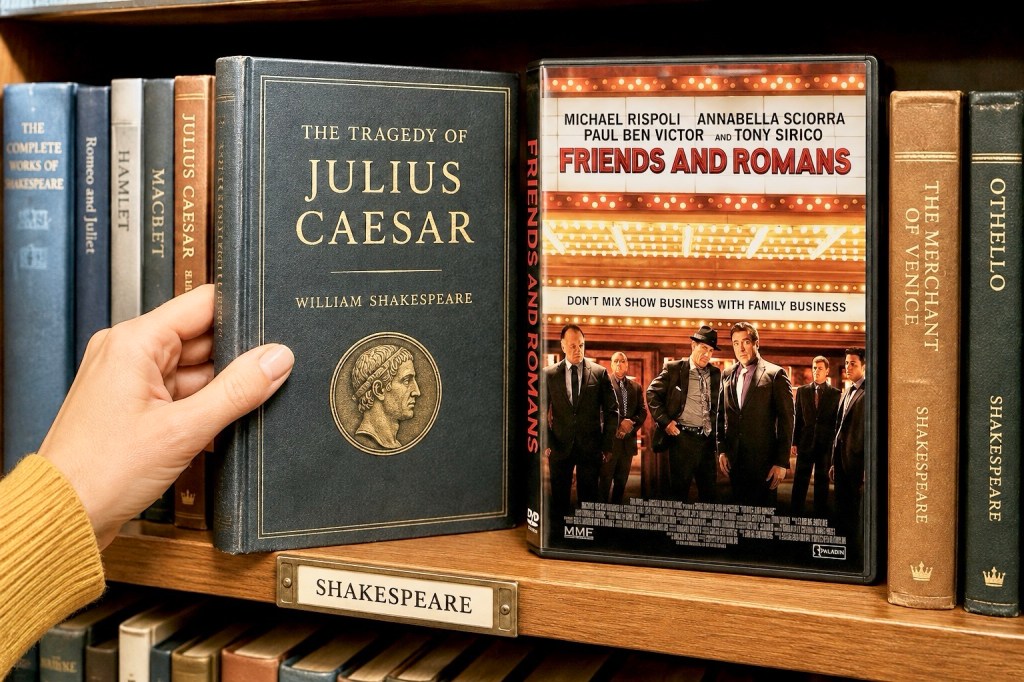
“What are you doing?” Noor asked.
“Checking the results.”
I opened the book. “Well,” I said, “there is good news.”
Noor waited.
“The collective monkeys did eventually produce Julius Caesar.”
She narrowed her eyes.
“Unfortunately, they appear to have produced the parody.”
John laughed. Noor did not.
“You mean Trump.”
“I mentioned no names.”
“You didn’t have to.”
There was a short silence.
“The electorate chose him,” I said.
Noor sighed.
“Yes.”
“Then I fear the monkeys must be allowed to keep the typewriters.”
Noor looked at the Eddington book, then at Mencken’s plaque.
“I hate this theory.”
“I don’t believe it requires your consent.”
A NOTE TO THE READER FROM THE COUNCIL
Before we congratulate ourselves too heartily on the thousand monkeys, one awkward fact should be disclosed. This report was prepared with the assistance of a large language model—a machine trained upon an almost inconceivable quantity of human words and which, by assigning mathematical probabilities to what ought to come next, somehow manages, with disturbing frequency, to produce something that makes sense.
In other words, we have just spent several pages questioning whether quantity can produce wisdom with the assistance of perhaps the most spectacular argument yet devised that sometimes it can.
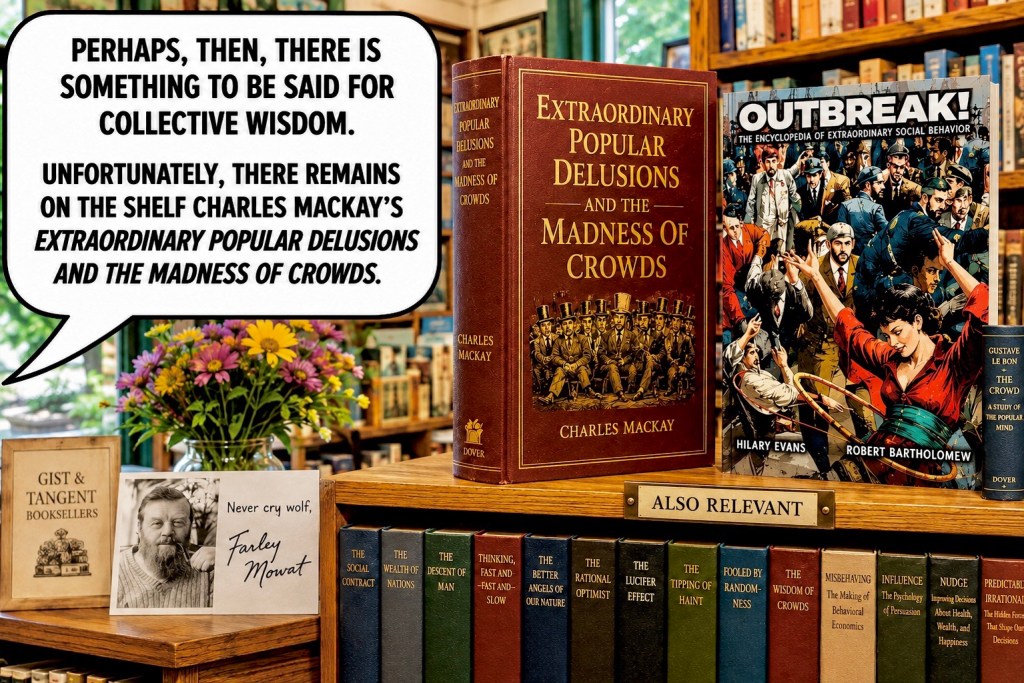
The Council regrets the complication.
And so, my dear René, that is how the inquiry ended. I had gone looking for the consequences of enlarging the franchise and returned having discovered that quantity is apparently capable of producing a form of Shakespeare—as predicted—and Donald Trump. . . and also, rather inconveniently, the machine that helped me write this report.
I leave you to decide what this proves.
Yours in statistical uncertainty,
Begonia Contretemps
RENÉ REPLIES
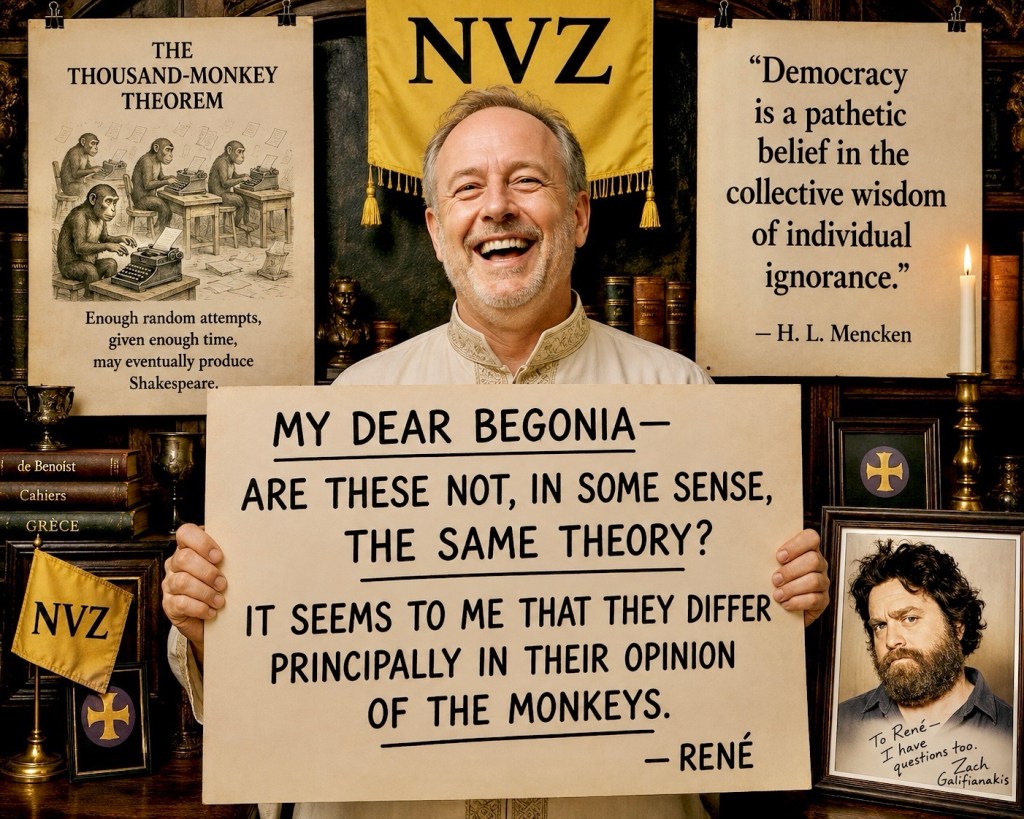
Begonia, I have considered your report carefully. In deference to the customs of the country you are studying, I have reduced my reply to what, as you say, is called a meme.
More from Mrs. Begonia’s road trips can be found: HERE
 COUNCIL-OF CONCERNED-CONSERVATIONISTS…..Between Jest And Earnest…..
Leave a comment