—Homemade Theme Parks as Weird Americana
—Where Wordplay Escaped into History
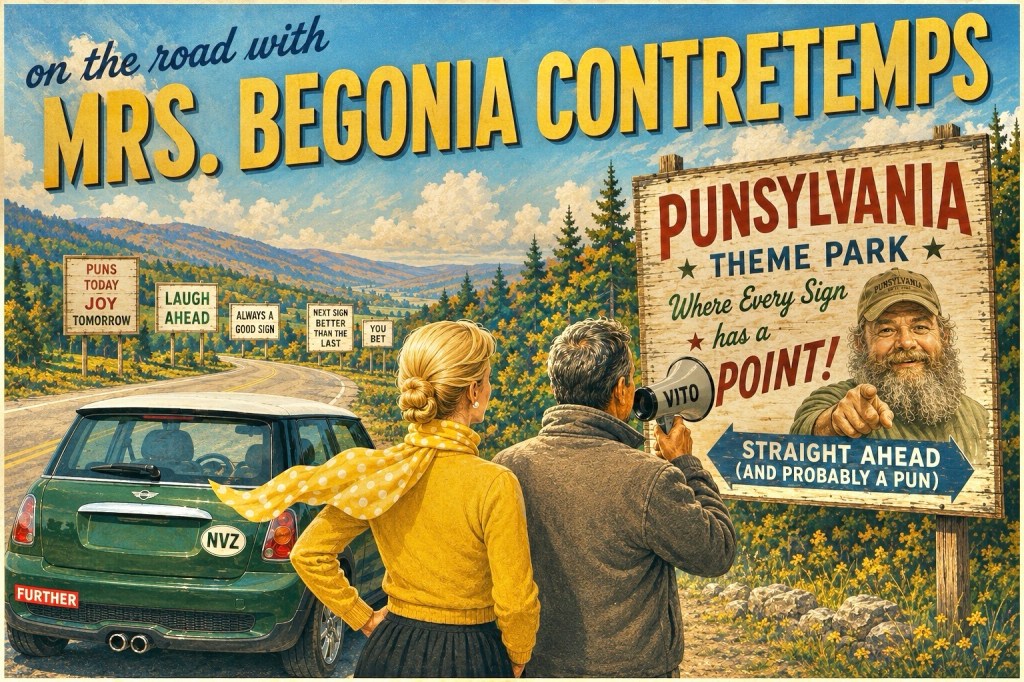
One of the enduring features of the American landscape is the roadside attraction: sometimes ingenious, sometimes homemade, but almost always the product of one person’s determination that the rest of the country ought to stop and take notice. For her continuing search for the real America, editor John St. Evola dispatched Mrs. Begonia Contretemps and Vito Haeckeler to investigate one such establishment that he assured them was “well worth the detour.”
The following letter was sent to René Seance shortly after their visit.
JELL-O Gallery Museum
Le Roy, New York
129th Year Since the Invention of Jell-O
Dear René,
I have long maintained that Americans possess an extraordinary gift for constructing museums devoted to subjects the rest of civilization never realized required preservation.
I believed I had seen them all.
Museums devoted to barbed wire, mustard, socks, trolls, kazoos, and even entire halls dedicated to individual household appliances.
I underestimated them.
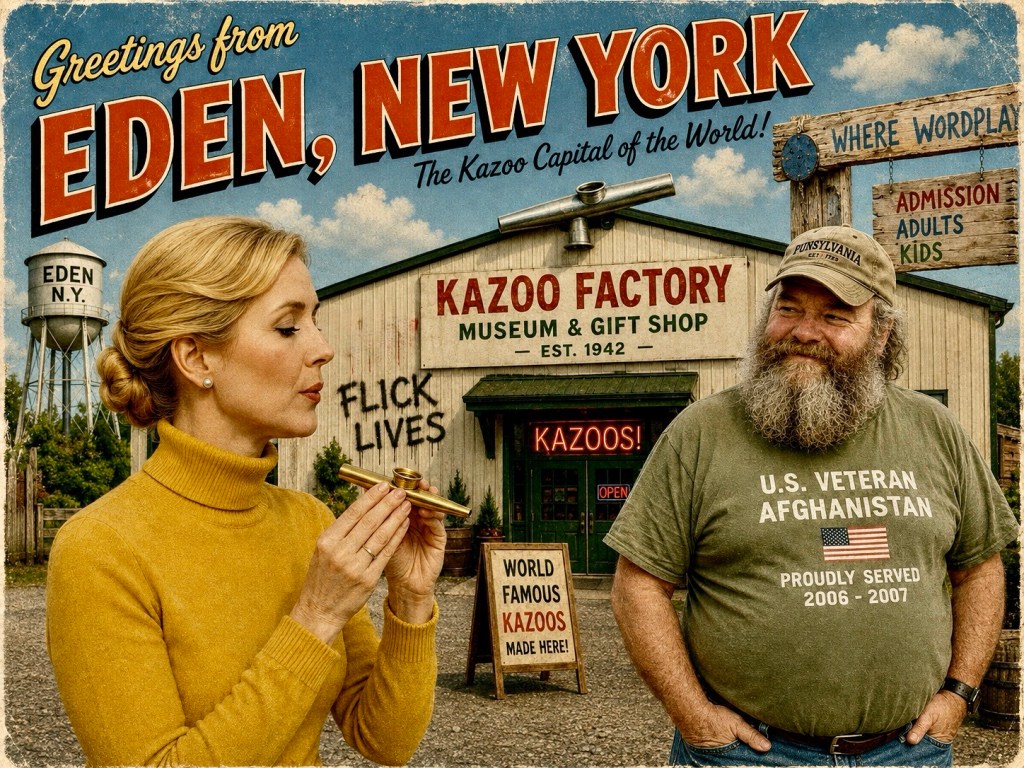
Yesterday John implored that we visit a modest interpretive theme park somewhere in rural Pennsylvania called Punsylvania.
According to its proprietor, the purpose of the establishment is to demonstrate that puns are among the most unfairly maligned achievements of civilization.
John assured me I would enjoy it.
Experience has taught me that whenever John says this, unexpected surprises generally follow.
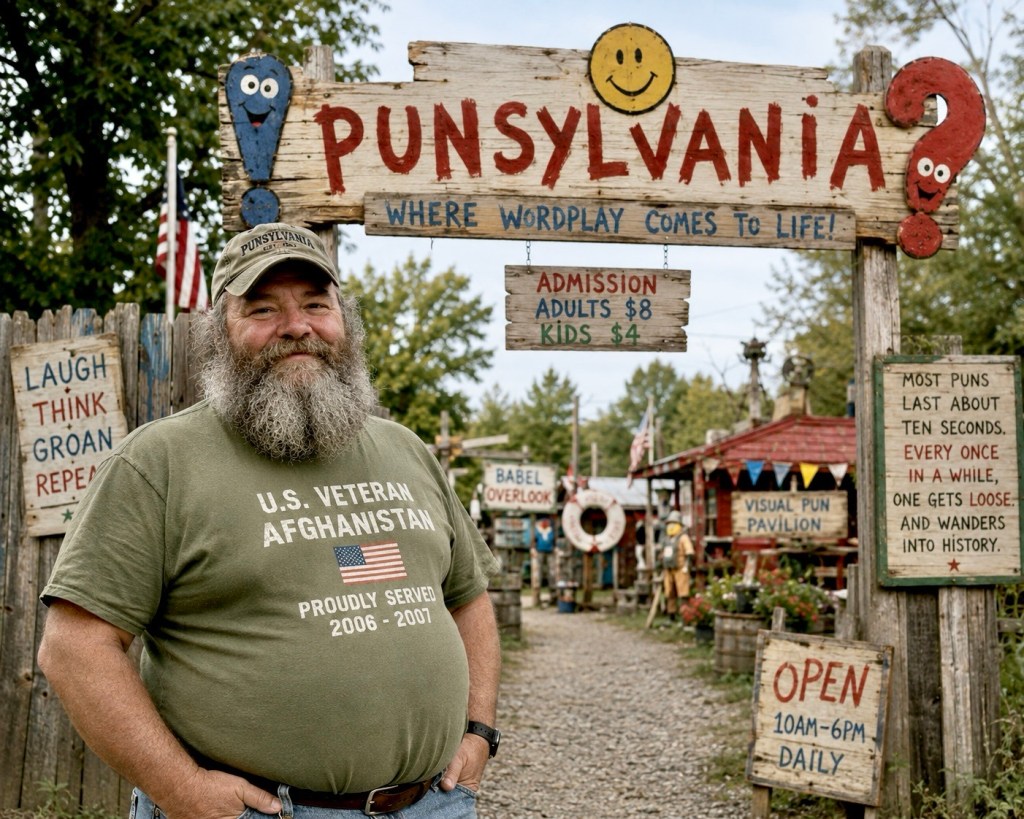
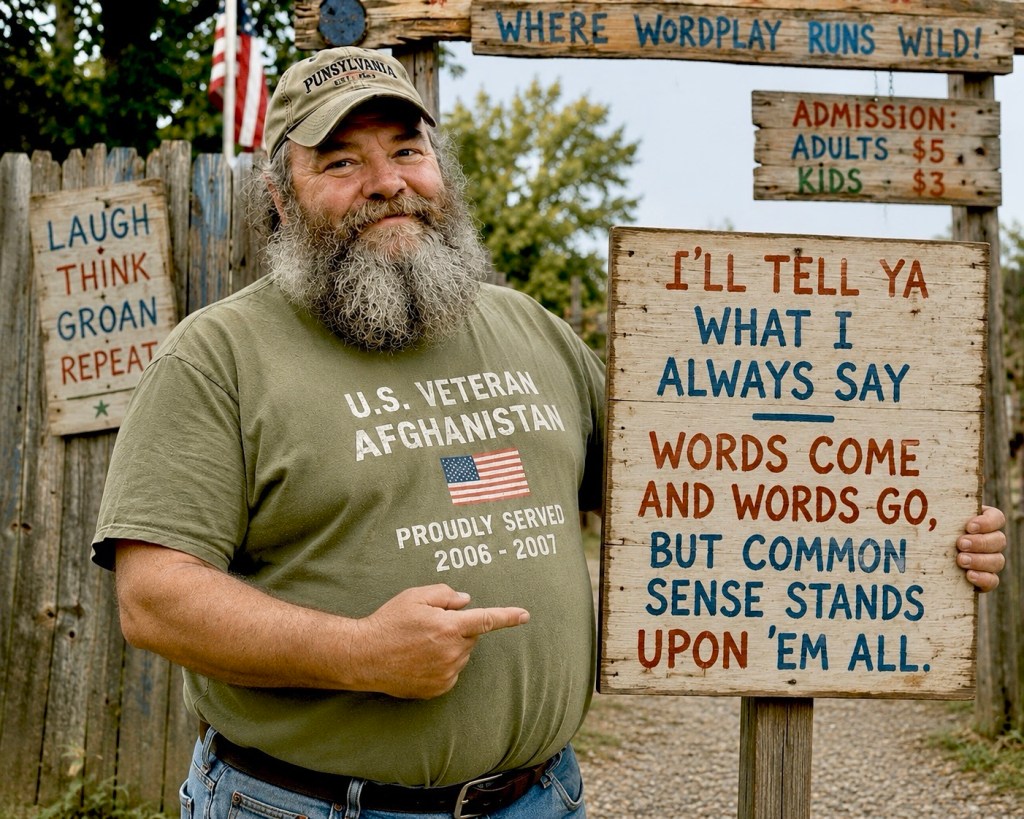
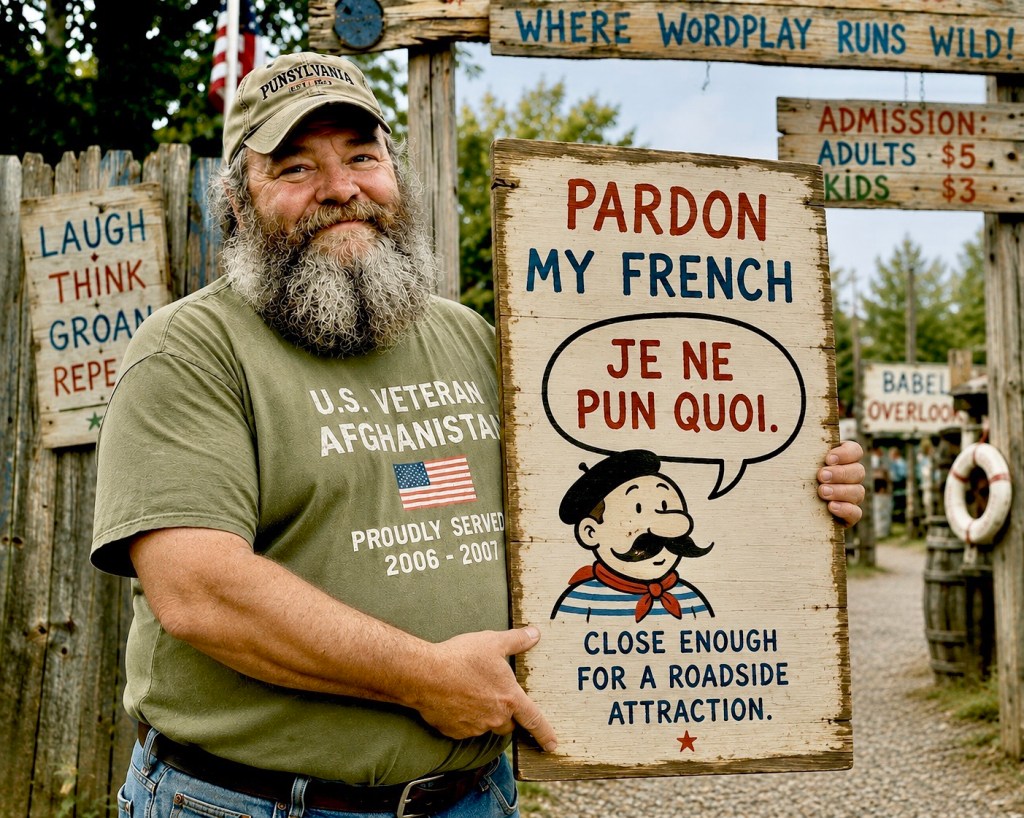
August “Gus” Groening welcomed us to Punsylvania.
The proprietor greeted us wearing a well-worn baseball cap, an Afghanistan veteran T-shirt, and the comfortably earned retirement belly of a man at peace with himself. His full salt-and-pepper beard immediately struck me as the sort Americans had once crossed an ocean to oppose and now seemed to cultivate with remarkable enthusiasm. One had the distinct impression that he had enlisted for the adventure, returned with a lifetime of stories, accidentally kept the beard, and devoted the remainder of his retirement to convincing complete strangers that puns occasionally change the course of civilization.
“Puns,” he announced, “are the only jokes that occasionally escape captivity.”
I confessed I had never heard such a sentence before.
“Most puns,” he continued, “last about ten seconds.”
He smiled proudly.
“Every once in a while, one gets loose. . . and wanders into history.”
I feared we were in for a very long afternoon.
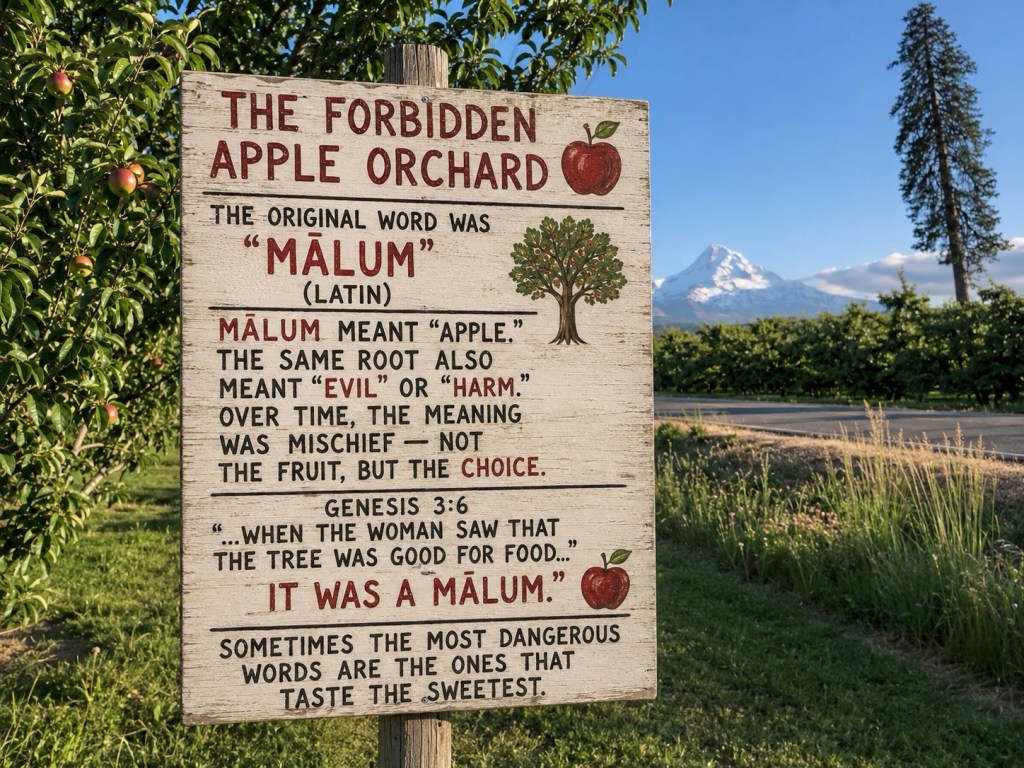
THE FORBIDDEN APPLE ORCHARD
Our first stop appeared entirely ordinary.
Rows of apple trees. Wooden fences. A pleasant country orchard. Only after reading the interpretive signs did I discover the joke.
The Book of Genesis never actually identifies the forbidden fruit as an apple.
That association emerged centuries later through language, symbolism, and artistic tradition until eventually the apple became inseparable from the story itself.
The proprietor folded his hands.
“Sometimes,” he said, “a civilization adopts a pun.”
“It wasn’t even the original fruit?” I asked.
“No, ma’am.”
“And now the entire Western world pictures an apple.”
“Exactly.”
My road companion, Vito looked pleased with himself.
I did not.
BABEL OVERLOOK
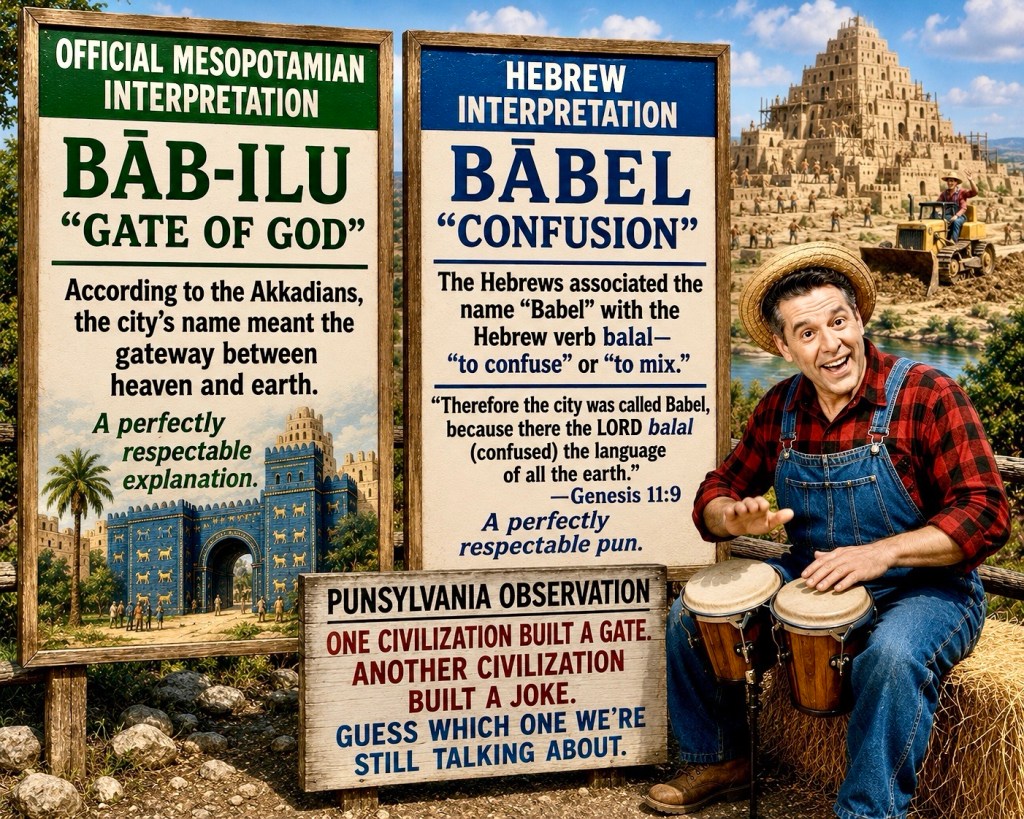
The next exhibit overlooked a miniature reconstruction of the Tower of Babel.
One plaque referred to it as The Gate of God.
Another called it The Tower of Confusion.
“Two civilizations,” explained the proprietor. “One built the city. The other renamed it. And history remembered the second story.”
I found this considerably more unsettling than the orchard.
THE HAMBURGER CORRECTIONAL FACILITY
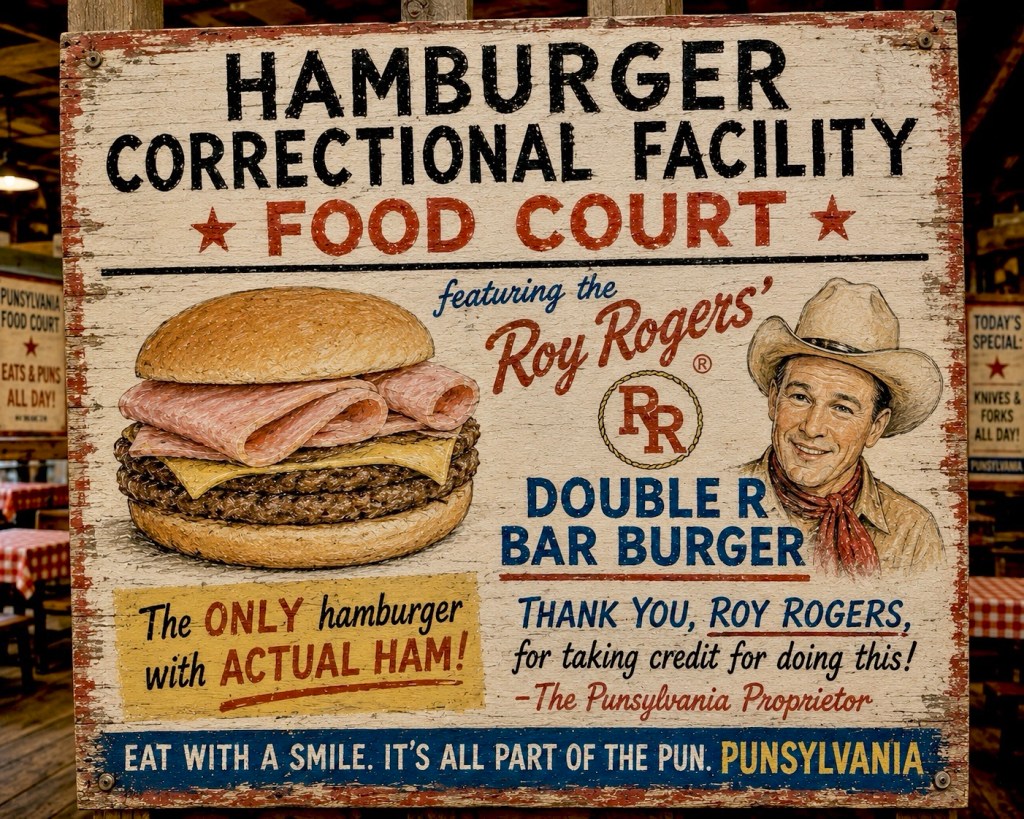
By lunchtime we reached Punsylvania’s food court, a cheerful snack bar thoughtfully incorporated into the exhibit.
The proprietor placed before us an enormous Roy Rogers Double R Bar Burger.™️
Complete with a fold of ham.
“You know why?” he asked.
I admitted I did not.
“German immigrants brought with them a chopped-beef dish called Hamburg steak, named after the city of Hamburg. Americans eventually tucked it into a bun and simply shortened the name to hamburger. Folks never assumed a hamburger ought to contain ham. They misunderstood the word. . . and before long we had cheeseburgers, bacon burgers, turkey burgers, veggie burgers. . .”
I interrupted.
“So the entire menu is based on a misunderstanding?”
The proprietor smiled.
“Strictly speakin’, ma’am, it ain’t a pun. It’s what happens when folks hear a word so many times they decide it oughta make more sense than it actually does.”
“So Americans corrected the language?”
“No, ma’am. The language corrected itself. Americans just helped.”
I regret to report that the burger was excellent, then glanced down at the French fries.
“Don’t start,” said the proprietor.
“I wasn’t going to ask.”
“Good,” he replied. “Neither France nor Belgium has forgiven us yet.”
THE VISUAL PUN PAVILION
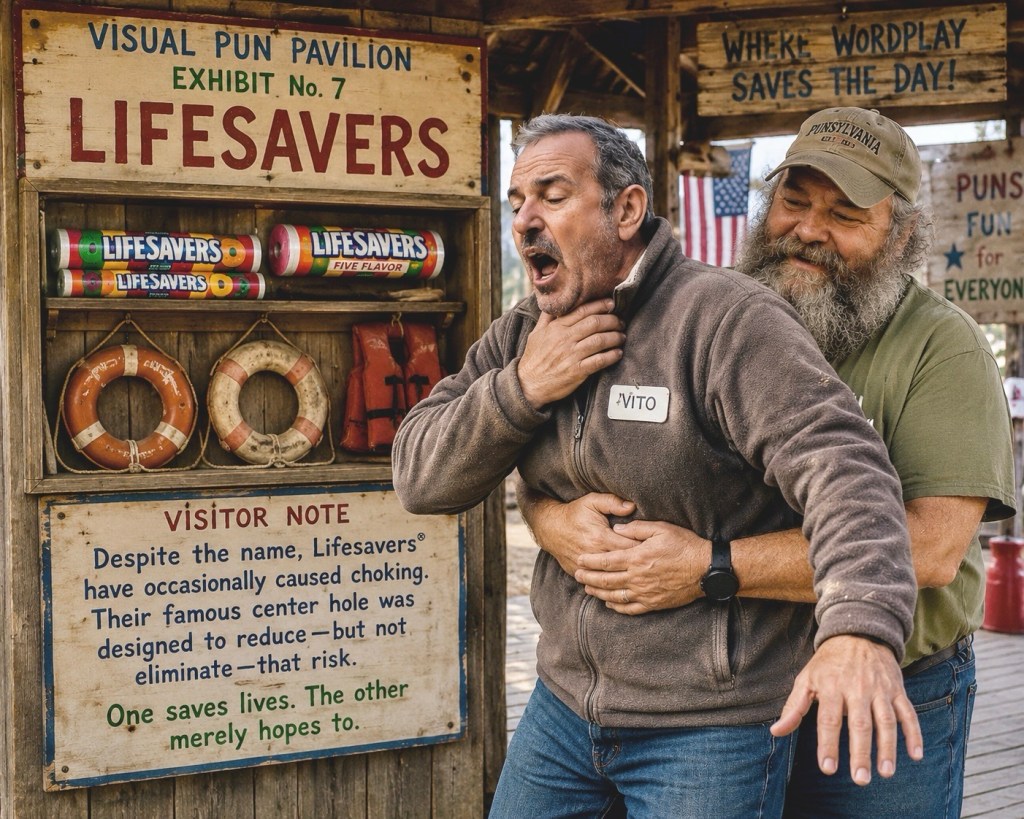
The proprietor next produced a roll of Lifesavers.
“Our Visual Pun Pavilion.”
He held one up between thumb and forefinger.
“Folks think puns have to be spoken. They don’t.”
He pointed to the candy.
“Looks like a ship’s life preserver. Name stuck. Millions sold.”
I examined one closely.
“Rather obvious once one sees it.”
“That’s the hallmark of a good pun,” he replied. “After somebody points it out, folks can’t imagine they ever missed it.”
I turned the candy over thoughtfully.
“One cannot help observing,” I said, “that there have been occasions when these particular Lifesavers have required the services of actual lifesavers.”
The proprietor closed his eyes briefly.
“Ma’am. . . that observation has been made.”
Vito, naturally, attempted to improve matters.
“So they don’t always save your life.”
The proprietor quietly returned the roll to its display.
“The Irony Department,” he sighed, . . . is just around the corner.”
THE SUN / SON GARDEN
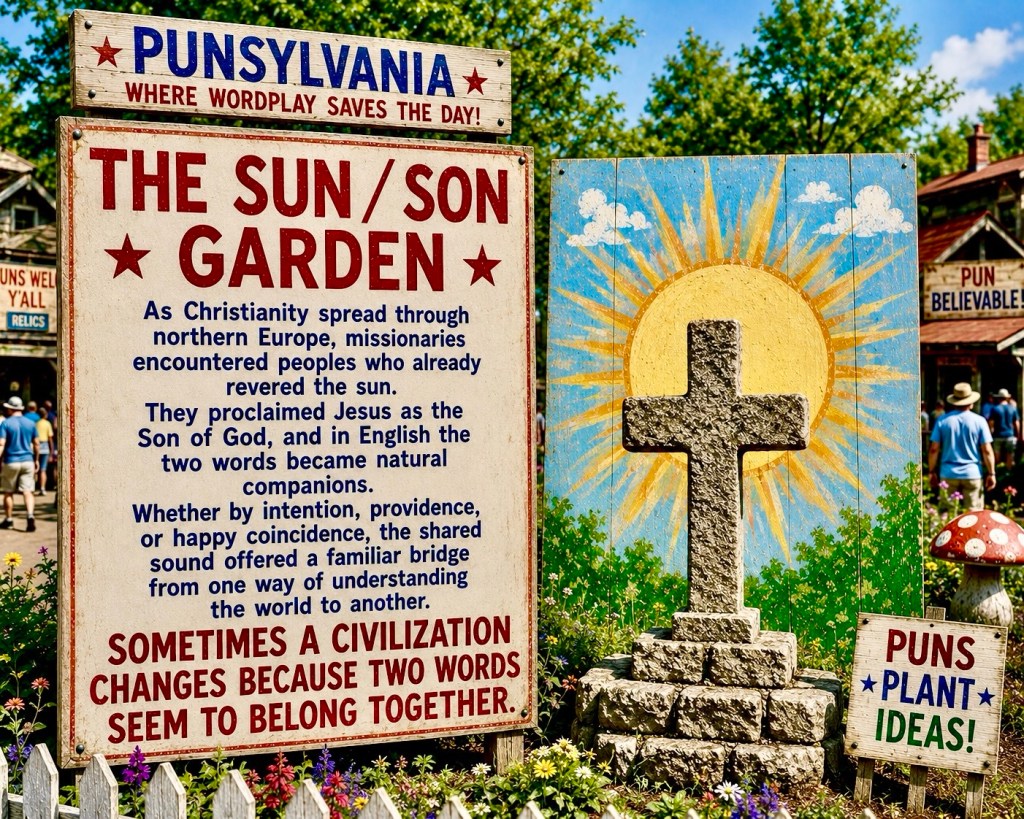
As we departed the Visual Pun Pavilion, the proprietor paused beside a modest stone marker standing in a sunny clearing.
“This one,” he said, “may have helped build a bridge.”
The sign was unusually restrained :
Mrs. Begonia remained unusually quiet.
“So,” she finally said, “the pun was not the destination.”
“No, ma’am,” replied the proprietor. “Only the bridge.”
Vito looked at me :
“Funny thing about bridges,” he said. “People rarely remember crossing them.”
For reasons I cannot entirely explain, that was the first exhibit that seemed less like a joke than a historical marker.
By the end of the afternoon I found myself reconsidering something I had accepted since childhood. As every educated English speaker knows, puns are supposedly the lowest form of wit.
The proprietor removed his ball cap.
“That notion,” he said, “came to us mostly from eighteenth-century Britain.” He paused.“Civilization never had much trouble with puns. Only intellectuals.”
I considered this in silence. After all, Shakespeare delighted in them. Scripture contains them. Advertisers built fortunes on them. Roadside attractions preserve them. Perhaps it was only respectable opinion that declared war upon them.
As a British woman, I feel a certain obligation to defend the literary reputation of my homeland. Unfortunately, after spending an afternoon in Punsylvania, I fear my countrymen may have been wrong.
Please do not tell John. He has entirely enough reasons to smile already.
Yours,
Mrs. Begonia Contretemps
Reply from René Séance
From a Bench Outside the Académie française
Paris
In the 391st Year of the French Academy
My dear Mrs. Contretemps,
A delightful report, as always. Permettez-moi. . . one microscopic observation :
The charming resemblance between Sun and Son is, strictly speaking, an English one. The missionaries who first converted the Germanic tribes around places such as Kitzingen were, regrettably, not preaching in English.
History has an unfortunate habit of refusing to speak English.
Fortunately for your enthusiastic proprietor, history occasionally spoke Old High German, where the words were sunna (sun) and sunu (son).
Not quite a pun. . . but close enough that one begins to understand why an old missionary might have smiled.
I have grown rather fond of your American proprietor. Like so many of his countrymen, he proceeds from the comforting assumption that everyone else eventually speaks English. Fortunately, Americans have never allowed this to discourage them.
Perhaps your proprietor deserves half credit. Which, for a roadside attraction, is considerably above average.
With warm regards,
René Séance,
Correspondant européen
Nouvelle Vague Zwischenshaft (NVZ)
Laboratoire d’idées européen
Read more of Mrs.Begonia Contretemps adventures On The Road: HERE


Leave a Reply