—On Loosh, Louche, and Certain American Habits of Mind—
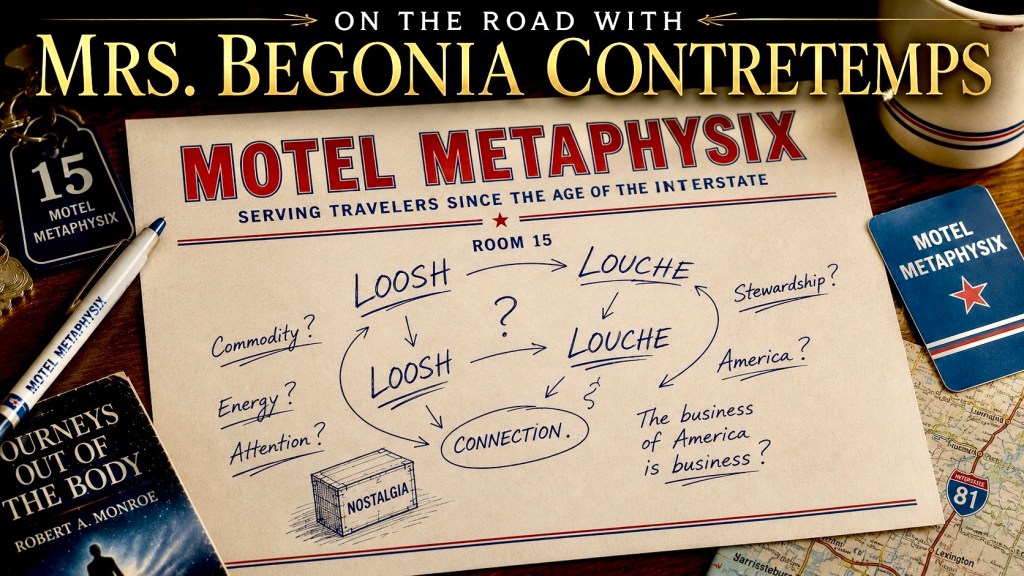
Assigned by the Nouvelle Vague Zwischenshaft (NVZ) to determine what, precisely, America means, Mrs. Begonia Contretemps occasionally finds that the answer arrives not at a monument, museum, battlefield, or overlook, but in a motel room somewhere off the interstate, where an unfamiliar word, a tankling ice machine, and a sleepless night prove unexpectedly revealing.
The Gilded Palace of Sin
Near Los Angeles, California
May MMXXVI
Dear René,
Last night, somewhere along Interstate 5, I found myself in a motel furnished in what can only be described as Mid-Century Interstate American. The ice machine in the hallway tankled on the half hour. A tractor-trailer idled in the parking lot. Along the second-floor walkway, members of a traveling high school lacrosse team had draped rain-soaked pads, jerseys, and practice pants over the railing to dry. I was reading Robert Monroe before bed.
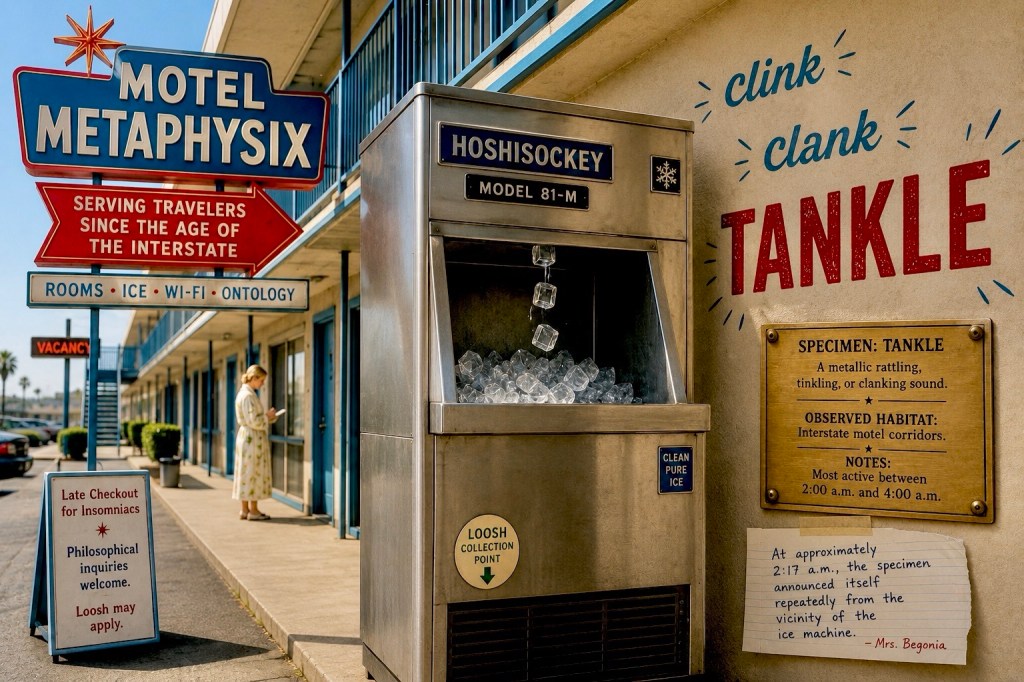
TANKLE, n.
A metallic rattling or tinkling sound. Not all music requires musicians.
You may not know Monroe. He was an American broadcasting executive who became famous for his writings on out-of-body experiences and consciousness. In one of his books he describes a mysterious substance called Loosh—a kind of emotional or spiritual energy generated by human experience and somehow valuable within a larger cosmic system. Monroe appears simply to have coined the word himself. It was not, so far as I can determine, an acronym or a term drawn from any older tradition, but a name for something he believed lacked an adequate earthly vocabulary.
I encountered the word and immediately thought of another.
Louche.

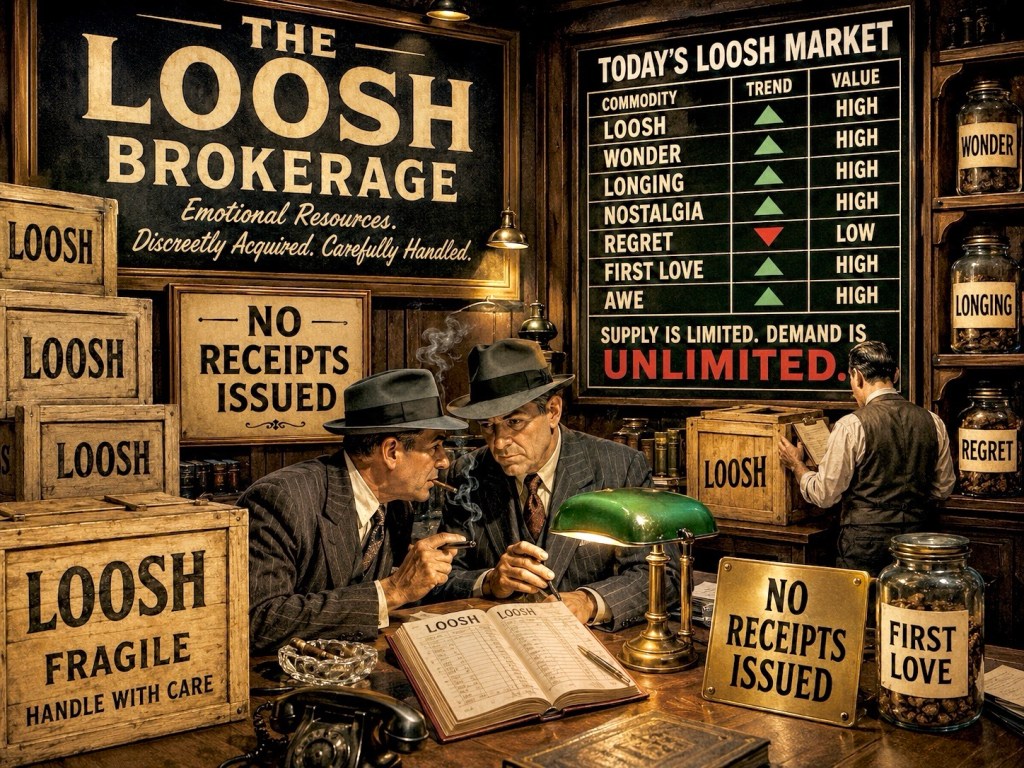
I laughed out loud. Not because the words are related. As far as I know, they are not. But because louche suggests something slightly shady, slightly disreputable, the sort of thing one imagines being discussed in the back room of an establishment that politely declines to issue receipts. I found myself wondering why Robert Monroe, having invented a word from whole cloth, had arrived at one that sounded so suspiciously close to it. Surely there were more angelic possibilities available. Yet perhaps that was part of its appeal. Loosh does not sound like a hymn, a prayer, or a revelation. It sounds like a substance. Something collected, stored, transported, and valued. Before I had even finished the chapter, I had unconsciously transformed Monroe’s cosmos into a kind of metaphysical commodities market—which, I suspect, says as much about America as it does about Mr. Monroe.
The more I thought about it, however, the less interested I became in the joke and the more interested I became in the fact that Monroe was an American.
For what struck me was not the oddity of Loosh itself but the form it took.
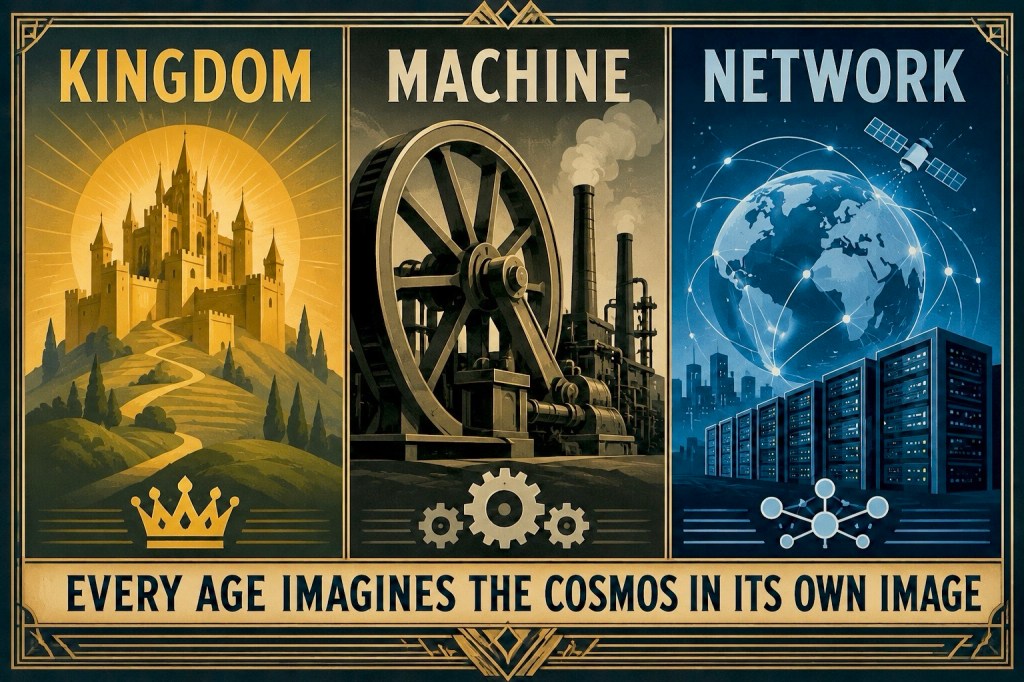
A medieval visionary might have imagined a heavenly kingdom.
An industrial visionary might have imagined a great machine.
Monroe imagined a valuable resource.
Something produced.
Something accumulated.
Something with value.
And suddenly I found myself wondering whether this reflected something larger about the country through which I have been traveling.
America has always displayed a remarkable talent for turning abstractions into enterprises. Americans build systems. They organize networks. They connect producers and consumers. They move goods, information, people, and ideas across vast distances with extraordinary efficiency.
Perhaps it should not surprise us if Americans occasionally imagine the cosmos in similar terms.
The more I reflected upon it, the less louche Monroe’s idea seemed and the more American it appeared.
The old saying that
“the business of America is business”
is usually spoken either as praise or criticism. I mean neither.
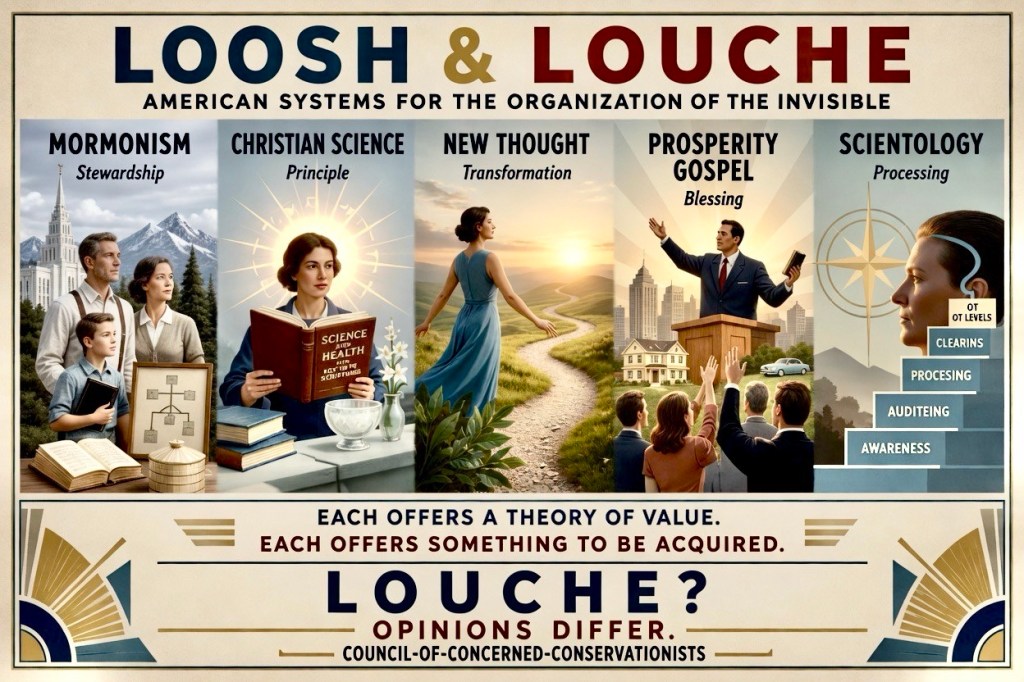
Loosh may simply be a description.
The same civilization that conceived of mail-order catalogs, interstate highways, broadcasting networks, franchise systems, and global supply chains might naturally imagine even the invisible world as a place where something valuable is being generated, exchanged, accumulated, or distributed.
Whether Loosh exists is a question I shall leave to others.
What amused me was the possibility that I had stumbled upon one small clue in my continuing effort to determine what, precisely, America means.
The clue arrived disguised as a word.
Loosh.
Which, unfortunately for Mr. Monroe, still sounds just a little bit louche.
Yours In Mild Amusement,
Mrs. Begonia Contretemps
Field Correspondent
Nouvelle Vague Zwischenshaft

“Only the usual amount”,
she offered.
The man brightened.
“Excellent. Our records indicate you’re also carrying a considerable reserve of wonder.”
SUPPLEMENTAL REPLY ATTRIBUTED TO RENÉ SÉANCE
(At least, this is how an American later claimed Monsieur Séance would have replied.)
Ma chère Begonia,
You are perhaps too hard on the Americans. The French have long understood that the easiest way to sell something slightly disreputable is to make it appear sophisticated. The Americans merely improved upon the technique.
Consider Edward Bernays, nephew of Sigmund Freud, who helped persuade respectable American women to smoke cigarettes by presenting them as “Torches of Freedom.” A Frenchman would have called this seduction. An American called it public relations.
Yours,
René Séance
Chief Theoretician, NVZ
More From Mrs. Begonia Contretemps: HERE


Leave a Reply