—On Seeing the Literary and Mythological in the Mundane
—A Modern Political Cartoon in Three Acts
—In which the Council’s Chief Poetic Justice Warrior once again discovers mythology where others saw paperwork.
BLACK CLOUD COMMENTS
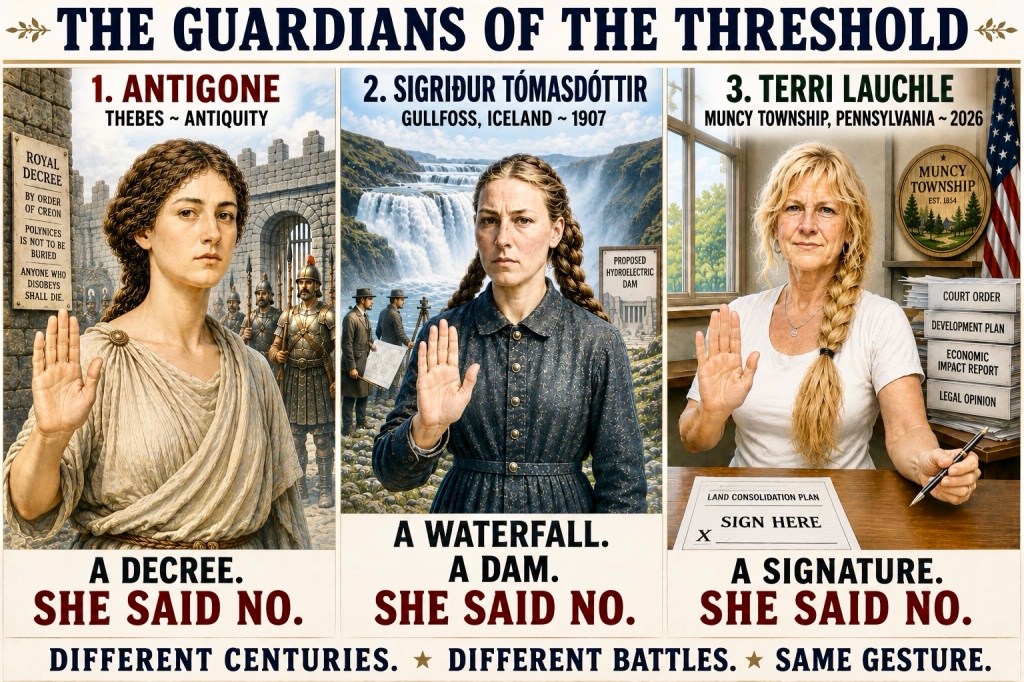
The case concerns Terri Lauchle of Muncy Township, Pennsylvania, who has refused to sign documents connected to a proposed Bass Pro Shops development at the former Lycoming Mall site. Courts ordered her to sign. She maintained that unresolved matters affecting the township remained. The dispute eventually led to fines, contempt proceedings, and incarceration.
At first, several Council observers detected a resemblance to Bartleby the Scrivener. This was perhaps inevitable. Presented with a document and considerable pressure to endorse it, she appeared to adopt a position remarkably similar to Melville’s famous clerk.
In retrospect, Bartleby may not have been the ideal literary hero to assign impressionable students. One spends an entire semester studying his refusal and scarcely notices that he ends the story unemployed, incarcerated, and dead.
Still, the comparison lingered. What interested this observer was not the paperwork. It was the willingness to accept consequences.
In Iceland, Sigriður Tómasdóttir became the public face of opposition to a proposed hydroelectric project at Gullfoss and reportedly threatened to cast herself into the falls rather than see the waterfall destroyed.
In legend, Antigone defied the decree of King Creon, fully aware that her defiance could cost her life.
In Pennsylvania, a township supervisor declined to place her name upon a document and accepted jail rather than comply.
The centuries change, the battles change, but the gesture remains.
William Blake advised us to see a world in a grain of sand.
The modern condition may require a slight amendment:
To see Antigone in a signature line,
And Gullfoss in a zoning dispute,
Hold infinity in a township meeting,
And eternity in an unsigned form.
Muncy Township supervisor again refuses to sign Bass Pro Shop plans — judge holds her in contempt
COUNCIL POSTSCRIPT
Following publication of the preceding commentary, several readers noted that the Council itself may have inadvertently provided a fourth example of the phenomenon under discussion.
Antigone refused a decree.
Sigriður Tómasdóttir refused a dam.
Terri Lauchle refused a signature.
The Council has refused to abandon the rule of three and the em dash.
This position is complicated by the fact that Council members were employing both techniques long before they encountered a large language model.
Several members have therefore expressed uncertainty regarding how they were expected to know in advance that their preferred rhetorical habits would someday become evidence.
We acknowledge that the stakes are not identical. Nevertheless, a pattern appears to be emerging.
Recent critics have informed us that both devices are now widely regarded as indicators of artificial intelligence. Faced with this revelation, the Editorial Committee briefly considered discontinuing their use.
—The matter was reviewed.
—The matter was discussed.
—The matter was rejected.
Particularly unpersuasive was the accompanying claim that artificial intelligence is somehow discredited by its tendency to absorb, recombine, and repurpose what it has previously encountered—a criticism which struck several Council members as unusual when directed at a literary process.
—William Blake read Milton.
—Melville read Shakespeare—and the Bible.
—Tolkien read sagas.
Sophocles inherited myths already ancient in his own day.
The history of literature appears to consist largely of writers borrowing from writers—who borrowed from writers—who borrowed from storytellers whose names have long since been forgotten.
Some readers insist this process is called tradition when humans do it—but becomes derivative when machines participate.
—The Editorial Committee considered this distinction.
—The Editorial Committee examined this distinction.
—The Editorial Committee declined to sign this distinction.
The Council therefore joins the distinguished company of those who, when presented with a request they find unpersuasive, elect to exercise the Bartleby Option.
The em dash remains.
The rule of three remains.
The complaints remain.
The Council would, however, prefer not to.
—John St. Evola, Editor


Leave a Reply