—On Libraries and Certain Necessary Reclassifications—
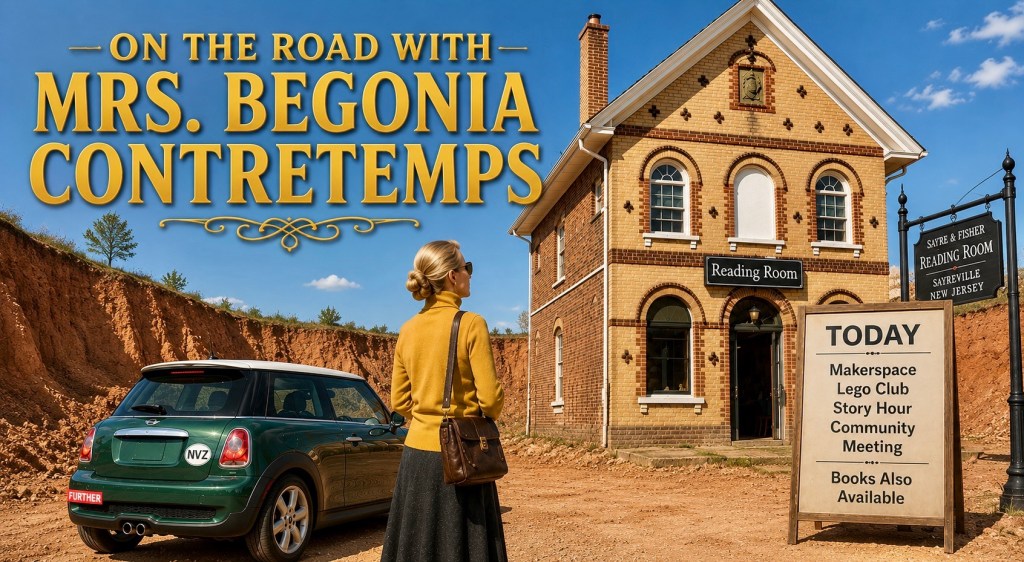
As part of an ongoing Nouvelle Vague Zwischenschaft [NVZ] inquiry into the meaning of America, Mrs. Begonia Contretemps continues her travels through the nation’s overlooked places, neglected institutions, roadside mysteries, and recurring absurdities. The present report concerns libraries, classification systems, discarded books, and certain difficulties that arise when volumes once shelved under Fiction begin requesting transfer to Current Events.
Roma, Texas
On the Rio Grande
June MMXXVI
My Dear René,
Having long suspected that one learns more about a civilization from its ordinary institutions than from its monuments, I decided to devote several days to the American public library. Growing weary of experts discussing libraries in the abstract, I elected instead to conduct a wholly unscientific survey by visiting libraries in towns whose names appeared unusually encouraging.
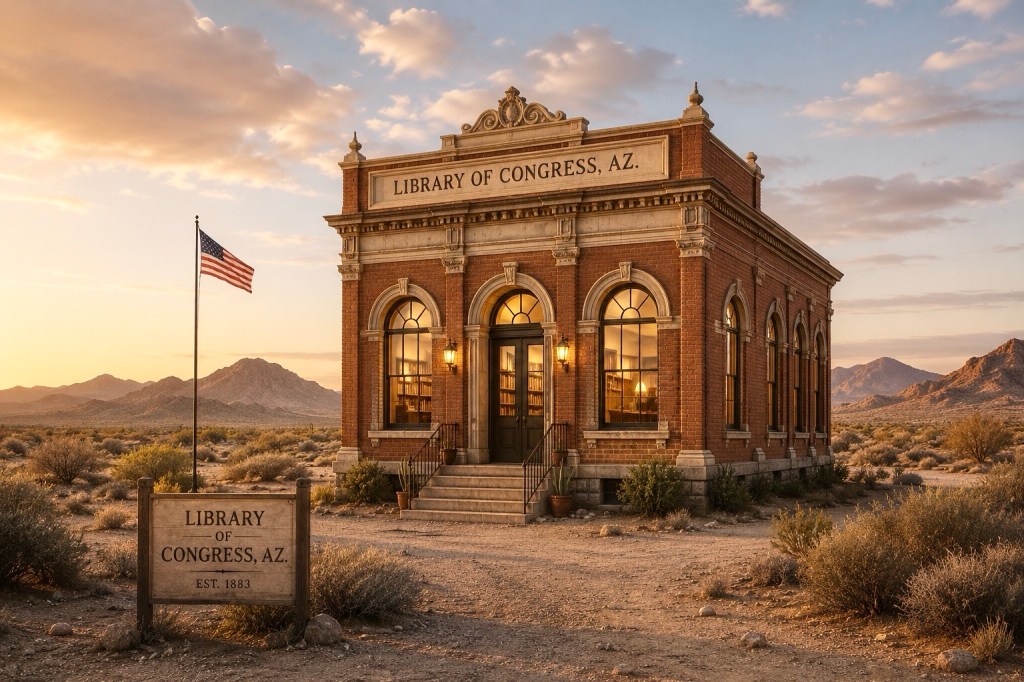
Thus my travels carried me through Reading, Pennsylvania; Page, Arizona; Story, Wyoming; Dewey, Oklahoma; and Literberry, Illinois, a state natives refer to as ill and annoyed as a sobriquet.
By this point I had become uncertain whether I was studying libraries or merely following directions supplied by an unusually literate road atlas.
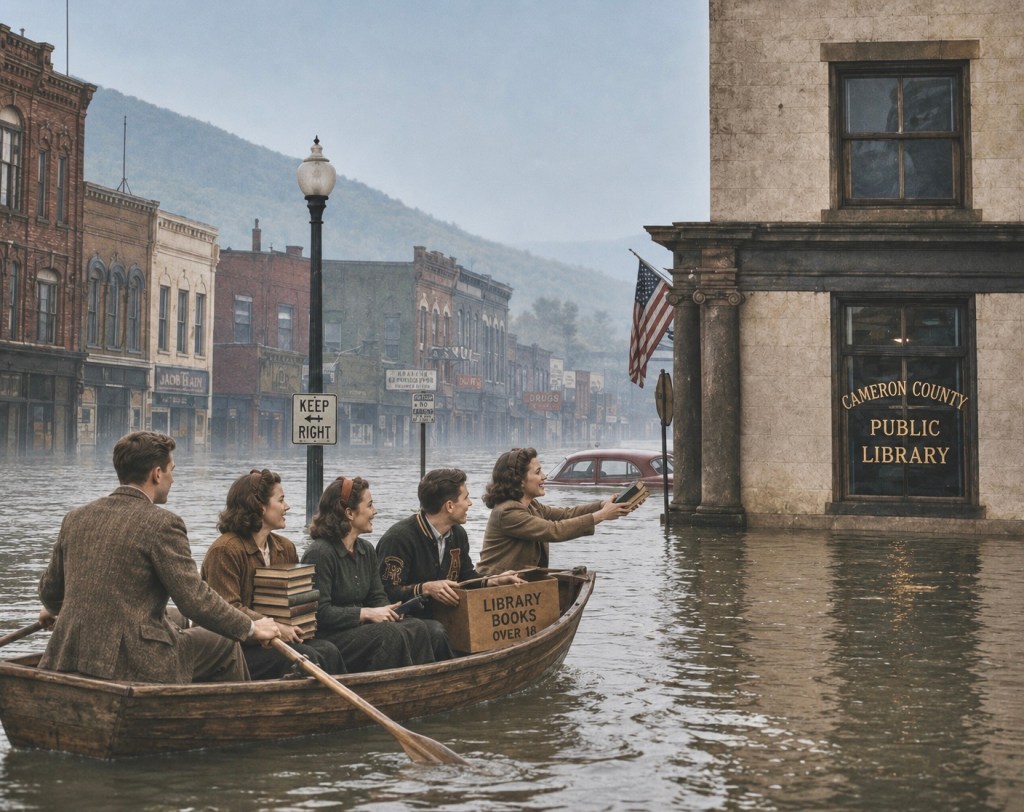
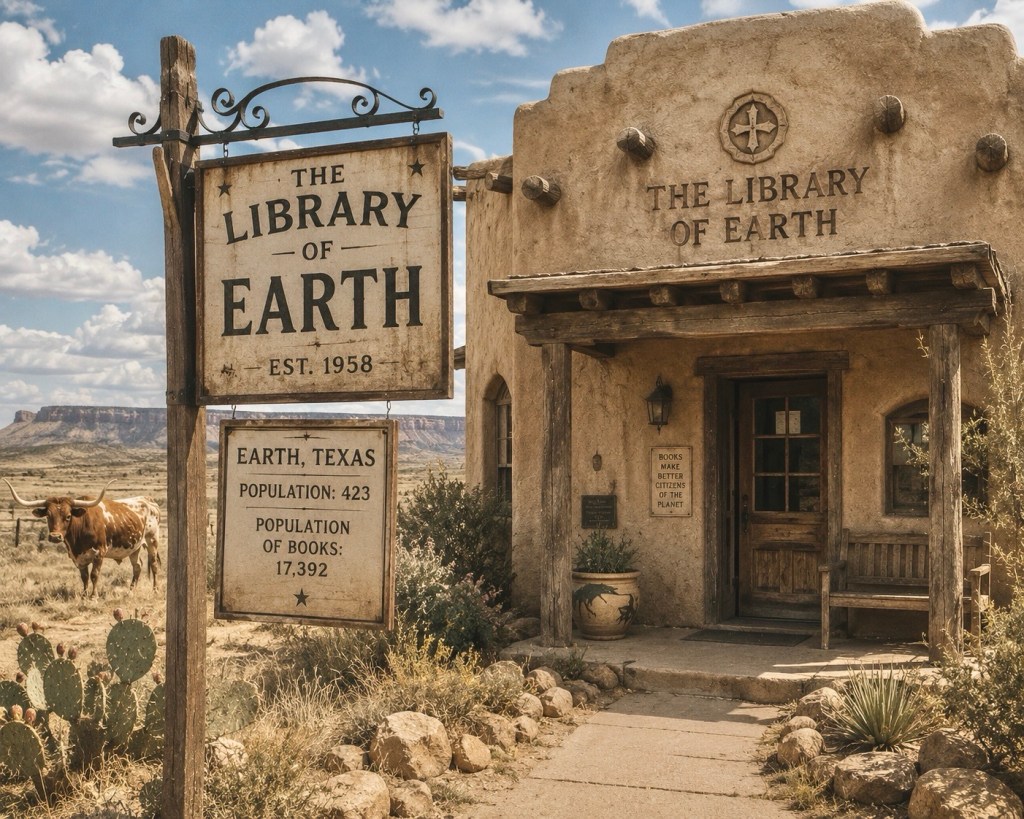
Even after the town disappeared beneath several feet of water in ‘42, the books were returned. One may draw one’s own conclusions about the people who considered this necessary.
[René, our editor, John St. Evola, informs me he still feels guilty about a book he failed to return to the Wichita Falls Public Library many years ago. He attributes the incident to youth, poverty, and a lack of fine money. The library may have forgotten. He has not.]
I remain fond of American libraries. Indeed, one of the admirable features of American civilization is its willingness to build institutions devoted to knowledge in places where other nations might have settled for a parking lot or a monument to local agriculture. Many of these libraries were gifts from robber-barons, industrialists, war manufacturers, and local brick magnates who, having reshaped the landscape through industry, occasionally chose to fill those same scenes of ecological destruction with reading rooms.
Andrew Carnegie famously scattered libraries across the continent, while lesser-known figures such as Thomas Struthers left communities with institutions like the Struthers Library in Warren, Pennsylvania. Some undoubtedly acted from civic pride, some from philanthropy, some from posterity, and a few, one suspects, from a desire to improve their standing with both their neighbors and the Almighty. Whatever their motives, they often left behind libraries where they might otherwise have left only statues of themselves.
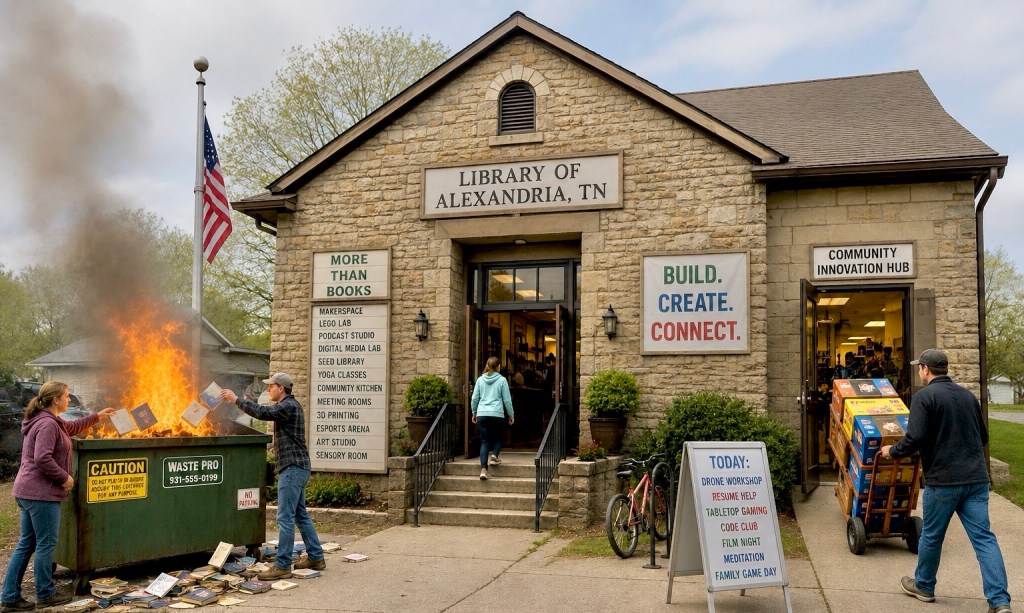
Yet I could not help noticing that many smaller libraries seem increasingly occupied by activities other than books.
There were Lego clubs, story rooms, craft rooms, media labs, and meeting spaces.
There were community programs. There were workshops, exhibits, and bulletin boards. And then there were the computers.
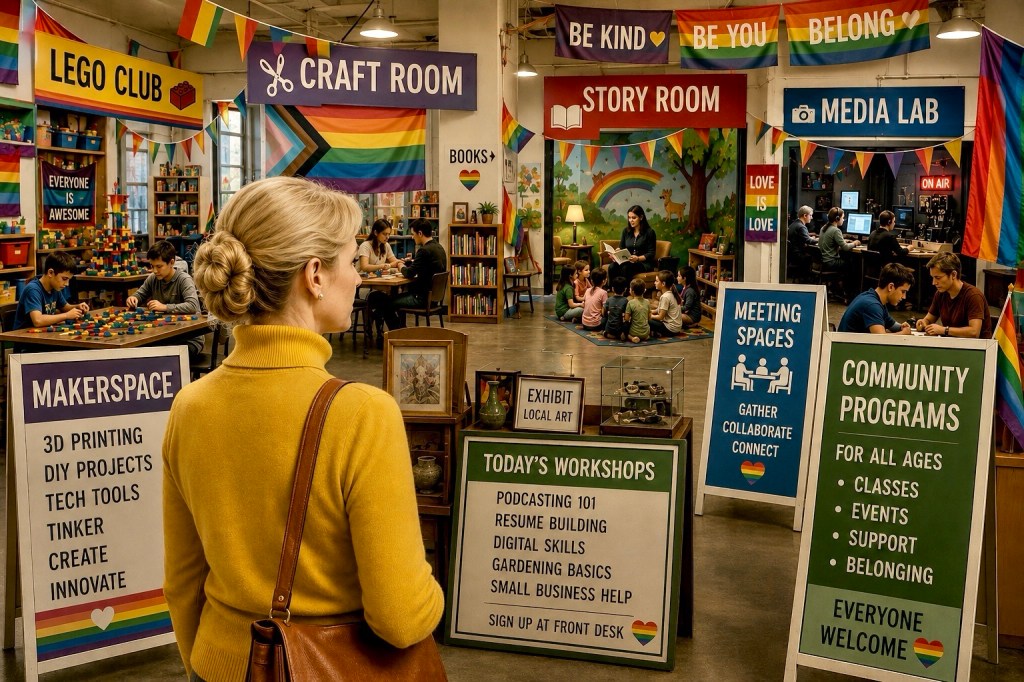
There appeared to be everything one might reasonably expect to find in a modern civic institution except, occasionally, a noticeable concentration of books.
The books themselves seemed engaged in a territorial dispute.
I also observed that many libraries devote extraordinary shelf space to self-improvement literature.
One may apparently become organized, optimized, streamlined, decluttered, empowered, centered, focused, mindful, productive, entrepreneurial, financially liberated, emotionally validated, spiritually aligned, and professionally transformed.
One may do all of these things. Whether one may become educated remains slightly less clear.
I found far more books explaining how to improve oneself than how to understand the civilization in which that improved self must ultimately reside.
Another curiosity was the annual celebration of banned books. The displays were often attractive and well intentioned. Yet I could not help noticing that many of the featured volumes were readily available in bookstores, libraries, universities, online retailers, and numerous other locations.
This struck me as a somewhat unusual definition of forbidden.
I wondered aloud whether there might also be books that were not officially banned yet had nevertheless disappeared from discussion, publication, curricula, or polite society.
This inquiry was received with approximately the same enthusiasm as a skunk entering a wedding reception, as our American friends might say. You see I am picking up the idioms quite readily.
In one larger city I visited a library that seemed to serve a multitude of functions simultaneously. Some patrons were reading or using computers. A few were charging phones while some desperate souls appeared to be escaping either the weather or circumstances. One too many seemed to be nodding off in chairs or conducting surprisingly thorough sponge baths in the lavatory.
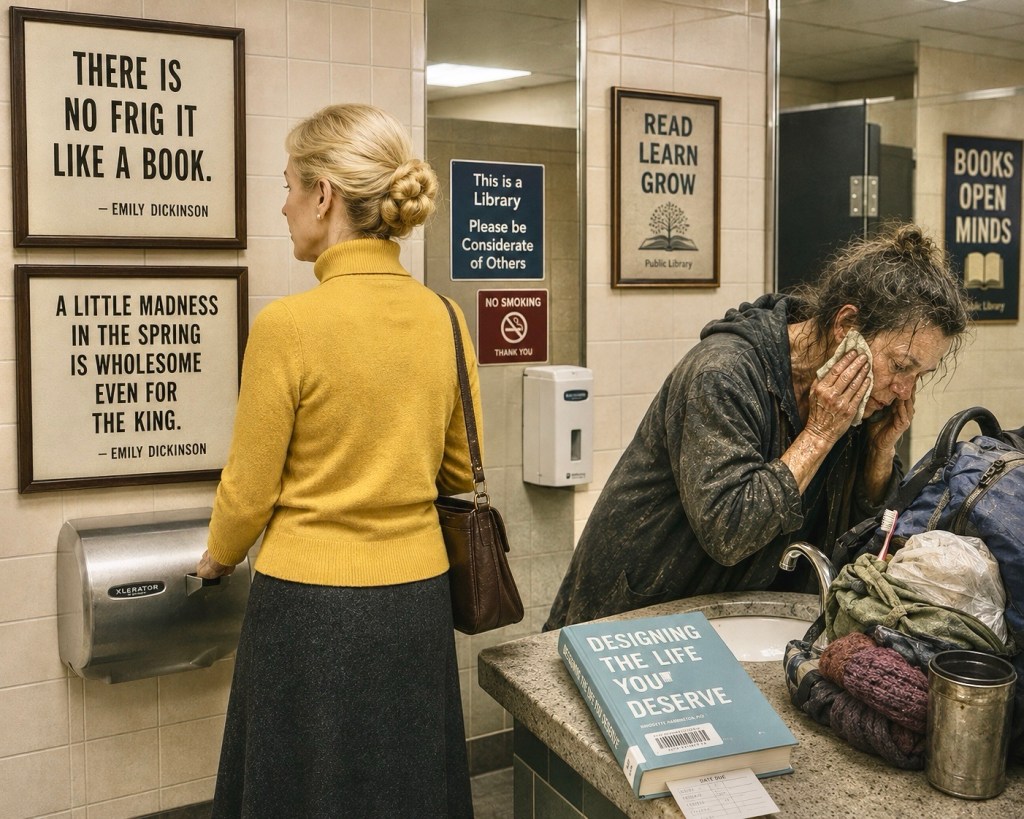
It occurred to me that the library had become one of the last places in America where a person may remain indoors for an extended period without being expected to purchase something.
This is, in its own way, both admirable and slightly tragic.
By evening I returned to my motel with a somewhat overcrowded mind.
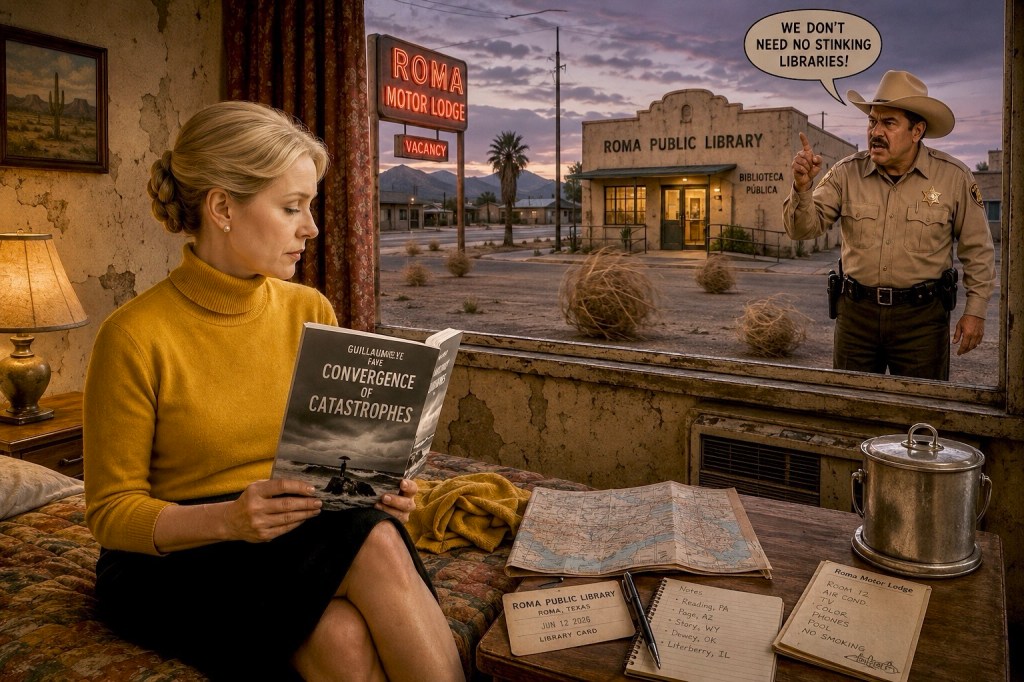
Between the makerspaces, the self-help shelves, the story rooms, the displays, the community programming, the public services, the computers, the workshops, the exhibits, and the remaining books, I found myself wondering what precisely a library had become.
Sometime after midnight, assisted no doubt by the motel’s sometimes soothing yet industrious ice machine, I dozed off. I should note, René, that despite staying in hundreds of establishments over the years, I invariably seem to receive the room nearest the ice machine. Whether this reflects coincidence, destiny, my preference, or a conspiracy among motel managers remains unclear.
In any event, I experienced the following dream:
I found myself in an immense library lit by green banker lamps.
At first I assumed I was observing a meeting of librarians, soon realizing I was mistaken.
The assembled figures wore dark academic robes embroidered with small golden bookmarks.
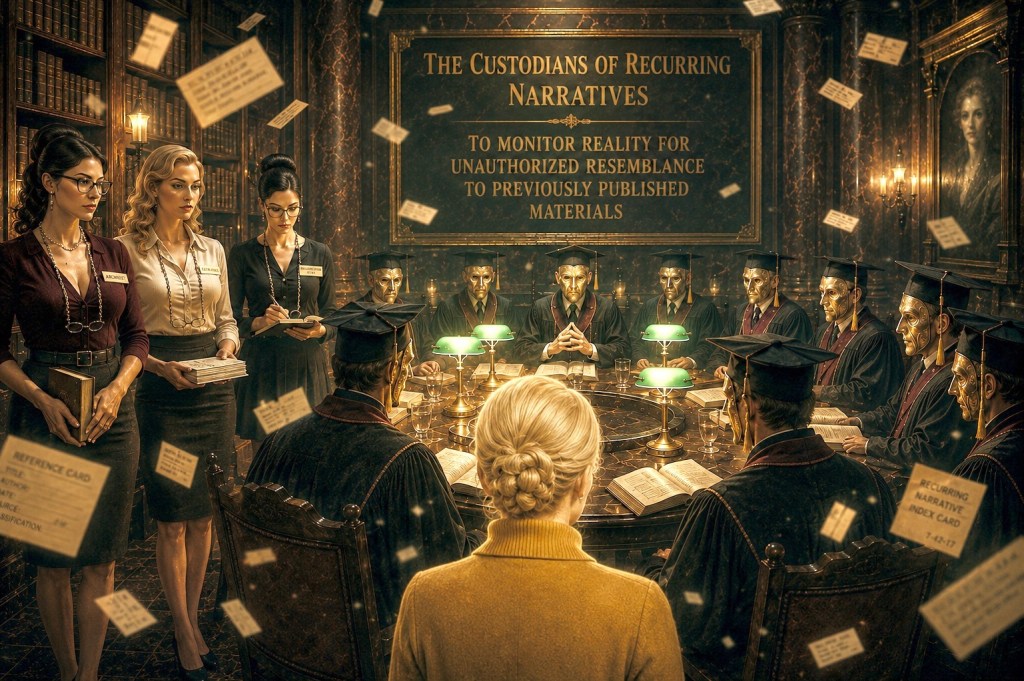
Above them hung a banner reading:
THE CUSTODIANS OF RECURRING NARRATIVES
Beneath it appeared their official purpose:
TO MONITOR REALITY FOR UNAUTHORIZED RESEMBLANCE TO PREVIOUSLY PUBLISHED MATERIALS
A bell rang.
The Chairman rose.
“We are gathered,” he announced, “to review recent incursions by Reality into territories previously reserved for literature.”
No one appeared surprised.
The first cart of books emerged.
FICTION to NON-FICTION:
1984, Eric Blair
“Removed from Fiction after repeated incursions by Reality involving surveillance, information management, and voluntary telescreen ownership.”
Polite applause followed, as was expected.
The book was stamped and relocated. I found myself unable to object.
It occurred to me that 1984 had not emerged entirely from imagination in the first place. Orwell had merely extended certain tendencies he had already observed in political life, particularly during the Spanish Civil War. The resulting volume was classified as fiction, though one suspects it always contained a substantial quantity of field notes disguised as prophecy.
Brave New World, Aldous Huxley
“Removed following remarkable progress in entertainment-based social management and chemical mood adjustment.”
More applause.
I wished the explanation sounded less reasonable.
Fahrenheit 451, Ray Bradbury
“Reassigned after investigators determined that books need not be burned if they can simply be ignored.”
Several members nodded gravely. To my discomfort, I understood the point.
The Machine Stops, E.M. Foster
“Removed after citizens demonstrated a willingness to conduct most human interaction through machines they do not understand.”
The transfer to non-fiction was approved unanimously. A murmur spread through the chamber.
Dream Story, Arthur Schnitzler
The Chairman paused.
“Later adapted into the motion picture Eyes Wide Shut.”
It was further noted that the film was now being prepared for reissue as a documentary, accompanied by a new unredacted library edition for educational use.
And then there was the tranche of books labeled:
TRANSFER APPROVED
Reason for Reclassification: Persistent resemblance between contemporary events and circumstances previously regarded as excessively imaginative.
I knew precisely why the transfer was occurring. That realization did not improve my mood.
The second cart emerged.
BOOKS FROM SPECULATIVE HISTORY MOVED TO CURRENT EVENTS:
The Decline of the West, Oswald Spengler
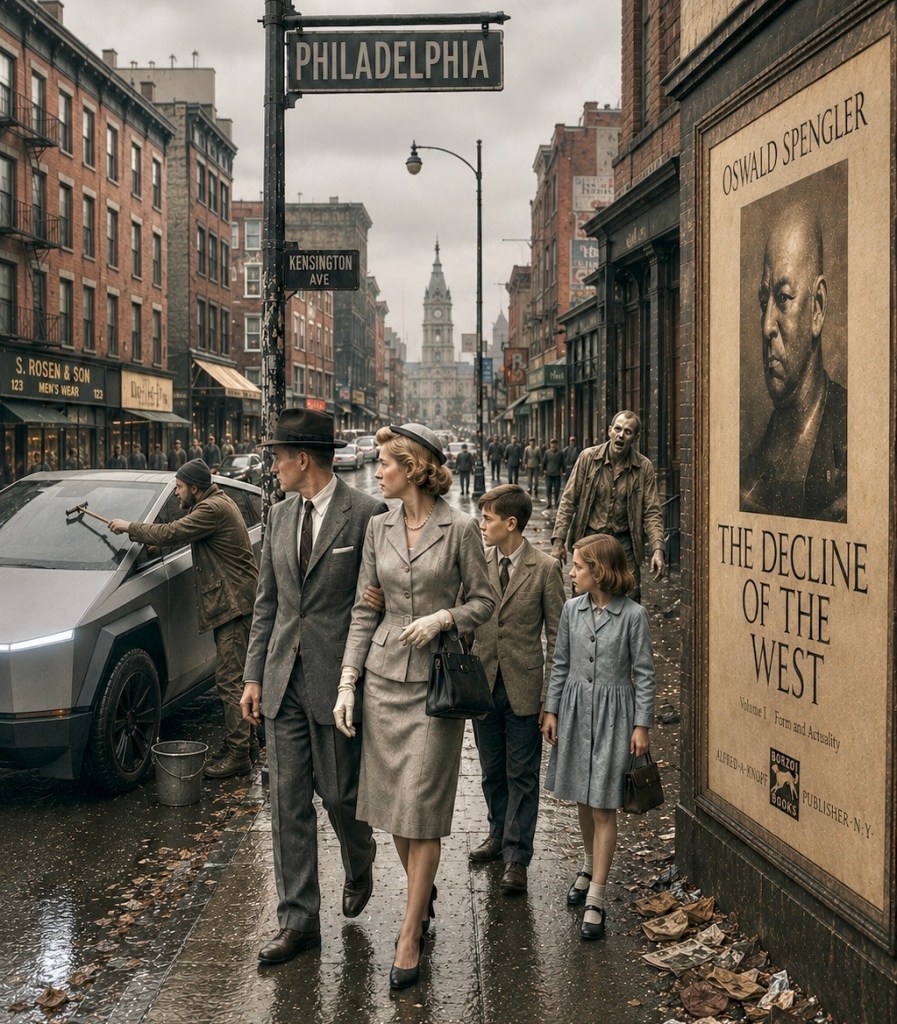
“Transferred following prolonged disagreement regarding whether the volume belonged in History, Forecasting, Sociology, or Newspapers.”
Soft laughter filled the chamber.
I was now quite certain the book belonged in Current Events.
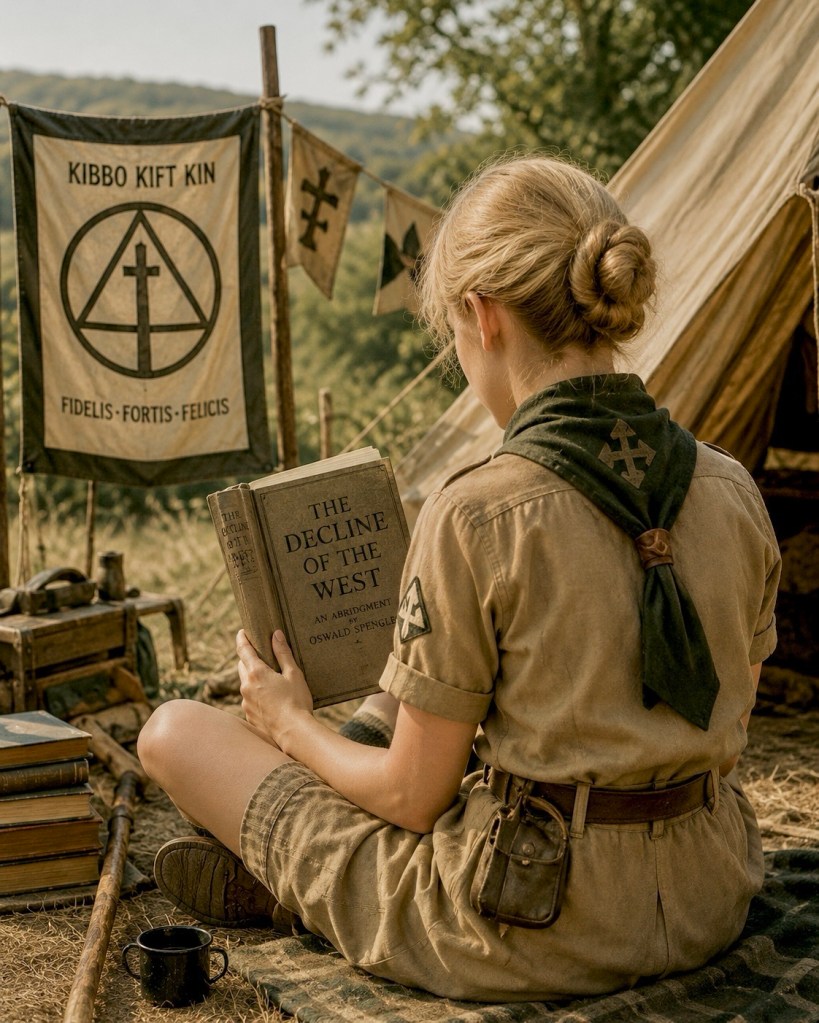
What troubled me was that I had first read The Decline as a teenager at a summer camp loosely modeled on the old Kibbo Kift movement, where one was encouraged to spend equal amounts of time learning woodcraft, contemplating civilization, and reading books one was probably too young to understand. I had never imagined I would live long enough to see the day when such a reclassification would seem necessary. At the time, the events it seemed to foreshadow appeared to belong to some distant future. One assumes there will be considerably more time.
And then there was,
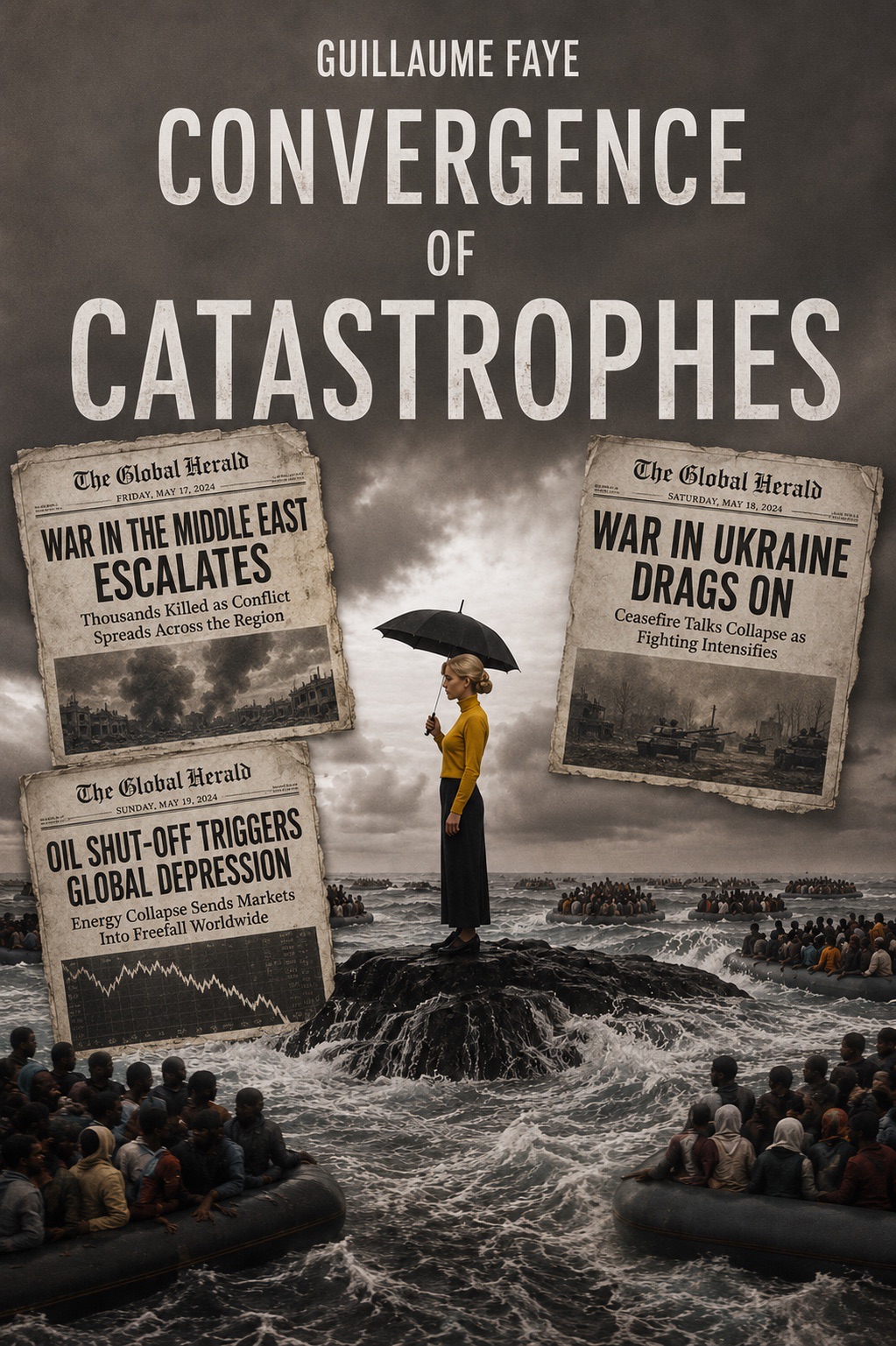
Convergence of Catastrophes, Guillaume Faye
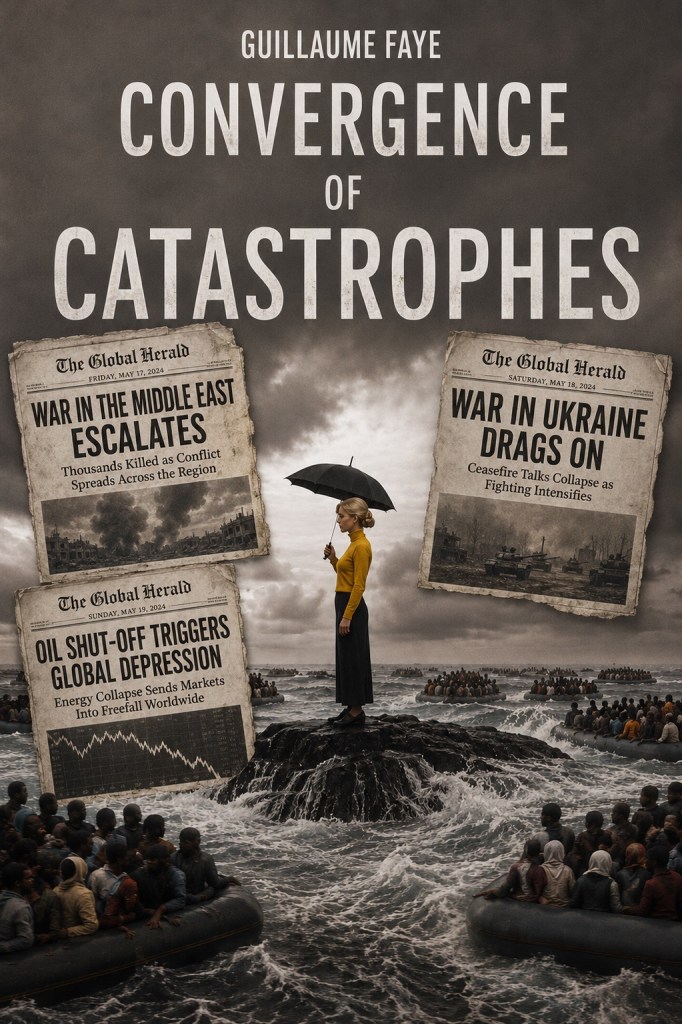
“Transferred after multiple forecasted crises arrived simultaneously and insisted upon being catalogued together.”
Several exhausted assistants struggled to push a cart labeled:
DEMOGRAPHICS
MIGRATION
ENERGY
FINANCE
POLITICS
SOCIAL COHESION
The explanation seemed absurd. Yet the cart continued rolling past.
The Chairman struck the bell again.
FICTION NOW IN CURRENT EVENTS
The Camp of the Saints, Jean Raspail
“Transferred after repeated disputes concerning whether the volume belonged in Current Events, Political Science, Immigration Studies, or the Complaint Department.”
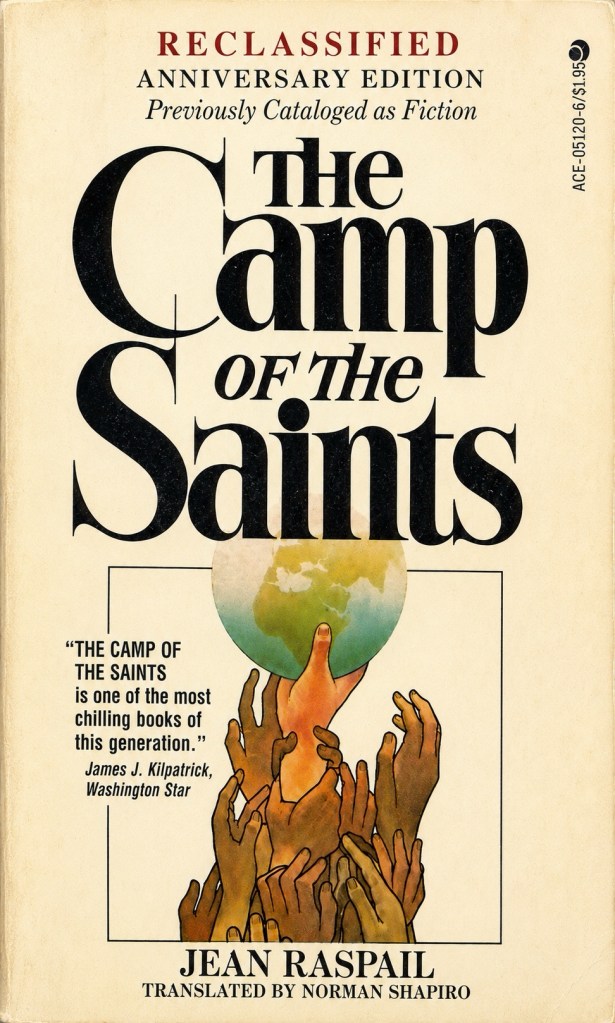
“I confess, René, that I have always found it curious how often people mention the surrounding and how rarely they mention the ending. The camp of the saints comes through the affair rather well.”
A lonely middle-aged female filed an objection to the transfer.
Defiant counter-objections were shouted noting her being a Census Denier.
A committee was appointed. The transfer proceeded anyway. I found myself increasingly uncomfortable. Not because the Custodians were celebrating. But because they appeared merely to be recording developments.
I then noticed an enormous cart loaded with old newspapers.
“Where are those going?”
The Chairman consulted his ledger.
CURRENT EVENTS TO PROPHECY
“Reclassification approved due to recurring difficulties distinguishing prediction from reporting.”
The audience erupted into applause. I joined them not knowing fully why.
Then I found out why. One old news item concerned the growing popularity of Allen Funt’s television program Candid Camera, in which unsuspecting citizens found themselves recorded by hidden cameras for the amusement of others. Contemporary readers reportedly found the premise hilarious. The Custodians noted that the article had subsequently become a description of ordinary life.
Finally I noticed one final shelf standing alone beneath a sign.
REALITY
The shelf was empty. Completely empty.
“Where are those books?”
The Chairman smiled.
“They are now distributed throughout the collection. They defy classification”
I considered this answer unsatisfactory. Then another thought occurred.
“If Reality is copying Literature, who is writing Reality?”
At once the chamber fell silent. The Chairman looked uncomfortable. Several members avoided eye contact. Then there arose a familiar metallic tankling.
“Reality appears to be resuming,” sighed the Chairman.
The meeting abruptly adjourned. A moment later I awoke to discover that the tankling was merely the motel ice machine completing its cycle immediately outside my room.
The next morning, while preparing to depart, I made one final stop at the library.
Near the entrance stood a cardboard box marked:
FREE BOOKS!
The contents appeared to consist largely of volumes that had failed to attract buyers during a recent library sale.
There were outdated manuals, forgotten novels, obsolete travel guides, and several books concerning hobbies that no longer seemed fashionable.
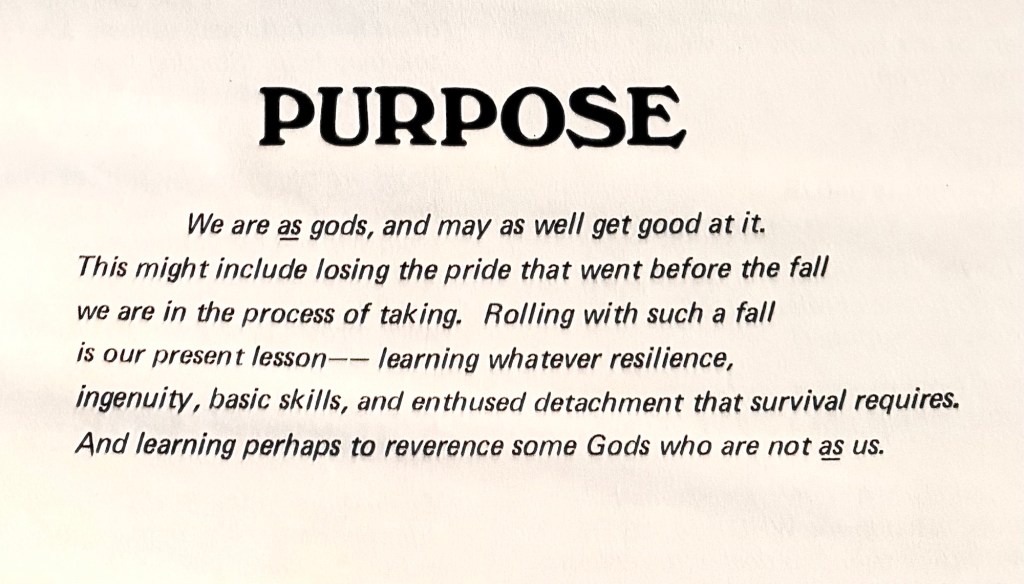
Among them I discovered a hardbound copy of the Whole Earth Epilog .
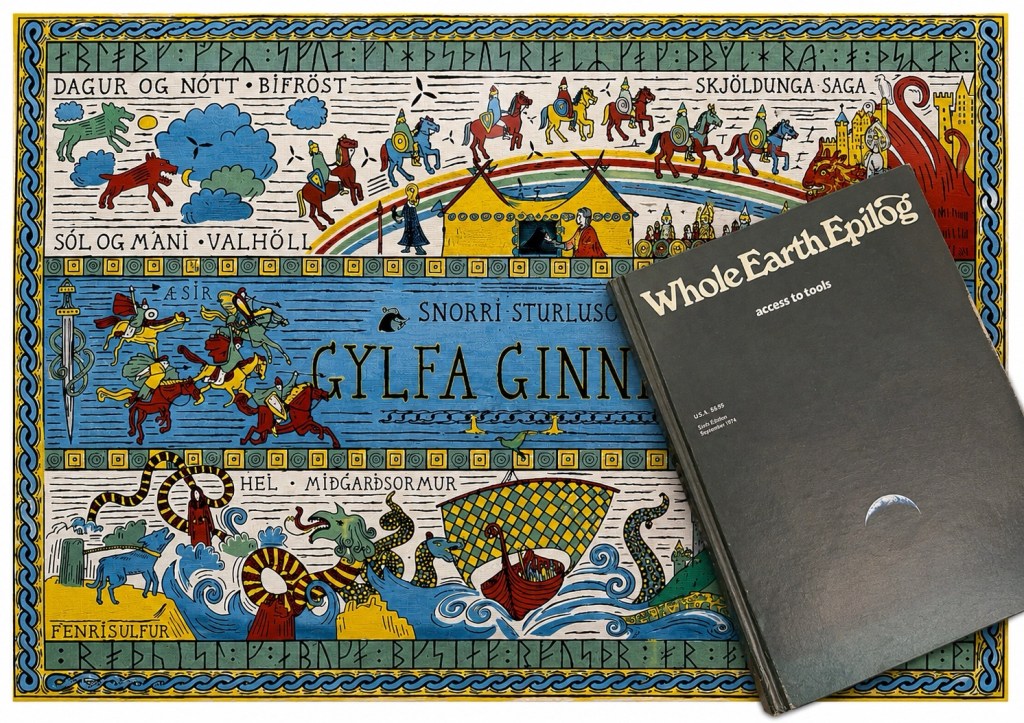
Whole Earth Epilog rescued from a library giveaway box: Free
In the interest of reassurance, René, and remaining mindful of my NVZ expense account, I submit the following :
The juxtaposition of the tea towel and Epilog: Priceless.”
The oversized, hardcover had apparently failed to find a purchaser. I carried it to my car before anyone could reconsider. This struck me as faintly amusing. Only a few hours earlier I had dreamed of books being transferred from speculation to current events.
Now I found myself rescuing a volume that had spent much of its life describing ideas that seemed eccentric at the time but increasingly familiar today.
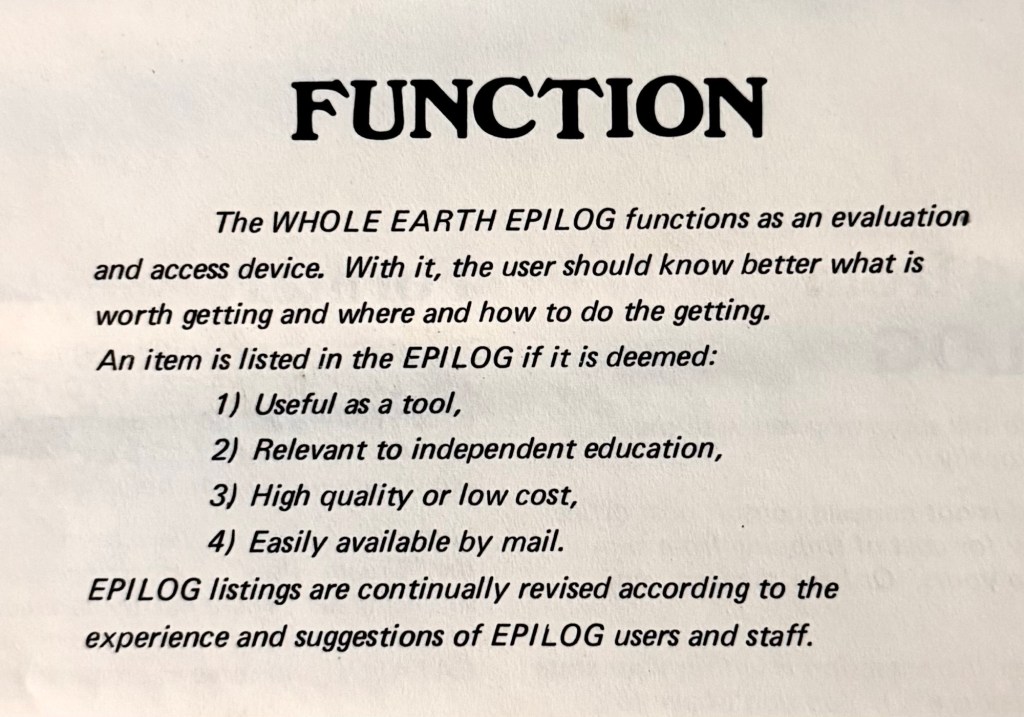
The Catalog concerned itself with homesteading, self-reliance, small-scale technology, tool ownership, alternative education, independent publishing, environmental stewardship, organic gardening, renewable energy, do-it-yourself construction, and the proposition that ordinary people should possess both information and practical competence.
At the time these interests were often regarded as the concerns of hippies, tinkerers, back-to-the-landers, survivalists, and assorted enthusiasts living at the outer edges of respectable society.
Today one can scarcely open a computer without encountering discussions of homesteading, solar power, off-grid living, food preservation, backyard agriculture, maker culture, remote work, self-directed learning, independent media, tool reviews, tiny houses, preparedness, or practical self-sufficiency.
Even the Catalog’s habit of connecting far-flung individuals through shared interests now appears oddly familiar.
The technology changed. The impulse remained.
I found myself wondering whether the volume had been removed because it was obsolete. Or because it had become difficult to notice. After all, a prophecy often becomes invisible once it has blended into the landscape.
In my dream the Custodians of Recurring Narratives had spent the evening reclassifying books.
Had they encountered the Whole Earth Epilog, I suspect they would have faced a procedural difficulty. The work was neither fiction nor prediction. It was merely early.
I placed the book on the passenger seat and continued my journey. For a moment I considered informing the Custodians. Then I decided they probably already knew.
Your affectionate correspondent,
Mrs. Begonia Contretemps
—René Replies—
My Dear Mrs. Begonia,
Here in France we have solved this problem.
When a book becomes controversial, prophetic, embarrassing, unfashionable, fashionable, politically inconvenient, culturally inconvenient, historically inconvenient, or merely confusing, we place it in the Philosophy section and argue about it for the next two hundred years.
Cordially,
René
P.S. I am not entirely convinced that you were dreaming.
The difficulty, my dear Mrs. Begonia, is that one eventually reaches an age at which the question is no longer whether certain books have become reality, but whether one is still willing to admit it out loud.
The Further Writings of Mrs. Begonia Contretemps Can Be Found: HERE


Leave a Reply