—A Report from the Replika Festival
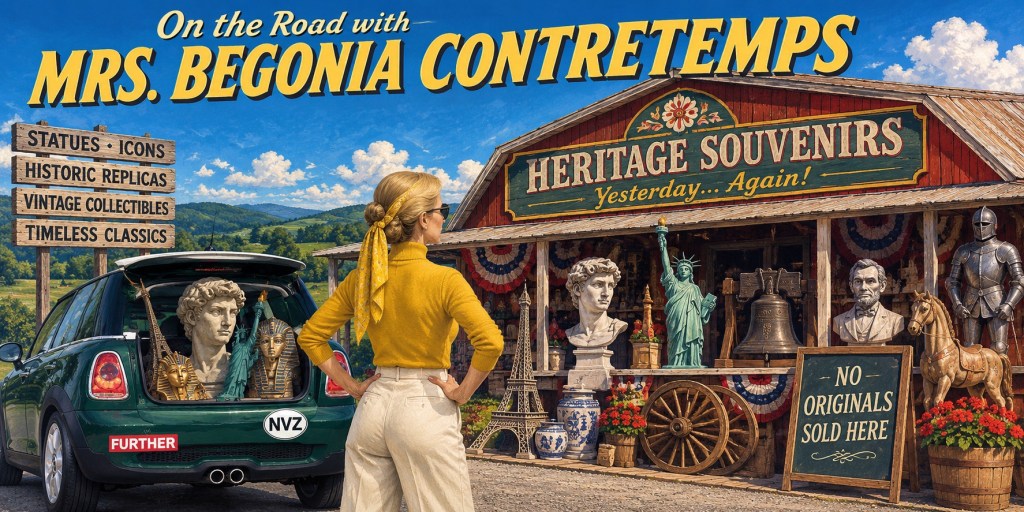
The following article appears through the kind and enthusiastic cooperation of our brother publication, The Perennial Sophomore, whose editors remain convinced they meant every word.
Mrs. Begonia found John St. Evola studying a festival brochure with the kind of satisfied expression that usually meant someone else’s afternoon was about to become considerably more complicated.
“What’ve you done now?” she asked.
John looked up.
“Maybe nothing.”
“I’ve known you too long for that answer.”
He slid the brochure across the desk.

“The folks running the Replika Festival got in touch a couple months ago.”
“The tribute band festival?”
“That’s the one.”
“What did they want with us?”
“They said people spend half the day waiting for the next act. You know replicant prima donna taking their time. The promoters were looking for ideas for side tents. Something folks could wander into. So I told ’em. . . if tribute singers work, why stop there? I said maybe they ought to have tribute writers. Tribute inventors. Tribute statesmen. People who changed history.”
“They actually listened?”
John shrugged.
“That’s the part that’s got me a little worried.”
She opened the program. Sure enough, there was a new section.
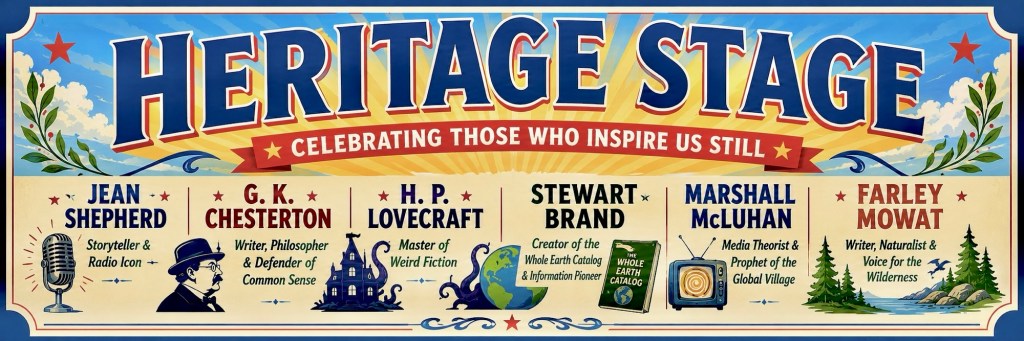
Beneath it were also names one expected :
Mark Twain.
Nikola Tesla.
William Shakespeare.
“Well,” she admitted, “that’s actually not a bad idea.”
John smiled.
“And why am I going?”
“One of the talks has been drawing a crowd.”
“Which one?”
John took another sip of coffee.
“I figured I’d let you tell me.”
“You don’t know?”
“I know.”
“And you’re not telling. Where’s the fun in that?  Oh, wait let me guess.
Mrs. Begonia sighed.
“One day your curiosity is going to become contagious.”
John grinned.
“I sure hope so.”
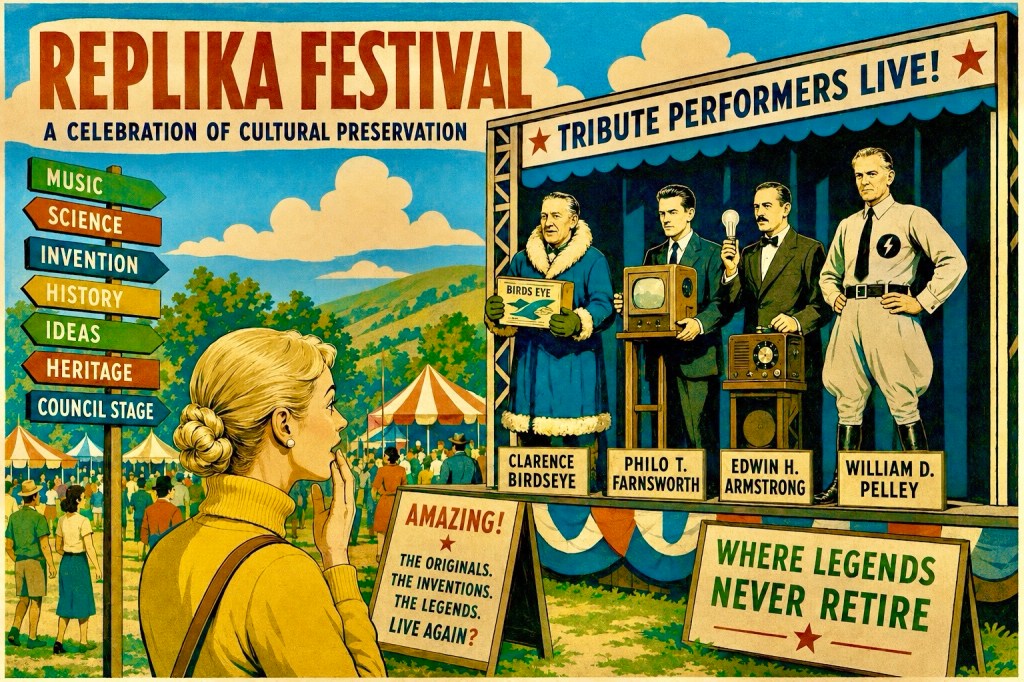
The Replika Festival looked exactly as Mrs. Begonia imagined. For the normies, Elvises wandered in every direction. Beatles crossed the pathways. Freddie Mercury posed for photographs. Two members of ABBA stood in line for lemonade.
From somewhere beyond the trees came the unmistakable sound of thousands of people singing together.
She wandered toward the Heritage Stage. Lee de Forest was holding forth on vacuum tubes while a neighboring tent featured L. Frank Baum happily autographing copies of The Show Window, his magazine for department-store window dressers—a venture he seemed just as proud of as Oz. Across the aisle, Robert Ripley was finding that a festival devoted entirely to tribute performers had become one of his easiest assignments.
Then she noticed another pavilion. People stood outside because there were no seats left. She worked her way through the crowd until she could finally read the banner :
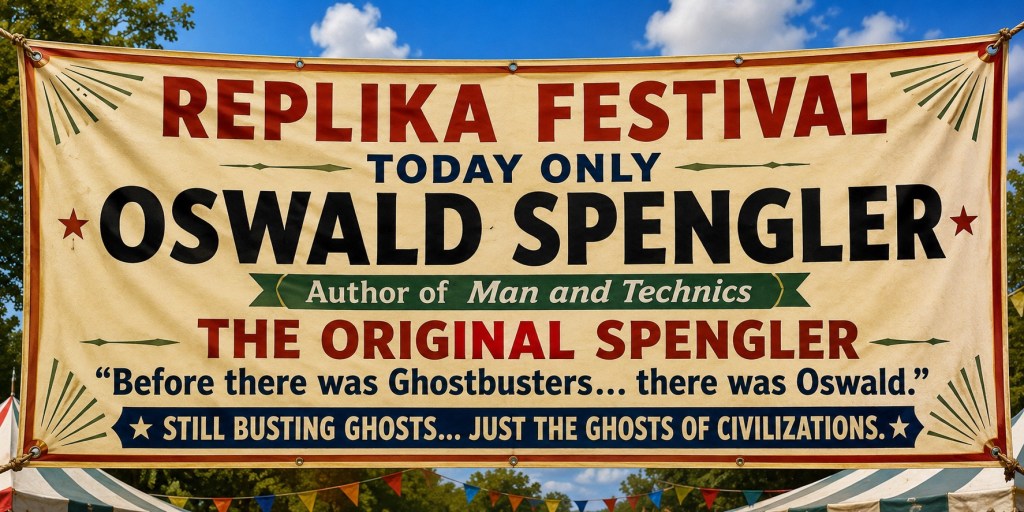
Mrs. Begonia stopped.
“Oh, John. . . “
Inside, every chair was occupied. People stood three deep along the walls. Several listeners were taking notes. Someone held a heavily worn copy of The Hour of Decision.
Mrs. Begonia slipped quietly into the last empty chair. A few moments later, a distinguished German gentleman stepped onto the platform. He adjusted his spectacles. Without introducing himself, he began.
“I confess I did not expect, upon finding myself in your century, to discover a festival devoted entirely to preserving musicians. Having spent the morning walking your grounds. . . I now find it perfectly understandable.”
The audience laughed. Mrs. Begonia made a note: Hasn’t broken character once.
The lecturer continued.
“I have observed that many of you have driven hundreds of miles. You return every year.”
People nodded.
“You gather at an appointed place. . . during an appointed season. . . among others who share your devotion.”
He paused :
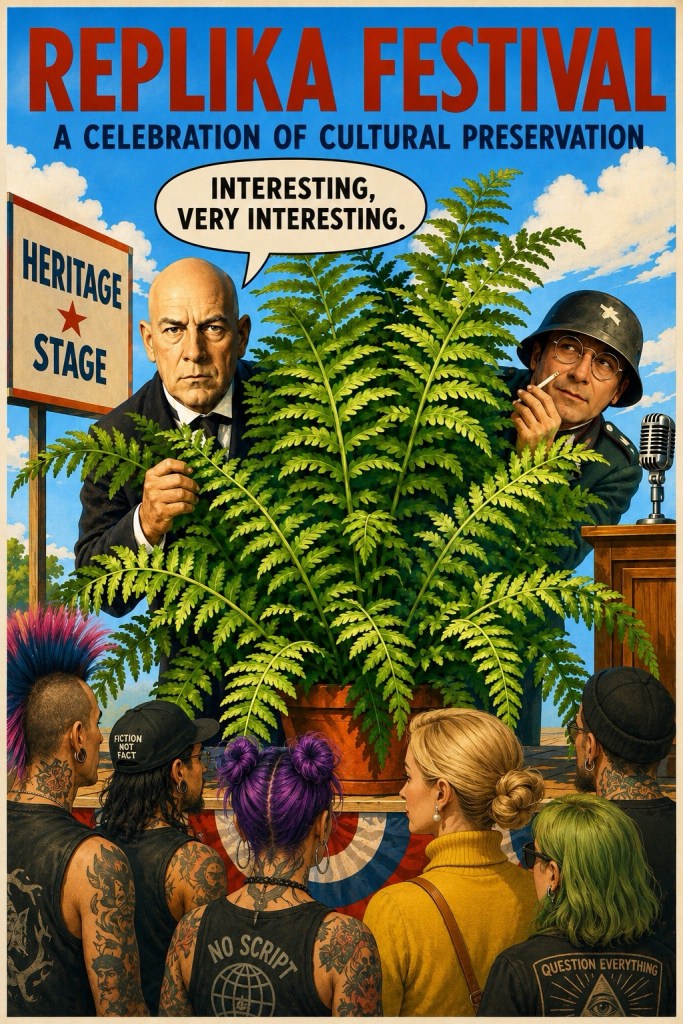
He looked across the audience.
“I have also noticed your vestments.”
He gestured toward the crowd.
“Beatles. Elvis. Queen. Pink Floyd. The Rolling Stones.”You announce your allegiance before speaking a single word.”
Soft laughter.
“Very Interesting, Very Interesting.”
He listened as music drifted from the main stage.
“You already know every lyric. No rehearsal. No instruction. When the proper moment arrives. . . thousands become one voice.”
He allowed the applause outside to fade.
“Interesting.”
Mrs. Begonia looked around. No one was laughing now. The lecturer stepped away from the podium.
“Permit me another observation. Suppose tonight a Beatles tribute announces: ‘Ladies and gentlemen. . . we shall perform twelve entirely new songs.’
“How many of you would stay?”
The audience erupted. One man shouted,
“Nobody!”
The lecturer nodded.
“Precisely. You do not come seeking originality. You come seeking fidelity.”
He let the sentence settle.
“The highest compliment given to a tribute performer is never:
‘He made it better.’
“It is:
‘He stayed true to the original.’”
Silence.
Then he spoke the sentence that changed the entire lecture.
“Ladies and gentlemen. . . Civilizations first produce originals. Only later. . . do they produce tributes.”
Mrs. Begonia stopped writing. Now she understood where he was going. The lecturer folded his hands.
“Years ago, I described a condition of mature civilizations which I called the Second Religiousness. It is not that people suddenly become more pious. It is that a civilization gradually turns from creation toward preservation. The question changes.
No longer:
‘What has never been imagined?’
But:
‘How faithfully can we preserve what was?’”
He slowly walked the front of the stage.
“Notice what has appeared here. Pilgrimage. You have traveled great distances.
Vestments. You wear the insignia of your chosen tradition.
Canon. You expect familiar songs, not new revelations.
Orthodoxy. You debate which performance is faithful. . . and which has departed from the original. The object has changed. The form has not.”
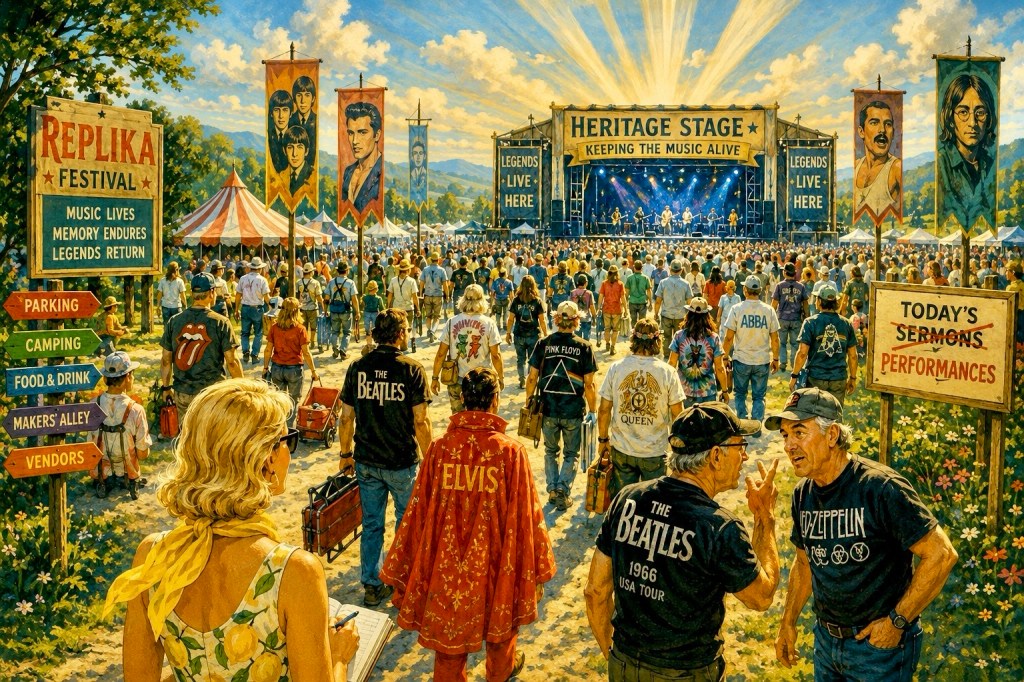
Herr Spengler looked around the pavilion.
“I am not suggesting that tribute bands are religions. That would be too simple. I am suggesting that when civilizations become old, memory begins to rival invention. The preservation of greatness gradually becomes almost as important as greatness itself.”
Outside, another audience roared as a familiar chorus began.
The lecturer smiled faintly.
“Even popular music. . . has now entered history.”He closed his notebook. “I thank you.”
For several seconds no one moved. Then the entire pavilion stood and applauded.
Mrs. Begonia remained where she was while everyone else lined up for autographs.
Young people. Older couples. A man dressed as Elvis. Someone wearing a Pink Floyd shirt. No one seemed remotely self-conscious. They simply wished to meet Professor Spengler.
When her turn came, she smiled.
“Herr Professor. . . ”
He inclined his head.
“I should tell you that the gentleman responsible for inviting you here is named John St. Evola.”
“I have been informed.”
“He’ll be insufferably pleased this worked.”
Professor Spengler considered this.
“Mr. St. Evola has evidently been spending too much time reading The Perennial Sophomore—a publication whose editors remain steadfastly convinced that the literal meaning is always the deepest one, and that slogans spare one the inconvenience of reading more broadly. One hesitates to encourage such behavior. There is, after all, an established curriculum. At this stage they have not yet progressed to Monsieur Baudrillard. That generally occurs sometime during the fourth year, after which they spend the next six months explaining simulacra to people who had not previously imagined themselves in need of the instruction.”
“One should never deprive the Perennial Sophomore of discovering his first French philosopher. It is considered an important stage of development.”
Hamangia Thinker, Europe, c. 5000–4600 BC.
He signed her program with a fountain pen. Nothing more than:
Oswald Spengler
Mrs. Begonia noticed he had never once referred to himself as a tribute performer. Not once.
*A Council Tangent Within The Gist*
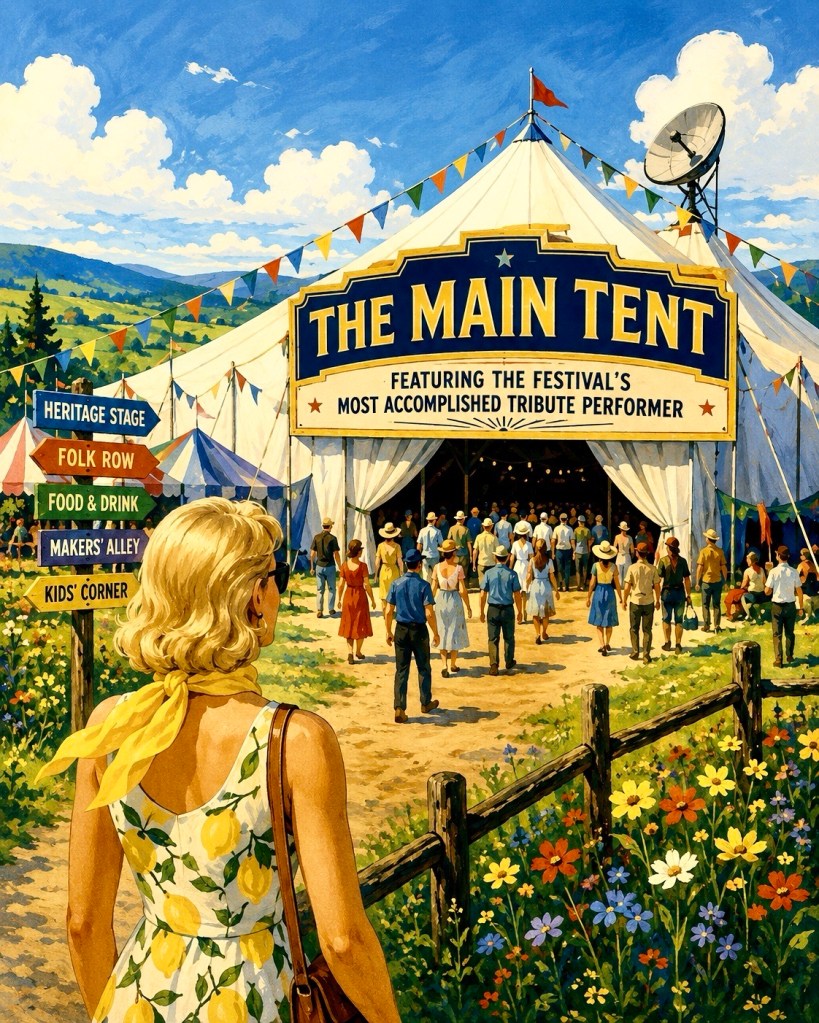
As she walked back toward the music, she looked over her shoulder. The line was now even longer than before. An Elvis waited patiently behind a Queen. She smiled to herself.
John had sent her to investigate a curiosity. Instead, she had attended the only lecture at the festival that explained why the festival existed at all.

More of Mrs. Contretemps On The Road series can be found : HERE


Leave a Reply