—An Exploration of a Latin Word Found in the Wild.
VITO HAECKELER COMMENTS:
The old saying wasn’t originally about ducks. It was about judgment.
When a thing walks like a duck, swims like a duck, and quacks like a duck, most people eventually conclude they’re dealing with a duck.
That’s the famous duck test.
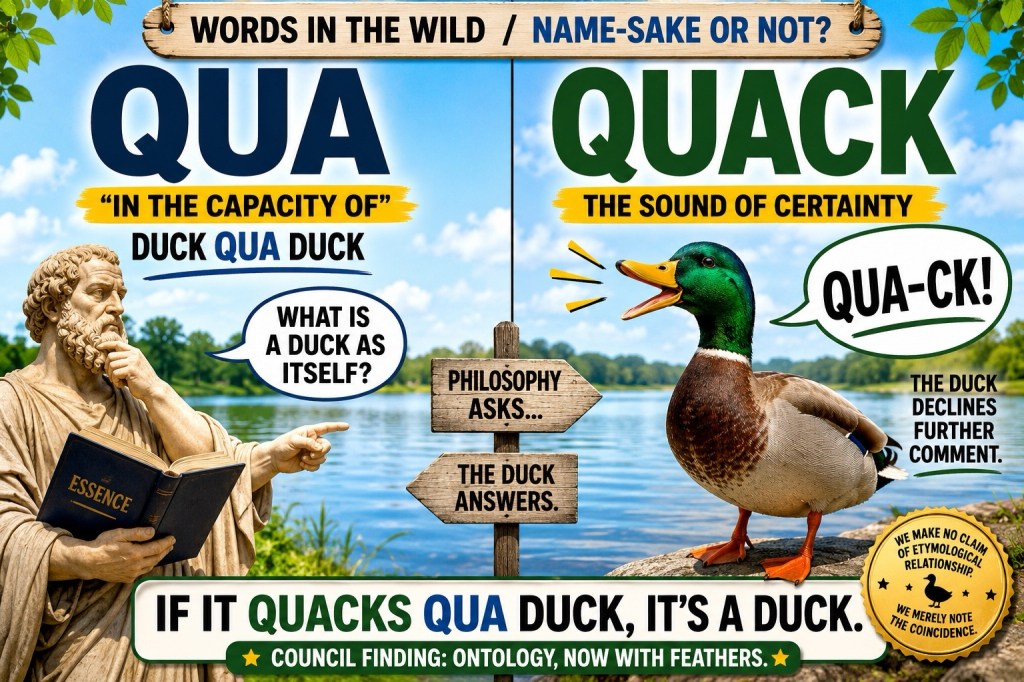
The philosophers, meanwhile, have a Latin word: qua.
It means a thing considered as itself. Duck qua duck.
Now one afternoon I’m sitting by a pond and it occurs to me that these are not entirely different enterprises.
The philosopher asks:
“What is a duck qua duck?”
The duck test asks:
“How much evidence do you require before you’ll admit it’s a duck?”
One approaches essence from above. The other approaches it from below. One begins with ideas. The other begins with observations.
And then, somewhere in the middle, the duck interrupts both discussions.
“Quack.”
At which point the philosophers continue debating and the rest of us go home.
Council Finding:
The shortest argument for essence ever devised may consist of a single duck making a single noise.
QUAck.

PAIGE TURNER, SUB-SUB LIBRARIAN, NOTES:
Having received Vito Haeckeler’s memorandum concerning possible metaphysical activity among waterfowl, I consulted several reference works.
The famous expression now known as the “duck test” is commonly traced to a remark attributed to James Whitcomb Riley:
“When I see a bird that walks like a duck and swims like a duck and quacks like a duck, I call that bird a duck.”
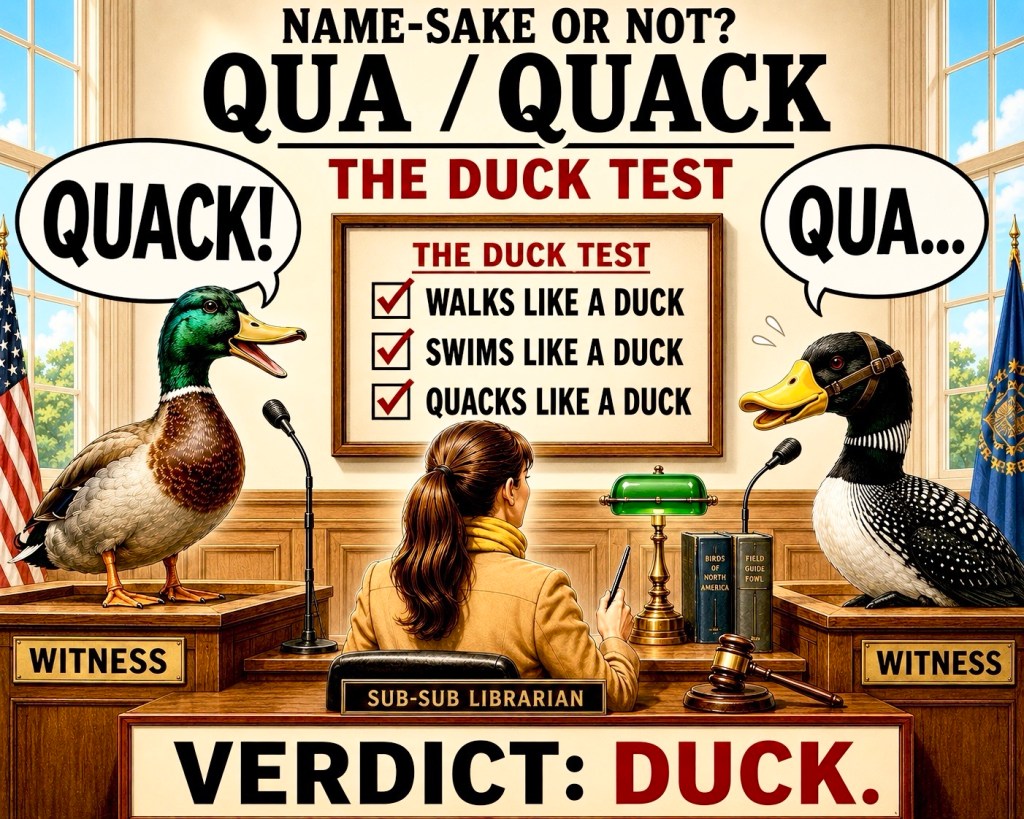
Contrary to appearances, the observation is not principally about ducks. It concerns classification. Specifically, it addresses the degree of evidence required before one is willing to identify a thing according to its observable nature.
Over time, the duck test found application in law, politics, science, and everyday reasoning. Whenever disagreement arose concerning what a person, institution, movement, or object truly was, the duck test offered a practical response: if something consistently behaves as a member of a category, one may be justified in placing it within that category.
During preparation of this report, the present investigator became aware of the philosophical term qua, meaning:
“considered as itself” or “in the capacity of.”
A philosopher might therefore inquire into a duck qua duck—that is, into the essential nature of duckness.
The Council makes no claim that qua and quack are historically related.
The Council merely notes that one seeks the essence of a duck through philosophical inquiry, while the other seeks it through repeated observation.
Sub-Sub Librarian’s Note:
A surprising number of philosophical questions appear less intimidating when relocated to a pond.—Paige Turner
PETER MOSSBACK, COUNCIL ATHWART HISTORIAN, COMMENTS:
For most of history, the matter seemed simple. If a thing walked like a duck, swam like a duck, and quacked like a duck, one could safely call it a duck.
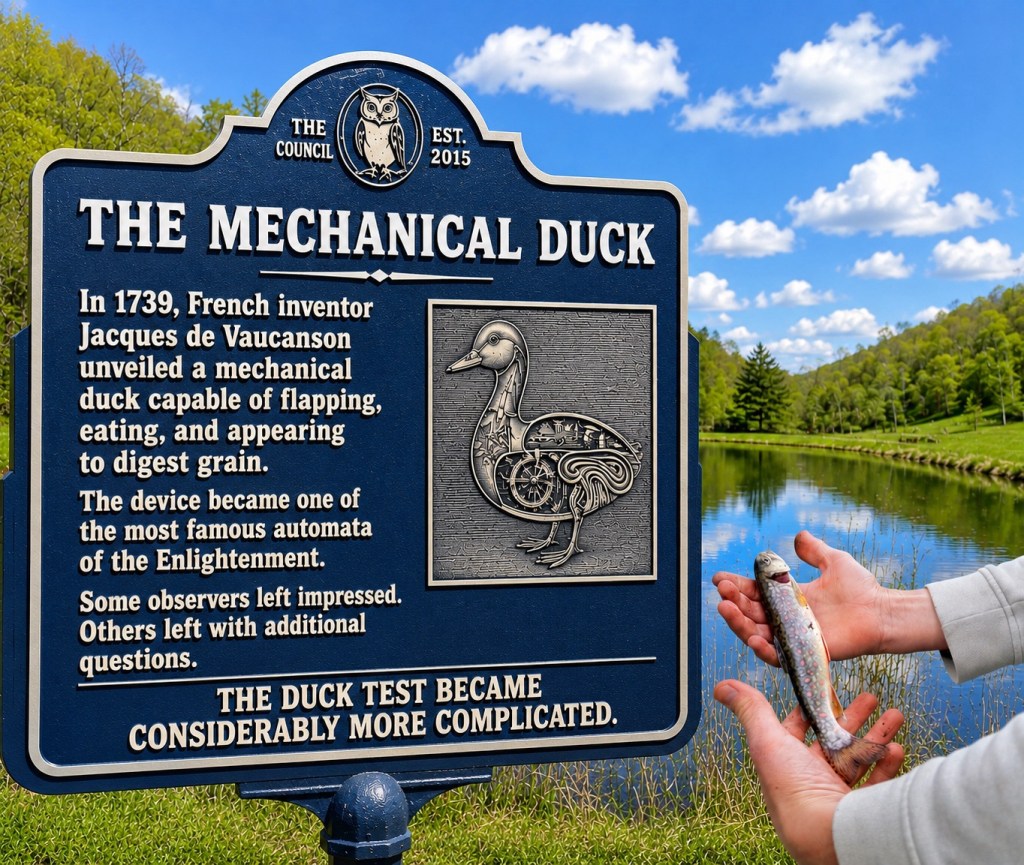
Then, in 1739, Jacques de Vaucanson unveiled a mechanical duck. It flapped, ate, and appeared to digest grain.
Suddenly the question became less straightforward.
The philosopher asks what a duck is qua duck. The duck test asks whether a thing behaves sufficiently like a duck to be called one. Vaucanson’s machine occupied an uncomfortable position between the two.
It was not a duck.
Yet it appeared to possess a surprising quantity of duckness.
The Council notes that Vaucanson’s duck could eat, digest, and defecate — but by all primary accounts, could not quack. The one behavior most associated with ducks was the one the machine omitted.
The duck test, it turns out, requires a duck.
Sub-Sub Librarian’s Final Note:
The term qua originated as an ordinary Latin word before being recruited into centuries of philosophical service. The duck, by contrast, appears to have arrived fully qua-lified.
Council pronunciation guide for QUA
More Words In The Wild can be found: HERE


Leave a Reply