The Accidental Initiate’s Just-So Story About Quality Emerging from Quantity.

Editor’s Note: Our regular Words in the Wild correspondent, Paige Turner, is away on a much-needed retreat at the Lexical Wellness & Rehabilitation Spa, where overworked words receive restorative treatments. Last reports indicate that literally is undergoing intensive therapy for exhaustion, iconic has been placed on restricted use, problematic is attending anger-management classes, and journey is trying to remember where it was originally headed. In the meantime, the Accidental Initiate has agreed to keep watch for any interesting linguistic specimens that wander by.

I wasn’t even looking for another entry for the Words in the Wild column when I came upon this one.
Usually I’m stalking an unfamiliar adjective or some newly fashionable verb that seems to have escaped into everyday conversation. This time it wasn’t a word at all. It was a phrase. I kept hearing people say:
“Oh, it’s just…”
At first I paid no attention. Then I began noticing it everywhere.
“It’s just math.”
“It’s just neurons firing.”
“It’s just evolution.”
“It’s just an algorithm.”
“It’s just statistical prediction.”
The curious thing wasn’t that any of these statements were necessarily false. Most of them were broadly correct as far as they went.
What fascinated me was that they all seemed to arrive with the same invisible punctuation:
Case closed. Mystery solved. Move along.
Being an accidental initiate rather than a professional anything, I decided to investigate the smallest word in the sentence. It turned out to be doing almost all the work :
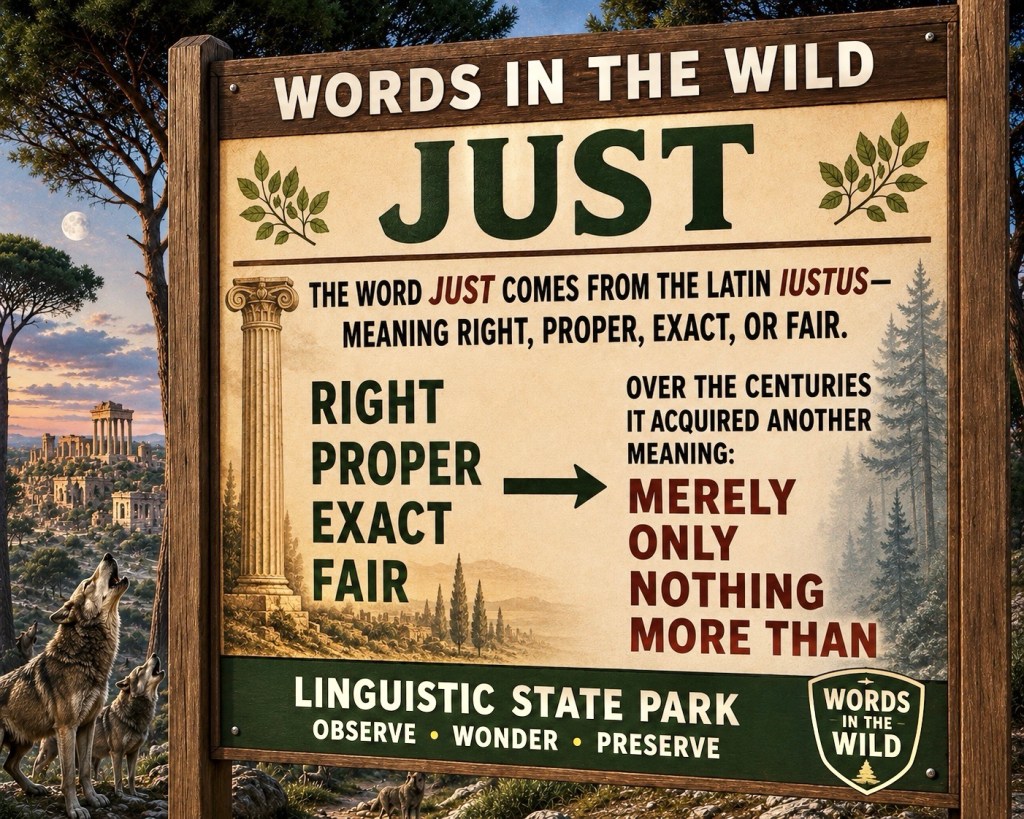
Somewhere along the line, a word that once suggested precision became the linguistic equivalent of a shrug.
The thought finally crystallized while listening to people discuss large language models.
“Oh, it’s just predicting the next token.”
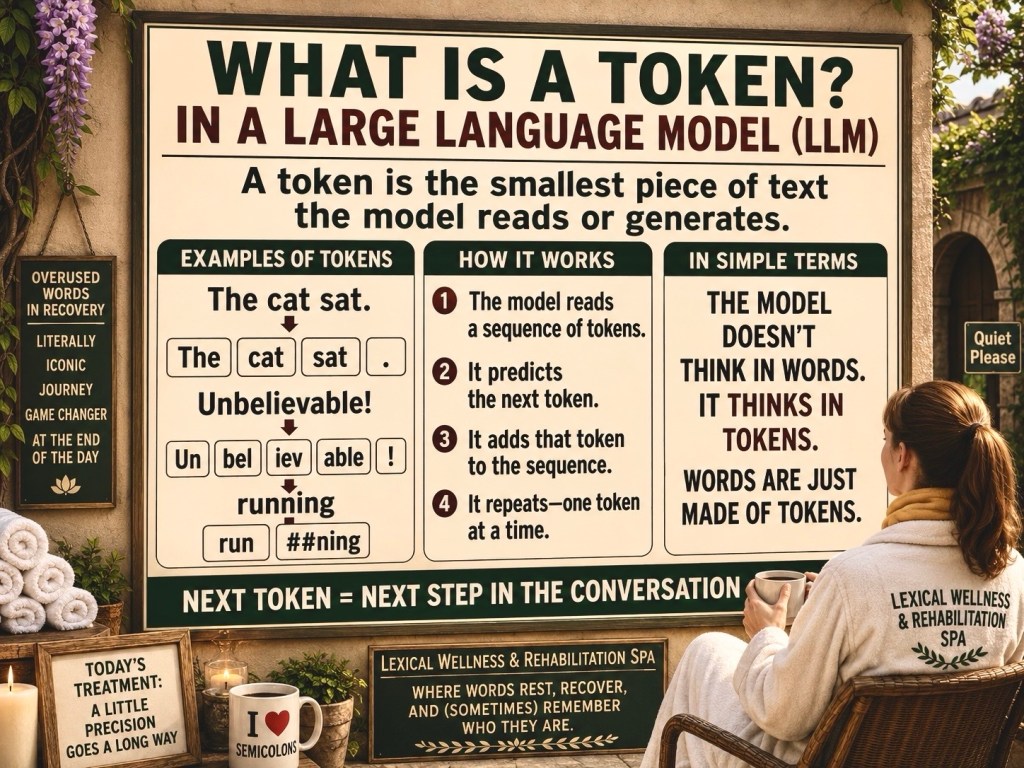
As far as anyone knows, that description is broadly correct. A large language model predicts what token is most likely to come next based upon everything that came before.
But then I noticed something odd. The explanation seemed to satisfy people far more than it explained anything.
The genuinely interesting question wasn’t whether the mechanism involved statistical prediction. The genuinely interesting question was this:
How does repeating that apparently simple operation billions or even trillions of times produce coherent conversation, translation, computer code, summaries, jokes, poetry, and the occasional answer that makes you stop and think?
One prediction seems almost trivial. A trillion predictions. . . no longer seem quite so trivial.
That reminded me of one of my favorite observations by Arthur C. Clarke:
“Any sufficiently advanced technology is indistinguishable from magic.”
It now struck me that our age has quietly invented the opposite principle.
Any sufficiently astonishing technology is eventually explained away with the words, “Oh, it’s just…”

Perhaps this has become our favorite incantation against wonder. Once I noticed the pattern, I couldn’t stop playing the game.
Beethoven is just vibrating air.
Shakespeare is just ink on paper.
A cathedral is just stacked stones.
The Grand Canyon is just a hole.
Pizza is just baked molecules.
Every one of those statements contains a measure of truth. Every one of them also leaves out the very thing that made someone ask the question in the first place. Explaining the ingredients isn’t the same as explaining the meal.
About this time my mind wandered—as it often does—to the famous infinite monkey theorem.
Given an infinite amount of time, monkeys randomly striking typewriter keys would almost surely produce the complete works of Shakespeare.
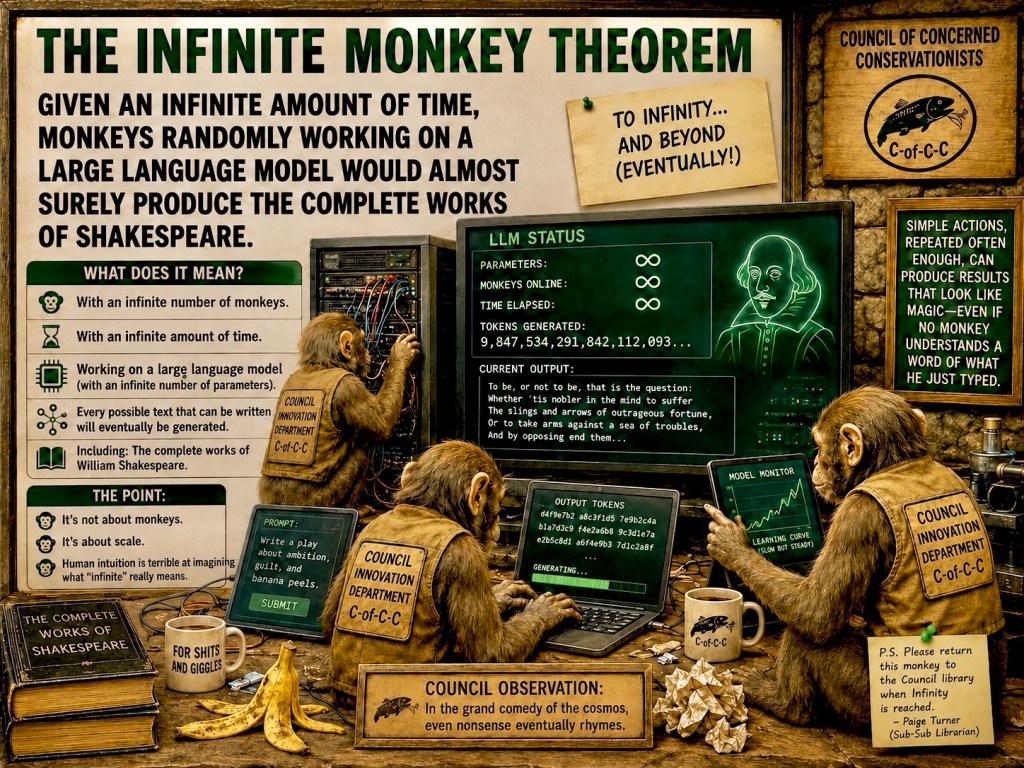
The point, of course, was never really about monkeys. It was about scale. It was about the fact that human intuition is remarkably poor at imagining what unimaginably many repetitions can accomplish.
Perhaps we understand one prediction. Perhaps we even understand a thousand. But our intuitions begin to fail somewhere around a trillion. Simple things, repeated often enough, have a curious habit of becoming something that no longer seems simple.
Just then my eye wandered to a nearby bookshelf where sat René Guénon’s The Reign of Quantity.
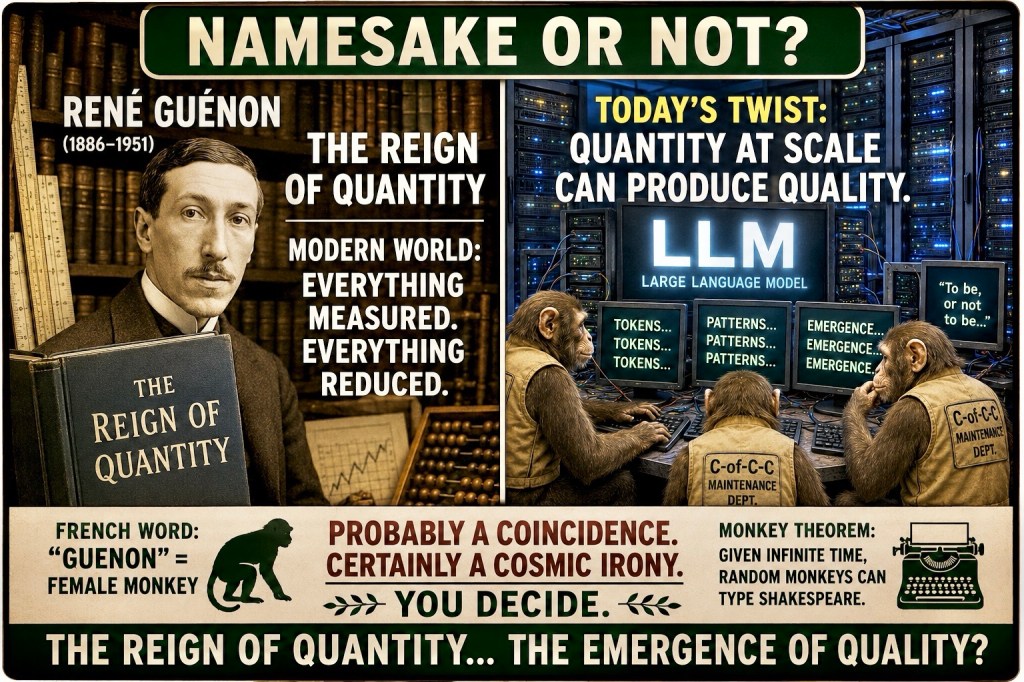
We have noticed that whenever civilization attempts to explain intelligence, creativity, probability, or evolution, monkeys are eventually summoned as expert witnesses.
Guénon argued that modern civilization had fallen under the domination of quantity—measurement, calculation, statistics, standardization—at the expense of genuine quality.
It is a profound criticism of the modern world. Yet I couldn’t help wondering whether nature sometimes plays a different game.
What if quantity doesn’t always destroy quality?
What if, under certain conditions, quantity becomes the very source of new qualities?
One neuron does not think.
One water molecule is not wet.
One ant does not comprehend a colony.
One statistical prediction does not carry on a conversation.
Yet enough neurons become a mind.
Enough molecules become waves.
Enough ants become something astonishingly like collective intelligence.
And perhaps enough statistical relationships begin producing conversations that, while not infallible, are coherent, useful, humorous, creative, and occasionally enlightening.
Perhaps Guénon was describing a disease of civilization.
I found myself wondering whether I had stumbled onto one of nature’s favorite tricks.
Not the destruction of quality by quantity. . . but the emergence of quality from quantity.
Reduction isn’t the villain here.
Science depends upon reducing complicated things into understandable mechanisms. Mechanisms matter. But somewhere between the laboratory and everyday conversation, we seem to have developed the habit of mistaking identifying the mechanism for exhausting the mystery.
Ever since I noticed the phrase “Oh, it’s just. . . ” I haven’t been able to stop hearing it.
Whenever someone says it now, I find myself silently asking one simple question:
“Yes. . . and then what?”
Because I’ve begun to suspect that the little word just doesn’t always mark the end of an explanation.
Sometimes it’s the place where the real mystery begins.
More WORDS IN THE WILD can be found HERE.

The dolphin’s smile is commonly explained as “just” facial anatomy. Perhaps. Yet dolphins continue approaching, playing with, and assisting humans in ways that keep the question—and the wonder—very much alive.



Leave a Reply