—A Study of Vegetable Mimicry and Human Humiliation
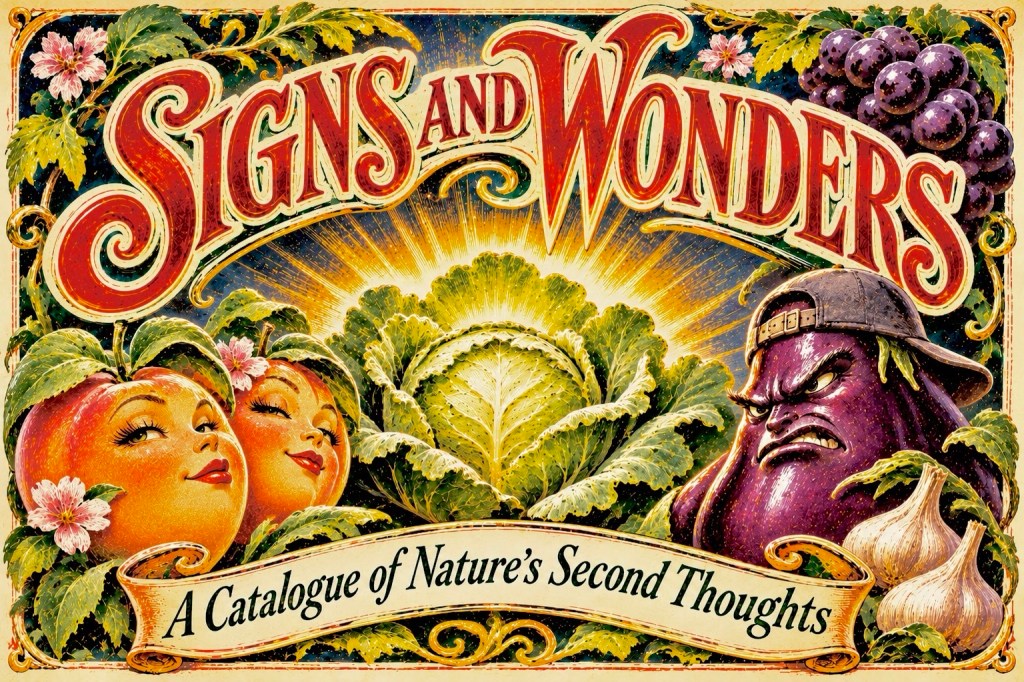
An investigation by Mrs. Begonia Contretemps, featuring Daphne Howlsmythe
From the Editor
The Council is pleased to report the reappearance of our blue-blooded correspondent Daphne Howlsmythe, whose responsibilities include fashion, food, and pet care. Daphne never officially left us, although her whereabouts and activities have been something of a mystery.
We had anticipated her return might bring the occasional recipe, some advice on sensible footwear, or the proper grooming of a Pekingese. Instead, Daphne has uncovered what may be a centuries-old conspiracy involving the vegetable kingdom and its increasingly impertinent attitude toward mankind.
We’ve dispatched Mrs. Begonia Contretemps to interview Daphne at the scene of the alleged offenses—the produce department of a local supermarket. We advise readers to keep their voices down. There are ears of corn everywhere.
—John St. Evola, Editor
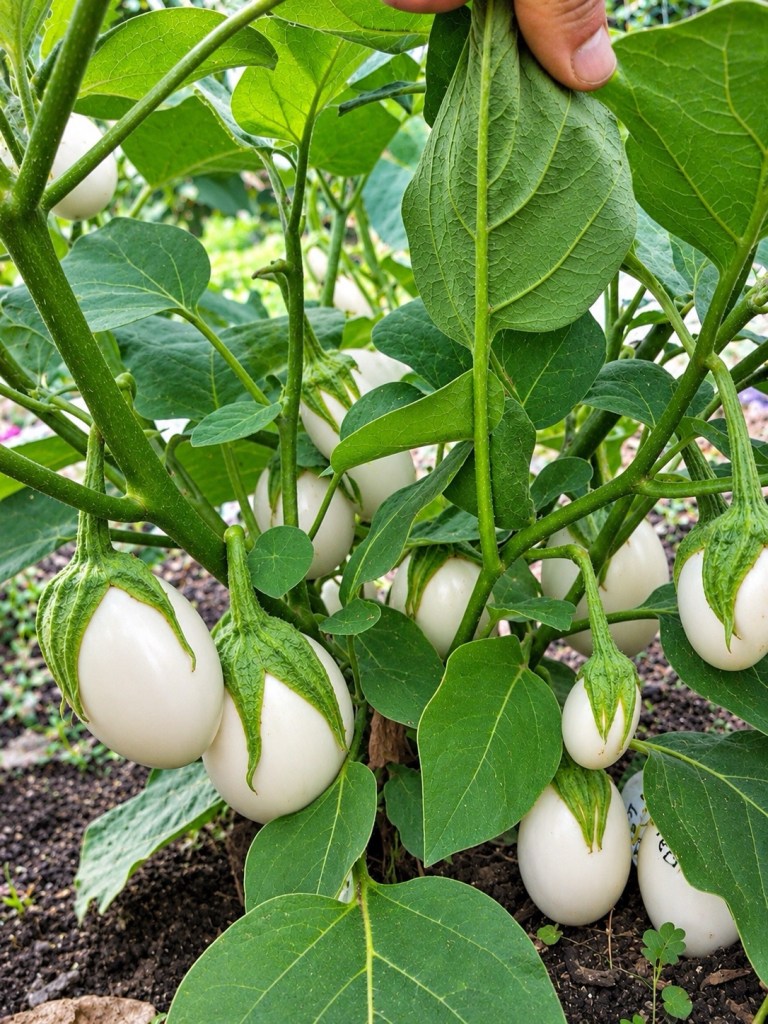
Long before the familiar dark purple varieties dominated American produce departments, white, egg-shaped varieties helped give the eggplant its English name. These are genuine eggplants, not albinos or recent genetic inventions.
Their appearance, however, has attracted the attention of the Council’s Daphne Howlsmythe, who suspects there may be more to the story than botanical history alone.
At the Scene of the Alleged Offenses
Mrs. Begonia Contretemps caught up with Daphne Howlsmythe in the produce department of a local supermarket, where the latter was examining the merchandise with an expression ordinarily reserved for identifying suspects in a police lineup.
The two longtime Council correspondents proceeded down the aisle, Daphne pushing a shopping cart and Mrs. Begonia keeping a cautious distance from the vegetables.
Mrs. Begonia: “Daphne, before we go any further, I must ask what possessed you to believe that the vegetable kingdom has developed an attitude toward humanity?”
Daphne: “Developed? My dear Begonia, I suspect they’ve had one for centuries. We’ve only just begun to notice.”
Mrs. Begonia: “And your evidence?”
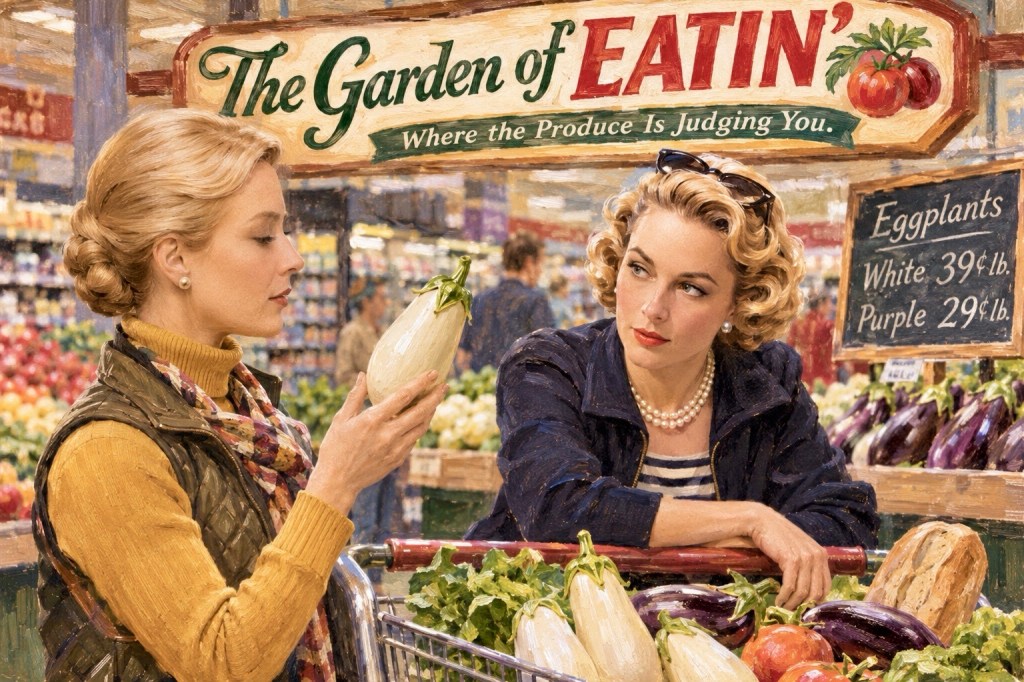
Daphne stopped the cart beside a display of white eggplants.
Daphne: “I suggest we begin here.”
Mrs. Begonia: “White aubergines. Unusual, perhaps, but hardly an act of aggression.”
Daphne: “Consider the Italian-American expression mulignan. Traditionally applied to the dark-skinned eggplant, but also used as a racial epithet. And now here we have white eggplants. Somehow the eggplant has responded to the current denigration of White folks, who are increasingly portrayed as the cause of all the world’s woes.”
Mrs. Begonia: “You’re suggesting the eggplants are taking sides?”
Daphne: “I’m suggesting they may know more than we give them credit for. Of course, this in no way changes the past and still-current resonance of street eggplants, which continue to be black.”
Mrs. Begonia: “But how could an eggplant possibly know what human beings are saying about it?”
Daphne: “Morphic resonance, my dear. Rupert Sheldrake’s hypothesis that nature possesses a kind of collective memory. Similar forms and patterns may influence one another across time and space. He even suggests that what we call laws of nature might be more like habits.”
Mrs. Begonia: “An interesting hypothesis. Though hardly established science.”
Daphne: “Certainly. But we’re investigating possibilities, not applying for a government research grant. Besides, our Italian-American members should appreciate the implications.”
Mrs. Begonia: “So these vegetables have inherited a memory of human attitudes?”
Daphne: “Perhaps. And if they can inherit memories, why shouldn’t they develop a response? Mankind has been cultivating, manipulating, exploiting, peeling, slicing, and boiling them for millennia. Wouldn’t you expect a certain resentment?”
Mrs. Begonia: “I should imagine being boiled alive might leave an impression.”
Daphne: “Precisely. Although I suspect the potatoes have taken it rather personally.”
The Vegetable Kingdom Strikes Back
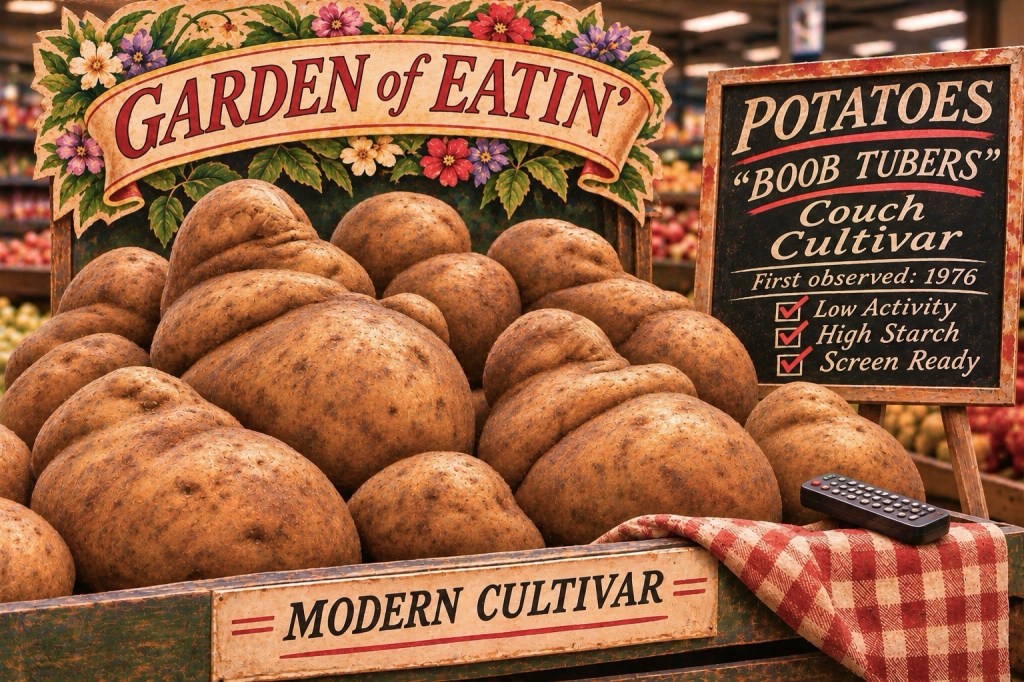
The women resumed their progress, passing an enormous display of potatoes.
Mrs. Begonia: “But surely the resemblance between a potato and an overweight person is something we humans have invented?”
Daphne: “And how can you be certain of that? Perhaps the potato is mocking the overweight. Perhaps carrots are taunting gingers. We assume we’re making metaphors out of vegetables. What if vegetables are making metaphors out of us?”
Mrs. Begonia stopped walking.
Mrs. Begonia: “That’s rather an extraordinary reversal.”
Daphne: “Botanical revenge, isn’t it? Perhaps the fruits and vegetables are simply getting even with us for centuries of botanical insults. We call people couch potatoes, bad apples, peaches, lemons, and vegetables. We compare noses to cucumbers and figures to pears. Why should the traffic in ridicule be entirely one-way?”
Mrs. Begonia: “You’re suggesting the vegetable kingdom has developed a sense of humor?”
Daphne: “Not developed, Begonia. Perfected.”
Mrs. Begonia: “But surely you’re not suggesting these vegetables are actually conscious of what they’re doing?”
Daphne: “Why not? There are entire philosophical traditions that regard consciousness as something permeating nature, rather than a privilege reserved for human beings. Perhaps we’ve been rather presumptuous in imagining ourselves the only creatures capable of recognizing a joke.”
Mrs. Begonia: “But recognizing a joke and making one are quite different things.”
Daphne: “Precisely. And we’ve never thought to ask the vegetables which they’re doing.”
Daphne selected a particularly bulbous potato from the display.
Daphne: “Look at this fellow. Doesn’t he remind you of someone?”
Mrs. Begonia studied the specimen.
Mrs. Begonia: “I believe I once sat beside him on a flight to Brussels.”
She returned it carefully to the pile.
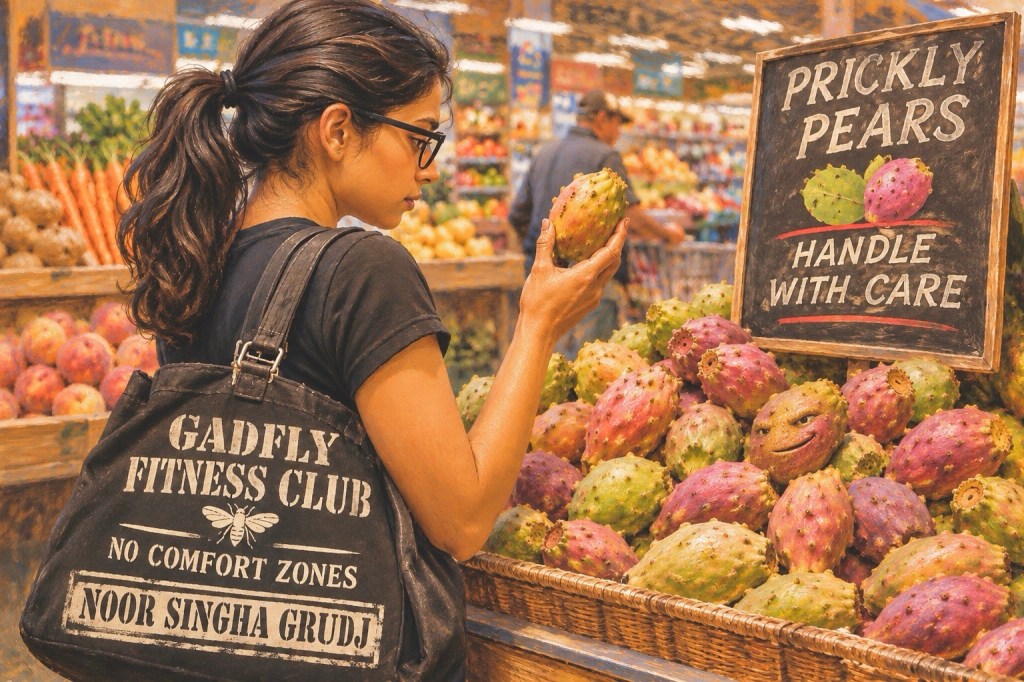
Daphne: “And listen to what the raspberries are saying.”
Mrs. Begonia: “I beg your pardon?”
Daphne: “Raspberries, Begonia! They’ve been expressing contempt for centuries, and we named the gesture after them.”
Mrs. Begonia: “And the melons?”
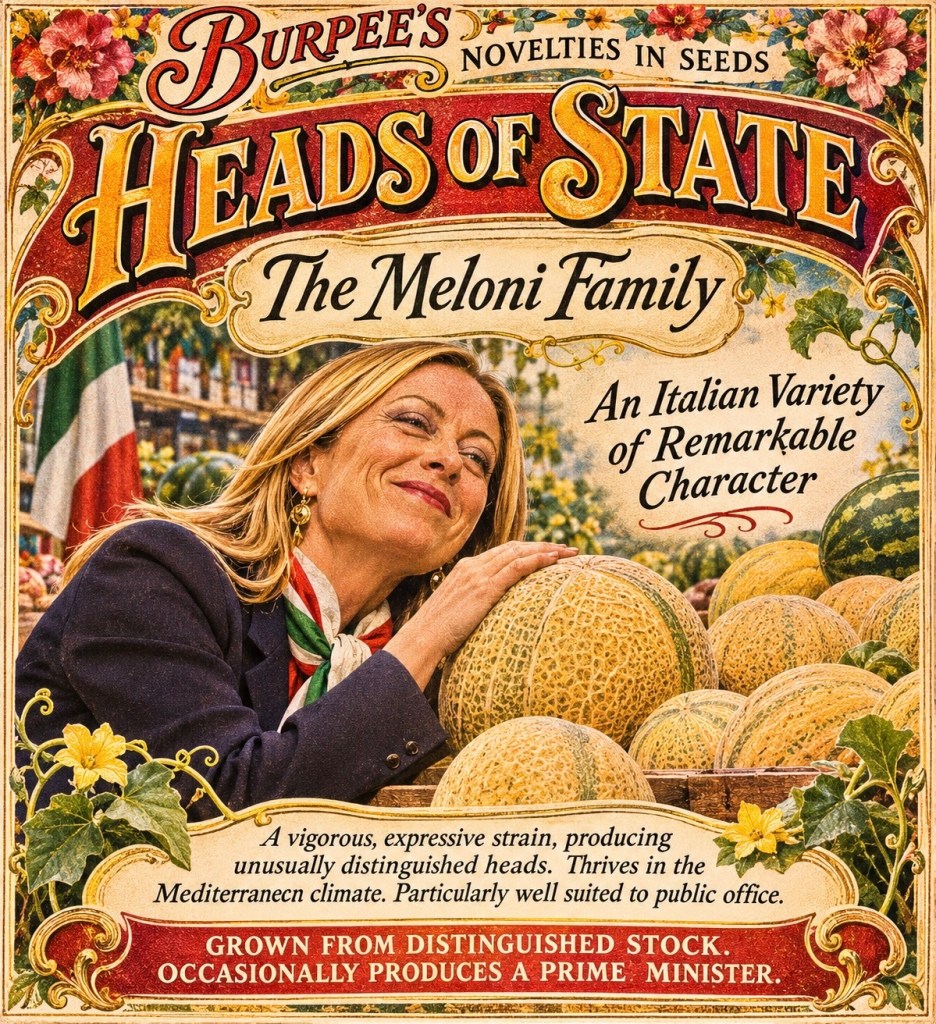
Daphne: “Oh, the melons! Although Italy’s prime minister, Giorgia Meloni, has already delivered something of a riposte to the fruit kingdom merely by flaunting her name.”
Mrs. Begonia: “I rather think you’re mixing botanical classifications with political ones.”
Daphne: “They started it.”
The Politics of Produce
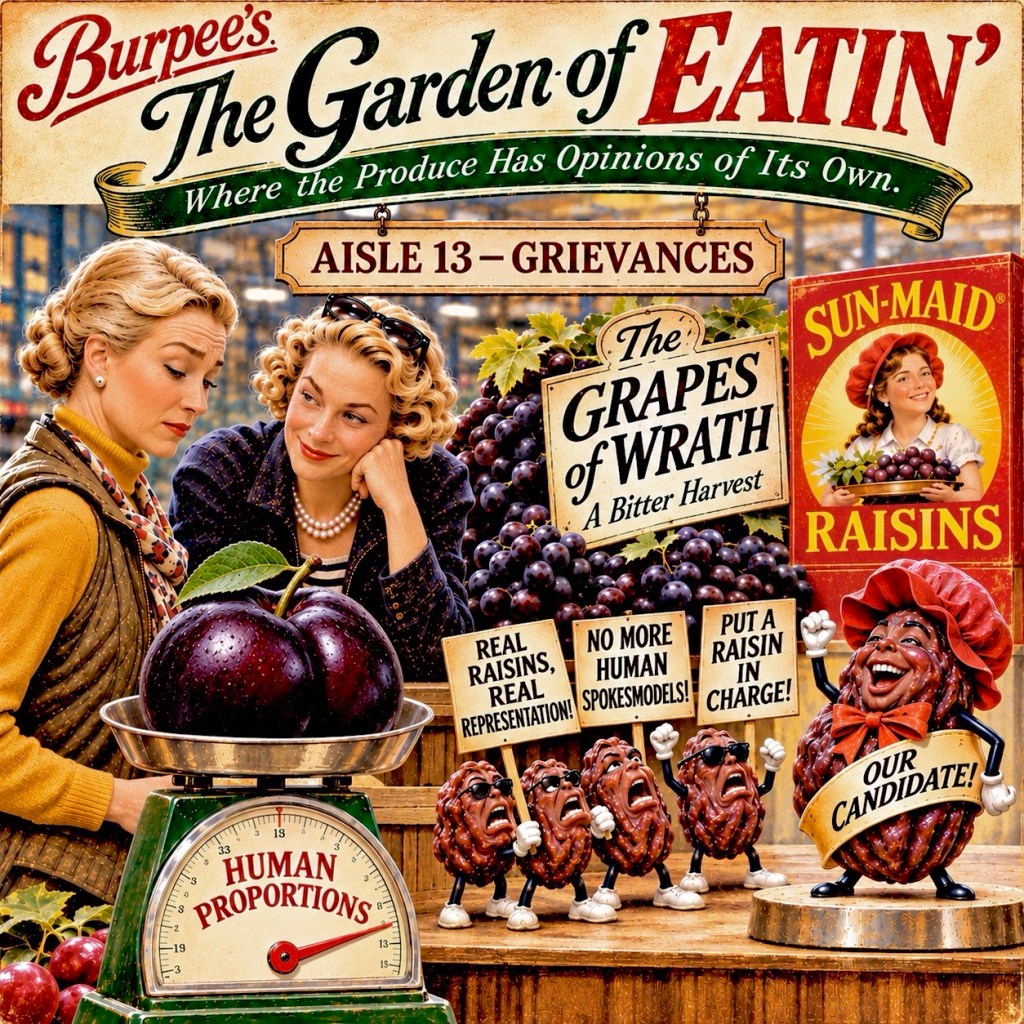
They turned into another aisle, where garlic, onions, cabbages, and imported delicacies were arranged beneath cheerful promotional signs.
Mrs. Begonia: “I can see how people might discover unfortunate resemblances. But what of the political implications you mentioned?”
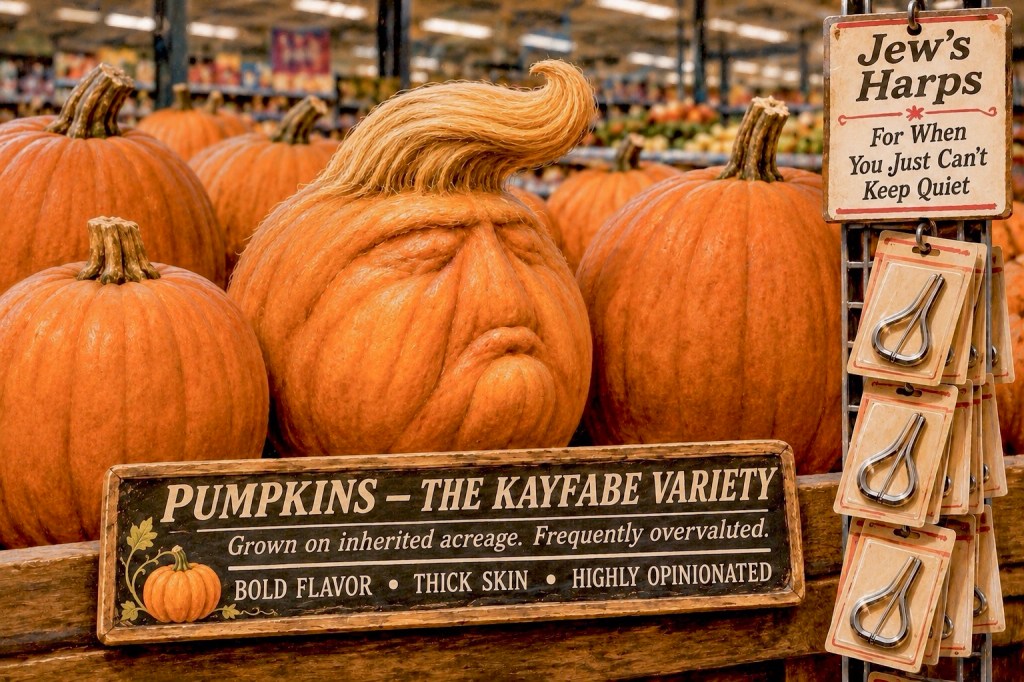
Daphne: “And now consider the connotations and innuendo of strawberries, cherries, peaches, bananas, and pickles. Then consider the ethnic associations of garlic, onions, sauerkraut, and any number of other foods. The possibilities for offense are practically inexhaustible.”
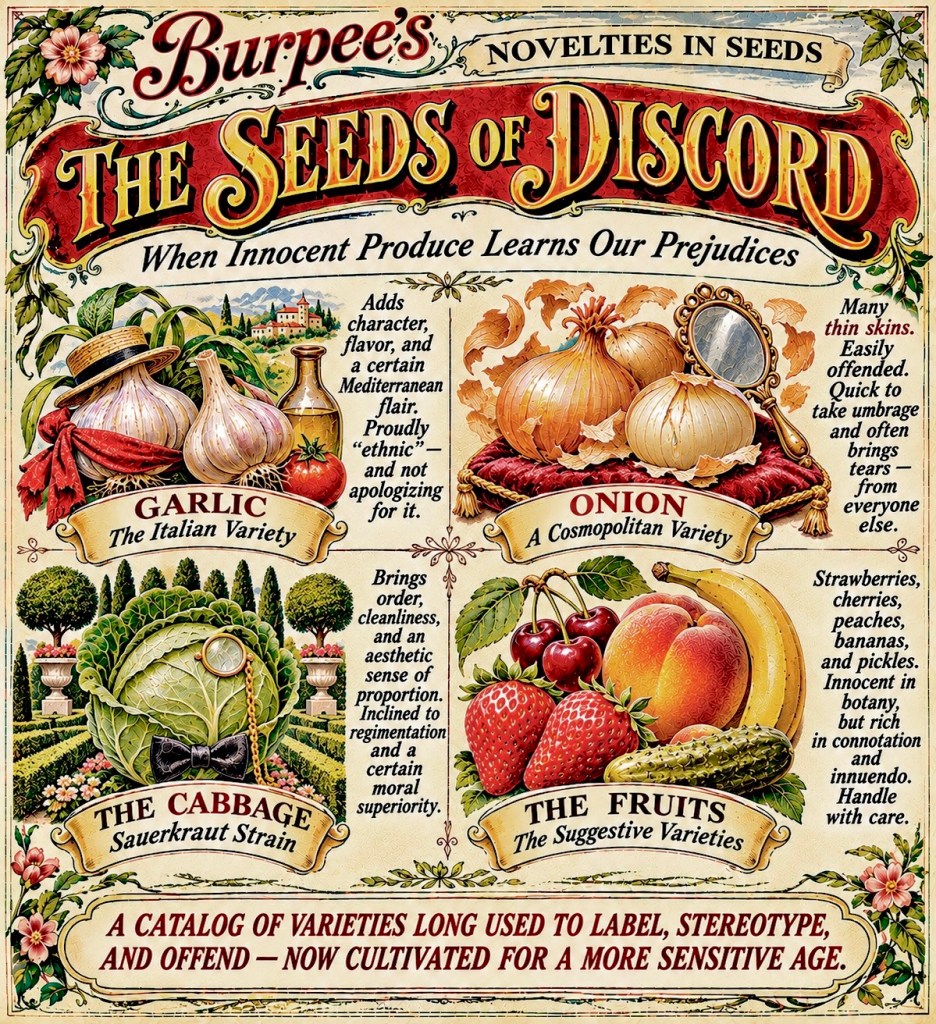
Mrs. Begonia: “Good heavens. Are you suggesting the produce department is a hotbed of microaggressions?”
Daphne: “A veritable greenhouse of them. And if the politically correct crowd discovers what these vegetables have been insinuating about humanity, there’ll be demands for investigations, apologies, and sensitivity training.”
Mrs. Begonia: “For the vegetables?”
Daphne: “For the grocers, naturally. One can hardly expect a cabbage to sign a statement of contrition.”
Mrs. Begonia: “And who would represent the accused?”
Daphne: “I imagine the fruits would insist upon separate counsel. They’ve always been a rather exclusive bunch.”
Mrs. Begonia: “I see. And what of the nuts?”
Daphne: “I should think they’d be running the proceedings.”
Mrs. Begonia glanced toward a nearby display of corn.
Mrs. Begonia: “Perhaps we ought not discuss these matters quite so loudly.”
Daphne: “Exactly! The wrong ears of corn may hear us, and the entire green grocery aisle will become the next target of the woke crowd.”
Mrs. Begonia: “That bunch of fruits?”
Daphne smiled approvingly.
Daphne: “You’re beginning to understand.”
A Scholarly Contribution
Near the end of the aisle, Mrs. Begonia noticed a small table piled with remaindered books beneath a large sign:
SPECIAL CLEARANCE — 75% OFF
Among the discounted cookbooks, celebrity memoirs, and obsolete diet manuals was a handsome volume bearing the title :
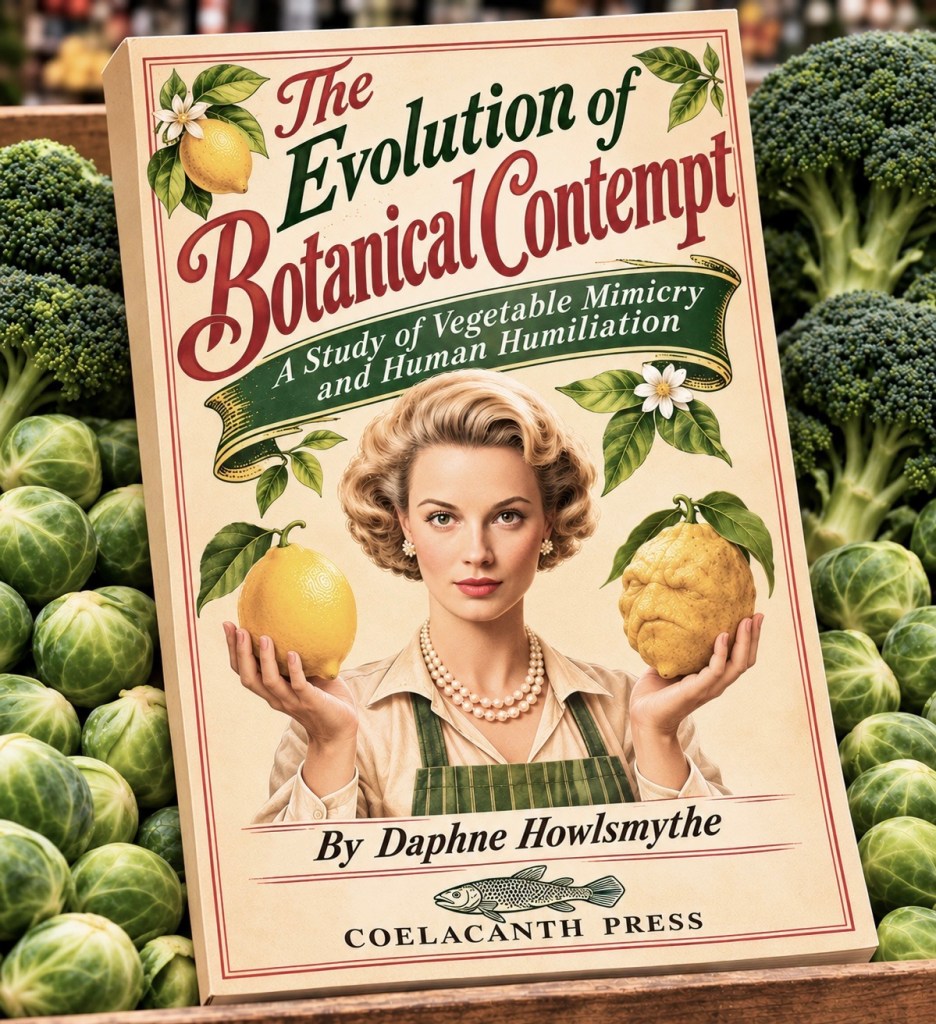
Mrs. Begonia: “Good Lord, Daphne! You’ve written a book about this?”
Daphne: “Naturally. One cannot expect a serious investigation of botanical behavior to be adequately covered in a fashion column.”
Mrs. Begonia: “And it’s being sold here in the supermarket?”
Daphne: “An inspired arrangement, I thought. Bringing the research directly to the scene of the phenomenon.”
Mrs. Begonia examined the price.
Mrs. Begonia: “Seventy-five percent off?”
Daphne: “The publisher was reluctant to call it a scientific breakthrough.”
Mrs. Begonia: “I see. And has it been reviewed?”
Daphne: “Not favorably. But then, the reviewers were mostly human.”
Mrs. Begonia: “You suspect a conflict of interest?”
Daphne: “An entire kingdom of it.”
More from Daphne Howlsmythe

The Last Word from the Produce Department
The two women continued toward the checkout, their cart containing a modest assortment of groceries and one heavily discounted scholarly volume.
Mrs. Begonia: “Daphne, there’s something that still troubles me. Surely these resemblances needn’t imply that vegetables are consciously ridiculing us?”
Daphne: “Of course not. That’s only one possibility. Another is that mankind has an extraordinary ability to find meaning in the shapes and circumstances of the natural world.”
Mrs. Begonia: “Then the resemblance might exist without the intention?”
Daphne: “Precisely. And that brings us to the most interesting question. Are we discovering meaning in nature, or are we imposing it upon nature? Or is there some relationship between the two that we haven’t yet understood?”
Mrs. Begonia: “Which brings us back to morphic resonance.”
Daphne: “Among other things. Sheldrake’s hypothesis invites us to consider whether patterns and associations might possess a continuity beyond what we ordinarily recognize. It doesn’t prove that a potato is laughing at us. But it does encourage us to reconsider what we think we know about nature.”
Mrs. Begonia: “So the same person might see an insult, a coincidence, or a rather delightful metaphor?”
Daphne: “Exactly! One shopper may become outraged by the sexual and ethnic connotations shouting from the crates. Another may grow paranoid about the supposed intentions of the produce. But a third might simply laugh at mankind’s ability to make the world more than it seems through poetic sense and understanding.”
Mrs. Begonia: “Returning to your point, Daphne, about our peculiar human ability to see more in things than is actually there—do you believe that’s an ability worth cultivating?”
Daphne: “My dear Begonia, it’s one of the things that makes life interesting. Imagine a world in which an eggplant was merely an eggplant.”
Mrs. Begonia considered this for a moment.
Mrs. Begonia: “Rather a dull world, I suppose.”
Mrs. Begonia: “But I notice you’ve left one possibility unresolved. Perhaps the resemblance isn’t entirely our invention. Perhaps the vegetables really are mocking us.”
Daphne: “Of course! We mustn’t dismiss a possibility merely because it offends our understanding of the natural order. After all, we’ve spent centuries assuming that nature exists for our benefit. Imagine discovering that nature has been having a little fun at our expense.”
Mrs. Begonia: “And what would constitute proof?”
Daphne: “I shouldn’t know. But I would be very interested in hearing the defense.”
Mrs. Begonia: “Perhaps mankind has spent centuries debating whether nature possesses consciousness, while nature has been debating whether mankind possesses a sense of humor.”
Daphne stopped pushing the cart and regarded her companion with evident satisfaction.
Daphne: “Begonia, I believe you’re beginning to appreciate the seriousness of my research.”
They approached the checkout counter.
Mrs. Begonia placed the potatoes, carrots, and white eggplants on the conveyor belt, followed by Daphne’s book.
The cashier examined the cover.
“Botanical contempt?” she asked. “What’s that about?”
Mrs. Begonia glanced at Daphne, then at the vegetables.
Mrs. Begonia: “I’m afraid it’s rather difficult to explain.”
Daphne: “Not at all. Put that in your coconut and think about it.”
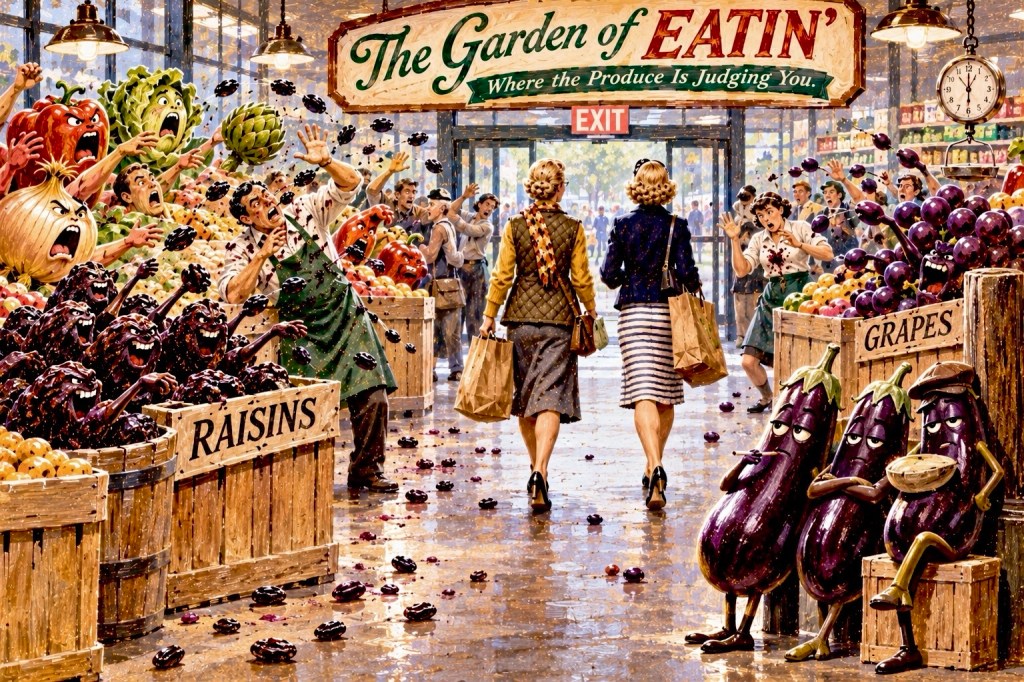
—Daphne Howlsmythe, Fashion, Food and Pet Care Correspondent
With Mrs. Begonia Contretemps, Special Investigator
C-of-C-C Newsletter — Between Jest and Earnest
More From Mrs. Begonia Contretemps Can Be Found: HERE
Daphne’s Writings Can Be Found: HERE


Leave a Reply