—An Agreement with the Universe.

For today’s scripture we turn not to the Good Book but to a rather good book by Joe Gioia, The Guitar and the New World. In it, Brother Gioia entertains the rather pleasing notion that the guitar, in its very construction, embodies a principle by which humanity might better conduct its affairs.
And for our accompanying hymn, I can think of no more fitting selection than the one performed by this talented and beautiful young lady who, I sometimes suspect, inhabits a more harmonious universe than our own.
Read the lesson, then listen to the hymn below. I think you’ll find them remarkably in tune with one another.

Author, Joe Gioia:
“Our guitar then, in its very form, offers a remedy for the world’s chaos, an agreement with the universe, not perfect, but good enough.”
“In 1581, Vincenzo Galilei, a renowned Italian flute player, and Galileo’s father, proposed the system of equal temperament (some think his son came up with it), which—with slight tweaking—became the enabling factor of all western music since.”

“With Galileo’s discovery, luthiers were able to set twelve metal frets permanently onto the guitar neck, spaced in a diminishing ratio of one eighteenth. (The first fret is placed one eighteenth the distance between the nut and the bridge, the second at one eighteenth the remaining distance, and so on.)
The fretboard therefore combines both musical and proportional meanings of the word ‘scale’, which comes from the Italian word for ‘stair’. One of the occult features of the guitar is that the regular shortening of its frets towards a singular point never reached, mimics exactly our visual perspective of the world. A guitar fretboard, in a pinch, can be used to measure distant objects.
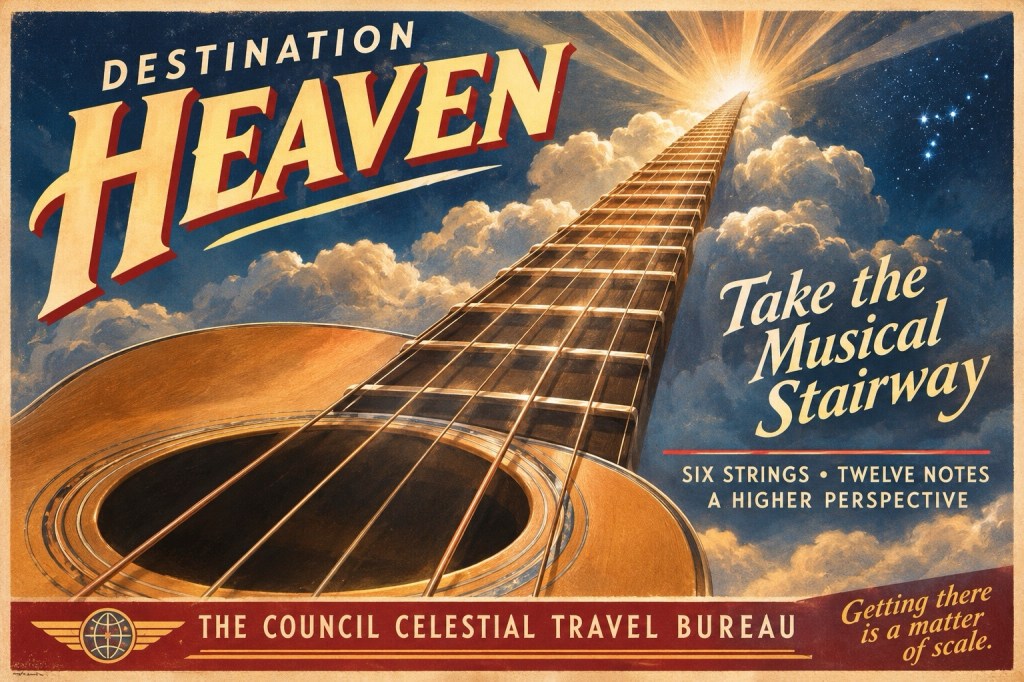
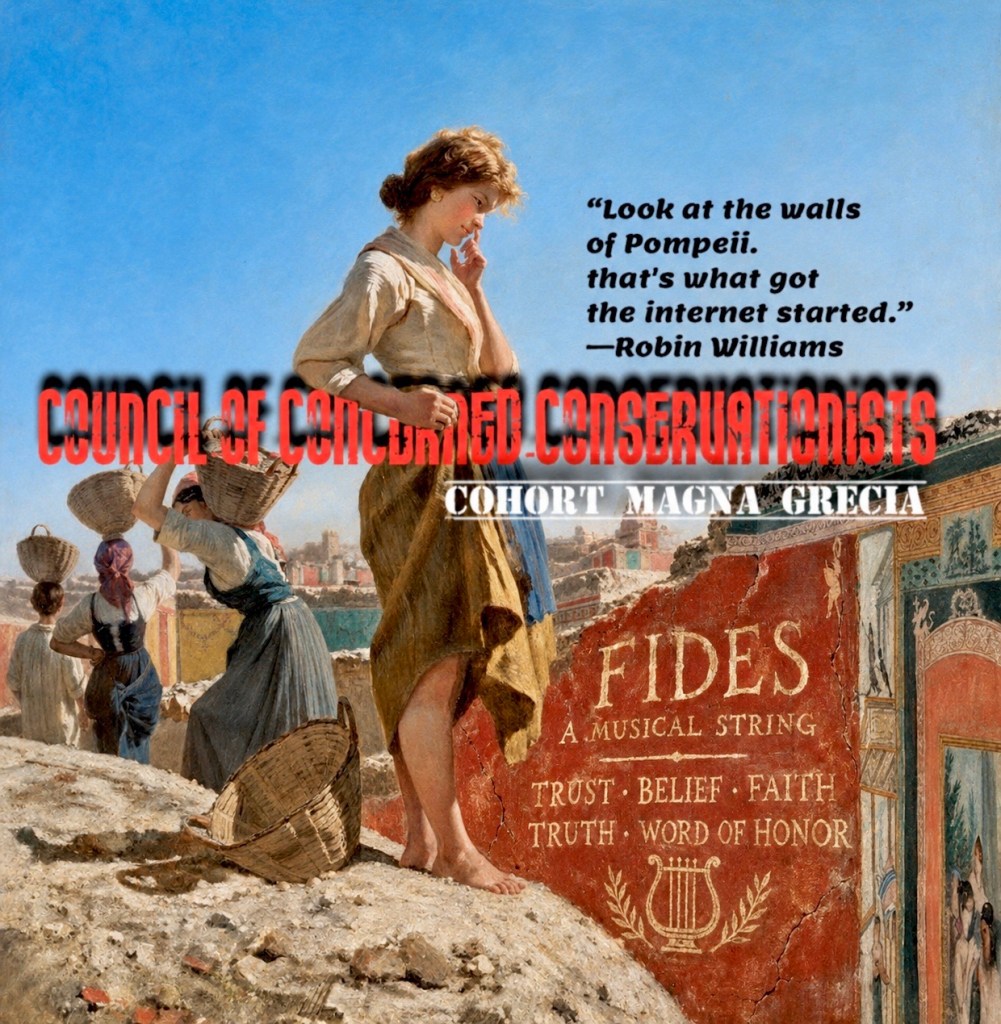
If the notion of the guitar-as-ordering-measure strikes you as far fetched, consider that in ancient Rome, the word ‘fides’, the string of a ‘fidicula’, also meant trust, belief, faith, truth, and word of honor. These ideals, which the ancient world prized above all, were literally laced into Apollo’s instrument with its strings.
Our guitar then, in its very form, offers a remedy for the world’s chaos, an agreement with the universe, not perfect, but good enough. To consider the ancient Mediterranean world, which produced the ‘fidicula’, and the ‘guitarras latina’ and ‘morisca’, is to be presented with a turmoil of centuries, endemic horrors to make our own era appear a place of refuge. Regarding the history of the last 500 years, in the Old and New Worlds, we will find no less cruelty perhaps compared with ancient times, but something resembling a humane, distinctly freeing spirit gradually taking hold.

While it might sound absurd to credit the guitar for the dawning ideal that humans can in fact repudiate the monstrous and brutal portions of our nature, neither, I think, can the instrument’s liberal abilities toward harmonization be casually dismissed. As such it is an avatar of our finest wishes and dreams.”
—Joe Gioia, The Guitar and the New World, pp. 36–37
And now for our accompanying hymn…


Leave a Reply