The Bonus Army of 1932 is one of those remarkable chapters of American history that has somehow slipped from American memory. At the depths of the Great Depression, before the New Deal, thousands of unemployed World War I veterans set out for Washington seeking immediate payment of compensation already granted them by Congress. Eugene Bodeswell is interested not only in why they went—but in how they managed to get there. Seems there once was a Country called America—with a capital C.
It was 1932, and America was deep in the Great Depression.
Millions of men who wanted work could not find it. Among them were veterans of the Great War, men who had gone to France fourteen years earlier and now found themselves unemployed, broke and sometimes unable to feed their families.
This was also an America in which taking a handout could still carry something approaching moral disgrace. The veterans, however, had something coming to them.
Congress had granted them adjusted-service compensation in 1924, represented largely by certificates not payable until 1945. To a hungry man in 1932, thirteen years was a considerable time to wait for money he believed he had already earned.
Their argument was essentially:
We aren’t asking for charity. Pay us what you owe us.
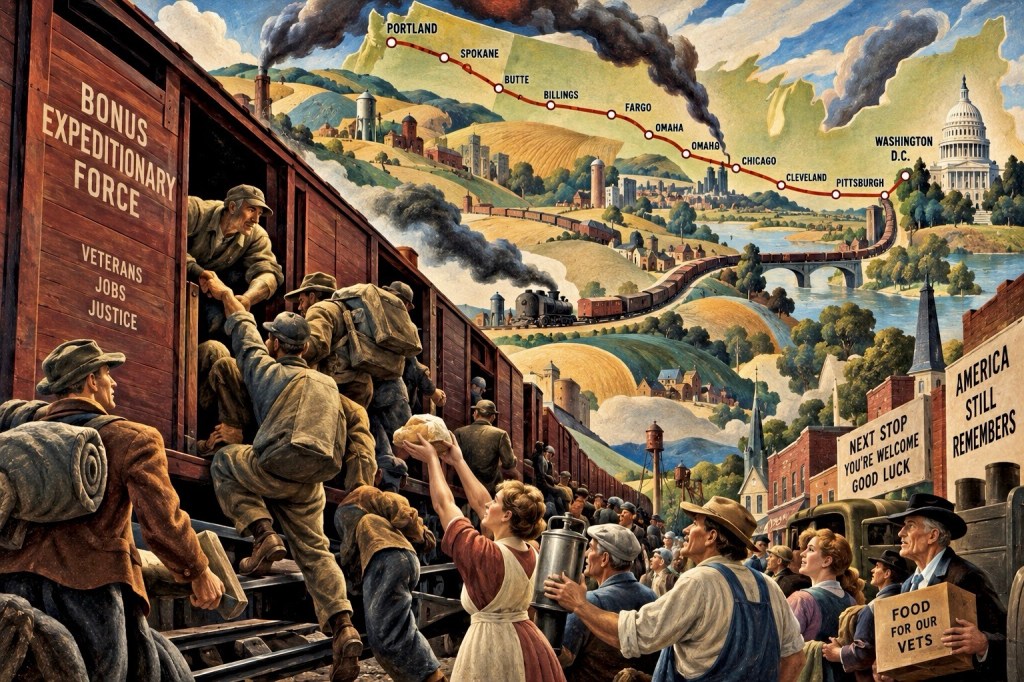
In May 1932, a few hundred unemployed veterans gathered in Portland, Oregon, with an unreasonable idea. They intended to go to Washington and make that argument in person.
There was a difficulty. They were broke. Nevertheless, they went.
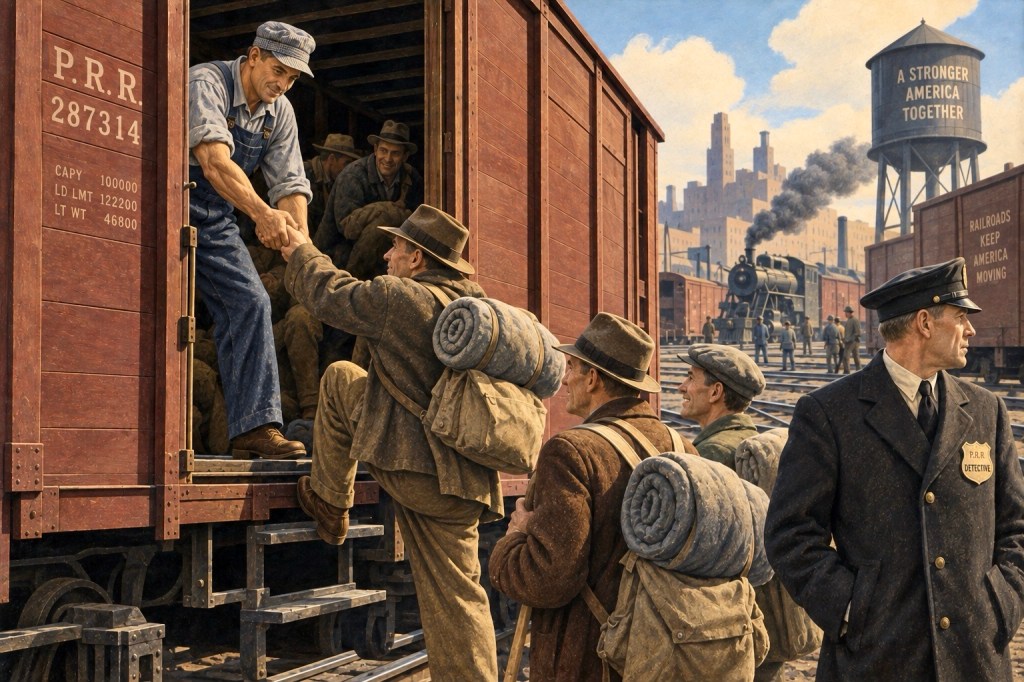
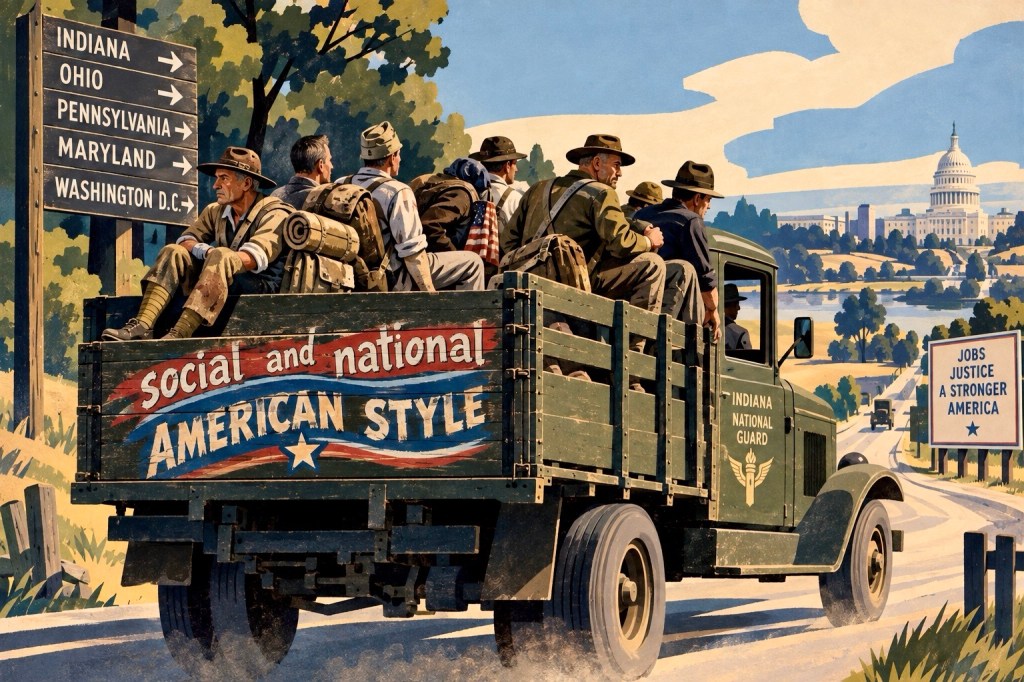
They rode freight trains. Railroad men—many of them veterans themselves—looked the other way or helped them aboard. In towns along the route, the marchers paraded and asked for food and money. Veterans’ organizations sent word ahead: more men were coming; have something ready for them. Other contingents followed by donated trains, borrowed vehicles, freight cars, hitchhiking and shoe leather.
An army without a quartermaster had somehow acquired a supply line.
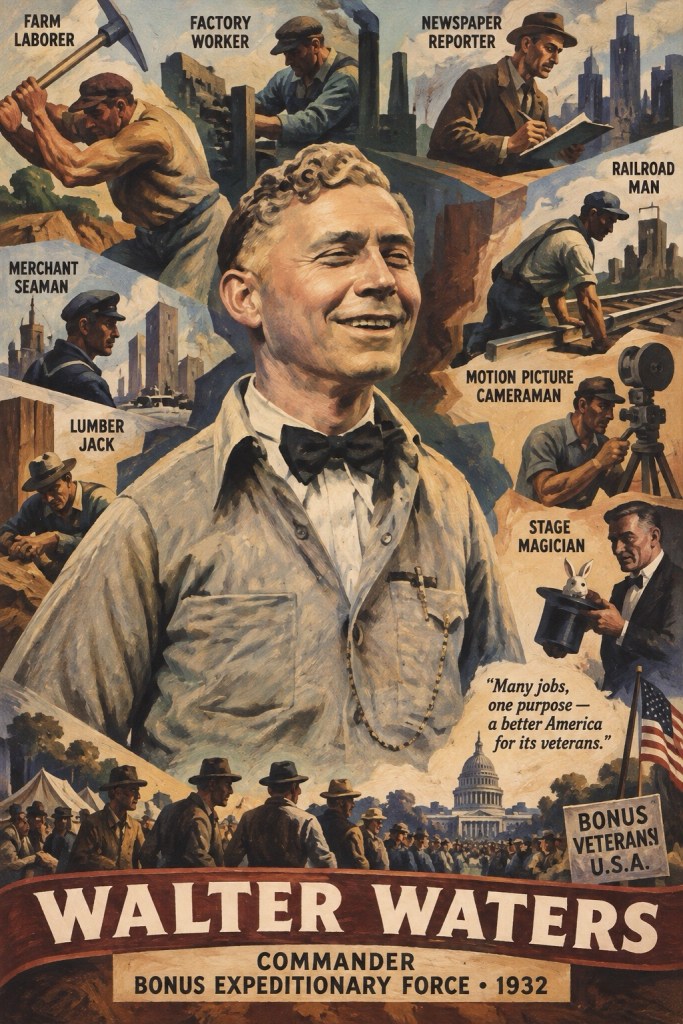
Walter W. Waters, an unemployed former Army sergeant, emerged as commander of what the veterans rather grandly called the Bonus Expeditionary Force. The name was partly a joke and partly not. These men had been in an expeditionary force before.
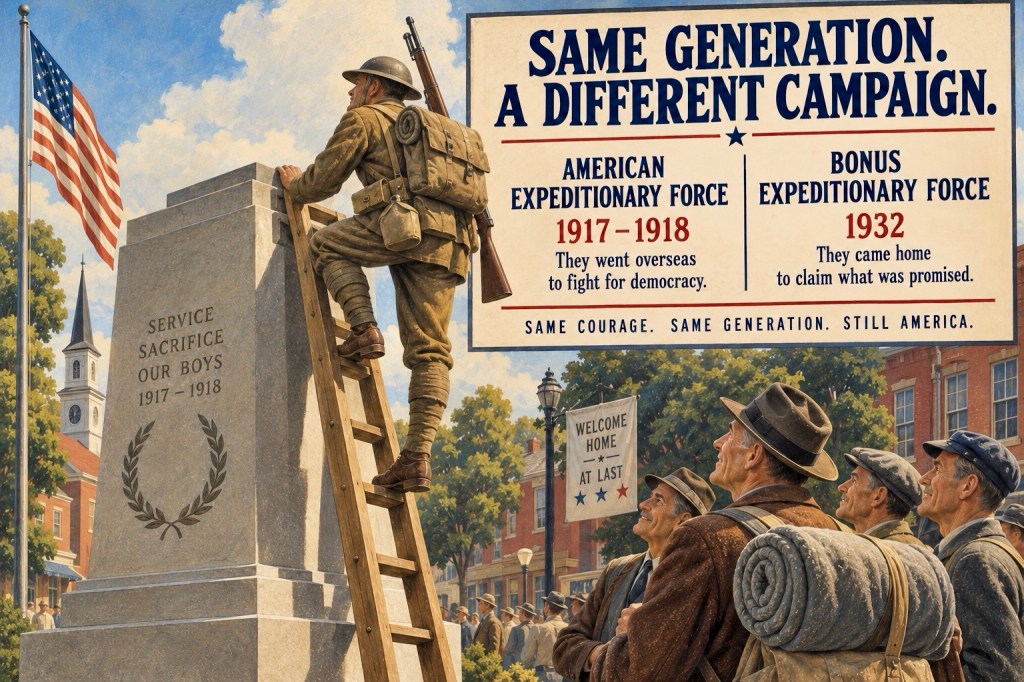
The Bonus Expeditionary Force organized themselves into companies, elected officers, appointed supply men and military police, maintained order and eventually established an enormous encampment at Anacostia. They were not trying to abolish the institutions of the United States. They had come to Washington specifically because they believed those institutions ought to listen to them.
Communists naturally appeared. They were not particularly welcome.
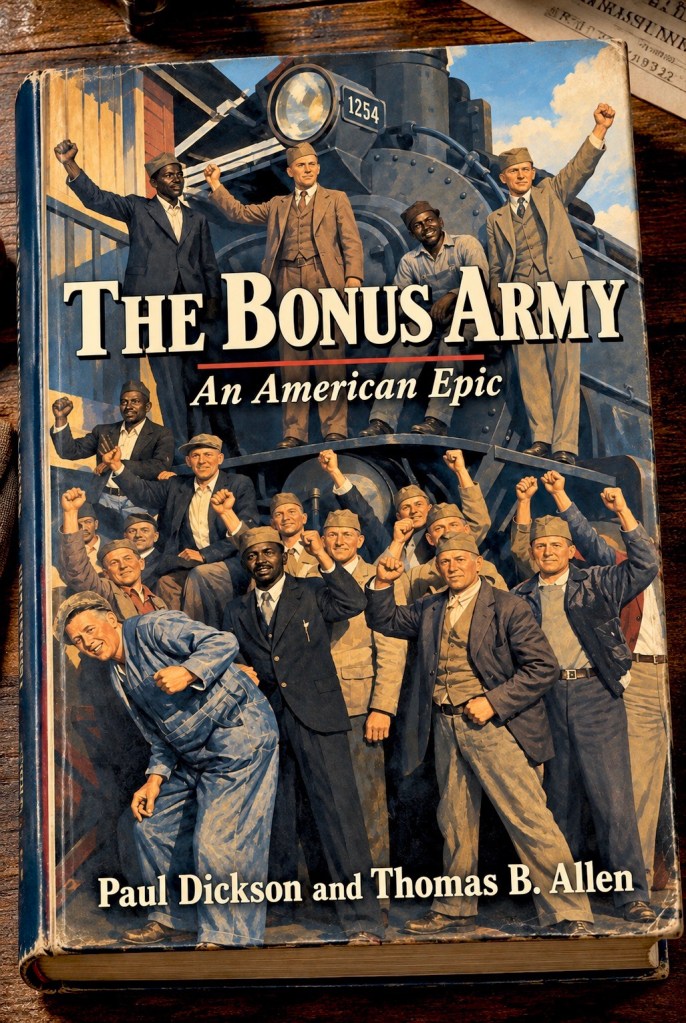
There were Communists among the marchers and Communist organizations attempted to make something of the movement, but the great body of veterans did not regard themselves as revolutionaries. Quite the contrary. Most were distinctly suspicious of the Communists in their midst.
The Bonus Army wasn’t marching against America.
It could march across America because America carried it. That distinction interests me.
We have become accustomed to thinking of socialism principally as something administered: departments, appropriations, programs, agencies and professionals delivering services to clients.
There is another and much older meaning hiding in the word social.
People doing things for other people.
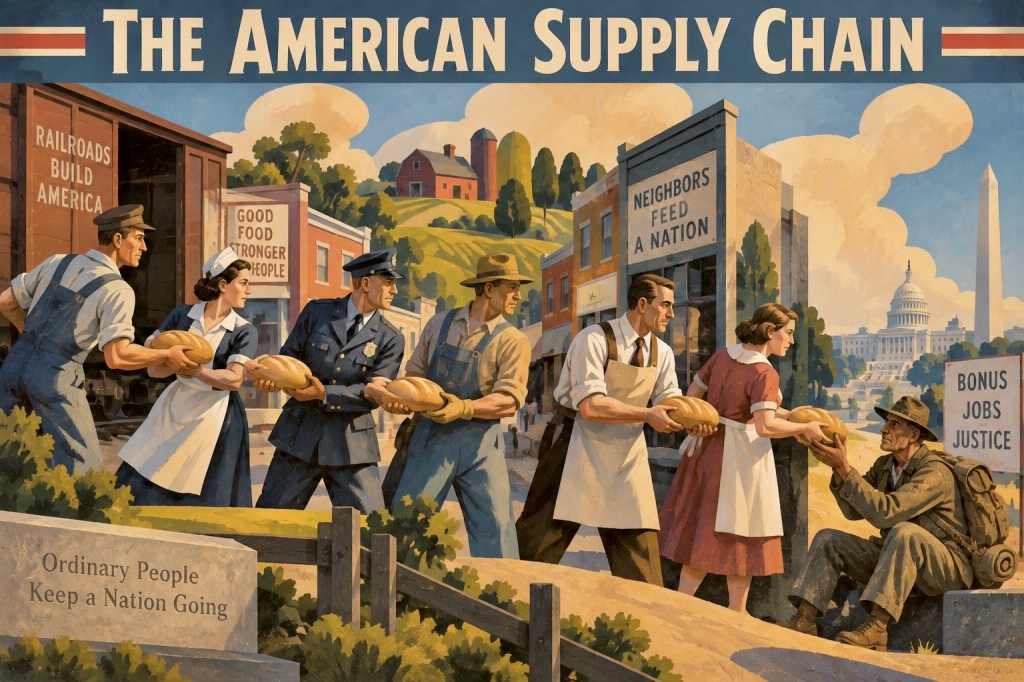
A railroad man sees a veteran without a fare and finds that he has temporarily developed poor eyesight. Someone produces sandwiches. Someone else produces coffee. A veterans’ organization passes the hat. A policeman finds a place for men to sleep. The next town is warned that several hundred hungry Americans are coming down the track.
Nobody has established the Department of Passing the Hat. The hat nevertheless gets passed.
This was national socialism, American style.
And I mean national with a lowercase n and socialism with a lowercase s.
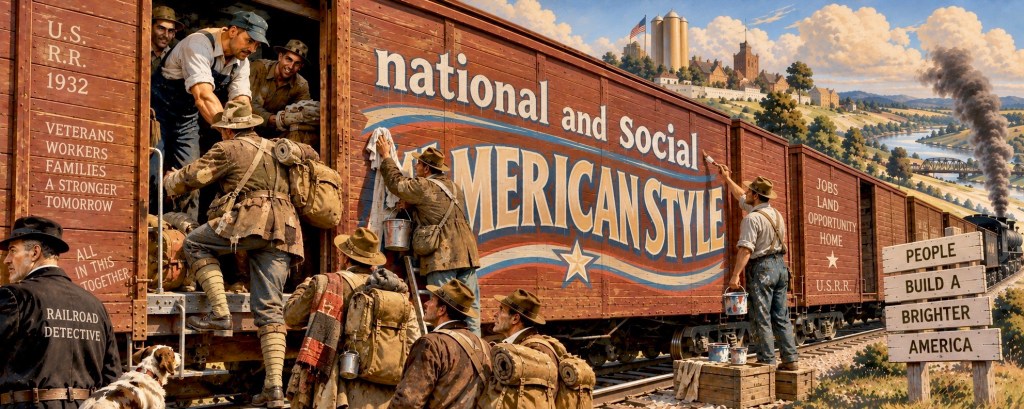
By lowercase socialism, I mean something horizontal rather than vertical: people voluntarily behaving socially toward other people. No bureau need order the sandwich made. No appropriation is required before the hat can be passed. One person recognizes another person’s need and helps.
And by lowercase national, I mean the scale upon which that fellow-feeling operated. The nation was not merely a jurisdiction enclosed by a border. It was a collection of people possessing some conception—however imperfect—of an us.
America in 1932 was overwhelmingly a country populated by people of broadly European ancestry. They were certainly not identical. An Italian Catholic, a Pennsylvania German, an Irish cop and a Scandinavian farmer could provide one another with quite an assortment of prejudices before breakfast.
But they inhabited a recognizably common civilization.
It is my opinion that this mattered. Not exclusively. Not perfectly. But materially.
The Bonus Army itself contained an interesting qualification. Black veterans marched with it too, and in some of its camps black and white veterans lived together with considerably less fuss than one might expect from America in 1932. Perhaps military service supplied an additional membership card. Whatever their ancestry, these men had all worn the same uniform and had been promised the same bonus. The social grace afforded by a predominantly white nation could accommodate this.
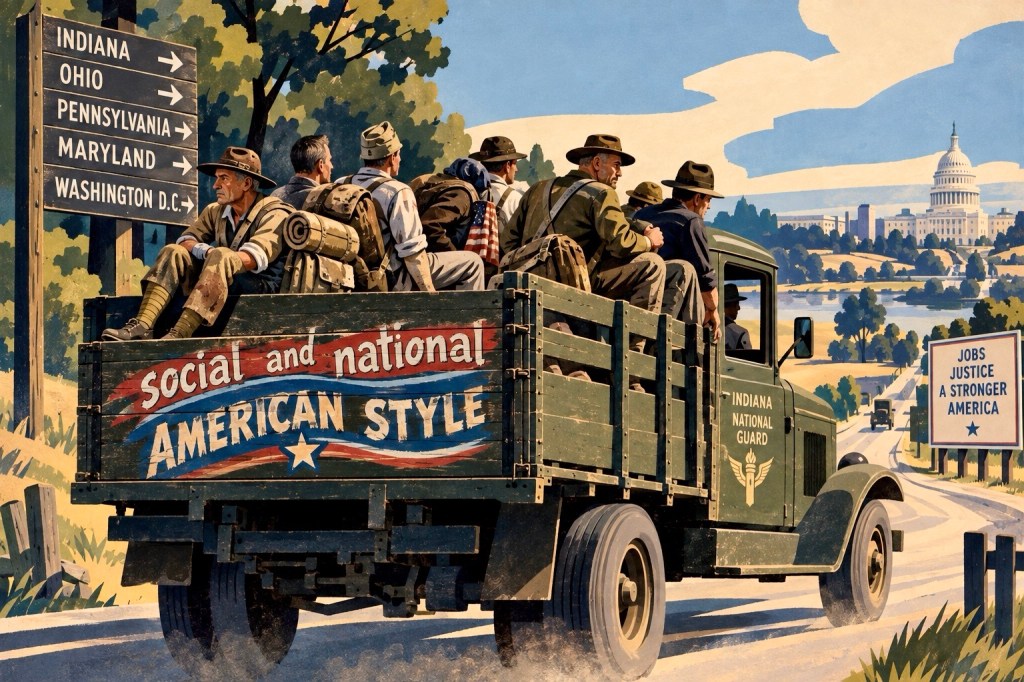
There was another common institution beneath all this: the old United States Army. The veterans instinctively reorganized themselves in its image, and within a year the Civilian Conservation Corps would likewise operate under Army administration. In my lowercase sense, the old Army was both national and social: men ate together, slept together, worked together and were provided for collectively in service to something belonging to all of them.
But the larger American population through which this curious army traveled possessed a degree of cultural and ancestral commonality that we seldom discuss when attempting to understand the institutions and habits of earlier America.
Perhaps we should.
There was already a precedent for one particularly poignant marcher.
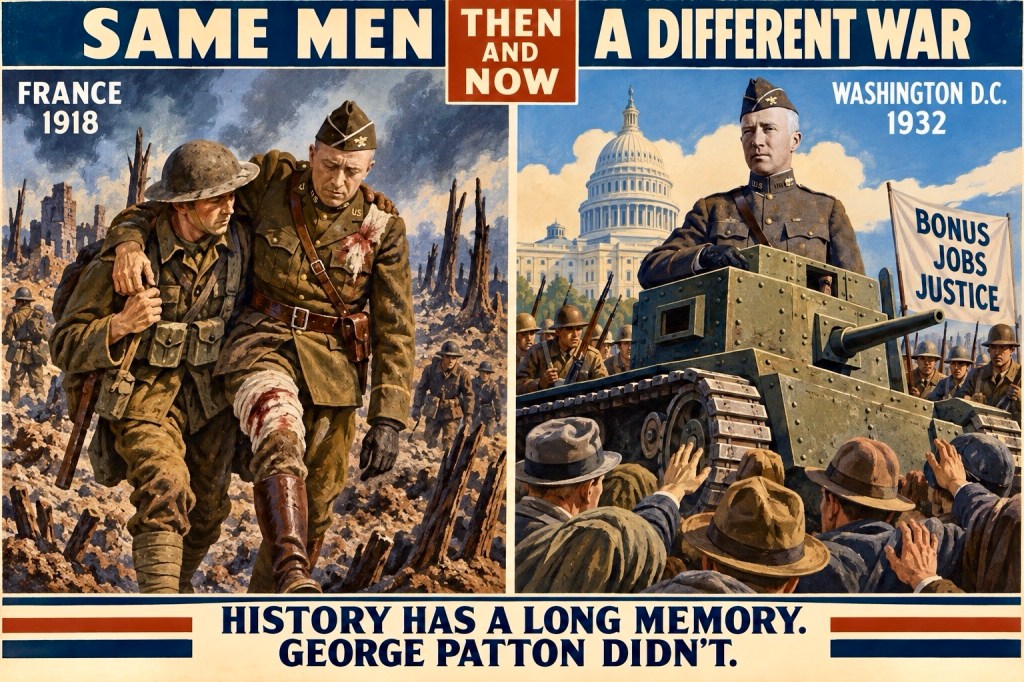
Joe Angelo had served in France. During the Meuse-Argonne fighting in 1918, his commanding officer was wounded by machine-gun fire. Angelo dragged the wounded officer to safety and remained with him.
The officer’s name was George S. Patton. Angelo received the Distinguished Service Cross.
By the Depression, decorations were proving difficult to exchange for groceries. Before the great Bonus Army arrived, Angelo had already walked from New Jersey to Washington in 1931 to testify for immediate payment of the bonus.
There is something almost indecently neat about the symbolism. A country had once used Joe Angelo. Now Joe Angelo needed the country. And history had one more turn of the screw waiting for him.
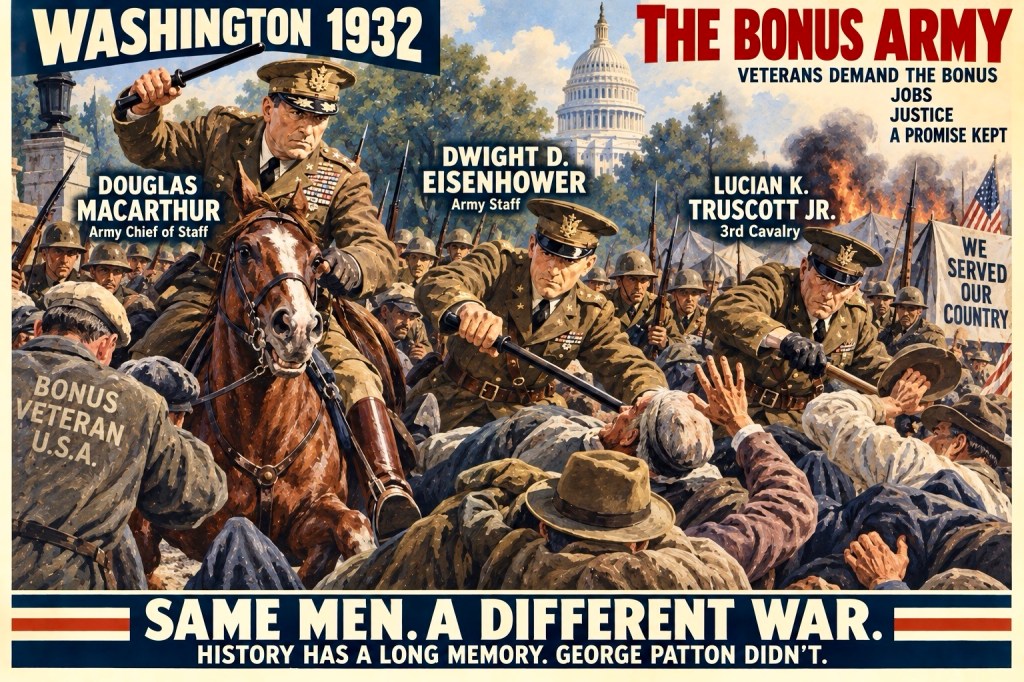
When the Bonus Army was eventually driven from Washington, Angelo encountered Patton again. This time Patton was not the wounded officer being carried from a battlefield. He was one of the Army officers involved in clearing the veterans from the capital.
The man who had once saved George Patton’s life now stood among the men George Patton’s Army had been ordered to remove.
History occasionally produces an irony too exact for a novelist.
By the summer of 1932, the march had become a city.
Some 20,000 veterans had converged on Washington; estimates run considerably higher when wives, children and others are included. They were accommodated within the comparatively confined geography of Washington and its surroundings.
Thousands occupied camps around the city, the largest on the Anacostia Flats. Shacks appeared. Streets appeared. Kitchens appeared. Sanitation had to be arranged. Discipline had to be maintained. Food had to arrive every day. A temporary society had formed.
Which brings to mind another temporary American city thirty-seven years later.
Woodstock.
The comparison sounds ridiculous until one looks at the photographs.
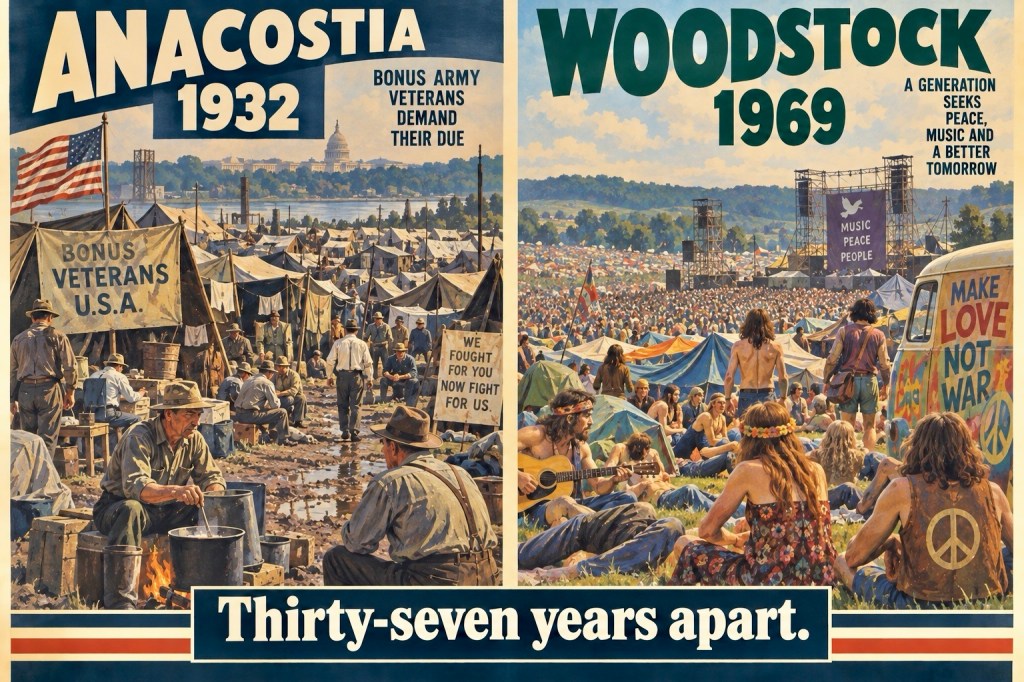
Woodstock deposited hundreds of thousands of people in a muddy field with inadequate preparations for feeding, sheltering and caring for them. And yet people fed one another, tended one another and somehow muddled through.
Woodstock with medals instead of marijuana.
Or perhaps Anacostia was Woodstock with medals instead of marijuana.
The Woodstock crowd, like the America of the Bonus March era, was in my observation overwhelmingly composed of young Americans of broadly European descent. Again, I happen to notice this degree of commonality mattered. Others are welcome to disagree. An ethnographer is permitted to report not only what he sees but what he thinks it means.
The two gatherings represented almost opposite Americas culturally: veterans of the First World War maintaining military discipline during the Depression and their children’s generation wallowing in mud while listening to amplified guitars.
Yet underneath the differences was something remarkably similar.
A great many strangers believed that the strangers around them were, in some meaningful sense, their people.
That belief has practical consequences.
You share your food. You tolerate inconvenience. You help the fellow beside you. You expect him, perhaps without ever saying so, to do approximately the same for you.
Social trust is rather like oxygen. Nobody gives it much thought while there is plenty of it.
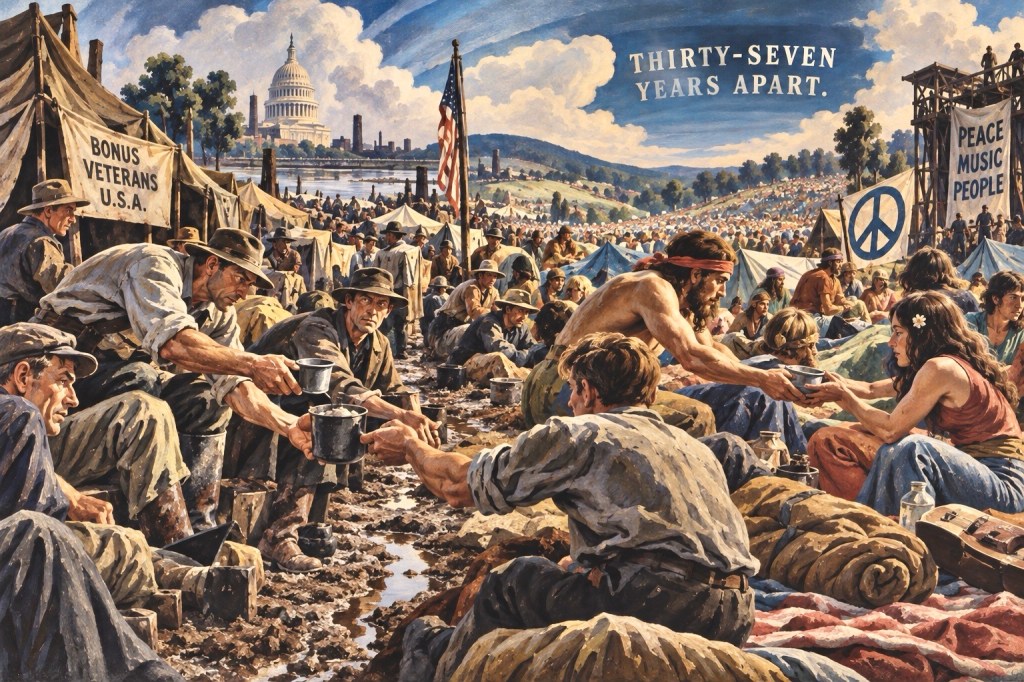
I do not propose the Bonus Army as evidence of some vanished American paradise. Anyone acquainted with 1932 would laugh at the suggestion. I propose something narrower. A movement of penniless men began at one edge of a continent and reached the nation’s capital because, again and again, people who were under no legal obligation to assist them decided that they would.
Walter Waters could organize the men.
He could not manufacture the country through which they traveled.
That country was already there. The railroad man was there. The policeman was there. The woman making sandwiches was there. The veteran with a few coins was there. The fellow who knew somebody with a truck was there.
And somewhere farther down the line was another American who had been told that some hungry veterans were coming. Have something ready for them.
Perhaps before deciding what sort of economic system a society possesses, we ought occasionally to ask a simpler question:
What sort of people does a society possess?
—Eugene Bodeswell
THE OUTCOME
More of Eugene Bodeswell’s writings can be found: HERE


Leave a comment